 Laisha
AI Operating System for Agriculture
Enter Laisha
Laisha
AI Operating System for Agriculture
Enter Laisha
Amaranthus cruentus · Also called: Grain amaranth, Ramdana, Rajgira, Chaulai, Kiwicha, Huauhtli, Amarante, Amaranto
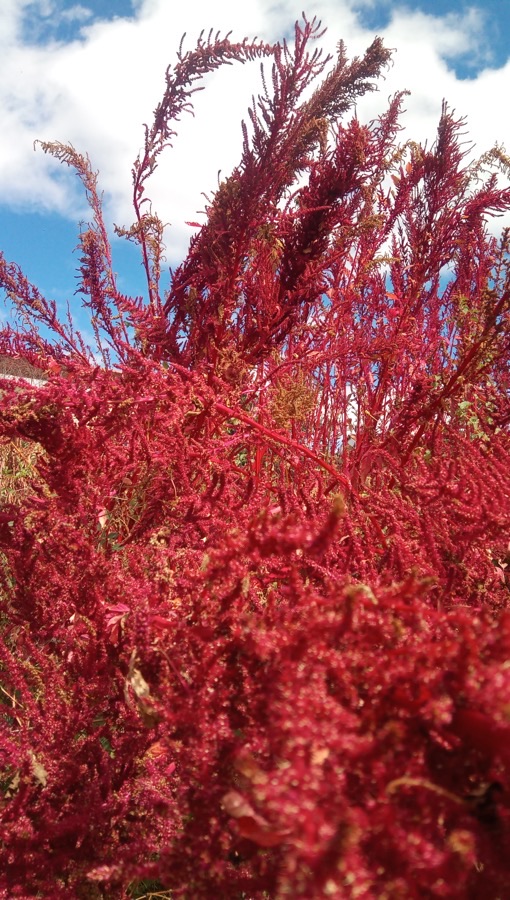
Photo: Jiròni B., CC BY-SA 4.0 (Wikimedia Commons)
Amaranth gives two crops from one plant and asks very little for either. The leaves are eaten as a green vegetable across Africa, Asia and the Caribbean from a few weeks after sowing, and the seed is a grain rich in lysine, an amino acid most cereals are short of. It was a staple of the Aztecs, was suppressed after the Spanish conquest, and has come back across India, China, Mexico, Peru, Nepal, Kenya and Nigeria. Unlike quinoa, which it otherwise resembles, it thrives in heat rather than cool, and its seed carries no bitter coating at all — so there is no washing step between the threshing floor and the pot. Its difficulty is the same as quinoa's in one respect: the young crop looks almost exactly like the pigweed it is related to.
If you see: Seed lying thickly on the soil under the crop and lighter heads than the field promised, before or during harvest.
It likely means: The crop was left too long. Ripe amaranth sheds at a touch, and the heads never ripen evenly, so waiting for the top costs you the bottom.
Do this: Rub a head between the palms every few days and cut when seed comes away easily.
If you see: A field that thinned badly after weeding, with gaps where people worked and pigweed still standing between them.
It likely means: The crop was pulled and the weed was left. Amaranth's own wild relatives look almost identical when young.
Do this: Sow in rows, so that a plant in the row is the crop and a plant between rows is not.
If you see: Tall plants leaning or lying flat across the field after wind or rain, with the heavy heads down on the soil.
It likely means: Too much nitrogen, too rich a field, or too thick a stand. The heads are heavy and the stems cannot carry them on soft growth.
Do this: Do not apply heavy nitrogen or fresh manure to amaranth.
If you see: Young seedlings collapsing at the soil line and dying in patches within the first two weeks, in a crowded or over-watered stand.
It likely means: Damping off, a soil fungus that takes seedlings in wet crowded conditions.
Do this: Sow thinly so that air moves between the seedlings.
If you see: Seed that grits between the teeth when cooked, or that a buyer refuses for sand, although it looks clean.
It likely means: It touched bare soil while drying or threshing. Amaranth seed and grit are close enough in size that winnowing cannot separate them.
Do this: Dry cut heads on mats or cloth and thresh on a clean hard floor, never on bare ground.
If you see: Plants that were picked hard for greens now heading poorly, with small thin heads and little seed.
It likely means: Too many leaves were taken. The plant fills its grain from its leaves, and a stripped plant has nothing to fill with.
Do this: Take a few leaves from each plant rather than stripping any one of them.
If you see: Heads noticeably lighter and thinner around the edges of the field, with flocks lifting off as you approach.
It likely means: Birds. Ripening amaranth is attractive and a small field beside cover can be badly stripped.
Do this: Watch the crop daily from the point the seed begins to harden.
Growing the crop is only part of the job. The last part is knowing what a normal harvest looks like where you are, and knowing what your grain is worth before you agree a price with anybody.
If you forget every other page of this guide, keep these lines. They are the whole crop, in order, short enough to carry in your head.
What is this plant with huge crimson plumes standing above everything around it?
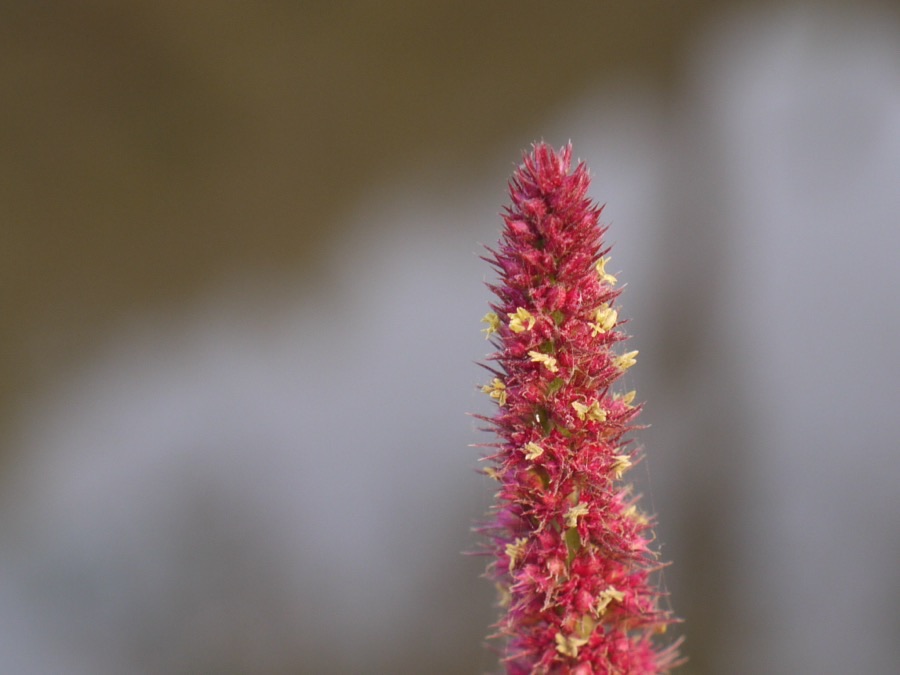
What are the tiny yellow specks on the head?
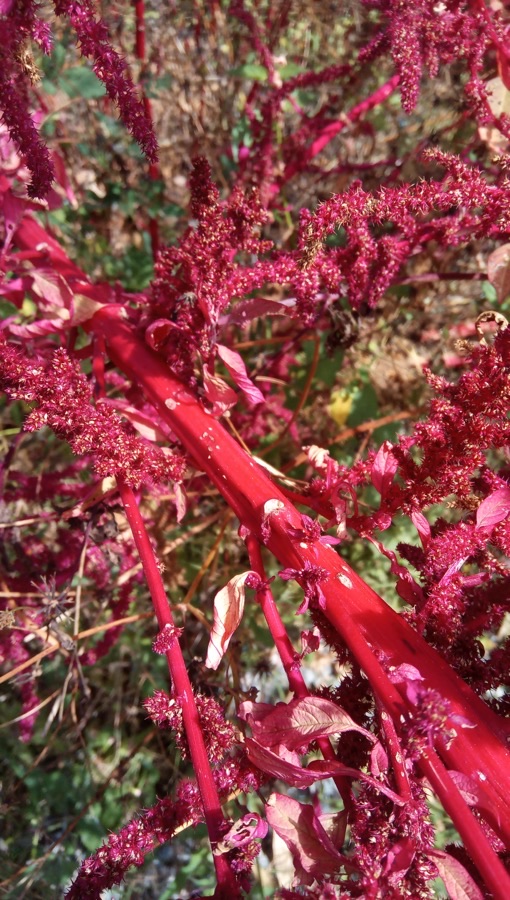
Can I eat the leaves, and how much can I take?