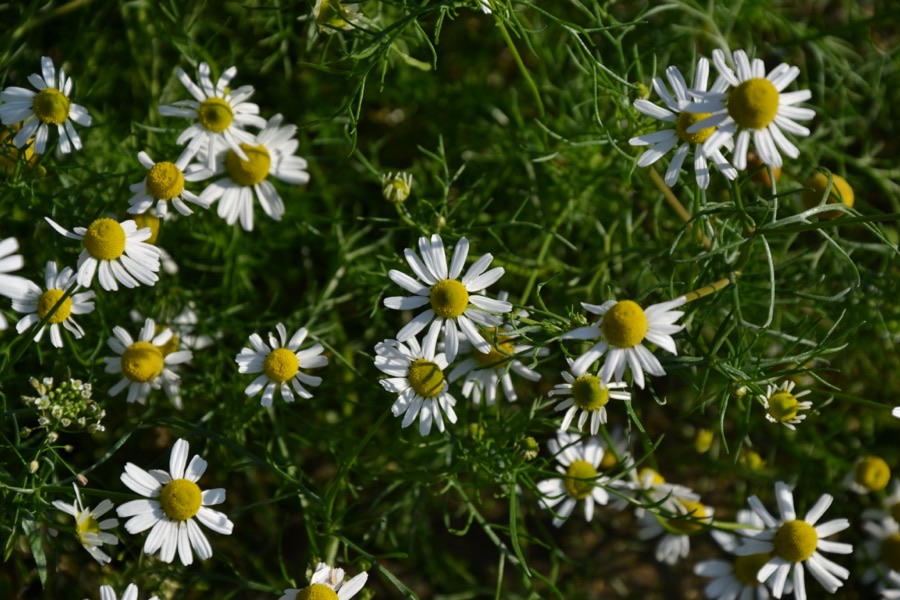
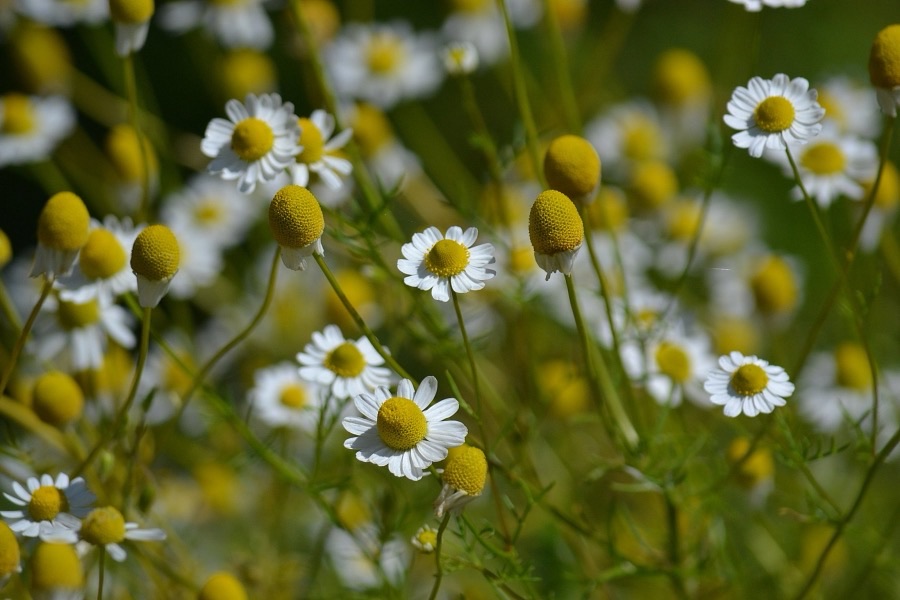
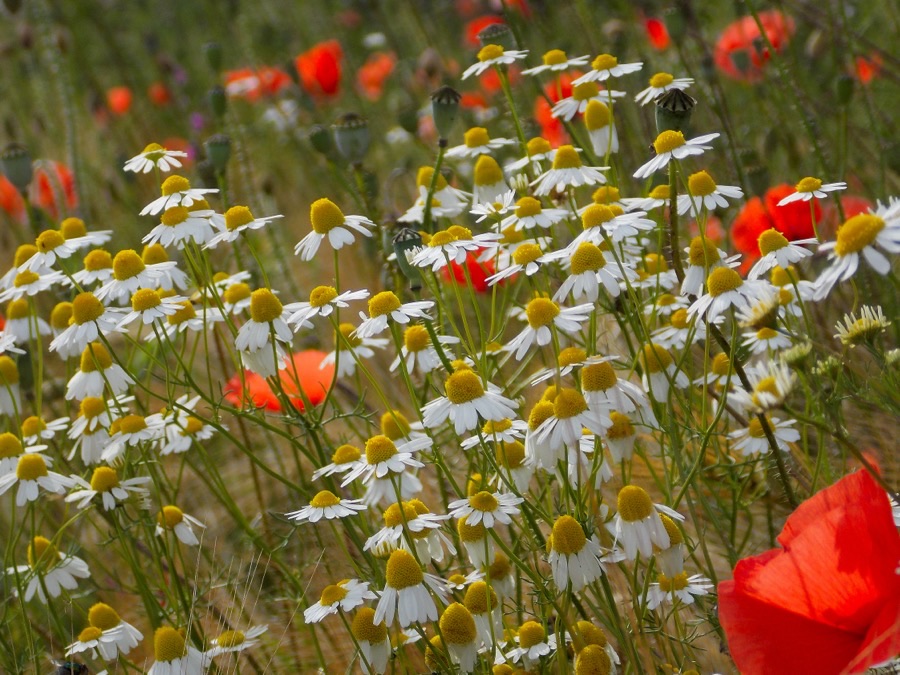
Matricaria chamomilla · Also called: German chamomile, Wild chamomile, Blue chamomile, Babuna, Kamille, Manzanilla, Rumianek
Photo: Joanna Boisse, CC BY-SA 4.0 (Wikimedia Commons)
Chamomile is one of the easiest crops in this library to grow and one of the most laborious to harvest. It will grow on poor, thin, even salty ground that will carry little else, it needs almost no water, it seeds itself, and it is finished in three or four months. What it asks for instead is hands: the crop is the flower head alone, picked at the right moment, and picked again every few days for six weeks. That is the whole economics of it. Egypt, Argentina, Hungary, Germany, Poland, Slovakia and India all produce it commercially, for tea and for an essential oil that is deep blue. For a family with more labour than land it is one of the better paying things to grow.
Growing Chamomile, Stage by Stage
1. Get the land ready — Poor ground, firm surface, full sun.
2. Sow the seed on the surface — Do not cover it. It needs light to wake up.
3. Weed and water sparingly — Almost nothing. Kindness costs you flowers.
4. Know which flower head is yours — Smell it, and look at the middle.
5. Watch for trouble — Few real problems, and most are self-inflicted.
6. Harvest the heads, and keep harvesting — The whole cost of this crop is here.
7. Dry cool, store it and sell it — Heat is what destroys the thing you are being paid for.
Common Problems & Troubleshooting
If you see: A sown bed where almost nothing came up.
It likely means: The seed was buried. Chamomile seed needs light to germinate and will simply sit there in the dark.
Do this: Scatter the seed on the surface and do not cover it with soil.
If you see: Tall, dark green, leafy plants falling across the rows with very few flowers.
It likely means: Too much water and too much feeding. This is a poor-ground plant and it answers generosity with leaf.
Do this: Do not manure the ground and do not feed the growing crop.
If you see: A dried lot rejected as adulterated, or heads in the crop that look right but smell of nothing.
It likely means: Mayweed. Scentless and stinking mayweed grow in the same fields, look almost identical, and are worth nothing.
Do this: Teach every picker to crush a head and smell it: German chamomile smells strongly of apples.
If you see: Dried flowers gone brown and broken instead of a clean pale gold.
It likely means: They were picked too late, picked wet, heaped too deep, or dried too hot.
Do this: Pick when the petals are still horizontal or only just bending down, not when the head is falling apart.
If you see: Clean, good-looking dried flowers that a distiller says are weak.
It likely means: Usually heat in the drying, sometimes picking too young, sometimes long storage in a warm open container.
Do this: Dry in shade and in moving air rather than in sun or with heat.
If you see: A field in full flower and not enough hands to pick it.
It likely means: The area was planned before the labour was. Picking is the dominant cost of this crop and it all lands in a six-week window.
Do this: Plan the area from the number of pickers you can actually get, not the other way round.
Yield & Market Value
Growing the crop is only part of the job. The last part is knowing what a normal harvest looks like where you are, and knowing what your chamomile is worth before you agree a price with anybody.
Remember It This Way
If you forget every other page of this guide, keep these lines. They are the whole crop, in order, short enough to carry in your head.
Firm the seedbed, then scatter the seed on top. Do not cover it.
Poor ground and full sun. Do not manure it.
Water sparingly. Lush chamomile gives leaf, not flowers.
Smell it and cut it. Apples and a hollow cone is the crop.
No smell and a solid flat centre is a weed. Pull it out.
Pick the head alone. Stem in the lot costs you money.
Pick when the petals are still flat, not falling apart.
Pick dry, after the dew has lifted.
Go over the field again every three to five days.
Dry it thin, in shade, and cool. Heat takes the oil.
Test Yourself: Identification
What does the plant look like?
How do you know it is the real thing?
What does the standing crop look like at picking time?
Honest Limits of This Guide
Timings here are given by season and by the state of the crop rather than in named months, because chamomile is grown in both hemispheres and in several seasons. In a hot country it is a cool-season crop.
This guide covers German chamomile, Matricaria chamomilla, which you may also see under its older name Matricaria recutita. Roman chamomile (Chamaemelum nobile) is a different plant with a different oil and is not covered here.
Oil content varies a great deal with variety, season and drying, and no figure is given because one from a single district would mislead. Ask your buyer what they test for.
The picking labour is the dominant cost of this crop and this guide cannot put a number on it, because it depends entirely on your wages and who is available. Pick a small trial area and time it before committing a field.
There is no photograph here of a flower head cut in half to show the hollow cone, or of picking or drying, because usable pictures of those are not available under a licence this library can use. The hollow cone is described in words instead, which is less good and is said plainly.
No varieties are named here. Types differ in oil content and in how uniformly they flower, and which suits a district is a question for a local seed dealer or research station.
No chemical treatments are named here. The flowers are brewed and drunk, the crop is worked heavily by bees, and what is permitted differs by country and by buyer.
Sources
GBIF Backbone Taxonomy species-match record for Matricaria chamomilla L. — Global Biodiversity Information Facility (GBIF), Copenhagen (source)
EPPO Global Database — Matricaria chamomilla (EPPO code MATCH) — European and Mediterranean Plant Protection Organization (EPPO), Paris (source)
FAO guidance on growing culinary and aromatic herbs — Food and Agriculture Organization of the United Nations (FAO), Rome (source)
FAO guidance on post-harvest handling and drying of aromatic flowers — Food and Agriculture Organization of the United Nations (FAO), Rome (source)
Laisha knows Chamomile better than this page can show.Photo diagnosis for pests and disease, live market prices, and an agronomist you can ask at two in the morning. Ten days free, no card. After that 10 US dollars a month, one price worldwide.Start ten free days
 Laisha
AI Operating System for Agriculture
Enter Laisha