Selenicereus undatus · Also called: Pitaya, Pitahaya, Red pitaya, White-fleshed pitahaya, Thanh long, Buah naga, Kaeo mangkon, Huo long guo
Photo: Dragfyre, CC BY-SA 3.0 (Wikimedia Commons)
Dragon fruit is one of the few genuinely new cash crops a smallholder can start this decade. It came from Mexico and Central America, was taken up seriously in Vietnam, and is now planted across Thailand, China, Indonesia, the Philippines, India, Sri Lanka, Israel, Australia and much of Latin America. It starts paying within two years of planting and keeps paying for twenty. It is a cactus, so it survives dry spells that would kill a fruit tree, and it grows on poor sandy ground. Against that, it needs posts, careful pruning and, for most varieties, somebody out at night with a brush. It is not a crop to plant and leave, and a grower who does not understand its flowering will get a field of handsome green stems and very little fruit.
Growing Dragon fruit, Stage by Stage
1. Get the land ready and put up the posts — Free-draining sunny ground and strong permanent posts, built before anything is planted.
2. Get your planting material and choose varieties — Stem cuttings from a healthy plant, and at least two varieties if yours cannot pollinate itself.
3. Plant and train up the post — Three or four cuttings against each post, tied up until they reach the top.
4. Water, weed and feed — Little water and modest feeding, because too much of either gives stems instead of fruit.
5. Prune — Keep a limited number of young hanging stems, and cut the rest out so light gets in.
6. Flowering and pollination — The flower opens for one night only, so pollination is a night job.
7. Watch for trouble — Stem rots and cankers in wet weather, and ants and birds at the fruit.
8. Harvest, store and sell — Cut it at full colour, because dragon fruit does not ripen after picking.
Common Problems & Troubleshooting
If you see: Plenty of large flowers opening and almost no fruit forming afterwards.
It likely means: Pollination failed. Most likely the variety cannot pollinate itself and there is nothing else to pollinate it with, or there are too few night insects and nobody pollinated by hand.
Do this: Find out whether your variety can pollinate itself, and plant a second variety that flowers at the same time if not.
If you see: Fruit that looks fine but tastes sour and watery, and buyers who do not come back.
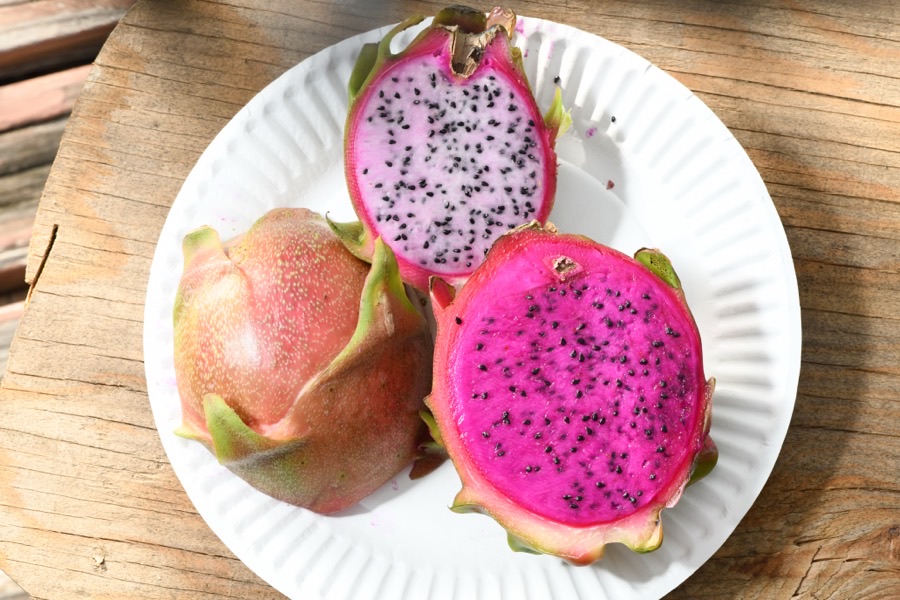
It likely means: It was picked before the skin had fully coloured. Dragon fruit does not ripen after picking, so whatever sweetness it had when cut is all it will ever have.
Do this: Wait until the skin has changed colour completely with no green patches left.
If you see: Huge healthy green plants covering the posts and hardly any flowers.
It likely means: Usually too much nitrogen, too much shade, or too many stems left on the post so the plant shades itself.
Do this: Prune back to roughly thirty to fifty hanging stems on a mature post.
If you see: Stems going soft, yellow and slimy, often starting at the bottom or where stems touch the ground.
It likely means: Stem rot, which takes hold in wet soil, in crowded plantings and wherever a stem sits against damp ground.
Do this: Cut out affected stems well below the damage and destroy them away from the field.
If you see: New cuttings going soft and black at the base instead of rooting.
It likely means: They were planted with a fresh wet cut, or planted too deep, or watered too much before they had roots.
Do this: Leave cut ends in a dry shaded place for a few days until a hard skin forms.
If you see: Small sunken orange-brown spots spreading on stems and marking the fruit skin.
It likely means: Canker, a fungal disease that spreads fast in wet humid weather and in plantings that never dry out.
Do this: Cut out and destroy affected stems rather than leaving prunings under the plants.
Yield & Market Value
Growing the crop is only part of the job. The last part is knowing what a normal harvest looks like where you are, and knowing what your dragon fruit is worth before you agree a price with anybody.
Remember It This Way
If you forget every other page of this guide, keep these lines. They are the whole crop, in order, short enough to carry in your head.
Build the posts first. They stand for twenty years.
Dry the cut ends for a few days before planting.
Plant shallow. Water lightly until it roots.
Tie it up the post. It will not climb by itself.
Tip it at the top so it branches and hangs over.
It is a cactus. Wet soil kills it, drought does not.
Ask if your variety can pollinate itself. Many cannot.
The flower opens one night only. Pollinate that night.
Keep thirty to fifty young hanging stems. Cut the rest.
Pick at full colour. It never sweetens after picking.
Test Yourself: Identification
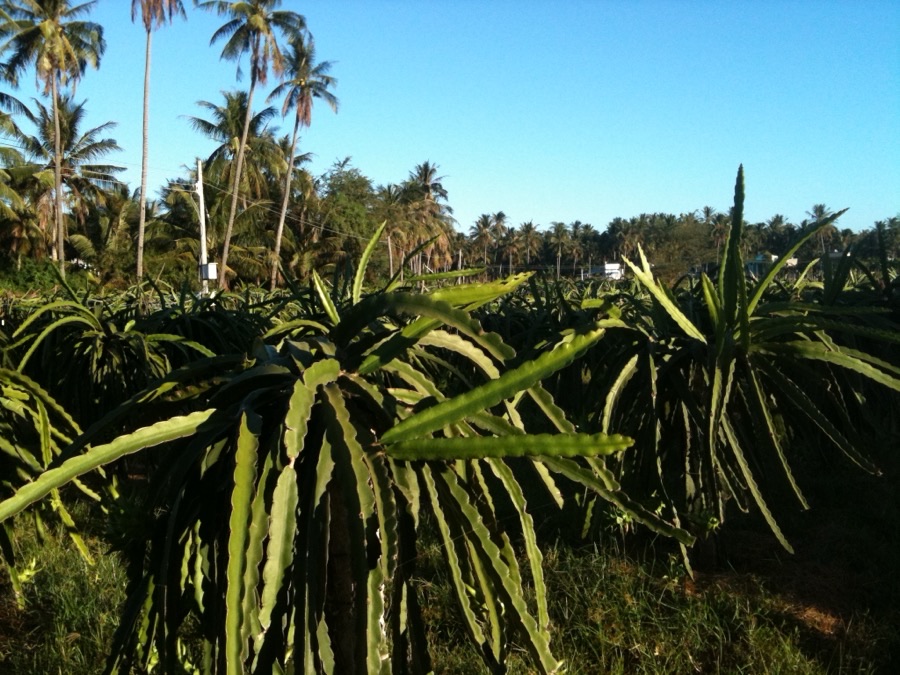
What does a dragon fruit planting look like?
How do you know a flower was pollinated?
When is the fruit ready to cut?
Honest Limits of This Guide
Timings here are given by season and by the state of the plant rather than in named months, because dragon fruit is grown from Vietnam to Mexico to Australia in both hemispheres. Count from your own warm season.
Variety advice is deliberately local. Whether a variety can pollinate itself is the most important thing about it and differs from one variety to the next, so this guide tells you to ask rather than naming varieties that suit nobody.
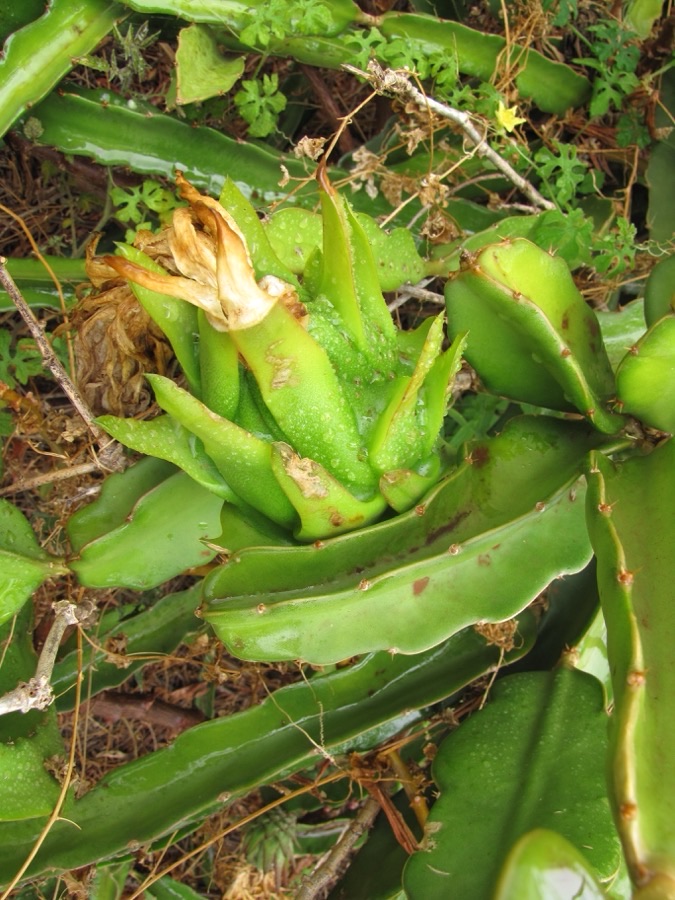
The photographs here do not include an open flower, because usable pictures of one are hard to find under a licence this library can use. The flower is very large, white and opens after dark, and the picture shown instead is of a flower that has already withered onto a set fruit.
Night lighting to bring on off-season flowering is mentioned because it is a real and important commercial practice, but this guide does not describe how to do it. It needs equipment, electricity and local advice on timing.
This guide names no chemical treatments. The fruit is eaten fresh and often with the skin handled, the main diseases are answered by pruning, drainage and clean planting material, and pollinating insects must not be harmed during flowering.
Sources
GBIF Backbone Taxonomy species-match record for Selenicereus undatus (Haw.) D.R.Hunt — Global Biodiversity Information Facility (GBIF), Copenhagen (source)
EPPO Global Database — Hylocereus undatus (EPPO code HCRUN) — European and Mediterranean Plant Protection Organization (EPPO), Paris (source)
FAO work on dragon fruit and tropical fruit markets, including post-harvest handling guidance, with FAOSTAT production data — Food and Agriculture Organization of the United Nations (FAO), Rome (source)
Laisha knows Dragon fruit better than this page can show.Photo diagnosis for pests and disease, live market prices, and an agronomist you can ask at two in the morning. Ten days free, no card. After that 10 US dollars a month, one price worldwide.Start ten free days
 Laisha
AI Operating System for Agriculture
Enter Laisha