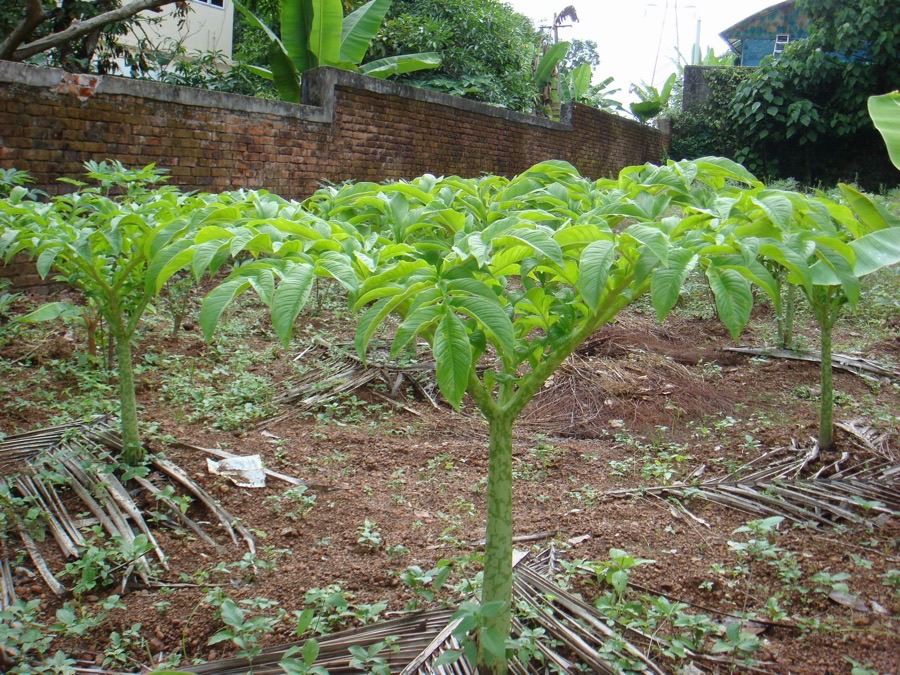
Photo: Challiyan at Malayalam Wikipedia, CC BY-SA 2.5 (Wikimedia Commons)
Elephant foot yam is one of the best returns a smallholder can get from a shaded corner. A single corm weighing a kilogram at planting becomes five or eight kilograms by the end of the season, it grows happily under coconut and areca where light crops will not, and it stores for months after lifting without any cooling at all. In Bihar, West Bengal, Odisha, Andhra Pradesh, Kerala and across Southeast Asia it is both a household food and a serious cash crop, and prices lift around the festivals it is traditionally eaten at. Two things about it must be understood before planting. The whole season's growth hangs on one leaf, so anything that damages that leaf costs the crop. And the corm itself contains crystals that make the mouth and the hands itch, which is a question of choosing the right variety and cooking it properly, not something to discover at the table.
Growing Elephant foot yam, Stage by Stage
1. Get the land ready — Deep, rich, well-drained soil, and generous pits.
2. Cut and cure the planting material — Pieces of corm, each with a bud, dried until the wound has healed.
3. Plant before the rains — Bud upwards, shallow, and covered with loose soil.
4. Weed, water and feed, and guard the leaf — One leaf has to last the whole season. Everything here protects it.
5. Watch for trouble — Rot at the collar, mealybugs on the corm, and anything that eats the leaf.
6. Harvest: lift when the leaf dies down — The plant tells you. Wait for it to collapse, then dig carefully.
7. Cure it, store it and sell it — A few days in the shade, then months in a cool dry shed.
Common Problems & Troubleshooting
If you see: Planted pieces going soft and rotten in the ground instead of sprouting.
It likely means: They were planted with the cut face still wet, or planted too deep, or into waterlogged soil.
Do this: Cure cut pieces in shade for two or three days until the cut face has dried and hardened.
If you see: A plant whose single stalk has been snapped, eaten or badly damaged partway through the season.
It likely means: Animals, wind, machinery or careless weeding. Unlike most crops, there is no second leaf coming to make up for it.
Do this: Fence or otherwise keep animals out of the plot for the whole season.
If you see: Corms that make the mouth, throat and hands itch and burn.
It likely means: Acridity: fine needle-like crystals in the flesh. Wild and unselected plants have far more of this than varieties bred to be low in it.
Do this: Buy planting material of a named low-acridity variety rather than digging up a wild plant.
If you see: The stalk going soft and brown at soil level, and the whole plant collapsing.
It likely means: Collar rot. It follows wet soil and it usually takes the plant completely once it has started.
Do this: Improve drainage and make channels before the rains.
If you see: Corms much smaller at lifting than the pieces you planted would suggest.
It likely means: The leaf did not work long enough: either it came up late, or it was damaged, or the crop was starved or dried out during the rains.
Do this: Plant before the rains so the leaf is up and working for the whole wet season.
If you see: Corms going soft and rotten in store within weeks of lifting.
It likely means: They were cut or bruised at lifting, lifted wet, washed, or heaped too deep with no air between them.
Do this: Loosen the soil well away from the plant before lifting, and never lever the corm against a spade.
Yield & Market Value
Growing the crop is only part of the job. The last part is knowing what a normal harvest looks like where you are, and knowing what your elephant foot yam is worth before you agree a price with anybody.
Remember It This Way
If you forget every other page of this guide, keep these lines. They are the whole crop, in order, short enough to carry in your head.
One leaf per plant per season. That leaf is the crop.
Anything that breaks the leaf stops the corm growing.
Buy a named low-acridity variety, not a wild corm.
Every piece needs a bud, or it will never come up.
Dry the cut face in shade for two or three days.
Plant shallow, bud upwards, before the rains.
Manure it generously. It is a heavy feeder.
Wait for the leaf to collapse. That is the signal.
Dig wide and loosen first. A cut corm will not store.
Cure it in shade, then it keeps for months. Sell when you choose.
Test Yourself: Identification
What does the crop look like growing?
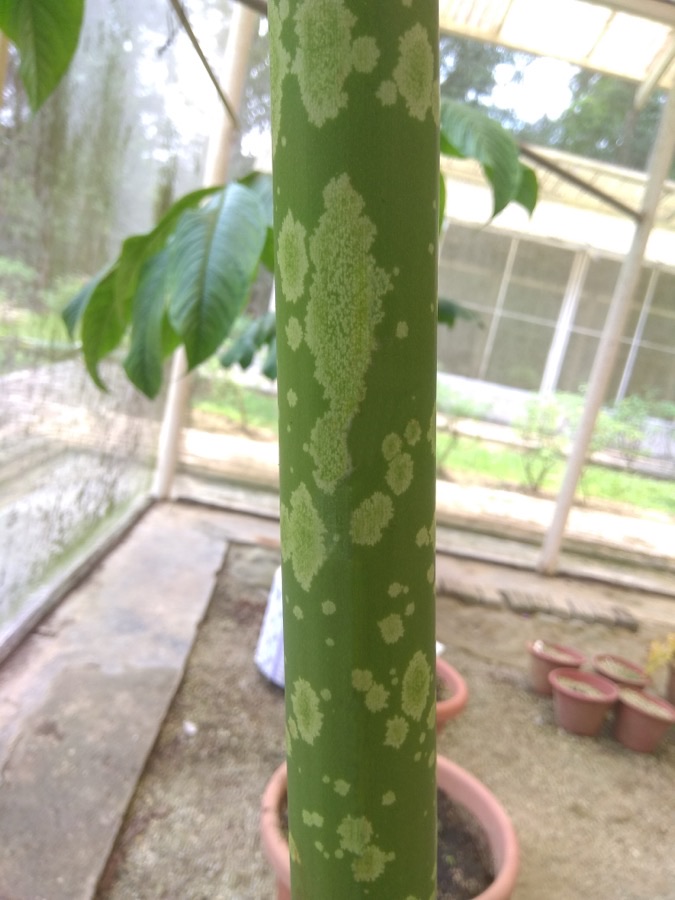
What does the stalk look like close up?
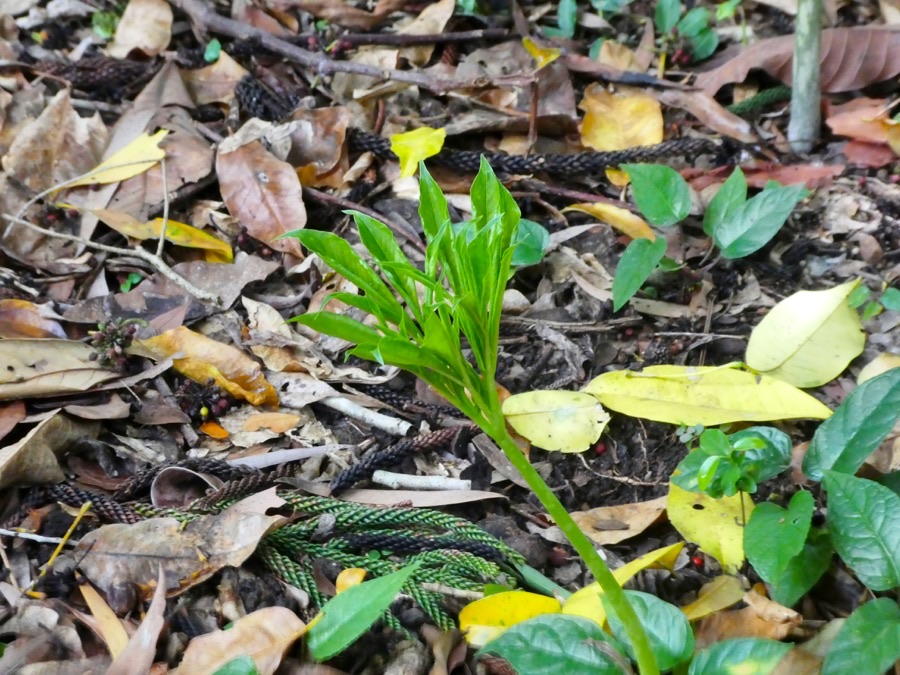
What does the shoot look like coming up?
Honest Limits of This Guide
Timings here are given by season and by the state of the plant rather than in named months, because although most of this crop is grown in South and Southeast Asia, rainfall patterns differ. Count from your own rains.
EPPO holds no record for this species, which breaks the pattern of every other guide in this library. The second independent check here is the World Flora Online instead, and the guide says so rather than quietly citing one source.
Acridity is described plainly because it is the thing people most often discover the hard way. This guide does not give a method for reducing it beyond saying to choose a selected variety and to follow local cooking practice, because the preparation is a kitchen skill best learned from someone who already does it.
Variety advice is deliberately local and no varieties are named here. Selected low-acridity types exist and differ by country, and which one is available and suitable is a question for a local agricultural office or nursery.
The photographs show a planted field, plant detail and a lifted corm, but not a cured corm in store or a market lot, because usable pictures of those are not available under a licence this library can use.
No chemical treatments are named here. The corm is eaten, and what is permitted differs by country and by buyer.
Sources
GBIF Backbone Taxonomy species-match record for Amorphophallus paeoniifolius (Dennst.) Nicolson — Global Biodiversity Information Facility (GBIF), Copenhagen (source)
World Flora Online taxonomic record wfo-0000965117 for Amorphophallus paeoniifolius — World Flora Online Consortium (source)
Indian Council of Agricultural Research and Central Tuber Crops Research Institute guidance on elephant foot yam cultivation — Indian Council of Agricultural Research (ICAR), New Delhi (source)
FAO guidance on post-harvest handling and storage of root and tuber crops — Food and Agriculture Organization of the United Nations (FAO), Rome (source)
Laisha knows Elephant foot yam better than this page can show.Photo diagnosis for pests and disease, live market prices, and an agronomist you can ask at two in the morning. Ten days free, no card. After that 10 US dollars a month, one price worldwide.Start ten free days
 Laisha
AI Operating System for Agriculture
Enter Laisha