Actinidia chinensis · Also called: Kiwi, Chinese gooseberry, Green kiwifruit, Gold kiwifruit, Hayward, Yang tao, Mihoutao, Kiwi fruit
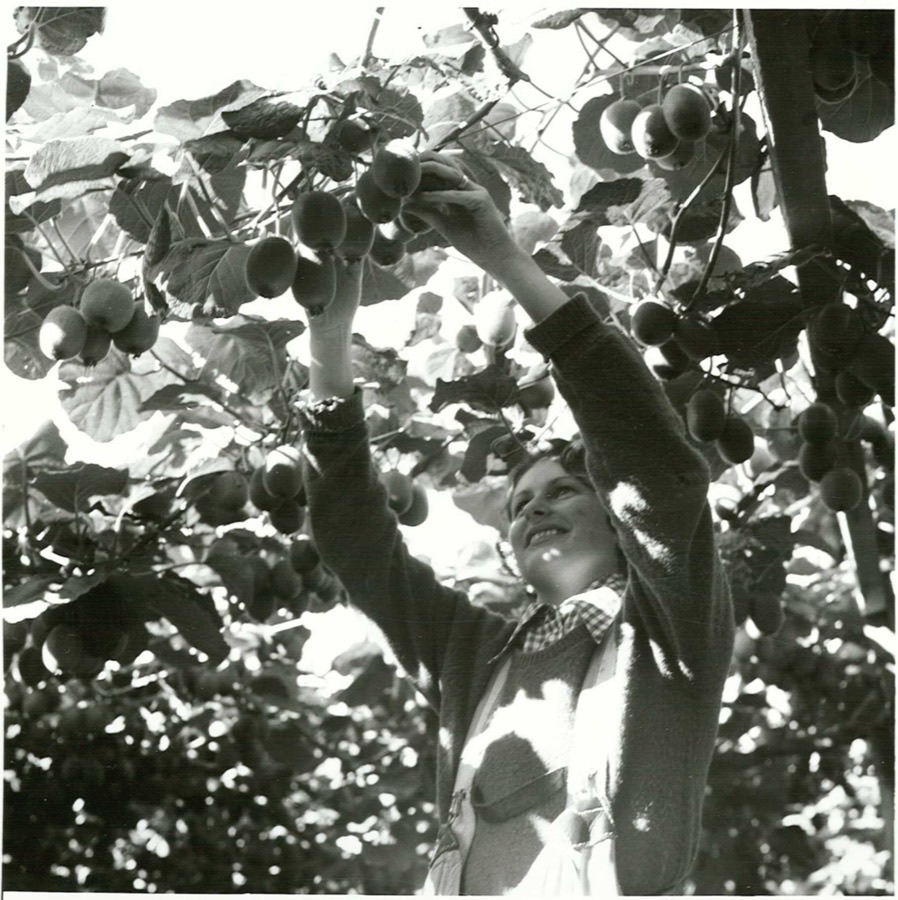
Photo: J. Waddington / Archives New Zealand, CC BY 2.0 (Wikimedia Commons)
Kiwifruit is a cool-climate fruit that pays. It came out of China, was taken to New Zealand, and became a serious export crop there and then in Italy, Greece, Chile, Iran, Turkey, France, Japan, Korea and the hill states of northern India. It suits places with cold enough winters to rest the vine and mild enough summers not to scorch it, which is a narrow band and therefore a valuable one. The fruit is picked hard, stores for months in a cold room, and travels across the world, which is a combination almost no other fruit manages. Against all that: it needs a permanent structure, several years before it pays, and — the thing that catches most new growers — male vines as well as female ones, because only the female vines carry fruit.
Growing Kiwifruit, Stage by Stage
1. Choose the land and build the structure — A sheltered site with cold winters, and a pergola strong enough for thirty years.
2. Get your vines, and get the males right — Grafted females of a named variety, and one male for every five or six.
3. Plant and train up to the wire — One strong stem to the top, then two arms along the wire, and nothing else.
4. Water, weed and feed — A thirsty crop with shallow roots, so steady water and a clear strip.
5. Prune, in winter and in summer — The fruit comes on this year's shoots growing from last year's wood, and nothing else does.
6. Flowering and pollination — Bees must carry pollen from the male vines to the female ones, in a short window.
7. Watch for trouble — A bacterial canker that has destroyed whole regions, plus wind, frost and root rot.
8. Harvest — Pick hard, by sugar rather than by softness, all in a short window.
9. Store, ripen and sell — Months in a cold store, then a few days to soften — and keep it away from apples.
Common Problems & Troubleshooting
If you see: Healthy vines that flower well every year and set almost no fruit.
It likely means: There are no male vines, or too few, or the male flowers at a different time from the females. Only female vines fruit, and they cannot pollinate themselves.
Do this: Plant about one male for every five or six females, spread through the block.
If you see: A large tangled vine covering the whole pergola and carrying very little fruit.
It likely means: It was not pruned, or the wrong wood was kept. Fruit only comes on shoots that grow this season from wood that grew last season, and wood that has already fruited never fruits again.
Do this: Prune the females hard in winter, cutting out the wood that carried fruit this year.
If you see: Red or orange ooze on the trunk and canes, leaf spots with yellow halos, and canes dying back.
It likely means: Bacterial canker. It has destroyed large parts of whole growing regions, it has no cure, and it travels in planting material and on tools.
Do this: Buy planting material only from a certified clean source.
If you see: A good number of fruit but most of them too small to make the size grades.
It likely means: Usually poor pollination, sometimes too many fruit left on a shoot, sometimes not enough water.
Do this: Bring in more hives during flowering, since fruit size follows how well each flower was pollinated.
If you see: Fruit that was hard at picking going soft in the cold store weeks before it should.
It likely means: Either something in the store is giving off the gas that ripens it — apples, pears or bananas — or the fruit was bruised at picking, or it was cooled too slowly.
Do this: Never store kiwifruit with apples, pears or bananas, since one crate can soften a whole room.
If you see: New spring shoots blackened after a cold night, or fruit with dull rubbed brown patches.
It likely means: Late spring frost killed the shoots that carry the crop, or loose shoots were whipped by wind and rubbed the fruit.
Do this: Choose a site without a late frost history, since this cannot be fixed afterwards.
Yield & Market Value
Growing the crop is only part of the job. The last part is knowing what a normal harvest looks like where you are, and knowing what your kiwifruit is worth before you agree a price with anybody.
Remember It This Way
If you forget every other page of this guide, keep these lines. They are the whole crop, in order, short enough to carry in your head.
Only the female vines fruit. Plant males among them.
One male for every five or six, spread through the block.
Make sure the male flowers when the females do.
Build the pergola first. It holds a very heavy vine.
It needs a cold winter to rest properly.
Fruit comes on this year's shoots from last year's wood.
So cut out the wood that has already fruited, every winter.
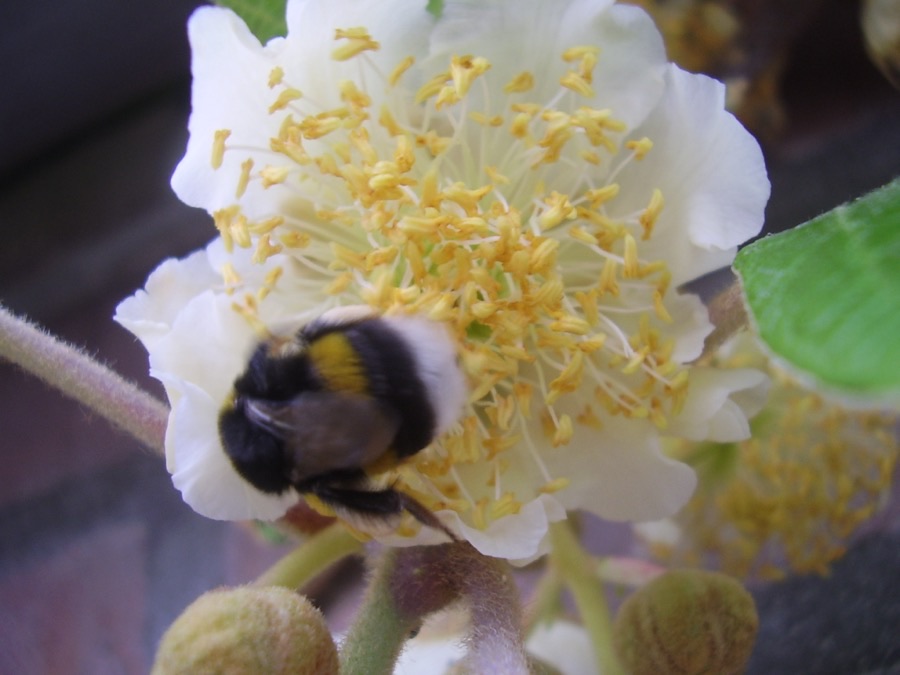
Bring bees. These flowers have no nectar.
Pick hard, by sugar, not by softness.
Never store it with apples. They will soften the lot.
Test Yourself: Identification
What does a kiwifruit orchard look like?
How do you tell a male flower from a female one?
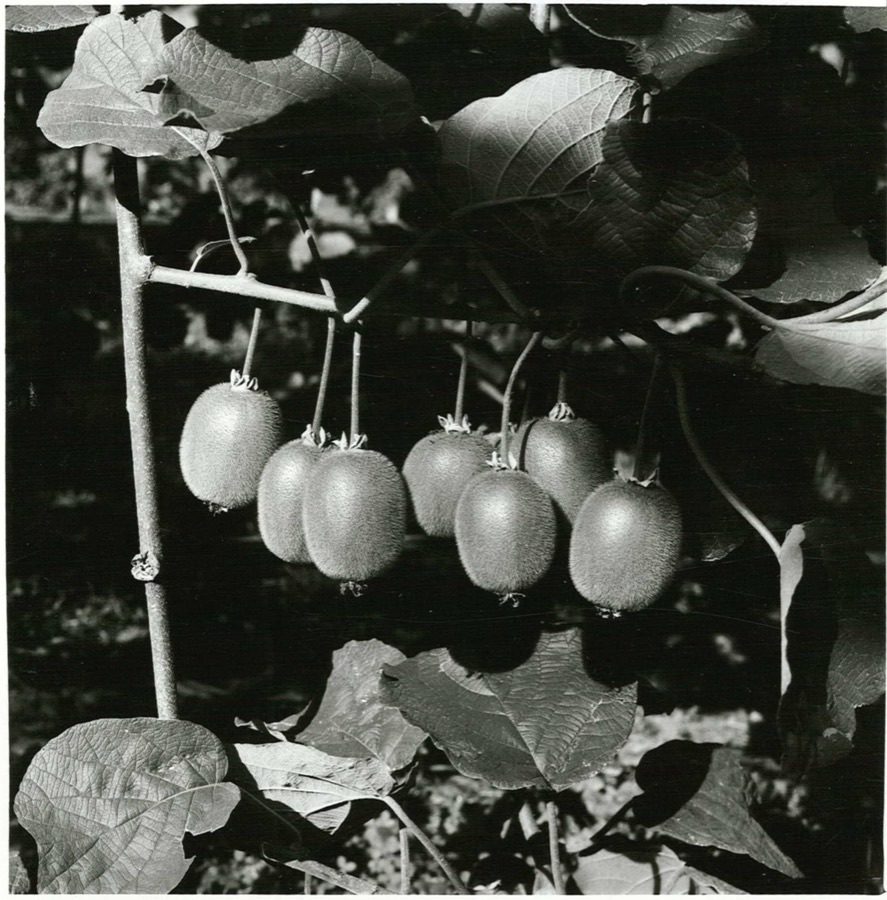
What does the fruit look like on the vine?
Honest Limits of This Guide
Timings here are given by season and by the state of the vine rather than in named months, because kiwifruit is grown in both hemispheres. Count from your own winter.
Variety advice is deliberately local, and unusually so for this crop. Which female variety suits your winter, and which male flowers at the same time as it, are the two most important decisions here and both are regional questions for a nursery or extension office.
Some gold kiwifruit varieties are licensed rather than freely available, and may only be grown under contract in some countries. Ask before planning a block around one.
Two of the photographs here are archive images from Te Puke in New Zealand and are in black and white. They show the pergola system and the fruit on the vine more clearly than anything available in colour under a licence this library can use.
Bacterial canker is described as a serious regulated disease because that is what it is, but this guide does not give control programmes. Where it is present, the local plant health service sets the rules and they are not optional.
This guide names no chemical treatments. The fruit is eaten fresh, canker has no cure and is answered by clean material and hygiene, and the crop depends entirely on bees during flowering.
Sources
GBIF Backbone Taxonomy species-match record for Actinidia chinensis Planch. — Global Biodiversity Information Facility (GBIF), Copenhagen (source)
EPPO Global Database — Actinidia chinensis (EPPO code ATICH) — European and Mediterranean Plant Protection Organization (EPPO), Paris (source)
FAO work on temperate fruit production and controlled-atmosphere storage, with FAOSTAT production data — Food and Agriculture Organization of the United Nations (FAO), Rome (source)
Laisha knows Kiwifruit better than this page can show.Photo diagnosis for pests and disease, live market prices, and an agronomist you can ask at two in the morning. Ten days free, no card. After that 10 US dollars a month, one price worldwide.Start ten free days
 Laisha
AI Operating System for Agriculture
Enter Laisha