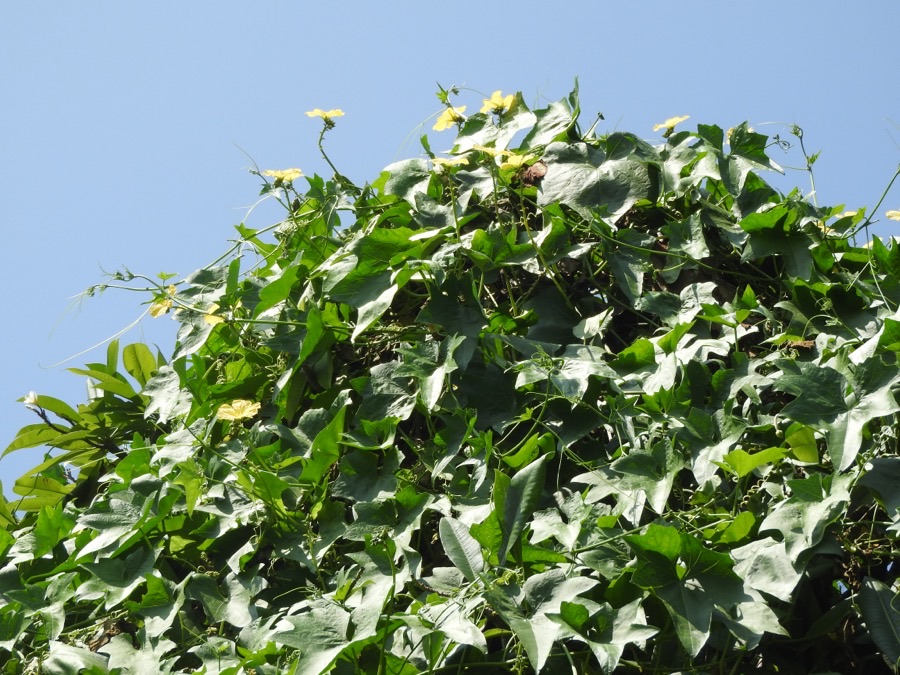
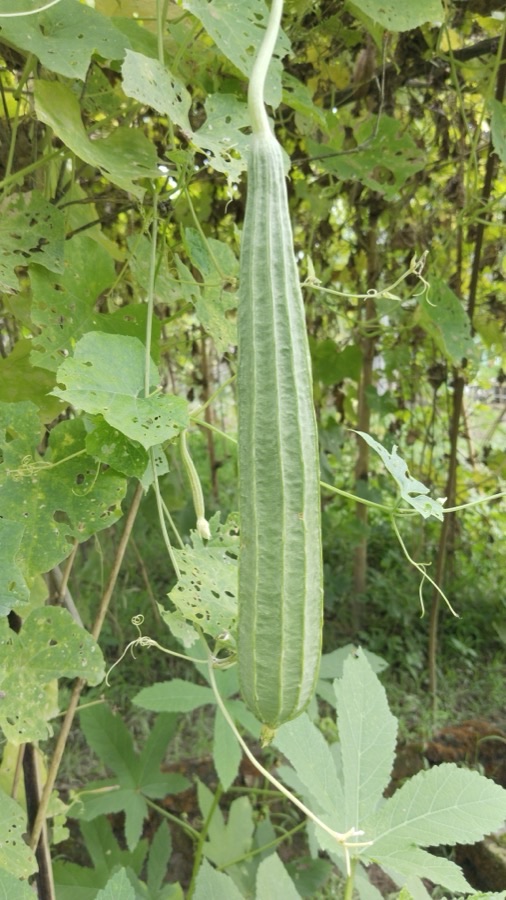
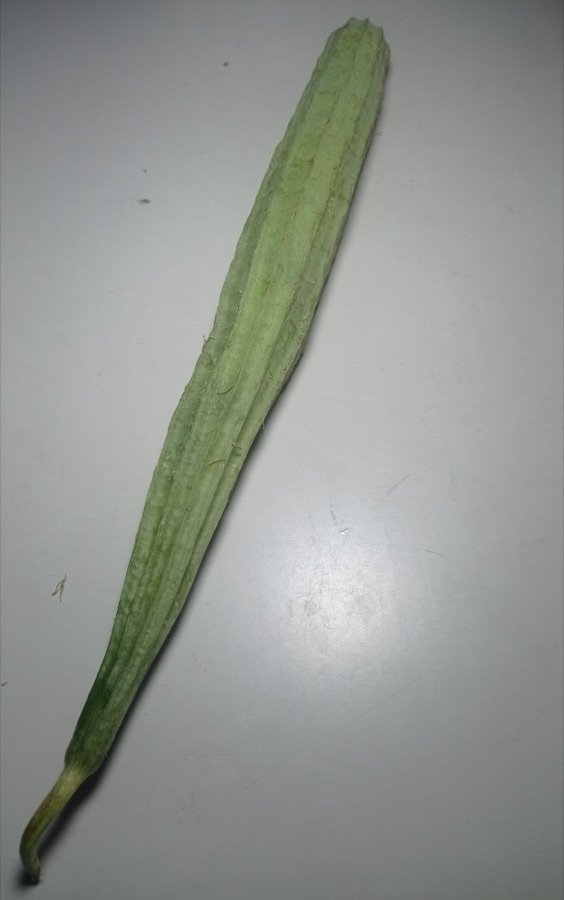
Luffa acutangula · Also called: Angled luffa, Chinese okra, Turai, Torai, Beerakaya, Peerkangai, Jhinge, Silk squash
Photo: Yercaud-elango, CC BY-SA 4.0 (Wikimedia Commons)
Ridge gourd is a fast, cheap, forgiving vegetable that turns a fence, a roof or a few poles into food. It is sown straight into the ground, it climbs whatever you give it, it starts cropping in about two months and then gives fruit every two or three days for a couple of months more. Across South and Southeast Asia it is a staple of small kitchen gardens and of market growing alike, precisely because it asks for so little. There is one thing about it that a new grower must understand or the crop is wasted: it is eaten young, and the window is short. A fruit that is perfect today can be fibrous and worthless in four days, and no amount of cooking will fix it. Left longer still, it turns into a bath sponge, which is a real product but not the one most growers are counting on.
Growing Ridge gourd, Stage by Stage
1. Get the land ready and put up the support — Warm well-drained ground, and something strong to climb on.
2. Soak and sow the seed — A hard seed that needs a night in water first.
3. Weed, water and feed — Steady water and a light hand with the feed.
4. Flowering and fruit set — Male flowers first, then females with a tiny gourd behind them.
5. Watch for trouble — A fly that lays inside the young fruit is the one that will cost you.
6. Harvest young, and harvest often — Every two or three days. Miss one and it is a sponge.
7. Keep it fresh, and keep the seed — It wilts fast, so sell it fast. Then dry a fruit for next year.
Common Problems & Troubleshooting
If you see: Fruit that is tough and stringy inside, with a buyer refusing it.
It likely means: It was left on the vine too long. This fruit goes from tender to fibrous in a matter of days and nothing reverses it.
Do this: Go over the whole vine every two or three days without exception.
If you see: Young fruit with small puncture marks, going soft and rotten with maggots inside.
It likely means: Fruit fly. The female lays her eggs under the skin of a young fruit, and the grubs develop inside where nothing reaches them.
Do this: Pick and destroy every affected fruit rather than dropping it beneath the vine.
If you see: A strong leafy vine covered in flowers that sets almost no fruit.
It likely means: Usually only male flowers so far, or too few insects, or too much nitrogen. The first flush of flowers on this plant is always male.
Do this: Wait, since the first flowers are male and the females come later.
If you see: Fruit that is bent, flattened on one side, spotted or partly rotten.
It likely means: The vine is running on the ground. Fruit lying on soil grows crooked, gets marked and rots where it touches.
Do this: Put up a support before sowing and guide the vine onto it early.
If you see: Fruit that is bitter to eat, or small and misshapen.
It likely means: Nearly always water stress. A vine that dries out while carrying fruit makes small bitter fruit.
Do this: Water regularly and never let the plants dry out while they are fruiting.
If you see: A white powdery coating spreading over the leaves, which then dry and die.
It likely means: Powdery mildew. It comes in warm weather and spreads fast through a crowded vine, and it costs the leaves that feed the fruit.
Do this: Grow on a support so air moves through the vine instead of it lying in a mat.
Yield & Market Value
Growing the crop is only part of the job. The last part is knowing what a normal harvest looks like where you are, and knowing what your ridge gourd is worth before you agree a price with anybody.
Remember It This Way
If you forget every other page of this guide, keep these lines. They are the whole crop, in order, short enough to carry in your head.
Soak the seed overnight. The coat is hard.
Put the support up before you sow, not after.
A vine on the ground gives crooked spotted fruit.
The first flowers are all male. They drop. That is normal.
A female flower has a tiny gourd behind it already.
The flowers open in the evening. Do not spray then.
Walk the whole vine every two or three days.
Press a thumbnail into the ridge. If it resists, it is late.
Look under the leaves. The hidden one becomes a sponge.
Leave one fruit to dry at the end. That is next year's seed.
Test Yourself: Identification
What does the plant look like growing?
When is the fruit ready to pick?
What does a good picked fruit look like?
Honest Limits of This Guide
Timings here are given by season and by the state of the plant rather than in named months, because ridge gourd is grown in both hemispheres and year-round in the tropics. Count from your own warm season.
This guide is written for Luffa acutangula, the ridged gourd eaten young. The smooth sponge gourd, Luffa aegyptiaca, is a different species; it is grown similarly but is more often taken through to the sponge stage.
The photographs show garden and wild plants rather than a commercial trellised field, because usable pictures of a commercial ridge gourd crop are not available under a licence this library can use. The vine, the fruit and the dried sponge are the same.
Variety advice is deliberately local. Types differ in fruit length, in how quickly they toughen and in how well they stand heat, and which suits a district is a question for a local supplier.
The fruit fly advice is cultural — sanitation, bagging and trellising — because that is what a smallholder can do everywhere and because the grub is inside the fruit where sprays do not reach. Traps exist and are worth asking a local dealer about.
No chemical treatments are named here. The fruit is eaten with its skin, often within a day of picking, and what is permitted differs by country and by buyer.
Sources
GBIF Backbone Taxonomy species-match record for Luffa acutangula (L.) Roxb. — Global Biodiversity Information Facility (GBIF), Copenhagen (source)
EPPO Global Database — Luffa acutangula (EPPO code LUFAC) — European and Mediterranean Plant Protection Organization (EPPO), Paris (source)
Luffa acutangula and cucurbit fruit flies — CABI Compendium datasheets — CABI, Wallingford (source)
Indian Council of Agricultural Research and State Agricultural University extension guidance on cucurbit vegetable cultivation — Indian Council of Agricultural Research (ICAR), New Delhi (source)
FAO guidance on post-harvest handling of perishable vegetables — Food and Agriculture Organization of the United Nations (FAO), Rome (source)
Laisha knows Ridge gourd better than this page can show.Photo diagnosis for pests and disease, live market prices, and an agronomist you can ask at two in the morning. Ten days free, no card. After that 10 US dollars a month, one price worldwide.Start ten free days
 Laisha
AI Operating System for Agriculture
Enter Laisha