 Laisha
AI Operating System for Agriculture
Enter Laisha
Laisha
AI Operating System for Agriculture
Enter Laisha
Xanthosoma sagittifolium · Also called: Yautia (cocoyam / tannia), Tannia, New cocoyam, Macabo, Malanga, Ocumo, Taioba, Mangarito
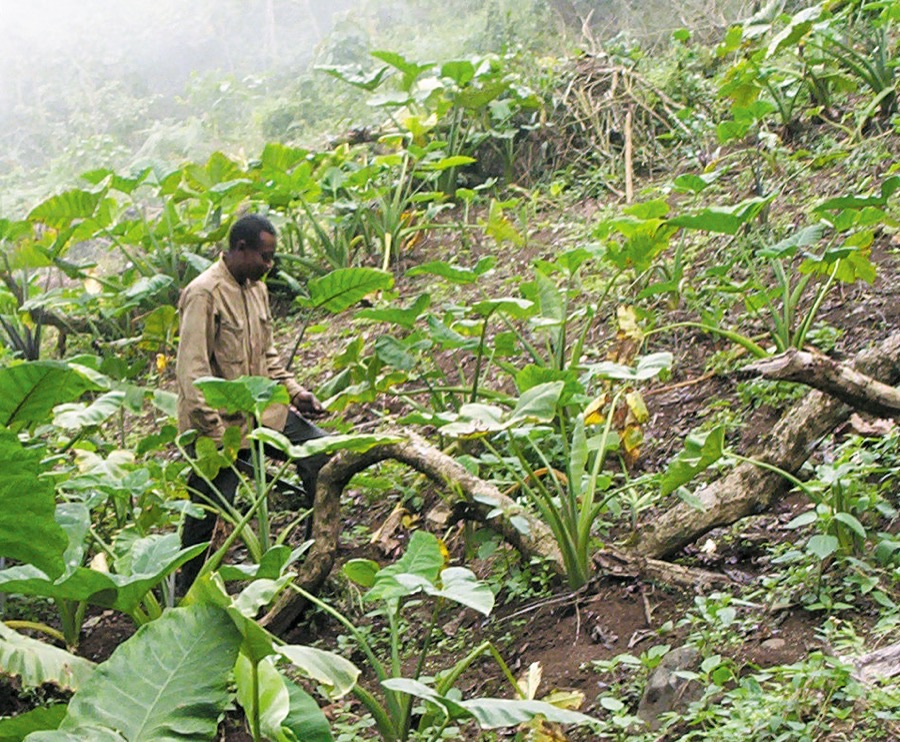
Photo: Amcaja, CC BY-SA 3.0 (Wikimedia Commons)
Yautia came from tropical America and found its most important home in West Africa, where Cameroon, Nigeria and Ghana grow a great deal of it under the name cocoyam or macabo, and it remains important across the Caribbean and the Pacific. For a smallholder it does three useful things at once: it produces on ground too dry for taro, it grows well in the shade under bananas and cocoa so it costs no extra land, and it gives both a starchy food and an edible leaf from the same plant. It also keeps in the ground, so a family can dig what it needs week by week rather than harvesting everything at once. Its two honest drawbacks are the sharp crystals that make every part of it unpleasant raw, and a soil rot that has badly damaged the crop across West Africa and has no cure.
If you see: A burning, prickling mouth and throat after eating, or badly itching hands after peeling, sometimes lasting hours.
It likely means: The sharp crystals in the raw plant. They are in the corms, the leaves and the sap, and cooking is what destroys them.
Do this: Never eat any part of this plant raw, and cook corms and leaves thoroughly before they go anywhere near a plate.
If you see: Plants yellowing, wilting and collapsing in patches, with soft brown rotted corms and a sour smell when you lift one, spreading through the field over a season.
It likely means: The root rot of cocoyam. It spreads in wet soil and on tools and boots, it has no cure, and it has badly damaged this crop across large parts of West Africa.
Do this: Lift and destroy affected plants with the soil around them, and never compost them.
If you see: Plenty of large healthy leaves at harvest but only small, few or misshapen side corms underneath.
It likely means: Hard or shallow soil, too little space, too little food over a long season, or the crop lifted before it had finished.
Do this: Work the soil deeply before planting, since corms cannot swell into hard ground.
If you see: Corms that have pushed up out of the soil and gone green and hard on the exposed part.
It likely means: They were not kept covered. A corm exposed to light greens and becomes tough and unpleasant.
Do this: Draw soil up around the base of each clump as the corms swell.
If you see: Stored corms going soft and wet within weeks, sometimes with a sour smell, spreading from one corm to those touching it.
It likely means: They were cut or bruised at lifting, washed before storing, or stored in a heap where air cannot move.
Do this: Dig carefully with a fork so the corms come out whole, since a cut corm cannot be stored.
If you see: A crop planted as cocoyam that is rotting in wet ground, or one whose big central corm is inedible when everyone expected to eat it.
It likely means: Taro and yautia have been confused. They are different plants with opposite needs, and both are called cocoyam in many places.
Do this: Look at the leaf: if the stalk joins the middle of the underside of the blade, it is taro, and if it joins at the notch on the edge, it is yautia.
If you see: Brown or dark water-soaked patches spreading across the leaves in wet weather, sometimes with a pale edge, until the leaves collapse.
It likely means: A leaf disease, which spreads in warm wet weather and in crowded plantings where the leaves stay wet.
Do this: Space the crop properly so that air moves through it rather than planting too thickly.
Growing the crop is only part of the job. The last part is knowing what a normal harvest looks like where you are, and knowing what your corms are worth before you agree a price with anybody.
If you forget every other page of this guide, keep these lines. They are the whole crop, in order, short enough to carry in your head.
This looks like taro. How do I tell which of the two I am looking at?
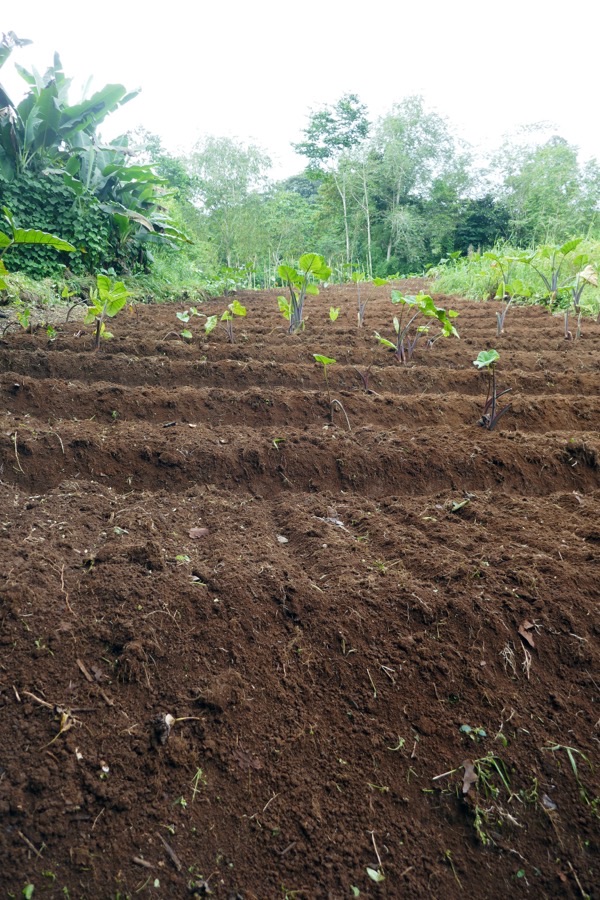
Why is this crop planted on ridges rather than on flat ground?
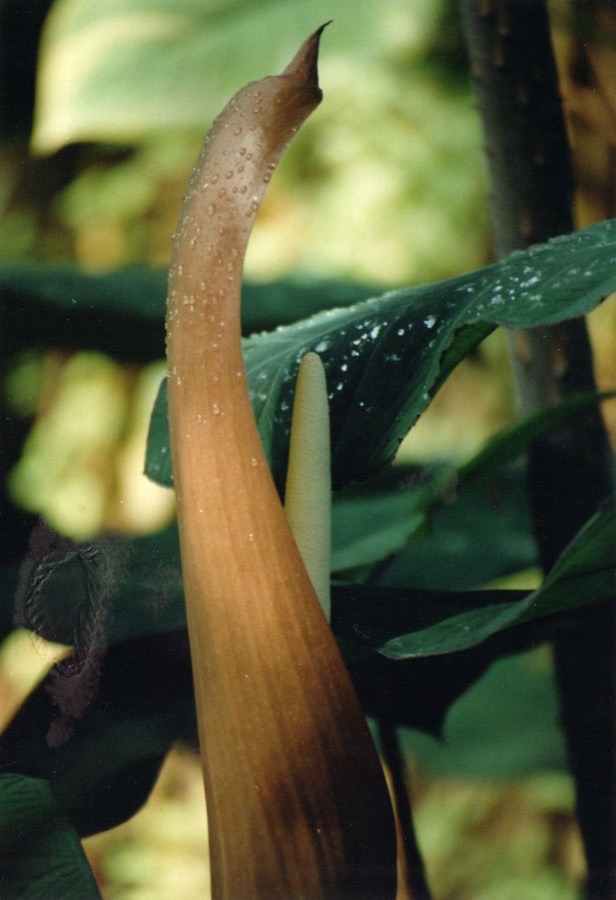
A pale hooded flower has come up in the middle of the plant. Does it mean anything?