Shunthi
शुण्ठी
Zingiber officinale Roscoe
Zingiberaceae · Zingiber
Benefits & side effects
TRADITIONAL VIEW, WITH SAFETY LIMITS
Hindi name: Sonth
What the texts say Shunthi does
- Deepana — kindles digestion (appetiser)
- Pachana — digests ama (digestive)
- Vatahara — pacifies vata
- Kaphahara — pacifies kapha
- Shulaprashamana — relieves colicky pain
- Vrishya — aphrodisiac, supports reproductive vigour
What the evidence says. Mixed, and unusually specific — supported for one use, not shown for several others.
Side effects and limits
- Abdominal discomfort
- Heartburn
- Diarrhoea
- Irritation of the mouth and throat when taken orally
A traditional classification, not a recommendation. The full safety record is below.
Stands in 9 groups
- Deepaniya — Kindling agni (named there as Shringavera)
- Trishnanigrahana — Quenching thirst (named there as Nagara)
- Shulaprashamana — Allaying colic (named there as Shringavera)
- Trptighna — Relieving cloying satiety (named there as Nagara)
- Hridayaputi — Cleansing the heart-passage (named there as Shringavera)
- Stanyashodhana — Purifying breast milk (named there as Mahaushadha)
- Pippalyadi — Agni, Kapha, and the digestive disorders (named there as Shringavera)
- Trikatu — The three pungents (named there as Shringavera)
- Panchakola — The five pungents that kindle agni
A Samhita can only be read forwards, from the group to its members. This is the same list read backwards.
Photographs
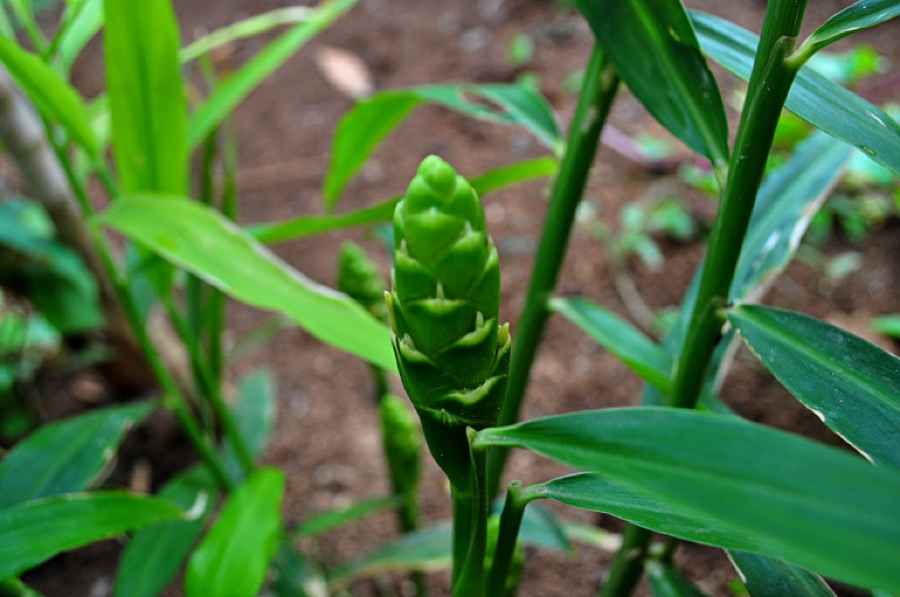
Photo: Venkatx5 · CC BY-SA 3.0 · Wikimedia Commons

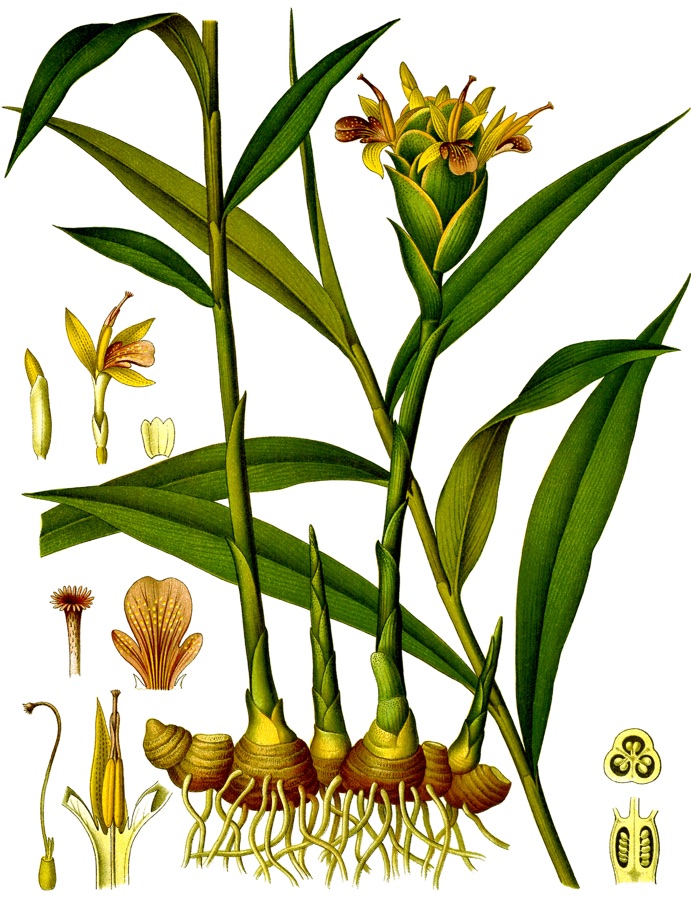
Photo: Franz Eugen Köhler, Köhler's Medizinal-Pflanzen · Public domain · Wikimedia Commons

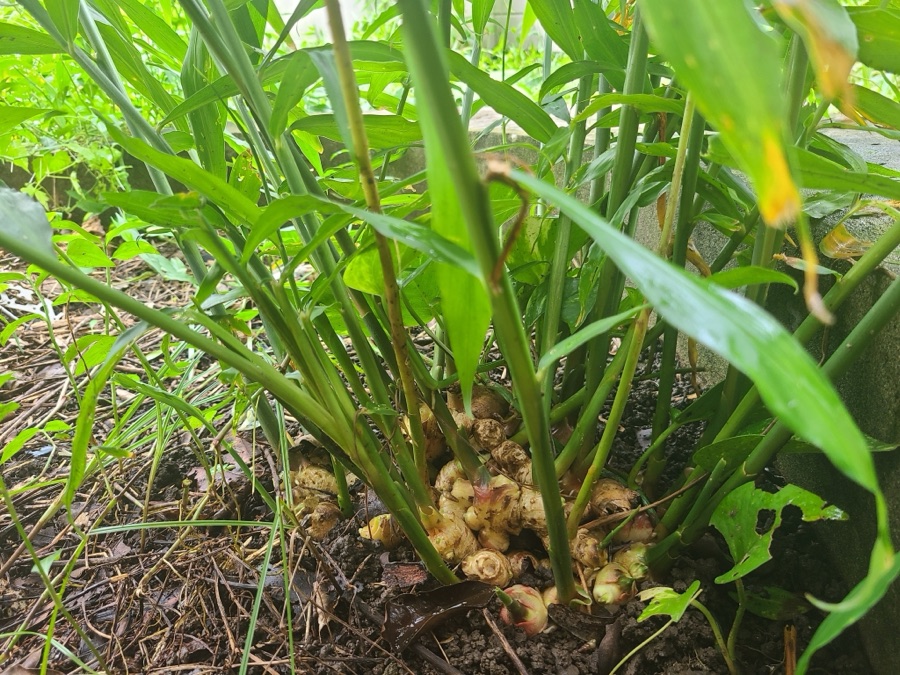
Photo: ritirene · CC BY 4.0 · Wikimedia Commons

Matra and anupana
AS THE CLASSICAL TEXTS AND THE API PRESCRIBE
| Churna | 1–2 g |
| Kwatha | 50–100 ml |
| Anupana | Ushnodaka · Guda · Madhu |
| Kala | Pragbhakta for deepana; adhobhakta for pachana |
Trikatu matra is lower per dravya because three ushna dravya act together.
Reported from Sharangadhara Samhita and the Ayurvedic Pharmacopoeia of India. Laisha states what the texts prescribe; it does not recommend. No quantity here is adjusted for a particular person — not for agni, koshtha, bala, age, pregnancy, kidney or liver function, or anything already being taken.
Pharmacopoeial standard
Ayurvedic Pharmacopoeia of India, Part I
| Marker | Volatile oil |
| Assay | Not less than 1.0 per cent |
| Total ash | Total ash not more than 6 per cent |
| Acid-insoluble ash | Not more than 1.5 per cent |
| Alcohol-soluble extractive | Alcohol-soluble extractive not less than 3 per cent |
| Water-soluble extractive | Water-soluble extractive not less than 10 per cent |
| Foreign matter | Foreign matter not more than 2 per cent |
Exhausted ginger — material from which the oil has already been extracted — is a common adulterant and shows as a volatile oil below the limit.
These are the pharmacopoeial limits for the article, not a test Laisha has run on anything. They are here so a practitioner can ask a supplier for a certificate of analysis and know what the numbers on it should say.
Rasapanchaka
| Rasa | Katu |
| Guna | LaghuSnigdha |
| Virya | Ushna |
| Vipaka | Madhura |
| Prabhava | Named Mahaushadha in the texts. The dried rhizome is classed as deepana and pachana, and the texts hold it to be snigdha where the fresh rhizome is not. |
| Doshakarma | Vatakaphahara. Being ushna it can increase pitta. |
Katu rasa with madhura vipaka — the shift from pungent to sweet after digestion is the point most often asked about this dravya.
Karma and part used
These are the actions the classical texts record. They are statements about what the tradition holds, and this library does not restate them as findings about a human body.
| Upayukta anga | Kanda (the dried rhizome) |
| Why it matters | The rhizome is an underground stem, not a root. Fresh ginger and dried ginger behave differently in cooking and are traded as different products. |
Paryaya
Mahaushadha means the great medicine and Vishwabheshaja the universal remedy. Ardraka is the fresh rhizome and Shunthi the dried one, and the texts treat them as two dravya with different properties, not one dravya in two states.
Names, by language
| English | Dry ginger |
| Sinhala | Inguru |
| Nepali | Sutho |
| Arabic | Zanjabil |
| Chinese | Gan jiang |
| Hindi | Sonth |
| Kannada | Shunthi |
| Tamil | Sukku |
| Telugu | Sonti |
| Malayalam | Chukku |
| Marathi | Sunth |
| Gujarati | Sunth |
| Bengali | Shunthi |
| Punjabi | Sund |
| Odia | Sunthi |
| Urdu | Sonth |
Classical references
Rasa, guna, virya, vipaka and karma are recorded as the classical texts give them, with the text and section named so a student can open the book and check. Where an exact chapter and verse could not be confirmed, this library names the section rather than inventing a number.
Formulations it appears in
| Trikatu | One of the three, with maricha and pippali. |
| Shunthi Churna | The plain powdered rhizome. |
| Dashamoolarishta | Among the dravya of the formulation. |
| Hingvashtaka Churna | Among the eight dravya. Shunthi, maricha, pippali, ajamoda, saindhava lavana, shweta jiraka, krishna jiraka and hingu. |
Adulterants and substitutes
Spent ginger — already extracted for oleoresin and dried again — is sold as whole dry ginger and is very hard to tell by eye. Powdered shunthi is also bulked with starch and with exhausted material. The classical distinction between ardraka and shunthi is itself a source of confusion in the market, where fresh-dried and properly cured rhizome are sold under one name.
Identity
Matched to the accepted name in the GBIF backbone at 99% confidence. Zingiberaceae is the ginger family; turmeric is a close relative, which is why the two are planted, lifted and cured in nearly the same way.
A WAY TO REMEMBER IT
Zingiber is from the Sanskrit shringavera — horn-shaped body — through Pali and Greek. Officinale means of the apothecary's shop. Shunthi is the dried rhizome; ardraka is the fresh.
What the tradition holds
Ginger is both a daily cooking ingredient and a long-standing preparation in Ayurveda, where adraka and dried sonth are treated as different materials. That is what the tradition holds and what the kitchen does; neither is a finding about what the plant does in a body.
What the evidence says
| Status | Mixed, and unusually specific — supported for one use, not shown for several others. |
| Suggested | Research shows ginger may be helpful for nausea and vomiting associated with pregnancy. Research also suggests possible benefit for menstrual cramp severity and for knee osteoarthritis symptoms, though study quality varies. |
| Not established | Most studies of ginger for motion sickness have not shown it to be helpful. It is uncertain whether ginger helps as an addition to standard treatment for nausea and vomiting from cancer chemotherapy, and equally uncertain for nausea and vomiting after surgery. |
| The honest gap | Nausea is not one condition. The pregnancy finding does not carry across to motion sickness, chemotherapy or post-surgical nausea — and for two of those the evidence is explicitly uncertain rather than absent. Anyone reaching for ginger during cancer treatment should be told that, not reassured by a study about pregnancy. |
Safety
Generally mild. The documented effects are digestive — discomfort, heartburn, diarrhoea, and irritation of the mouth and throat. Ginger supplements may be safe in pregnancy, but that is a conversation to have with a midwife or doctor rather than a conclusion to draw from a page.
| Side effects | Abdominal discomfort Heartburn Diarrhoea Irritation of the mouth and throat when taken orally |
| Interactions | Warfarin, clopidogrel, aspirin — ginger has antiplatelet activity; bleeding case reports exist at higher intakes. Antidiabetic medicines — additive lowering. Calcium channel blockers — modest additive effect reported. |
| Pregnancy and breastfeeding | The use of ginger dietary supplements during pregnancy may be safe, and NCCIH recommends consulting a healthcare provider. Safety while breastfeeding is not known. Ginger eaten as an ordinary food is a separate question from a concentrated supplement. |
Growing it
| Climate | A warm, humid crop of the tropics and subtropics, grown in partial shade in much of its range. |
| Soil | Deep, loose, free-draining soil rich in organic matter. Standing water rots the rhizome, which is both the crop and the planting material. |
| Planting | Grown from disease-free seed rhizomes rather than from seed. Because the planting material is itself a rhizome, a diseased one carries the problem straight into the next season, which is why certified or carefully selected material matters more here than in a seed crop. |
| Harvest | Lifted once the leaves yellow and die back. Young ginger may be lifted earlier for the fresh trade, when it is milder and thinner-skinned. |
| What is not stated | Laisha holds no sourced per-hectare yield or cost-of-production figure for ginger. None is offered here rather than estimated, and the cultivation detail above is deliberately general because it is not drawn from a single cited trial. |
Grown as a crop: how to grow ginger, from sowing to harvest, in Laisha's grow guides.
Check this page
Print it and the code still works. It goes to this page and nowhere else.
What this is not
- No dose is given, here or anywhere in this library.
- Nothing here is a recommendation to take ginger as a supplement, or to stop taking anything prescribed.
- Where evidence supports one use and not another, both are stated. 'Good for nausea' is too coarse to be either useful or safe.
Sources
https://www.nccih.nih.gov/health/ginger
https://api.gbif.org/v1/species/match?name=Zingiber%20officinale
https://www.ema.europa.eu/en/medicines/herbal/zingiberis-rhizoma
https://pcimh.gov.in/
https://niimh.nic.in/ebooks/esharangadhara/