LAISHA
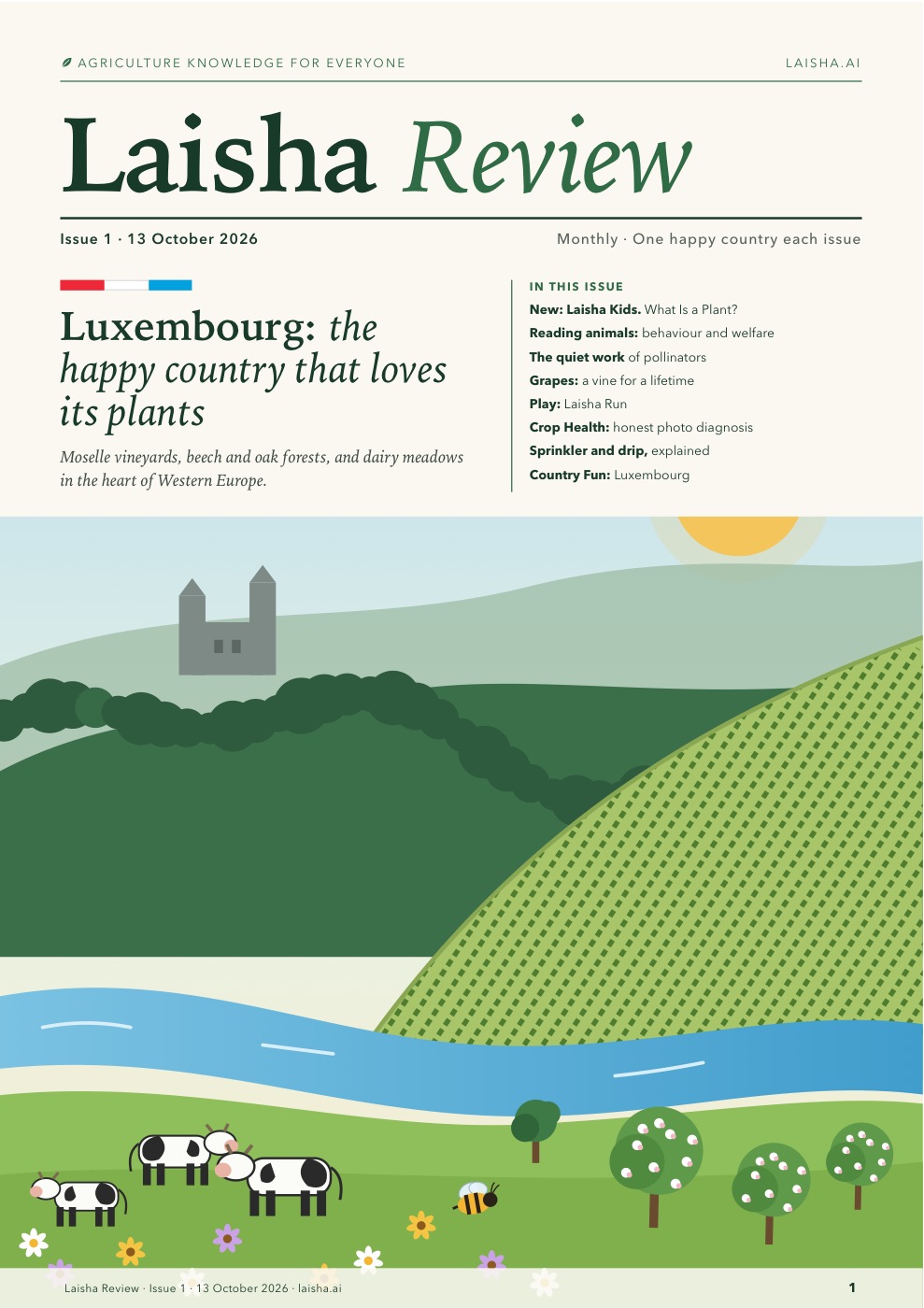
Cover of Laisha Review Issue 1, 13 October 2026: Luxembourg: the happy country that loves its plants

Issue 1 · 13 October 2026 · 20 pages

Luxembourg: the happy country that loves its plants

Moselle vineyards, beech and oak forests, and dairy meadows in the heart of Western Europe.

Laisha Review · Monthly

Get the next issue by email

One email a month when a new issue is out: a degree manual, a crop from field to harvest, an app inside Laisha, a new Laisha Kids book and one of the world's happiest countries.

We will first email you a link to confirm; nothing is sent until you do. Every email has a one-click unsubscribe link. We use your address only to send the magazine. Privacy

Welcome

Why Laisha Review

A monthly magazine about growing things, caring for animals and looking after the land, written for readers in every country.

Laisha exists for one reason: agriculture knowledge should belong to everyone. A student preparing for an exam, a farmer deciding when to prune, a vet in her first year of practice, and a six-year-old asking why leaves are green all deserve the same thing: clear, honest, carefully checked answers.

Laisha Review brings a little of that library to you each month. Every issue opens a manual from our degree courses, follows a crop from field to harvest, shows you one of the apps inside Laisha, and gives children a new Laisha Kids book to share.

Each issue also visits one country chosen from among the world's happiest, because a happy country always loves plants. We begin with Luxembourg, a small Grand Duchy of forests, vineyards and dairy meadows that regularly ranks among the happiest countries in the world. You will find its Moselle vineyards in our crop story, and its words, woods and farms in Country Fun.

Every article ends with a QR code. Scan it with your phone camera, or type the short link, to open the full manual or app on laisha.ai.

We hope you enjoy Issue 1. Share it with anyone who grows, studies or simply loves plants.

— The Laisha team
In this issue

Page numbers as in print

  1. 3Laisha KidsWhat Is a Plant?Our new series for children begins with Class 1: roots, leaves, seeds and the green magic of sunlight.
  2. 6VeterinaryReading the animalA sow chewing an empty mouth for hours, a cat that has stopped grooming, a heifer that will not walk into the crush: each is telling us something. A chapter-by-chapter tour of Laisha's manual on Animal Behaviour, Ethology & Welfare Science.
  3. 8SustainabilityThe quiet work of pollinatorsEvery farm is an ecosystem. It borrows pollination, pest control, fertile soil and clean water from nature, and pays them back, or runs them down, with every season's decisions.
  4. 10CropGrapes: a vine for a lifetimeOn the steep slopes above Luxembourg's Moselle, Riesling, Auxerrois and Pinot Gris ripen in the autumn sun. The same plant grows on every inhabited continent. Here is how it is really grown, from Laisha's grow guide.
  5. 12GameLaisha Run: harvest at full speedA free farm runner that opens in the browser you already have. No download, no app store, no account and no sign-in. Just a field trail, a full harvest and a lot of things in the way.
  6. 14An app in LaishaCrop Health: an honest second opinionPhotograph what is wrong, say what you have noticed, and get back an organised reading of what is visible, what it could be and how sure anyone can be. What it will not do matters just as much.
  7. 16From the Laisha LibrarySprinkler and drip, explainedPressurised irrigation can water a field more evenly than any surface method and feed the crop through the same pipes. Done badly, it clogs, floods and never repays its cost. A tour of Laisha's degree manual on Sprinkler & Micro-Irrigation Systems.
  8. 18Country FunLuxembourg: forests, vines and cowsA small green Grand Duchy of forests, vineyards, castles and cows, right in the heart of Western Europe. Say “Moien!” to this issue's happy country.
  9. 20Back pageThe Issue 1 quizFive questions, one from each corner of this issue.

Laisha Kids · Class 1 · Ages 6–7

What Is a Plant?

Our new series for children begins with Class 1: roots, leaves, seeds and the green magic of sunlight.

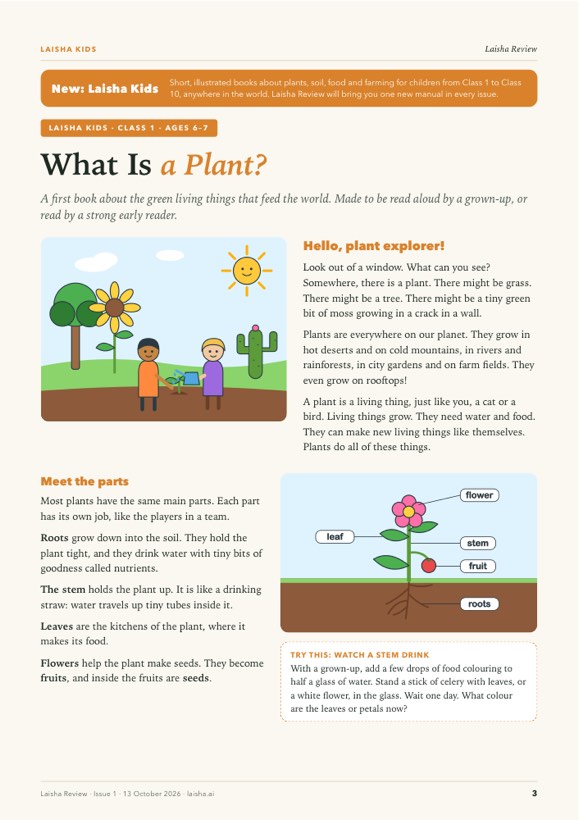
Short, illustrated books about plants, soil, food and farming for children from Class 1 to Class 10, anywhere in the world. Laisha Review will bring you one new manual in every issue. This month: What Is a Plant?, a first book about the green living things that feed the world, made to be read aloud by a grown-up, or read by a strong early reader.

Look out of a window. What can you see?

Continue reading →Read the whole book on laisha.ai

Page 3 of Laisha Review Issue 1: What Is a Plant?

Page 3 in print

Veterinary · Degree manual

Reading the animal

A sow chewing an empty mouth for hours, a cat that has stopped grooming, a heifer that will not walk into the crush: each is telling us something. A chapter-by-chapter tour of Laisha's manual on Animal Behaviour, Ethology & Welfare Science.

Ethology is the scientific study of animal behaviour: what animals do, how the behaviour is produced, how it develops, what it is for and how it evolved. Welfare science asks a related question: how is this animal faring, in its body and in its experience, in the conditions in which it lives and dies? The two belong together, because behaviour is the most direct window a veterinarian has into how an animal feels. The World Organisation for Animal Health lists animal welfare among the Day 1 competencies of every graduating veterinarian.

Ethology asks four classic questions about any behaviour: what causes it, how it develops, what it is for and how it evolved. Young animals pass through sensitive periods; puppies are most open to socialisation from about 3 to 12–14 weeks of age, kittens from about 2 to 7 weeks. Learning runs from habituation, getting used to a harmless repeated stimulus, to associative learning, in which reinforcement makes a behaviour more likely and punishment less likely. Behaviour rewarded unpredictably is the hardest to extinguish.

Continue reading →Read the full manual on laisha.ai

Page 6 of Laisha Review Issue 1: Reading the animal

Page 6 in print

Sustainability · Degree manual

The quiet work of pollinators

Every farm is an ecosystem. It borrows pollination, pest control, fertile soil and clean water from nature, and pays them back, or runs them down, with every season's decisions.

Stand at the edge of a flowering orchard on a warm morning and listen. The hum is the sound of a service that no farmer invoices and no market prices.

Laisha's manual on ecosystem services and pollinators starts from a simple idea: farms are ecosystems. They depend on services that nature provides, from the bees that carry pollen to the soil organisms that build fertility, and they in turn produce food while changing the services that neighbours downstream, and people in the future, will receive.

Continue reading →Read the full manual on laisha.ai

Page 8 of Laisha Review Issue 1: The quiet work of pollinators

Page 8 in print

Crop · Grow guide

Grapes: a vine for a lifetime

On the steep slopes above Luxembourg's Moselle, Riesling, Auxerrois and Pinot Gris ripen in the autumn sun. The same plant grows on every inhabited continent. Here is how it is really grown, from Laisha's grow guide.

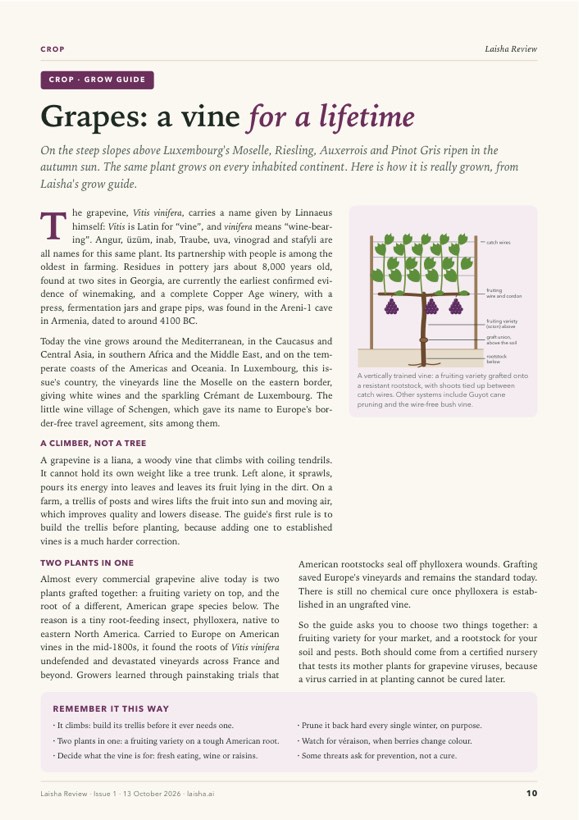
The grapevine, Vitis vinifera, carries a name given by Linnaeus himself: Vitis is Latin for “vine”, and vinifera means “wine-bearing”. Angur, üzüm, inab, Traube, uva, vinograd and stafyli are all names for this same plant. Its partnership with people is among the oldest in farming. Residues in pottery jars about 8,000 years old, found at two sites in Georgia, are currently the earliest confirmed evidence of winemaking, and a complete Copper Age winery, with a press, fermentation jars and grape pips, was found in the Areni-1 cave in Armenia, dated to around 4100 BC.

Today the vine grows around the Mediterranean, in the Caucasus and Central Asia, in southern Africa and the Middle East, and on the temperate coasts of the Americas and Oceania. In Luxembourg, this issue's country, the vineyards line the Moselle on the eastern border, giving white wines and the sparkling Crémant de Luxembourg. The little wine village of Schengen, which gave its name to Europe's border-free travel agreement, sits among them.

Continue reading →Read the full grow guide on laisha.ai

Page 10 of Laisha Review Issue 1: Grapes: a vine for a lifetime

Page 10 in print

Game · Free to play

Laisha Run: harvest at full speed

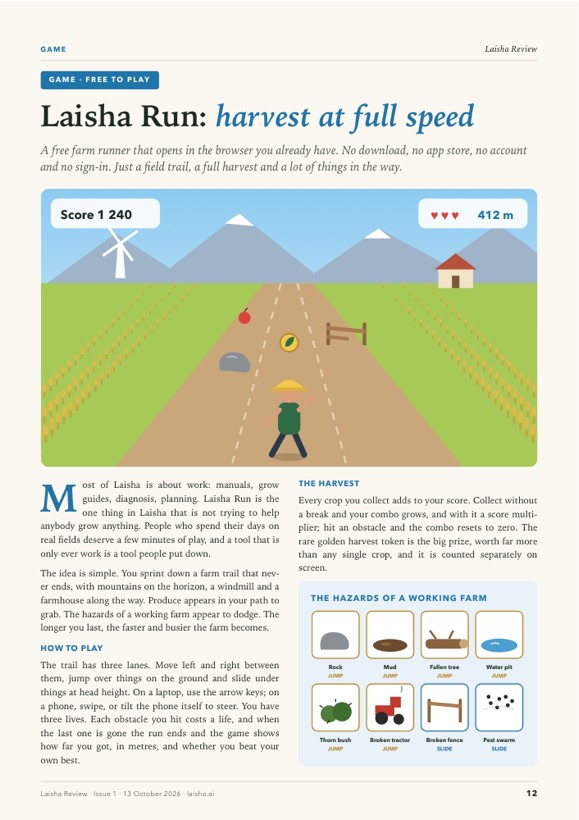
A free farm runner that opens in the browser you already have. No download, no app store, no account and no sign-in. Just a field trail, a full harvest and a lot of things in the way.

Most of Laisha is about work: manuals, grow guides, diagnosis, planning. Laisha Run is the one thing in Laisha that is not trying to help anybody grow anything. People who spend their days on real fields deserve a few minutes of play, and a tool that is only ever work is a tool people put down.

The idea is simple. You sprint down a farm trail that never ends, with mountains on the horizon, a windmill and a farmhouse along the way. Produce appears in your path to grab. The hazards of a working farm appear to dodge. The longer you last, the faster and busier the farm becomes.

Continue reading →Play free in your browser on laisha.ai

Page 12 of Laisha Review Issue 1: Laisha Run: harvest at full speed

Page 12 in print

An app in Laisha

Crop Health: an honest second opinion

Photograph what is wrong, say what you have noticed, and get back an organised reading of what is visible, what it could be and how sure anyone can be. What it will not do matters just as much.

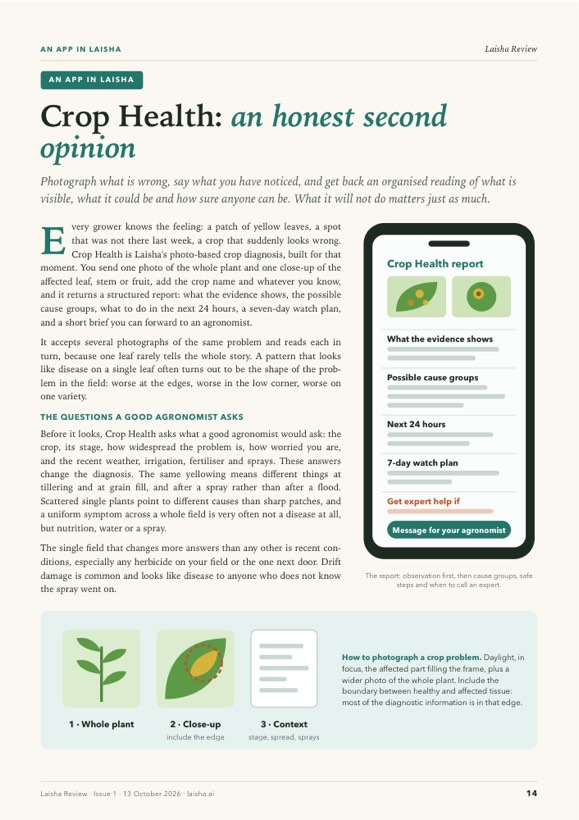
Every grower knows the feeling: a patch of yellow leaves, a spot that was not there last week, a crop that suddenly looks wrong. Crop Health is Laisha's photo-based crop diagnosis, built for that moment. You send one photo of the whole plant and one close-up of the affected leaf, stem or fruit, add the crop name and whatever you know, and it returns a structured report: what the evidence shows, the possible cause groups, what to do in the next 24 hours, a seven-day watch plan, and a short brief you can forward to an agronomist.

It accepts several photographs of the same problem and reads each in turn, because one leaf rarely tells the whole story. A pattern that looks like disease on a single leaf often turns out to be the shape of the problem in the field: worse at the edges, worse in the low corner, worse on one variety.

Continue reading →Try Crop Health on laisha.ai

Page 14 of Laisha Review Issue 1: Crop Health: an honest second opinion

Page 14 in print

From the Laisha Library · Agricultural engineering

Sprinkler and drip, explained

Pressurised irrigation can water a field more evenly than any surface method and feed the crop through the same pipes. Done badly, it clogs, floods and never repays its cost. A tour of Laisha's degree manual on Sprinkler & Micro-Irrigation Systems.

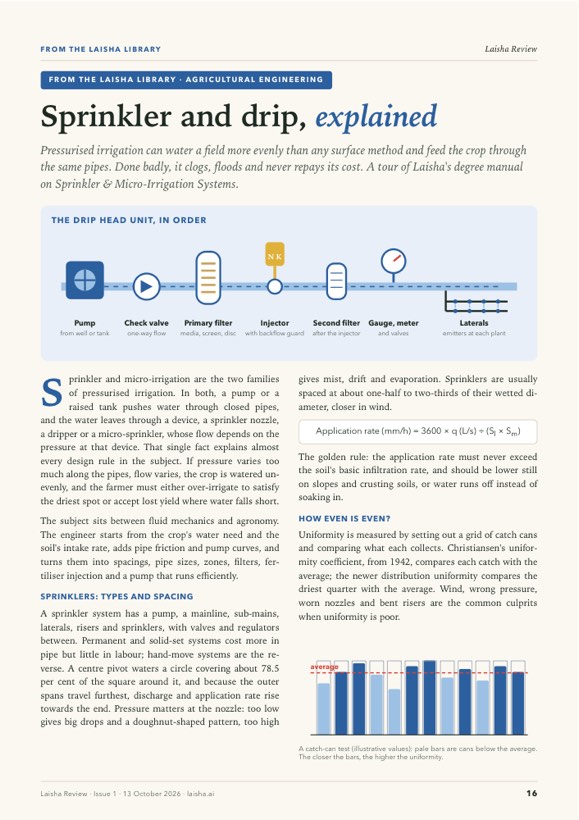
Sprinkler and micro-irrigation are the two families of pressurised irrigation. In both, a pump or a raised tank pushes water through closed pipes, and the water leaves through a device, a sprinkler nozzle, a dripper or a micro-sprinkler, whose flow depends on the pressure at that device. That single fact explains almost every design rule in the subject. If pressure varies too much along the pipes, flow varies, the crop is watered unevenly, and the farmer must either over-irrigate to satisfy the driest spot or accept lost yield where water falls short.

The subject sits between fluid mechanics and agronomy. The engineer starts from the crop's water need and the soil's intake rate, adds pipe friction and pump curves, and turns them into spacings, pipe sizes, zones, filters, fertiliser injection and a pump that runs efficiently.

Continue reading →Read the full manual on laisha.ai

Page 16 of Laisha Review Issue 1: Sprinkler and drip, explained

Page 16 in print

Country Fun · Issue 1

Luxembourg: forests, vines and cows

A small green Grand Duchy of forests, vineyards, castles and cows, right in the heart of Western Europe. Say “Moien!” to this issue's happy country.

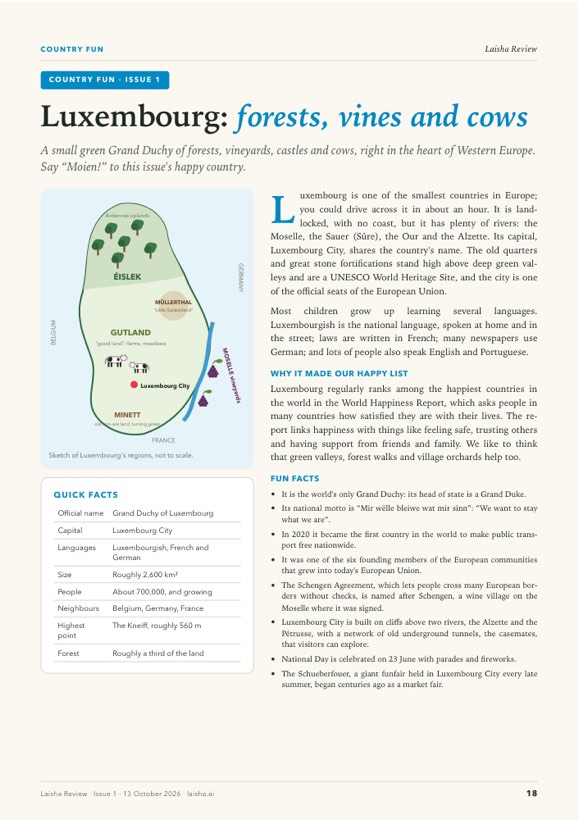
Luxembourg is one of the smallest countries in Europe; you could drive across it in about an hour. It is landlocked, with no coast, but it has plenty of rivers: the Moselle, the Sauer (Sûre), the Our and the Alzette. Its capital, Luxembourg City, shares the country's name. The old quarters and great stone fortifications stand high above deep green valleys and are a UNESCO World Heritage Site, and the city is one of the official seats of the European Union.

Most children grow up learning several languages. Luxembourgish is the national language, spoken at home and in the street; laws are written in French; many newspapers use German; and lots of people also speak English and Portuguese.

Continue reading →More Country Fun on laisha.ai

Page 18 of Laisha Review Issue 1: Luxembourg: forests, vines and cows

Page 18 in print

Back page · page 20

The Issue 1 quiz

Five questions, one from each corner of this issue.

  1. 1 · Laisha Kids

    Where does a plant make most of its food?

    a) In its roots · b) In its leaves · c) In its seeds
  2. 2 · Veterinary

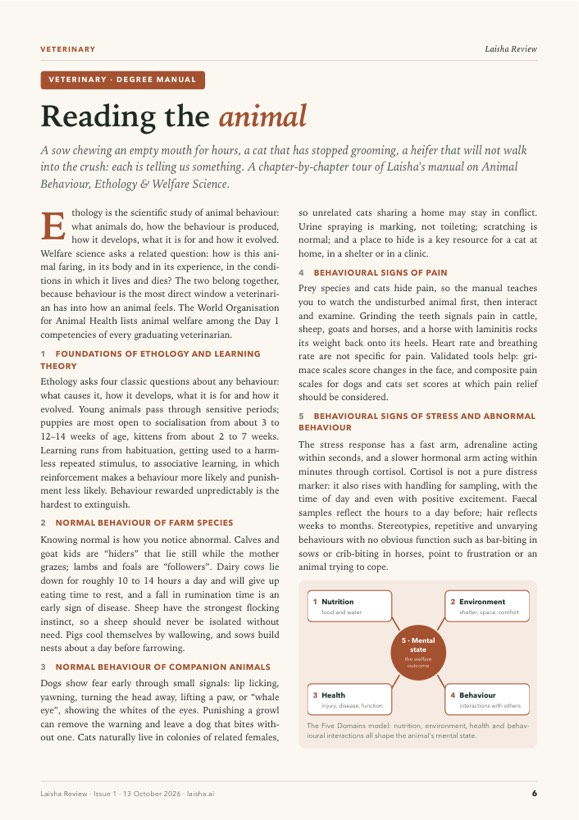
    In the Five Domains model, which domain is the welfare outcome?

    a) Nutrition · b) Health · c) Mental state
  3. 3 · Sustainability

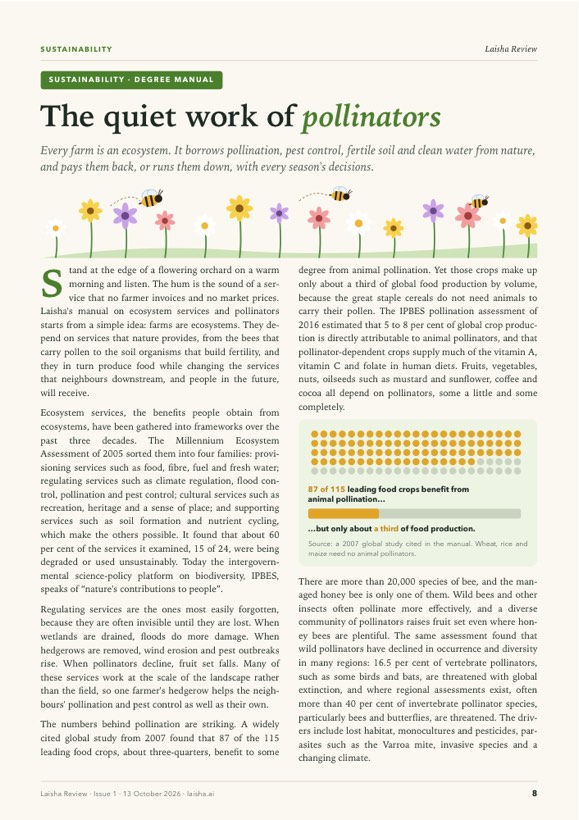
    How many of the 115 leading food crops benefit from animal pollination?

    a) 12 · b) 87 · c) All 115
  4. 4 · Crop

    What happens to grape berries at véraison?

    a) They change colour and soften · b) They are pruned · c) They flower
  5. 5 · Library

    A sprinkler's application rate must not exceed the soil's…

    a) Colour · b) Infiltration rate · c) Temperature
Show the answers

1 b (In its leaves) · 2 c (Mental state) · 3 b (87) · 4 a (They change colour and soften) · 5 b (Infiltration rate)

Coming next issue

Laisha Kids, Class 1: Seeds and Sprouts

Seeds of every size, what is inside them, and how to grow beans, peas and cress at home or at school, watching and drawing each day.

A new happy country

Another of the world's happiest countries, and the plants its people love. Can you guess which?

← All issuesThe Laisha Review archive Next issueComing next month