How to Grow Cassava
Manihot esculenta · Also called: manioc, yuca, mandioca, tapioca, muhogo, gari plant, kamoteng kahoy, ubi kayu
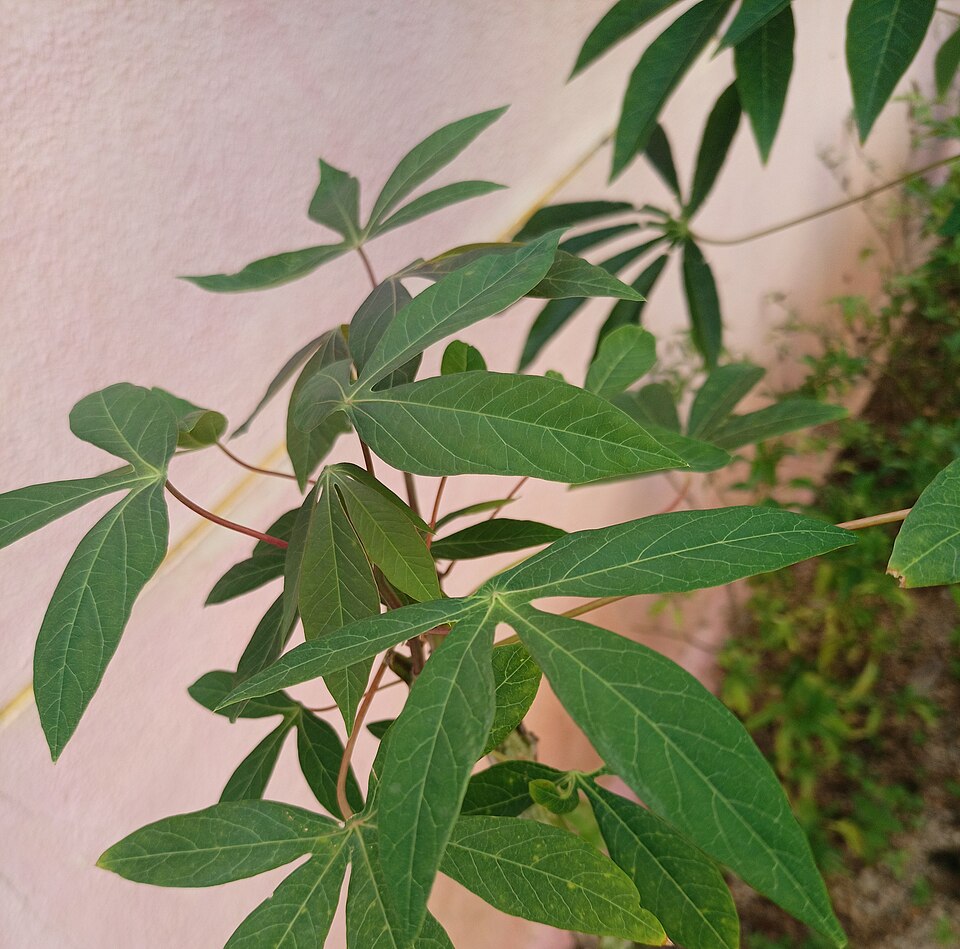
Photo: Manojkumar Subramani, CC BY-SA 4.0 (Wikimedia Commons)
Cassava grows where other food crops fail. It stands up to poor soil, to acid soil, and to long dry spells. In much of Africa it is the cheapest food energy there is. You do not buy seed for it. You cut a piece of stem from last year's plant. And you can leave the roots in the ground and dig them when you need them.
Growing Cassava, Stage by Stage
- 1. Get the land ready — Loosen the soil deep, and decide whether to plant on flat ground or on ridges.
- 2. Choose your planting stems — This is the most important choice you will make. A sick stem gives a sick field.
- 3. Keep and cut the stems — Keep whole stems standing in the shade. Cut them into short pieces only on the day you plant.
- 4. Plant the stems — Push them in the right way up, shallow, straight or leaning, with a big step between plants.
- 5. Water — Cassava needs rain at the start. After that it can survive dry weather better than almost anything.
- 6. Weeds — The first three months are a race. Cassava grows slowly at the start and weeds can beat it.
- 7. Know when to harvest — Usually 8 to 10 months. But you can leave it in the ground and dig it when you need food.
- 8. Make it safe to eat, and keep it — Never eat it raw. Peel it, then cook it, soak it, ferment it or dry it. Use the roots within a few days.
Common Problems & Troubleshooting
If you see: Leaves with a mixed pattern of yellow and green patches. Leaves that are twisted, crumpled, or much smaller than normal. The whole plant short and stunted. Worst on the newest leaves.
It likely means: A virus disease carried in the planting stems and spread by tiny white flying insects. The most damaging cassava problem in Africa.
Do this: You cannot cure a plant that has it. Do not waste effort trying.
If you see: The plant looks reasonable above ground, maybe with yellow blotches along the leaf veins and brown dead patches on the stem. But when you cut a root open there are dry, corky, brown or black streaks and rotten patches in the white flesh.
It likely means: A different virus disease from the mosaic one. It is dangerous because you often cannot see it until you dig, and by then the food is spoiled.
Do this: Do not take planting stems from any field where you have found this in the roots, even if the plants looked fine.
If you see: White, soft, powdery looking insects clustered on the growing tip and along the stem. The top of the plant bunched up tight like a small cabbage. Leaves small and stems short between joints.
It likely means: Cassava mealybug. It sucks the plant and injects something that stops the tip growing properly.
Do this: Do not take planting stems from an attacked plant. The insects travel to the new field on the stem.
If you see: Weeks after planting, many pieces of stem have not sprouted at all. When you pull them up they are dry, soft, black at the cut end, or rotten.
It likely means: The planting stems were poor, or too old, or dried out, or planted the wrong way up, or planted into ground that then went dry, or planted into ground that was waterlogged.
Do this: Fill the gaps now with fresh, good pieces. An empty gap grows nothing all season.
If you see: Tall, leafy, healthy looking plants. But when you dig, there are only thin, stringy roots and almost nothing worth eating.
It likely means: The plant put its energy into stems and leaves instead of roots. Usually because plants were too close together, or shaded by a taller crop, or given a lot of nitrogen fertiliser.
Do this: Next season leave a full big step between plants in every direction. Do not crowd them.
If you see: Plants wilting or dying in patches. When dug, the roots are soft, foul smelling, black or slimy.
It likely means: Root rot, usually because water stood around the roots, or because the land was infected from a previous crop.
Do this: Harvest the plants around the bad patch now, before the rot spreads to them.
If you see: Roots that were fine when dug, but two or three days later show blue-black or brown streaks inside, and taste bad.
It likely means: This is normal for cassava. It is not a disease. Fresh cassava roots simply spoil very fast once they leave the ground, and any bruise or cut speeds it up.
Do this: Do not dig more than you can use or process in one or two days.
If you see: People feeling dizzy, sick, weak in the legs, or with a headache after eating cassava. Especially where cassava has been the main food for a long time, or in a hungry season when it was cooked quickly.
It likely means: The cassava was not processed properly, or a bitter kind was used with only quick cooking. This is a real and serious risk, not a superstition.
Do this: Stop eating from that batch immediately.
Yield & Market Value
Growing the crop is only part of the job. The last part is knowing what a normal harvest looks like, and knowing what your roots are worth before you agree a price with anybody.
Remember It This Way
If you forget every other page of this guide, keep these lines. They are the whole crop, in order, short enough to carry in your head.
- Never eat the root raw. Peel it, then cook it, soak it, or dry it.
- You plant a stem, not a seed. Take it from a healthy plant, never a sick one.
- Middle of the stem, as thick as your thumb, with several bumps on it.
- Plant at the start of the rains, two thirds buried, bumps pointing up.
- The first three months are the whole fight. Keep it clean of weeds.
- After that it looks after itself, and it can wait in the ground for months.
- Dig it, and the clock starts. Use it, dry it or ferment it within two or three days.
- Save your own best stems at harvest. That is next year's whole crop, free.
Test Yourself: Identification
This leaf is of which plant?
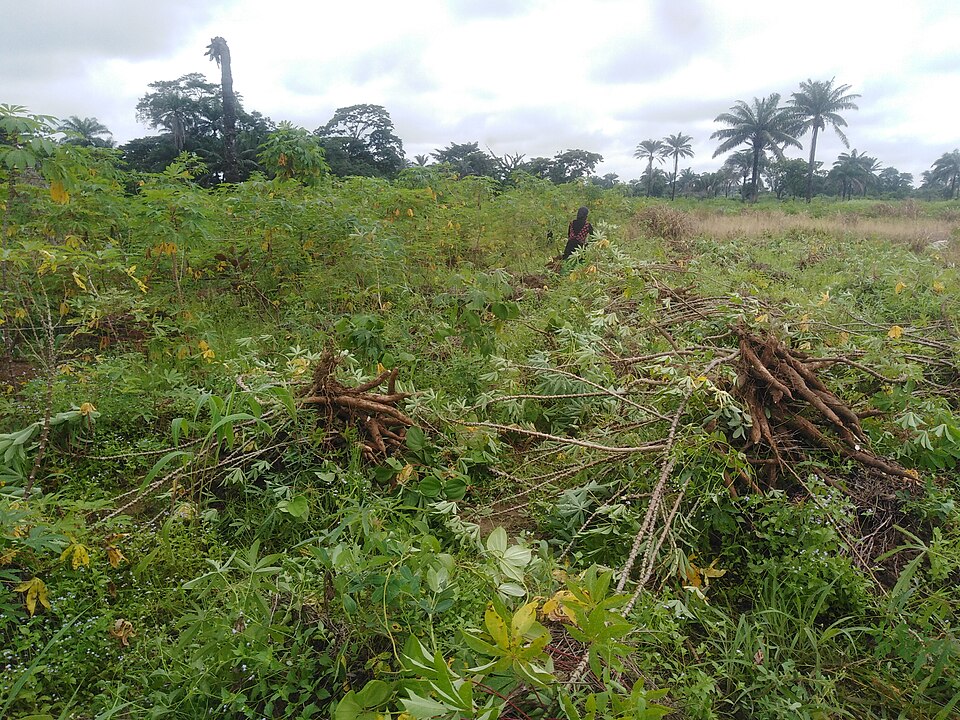
Which crop is this field of, and what kind of plant is it?
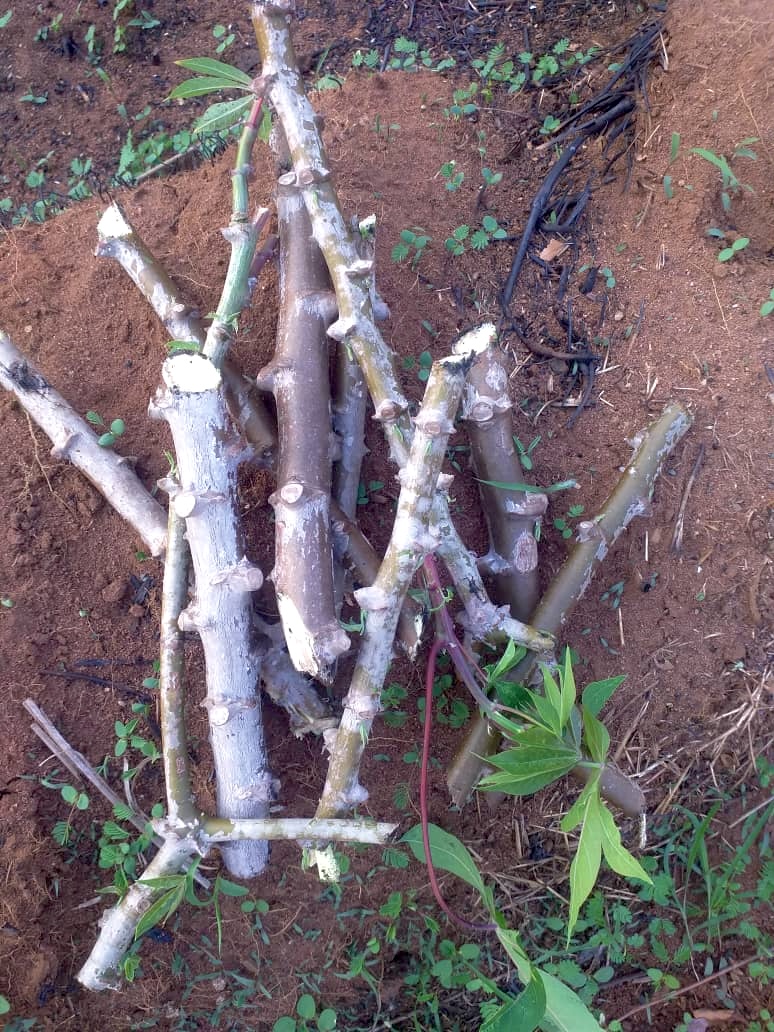
Which crop is planted from pieces of stem instead of from seed?
Honest Limits of This Guide
- The right planting month is different everywhere. The rule that is true everywhere is: plant at the start of your rains.
- Whether your cassava is a sweet or a bitter kind changes how it must be processed. This guide cannot tell you which one you have. Someone local can.
- Which varieties resist the virus diseases depends entirely on your country and region. Ask your local agricultural officer.
- This guide does not name any pesticide, weedkiller or fungicide product. If you decide to use one, buy only from a licensed dealer and follow the label.
Related Laisha Tools
- Global Market Price Outlook — Check today's price and trend
- Crop Calendar — Build a season-long sowing plan
- Pest & Disease Intelligence — Risk reasoning and a global pest & disease library
- Crop Health — Photo-based first read on a field problem
- Post-Harvest Loss Prevention — Real storage science by crop
Open the free Applied Agriculture Library in the Laisha app →
Sources
- Save and Grow: Cassava. A guide to sustainable production intensification — Food and Agriculture Organization of the United Nations, Rome (source)
- Towards integrated commodity and pest management in grain storage — FAO in collaboration with NAPHIRE, Rome (source)
- GBIF Backbone Taxonomy record for Manihot esculenta Crantz — Global Biodiversity Information Facility (GBIF), Copenhagen (source)
- World Checklist of Vascular Plants (WCVP), the checklist behind Plants of the World Online — Royal Botanic Gardens, Kew (source)
- Flora of China, Volume 11 (Euphorbiaceae): Manihot esculenta treatment, pages 275-276 — Science Press, Beijing, and Missouri Botanical Garden Press, St. Louis, published online at eFloras.org by the Missouri Botanical Garden and the Harvard University Herbaria (source)
- Cassava yields (dataset), built on FAOSTAT: Production, Crops and livestock products — Food and Agriculture Organization of the United Nations, with major processing by Our World in Data (source)