How to Grow Coconut
Cocos nucifera · Also called: coconut palm, coco palm, common coconut palm, coconuts, nariyal, naariyal, nariyal ka ped, narikela
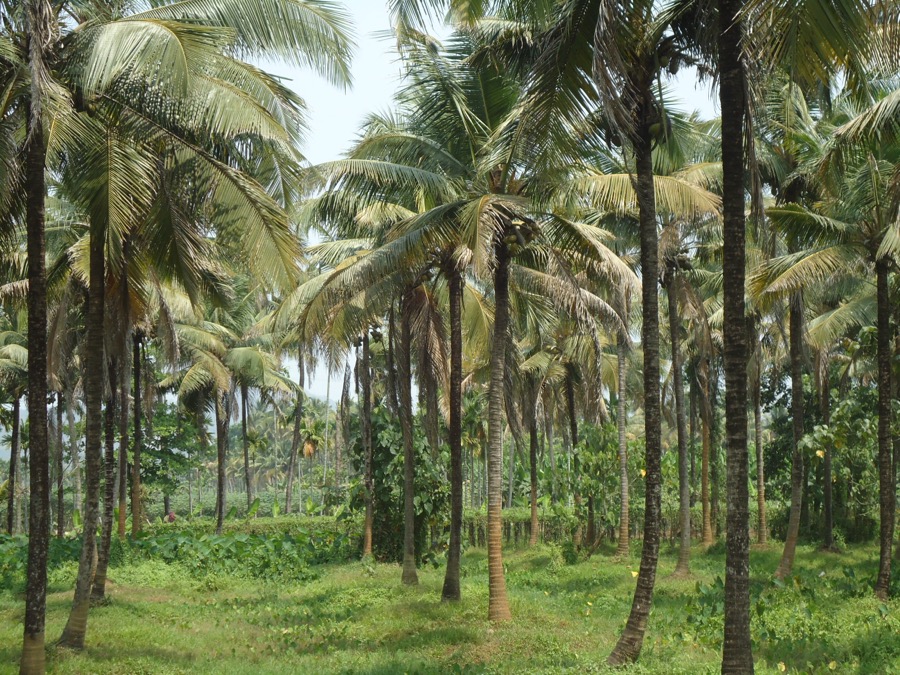
Photo: Ranjithsiji, CC BY-SA 3.0 (Wikimedia Commons)
Coconut is the single biggest crop grown of all in thirteen of the world's 195 countries — Comoros, Grenada, Jamaica, Kiribati, the Marshall Islands, Micronesia, Nauru, Saint Kitts and Nevis, Saint Lucia, Samoa, Seychelles, the Solomon Islands and Vanuatu — and a real top-ten crop in 43 countries altogether, nearly all of them small tropical island and coastal states with comparatively few other cash crops to fall back on. No other crop in this library carries that particular kind of concentrated, small-nation importance. It is also, honestly, the odd one out in every other sense: every other guide in this library covers a plant that lives for one season, or at most — sugarcane's ratoons aside — a handful of years. A coconut palm, once it starts bearing, can go on bearing for sixty to eighty years, sometimes longer, making it by a wide margin the longest-lived crop in this entire library, and the growing of it a genuinely multi-generational decision rather than a single farmer's single-season plan. It earns its place the way it does because almost the whole palm has real economic value at once: the kernel presses into coconut oil and dries into copra, the fruit's own water is now a fast-growing global drink category in its own right, the husk fibre (coir) is a real global export commodity, the hard shell becomes activated carbon and charcoal, the trunk timber and the leaves are real, traditional building materials across the tropics, and a young, unripe nut sold whole for its water is a genuine, immediate cash crop that needs no processing at all. Few plants anywhere give a smallholder family this many separate, real ways to earn from a single planted palm.
Global Importance
Coconut is grown across roughly 11 million hectares worldwide, overwhelmingly within about 20 degrees of the equator, and three countries — Indonesia, the Philippines and India — between them grow around 72 percent of the entire world's supply. Its true value is spread across genuinely different demands: copra and coconut oil for cooking and industry, coconut water as a fast-growing global drink, coir fibre from the husk, and a direct fresh tender-nut market that needs no processing at all.
Market Segments
Almost no other crop in this library gives one plant this many genuinely different, real, separate markets at once. What you are really growing this palm for — oil, water, fibre or seed — changes which variety you plant, how you space it, and even how you harvest it, long before any of that decides your final price.
Growth Habit
Three real facts about this palm's habit shape this entire guide, and none of them apply to any other crop in this library: it is a monocot with exactly one growing point for its whole life, not a branching tree; it will not give you a return for years, and then it keeps giving one for decades; and the single biggest early decision you make — Tall, Dwarf or Hybrid — locks in your spacing, your palm's lifespan and your realistic first-income date all at once.
Growing Coconut, Stage by Stage
- 1. Choose land, climate and site — Pick genuinely frost-free, well-watered land with real drainage, and plan your spacing by variety before a single pit is dug — because this decision, more than for any other crop in this library, cannot be corrected once palms are decades into the ground.
- 2. Select the mother palm and seednuts — Choose seednuts only from a real, healthy, high-yielding, middle-aged mother palm with a known bearing history — because in this crop, as in sugarcane's seed cane, almost everything about the next palm's health and yield is decided at this single step, decades before it matters.
- 3. Nursery — raising and grading the seedling — Sow seednuts in a real nursery bed, then grade the resulting seedlings honestly at 9 to 12 months by girth, leaf number and root development before ever taking one to the field — because a weak seedling planted out rarely becomes a strong palm later.
- 4. Field planting and establishment — Plant the selected seedling into its prepared pit at the start of the rainy season, at the right depth, and protect it through its first fragile months — the palm's whole later shape and health traces back to how carefully this one transplant is done.
- 5. The juvenile years — weeding, intercropping and protecting a young palm that gives you nothing yet — Use the genuinely long wait before first bearing productively: intercrop the open ground between young palms for real income, keep the collar and crown clear of the rhinoceros beetle, and irrigate through this period as if the whole grove's future depended on it — because it does.
- 6. Early bearing — flowering, pollination and the first nuts — Recognise the palm's first real inflorescence, understand honestly how Tall and Dwarf palms are pollinated differently, and expect early yields to build gradually toward full bearing around year 15 rather than arriving all at once.
- 7. Feed the palm — nitrogen, potassium, and the salt this crop is genuinely unusual about — Coconut is fed per palm, not per hectare, and it is genuinely one of the more potassium-hungry crops in this library — but its real stand-out feature is chloride: this is one of the very few crops anywhere that measurably benefits from applied common salt on chloride-poor soil.
- 8. Water — the palm's two real critical periods, and irrigation method — A mature coconut palm tolerates real dry spells better than most crops in this library, but a young, non-bearing palm and a palm carrying a developing bunch are both genuinely water-critical, and even a small, well-placed irrigation basin does more for this crop than for almost any other in this guide.
- 9. Full bearing — crown inspection and canopy management — Once a palm reaches full commercial bearing, the real ongoing job shifts from establishment to routine inspection — because this crop's worst disease and pest problems both start at the crown, and both are far cheaper to catch early than to discover only once a palm is dying.
- 10. Insect pests, stage by stage — Two insects do most of the world's coconut damage: the rhinoceros beetle, which bores into the crown to feed and is now spreading a dangerous new biocontrol-resistant biotype across the Pacific, and the red palm weevil, which tunnels invisibly inside the trunk and is often only discovered once it is too late to save the palm.
- 11. Diseases, stage by stage — Coconut carries the single most devastating disease story in this whole library's tree and palm coverage — lethal yellowing has killed millions of palms across whole regions — alongside a serious, still-active regional disease in South Asia and a fungal bud rot that kills through this palm's one and only growing point.
- 12. Harvest — climbing, poles, safety and the real harvest cycle — Coconut fruits continuously rather than in one seasonal flush, so harvesting is a repeating round every 45 to 60 days rather than a single annual event — and how that harvest is actually done, by human climber, pole-cutter or, in one specific and genuinely contested case, trained monkey labour, carries real, honestly disclosed safety and ethical weight this guide will not gloss over.
- 13. Senescence and the replanting decision — Even a well-managed palm's yield eventually declines with genuine old age, somewhere between 60 and 80 years for a Tall palm and sooner for a Dwarf or Hybrid, and deciding when and how to replant is a real, staggered, decades-long planning problem unlike any other crop in this library.
- 14. Grade it, store it and sell it well — Know which real market each harvest round is actually going to before you sell, understand what that specific market judges the nut on, and remember that this guide never prints a price, because Laisha's own live commodity tracking honestly does not yet reach this crop at all.
Fertiliser Programme
Coconut is fed differently from every other crop in this library in two specific ways: the dose is set and recorded per individual palm rather than per hectare, and this is one of the very few crops anywhere where ordinary common salt is a real, published, beneficial fertiliser input rather than something to avoid.
Common Problems & Troubleshooting
If you see: The newest, still-unopened spear leaf at the very centre of the crown wilts, yellows or browns, and can be pulled out easily by hand, often with a foul smell of decay at its base.
It likely means: Bud rot, caused mainly by the fungus Phytophthora palmivora — a genuine emergency, since this fungus is attacking the palm's one and only growing point.
Do this: Act immediately rather than waiting to see if it worsens. Where the rot is genuinely still limited to the spear leaf and has not spread far into the crown's growing tissue, remove and destroy the infected spear leaf and surrounding rotten material, then protect the wound from rain and further infection.
If you see: Fronds yellowing progressively from the oldest toward the youngest, new inflorescences blackening and dying, and nuts at all stages of development dropping prematurely, over a period of a few months.
It likely means: Lethal yellowing, caused by a phytoplasma spread between palms by a sap-feeding insect vector — the single most historically destructive coconut disease in this library, having killed millions of palms across the Caribbean and Florida in the twentieth century.
Do this: There is no cure once a palm is infected. Report the case to your local agricultural extension or plant protection service, since this is a genuinely serious, notifiable-level disease in several countries with a real history of destroying entire regional coconut populations.
If you see: A general, progressive decline in leaf production and bunch and nut numbers over one or more seasons, with older fronds yellowing and drying prematurely, but without the sharper, faster crown-death pattern lethal yellowing shows — most often in South India.
It likely means: Possibly root (wilt) disease, caused by a phytoplasma, a genuinely serious and still-active regional problem across parts of Kerala, Karnataka and Tamil Nadu specifically.
Do this: There is no cure, so focus on mitigation: review and strengthen the nutrient and water programme (Stage 7 and Stage 8), since a genuinely comprehensive programme measurably slows decline in affected palms even though it cannot reverse the underlying infection.
If you see: Neat, V-shaped or triangular cuts through unopened fronds, becoming visible as a row of holes once that leaf unfurls, especially on a young, juvenile palm.
It likely means: Rhinoceros beetle (Oryctes rhinoceros) feeding damage — the adult beetle has bored into the crown to feed on soft, unopened tissue.
Do this: Check the crown directly for a beetle lodged in a feeding tunnel and hook it out with a stiff wire where this is practical and safe.
If you see: Small holes in the trunk with a fermented, sour smell and gum or frass oozing out, or, in advanced cases, a drooping or collapsing crown with no other obvious explanation.
It likely means: Red palm weevil (Rhynchophorus ferrugineus) infestation — larvae tunnelling and feeding entirely inside the trunk, invisible from outside until damage is already severe.
Do this: Cut open a small suspect section, where safe and practical, to check for internal tunnelling and confirm the diagnosis rather than guessing from the outside alone.
If you see: Standing nuts on the palm with gnawed holes through the husk, sometimes with immature nuts shed onto the ground still attached to visible tooth marks.
It likely means: Rat damage — a genuine, widely documented pest of standing coconut in many regions, easily mistaken for a disease-driven immature nut shedding pattern (Stage 2 and Stage 6) if the gnaw marks are not looked for directly.
Do this: Check gnawed nuts directly for tooth marks before assuming a disease or nutrient problem is behind unexplained nut loss.
If you see: Older fronds showing yellowing and a scorched appearance at the margins, alongside visibly smaller nuts and lower copra weight than the palm's own established pattern, without any of the specific disease or pest signs above.
It likely means: Most likely potassium or chloride shortage — a real, and in this crop specifically common, correctable nutrient problem rather than disease or age.
Do this: Review your fertiliser programme honestly against Stage 7 and fertiliserProgramme before assuming disease: has potassium genuinely been applied at a real local rate, and has chloride been considered at all, especially on an inland site with no sea spray?
If you see: Visible mould, an off or musty smell, or discolouration on stored copra, especially copra that was dried quickly, incompletely, or during a spell of humid weather.
It likely means: Storage mould on under-dried copra, with a real risk of aflatoxin contamination — the same family of toxin this library's groundnut and maize guides warn about, produced by moulds that thrive specifically on copra left above its safe storage moisture.
Do this: Take the affected portion out and inspect it separately. Do not blend it back into the rest of the lot to dilute the problem.
Real Farm Economics
Coconut's real economics are shaped by a genuinely longer investment horizon than any other crop in this library: a real, substantial establishment cost and years of zero income before a palm bears at all, followed by decades of ongoing, comparatively modest annual cost against a real, recurring harvest income.
Yield & Market Value
Growing the crop is only part of the job. The last part is knowing what a normal harvest looks like, and knowing what your coconut is actually worth before you agree a price with anybody — and for this specific crop, that second part carries a real, honest gap this guide will not hide.
Remember It This Way
If you forget every other page of this guide, keep these lines. They are the whole crop, in order, short enough to carry in your head.
- This is not a tree. It is a giant grass relative with one growing point and no branches, ever.
- A beetle, a fungus or carelessness can destroy that one point, and the whole palm with it.
- Choose Tall, Dwarf or Hybrid by how long you can wait, not by which one grows biggest.
- The seednut is only as good as the mother palm it came from. Check her, not just it.
- The empty years before bearing are not wasted years — plant something else between the young palms.
- Feed it potassium like sugarcane, and feed it salt like nothing else in this whole library.
- Inspect the crown, not just the bunches. That is where this crop's worst dangers actually start.
- A climber's safety is not a footnote to the harvest. It is part of the harvest.
- This palm can outlive the farmer who planted it — plan the replanting decades ahead, not the season ahead.
Test Yourself: Identification
You are shown a grove of tall, single-stemmed palms with no branches at all, each topped by a crown of long, arching leaves, growing among other tropical crops. What tells you this is coconut rather than any other tall palm?
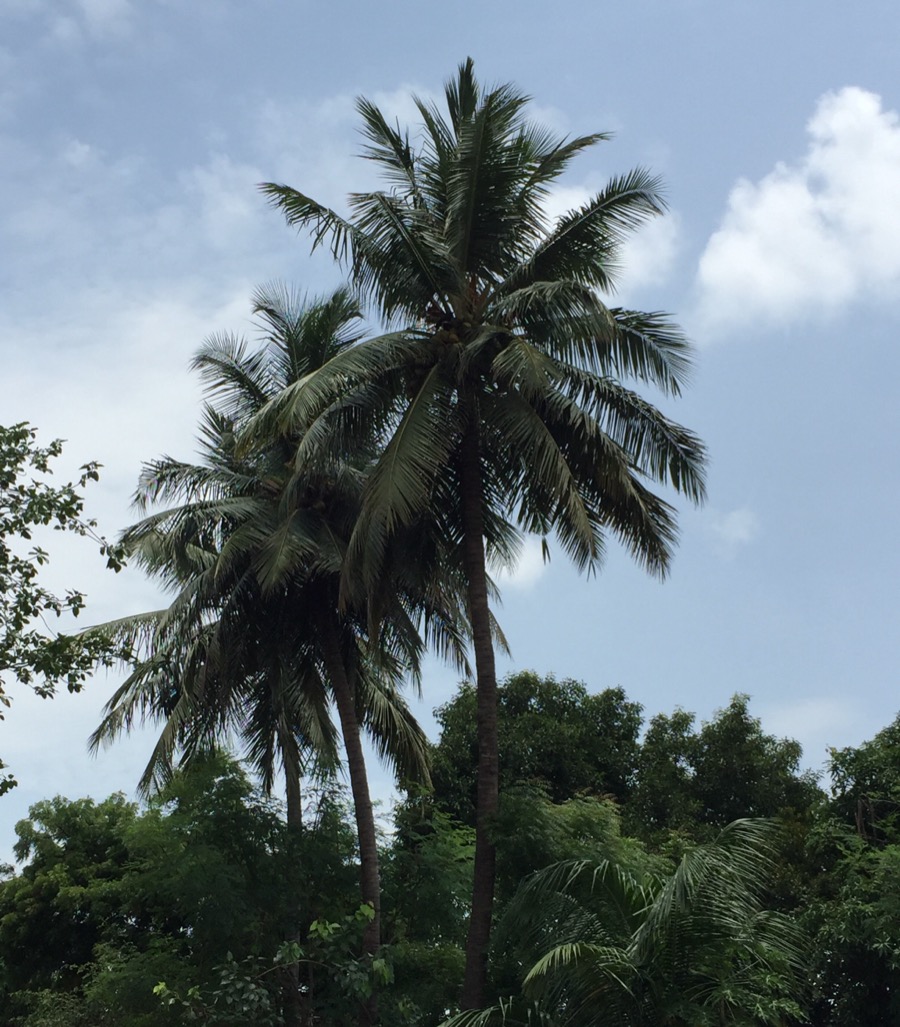
This mature palm stands well over 20 metres tall with a thick, grey, ringed trunk. Is this most likely a Tall, Dwarf or Hybrid variety, and why does the answer matter?
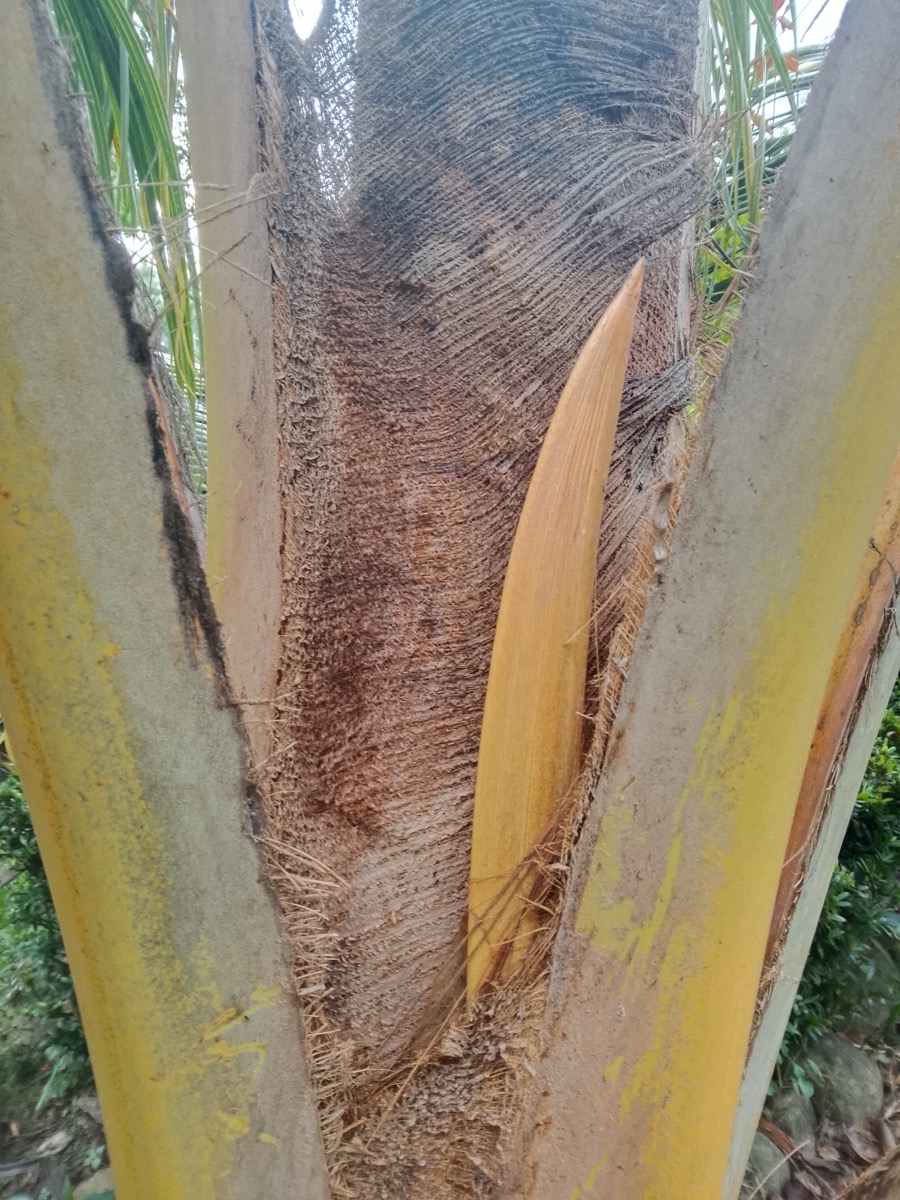
You are shown the spathe (the woody sheath enclosing a developing inflorescence) of a Malayan Yellow Dwarf palm. What does this variety's own biology tell you about how it is pollinated?
Honest Limits of This Guide
- This session's own live attempt to query FAOSTAT's public API for coconut production timed out with no response at all, a similar failure to the HTTP 521 error this library's barley and sugarcane guides record independently. The world and country production figures in this guide are therefore drawn from a secondary compilation that itself cites FAOSTAT by name (Wikipedia's country-by-country coconut production table), cross-checked against a second independent source for the three-country production-share claim, rather than read directly from a live FAOSTAT file. The world yield figure is a calculation from two separately compiled figures (production and area harvested), not a single directly published FAOSTAT yield statistic.
- Laisha's own live global commodity price service (globalCommodityPriceService.js) does not currently track coconut, copra or coconut oil, even though the World Bank's own underlying Pink Sheet dataset does separately publish a coconut oil reference price. This is disclosed honestly in yieldAndMarketValue as a real gap in what Laisha's own tool currently reads, not as evidence that no global reference price for this crop exists anywhere.
- There is no single global minimum-germination-percentage law for coconut seednuts the way there genuinely is for barley or groundnut seed in this same library. This guide's seedGradingAndCertification section states that structural difference honestly rather than inventing a false equivalence, and relies on India's Coconut Development Board and ICAR-Central Plantation Crops Research Institute's published mother-palm and seedling criteria as the real, checkable reference, not a universal international standard.
- Laisha's own curated leaf-and-plant visual diagnostic reference does not yet contain coconut-specific entries at the time this guide was written. The pest and disease descriptions in this guide are grounded in the published plant pathology and entomology literature named in its sources, not in that internal reference file.
- This guide could not find an adequately licensed, freely reusable Wikimedia Commons photograph specifically showing bud rot's collapsed-spear-leaf symptom or root (wilt) disease's own field symptoms. Rather than illustrate these with a stand-in image of a different problem, this guide describes them in words and names the real pathogen for each, exactly as this library's sugarcane guide does for red rot and ratoon stunting disease. The red palm weevil identification photograph is a genuine museum specimen rather than a field photograph of an infested palm, and its own caption says so.
- The coconut rhinoceros beetle's resistant CRB-G biotype is a real, actively spreading, still-evolving situation across parts of the Pacific at the time this guide was written. The specific countries and mortality figures named in Stage 10 and troubleshooting reflect published research current to this session and may already be out of date by the time this guide is read; a grower should ask their own national plant protection authority for the current local status rather than relying on this guide's figures alone.
- The per-palm fertiliser figures in this guide are drawn from India's ICAR-Central Plantation Crops Research Institute's own published recommendations, a real, specific national reference, not a universal target. Take your own actual fertiliser and salt programme from your own local extension service, which will differ with your soil's own chloride status, your variety and your climate.
- The farm economics figures in this guide come from one real, published Indian district cost-of-cultivation study (Karur, Tamil Nadu), given honestly as a real illustration of coconut's establishment-versus-ongoing cost shape rather than a global forecast. A Dwarf or Hybrid planting's real economics, and any other country's cost structure, would look genuinely different.
- The global coconut water and coconut products market-size figures in this guide are given as ranges because independent market-research firms genuinely disagree with each other by billions of US dollars depending on methodology and forecast year — this guide reports that disagreement honestly rather than presenting one firm's estimate as a single settled fact.
- This guide does not name any pesticide, fungicide or herbicide product or compound. It names mode-of-action groups and the toxicity colour-band principle only. If you decide to use a product, buy only from a licensed dealer and follow the label on the actual package.
- The toxicity colour band is a principle, not a fixed chemical-to-colour list. The same active substance can sit in a different band in a different formulation or country, and registrations change. Read the real triangle on the real package.
- The trained-monkey-labour harvesting method named honestly in Stage 12 and safetyWarningFirst is a real, documented, but geographically specific and genuinely contested practice reported in parts of Thailand's coconut industry, disputed in scale by the Thai government and parts of the industry. This guide states both the investigation findings and the industry's disputed response, and says plainly that this method is not representative of how the overwhelming majority of the world's coconut is actually harvested.
- This guide's real timing figures — bearing age, the 45-to-60-day harvest cycle, and fertiliser timing tied to 'the local rainy season' — are given as real, published ranges rather than a fixed calendar, because a coconut palm's actual rhythm genuinely shifts by region and by season: a grower should time these steps against their own real local rainy season and their own palms' own observed bearing pattern, not against a month number copied from a different climate.
Related Laisha Tools
- Global Market Price Outlook — Check today's price and trend
- Crop Calendar — Build a season-long sowing plan
- Pest & Disease Intelligence — Risk reasoning and a global pest & disease library
- Crop Health — Photo-based first read on a field problem
- Soil Health — Track soil test results across seasons
Open the free Applied Agriculture Library in the Laisha app →
Sources
- GBIF Backbone Taxonomy species-match record for Cocos nucifera L. (usage key 2735117) — Global Biodiversity Information Facility (GBIF), Copenhagen (source)
- EPPO Global Database entry for Cocos nucifera (EPPO code CCNNU) — European and Mediterranean Plant Protection Organization (EPPO), Paris (source)
- Independent Origins of Cultivated Coconut (Cocos nucifera L.) in the Old World Tropics — Gunn, B. F., Baudouin, L., and Olsen, K. M., PLOS ONE (source)
- Global Crop Priority Research (globalCropPriorityResearch.json), Coconut entry — Laisha internal reference data set, built on FAOSTAT (source)
- FAOSTAT public query API (FENIX services), live query attempted for coconut world production — Food and Agriculture Organization of the United Nations (FAOSTAT) (source)
- List of countries by coconut production — Underlying production data: Food and Agriculture Organization of the United Nations (FAOSTAT), compiled via Wikipedia's country-by-country coconut production table (source)
- EU market note on global coconut-producing area concentration, 2023 — European Union agricultural market observatory compilation, cited via secondary market research (source)
- Coconut yield, area harvested and copra yield potential — compiled agronomic reference including FAO's own 'Tree of Life' coconut monograph — Food and Agriculture Organization of the United Nations (FAO), and compiled secondary agronomic sources (source)
- Coconut Products Market Overview, and coconut-shell activated carbon and desiccated coconut export data — Compiled market-research sources (Introspective Market Research, Market.us, and Sri Lanka Export Development Board industry capability reporting) (source)
- Global Coconut Water Market Statistics — Compiled market-research sources (IMARC Group and other independent market-research firms, whose estimates genuinely disagree with each other) (source)
- Global Coir Trade, and India/Sri Lanka coir export data — Coir Board, Government of India, and India Brand Equity Foundation (IBEF) (source)
- Coconut planting material selection: mother palm and seednut criteria — Tamil Nadu Agricultural University (TNAU) Agritech Portal, reflecting Coconut Development Board and ICAR-published standards (source)
- Coconut nursery and seedling selection standards — Compiled agronomic extension sources reflecting Coconut Development Board nursery management guidance (source)
- Coconut Tall, Dwarf and Hybrid variety agronomy: spacing, bearing age, yield and lifespan — Compiled agronomic extension sources (Agri Farming, Tetra Pak Coconut Handbook, and Tamil Nadu Agricultural University Agritech Portal) (source)
- Intercropping in juvenile coconut plantations — Compiled agronomic extension guidance on coconut-based cropping systems (source)
- Coconut nutrient management: NPK and Kalpa Vardhini/Kalpa Poshak per-palm recommendations — ICAR-Central Plantation Crops Research Institute (CPCRI), reflected via Tamil Nadu Agricultural University Agritech Portal (source)
- Salt Fertilization for Coconut Palms, and residual effects of sodium chloride fertilisers on coconut yield — University of Hawai'i College of Tropical Agriculture and Human Resources (CTAHR) extension publication, and the Coconut Community's published journal (source)
- Bud rot of coconut (Phytophthora palmivora): symptoms and management — Compiled plant pathology extension sources (ICAR-CPCRI crop protection reporting and Kerala Agricultural University's Agri-Infotech Portal) (source)
- Coconut Rhinoceros Beetle in Samoa and across the Pacific: the resistant CRB-G biotype — Compiled entomological research (PMC-indexed reviews on CRB biosecurity and Oryctes rhinoceros nudivirus resistance) (source)
- A review of the issues and management of the red palm weevil (Rhynchophorus ferrugineus) in coconut and date palm — International Journal of Tropical Insect Science, Cambridge University Press (source)
- Coconut Lethal Yellowing Diseases: A Phytoplasma Threat to Palms of Global Economic and Social Significance — Frontiers in Plant Science, and Wikipedia's compiled lethal yellowing history article (source)
- Root (wilt) disease of coconut palms in South Asia — an overview, and phytoplasma diseases of coconut in India — Compiled plant pathology research (CORD/Journal of the Coconut Community, and Indian Phytopathology historical accounts) (source)
- Under the coconut palm — a retrospective analysis of trauma incidents caused by falling coconuts, and coconut palm-related injuries in the Pacific Islands — International Journal of Emergency Medicine (Springer Nature), and compiled Pacific Islands trauma research (source)
- Exposed: Thai Coconut Industry Abuses Primates, and Thai government/industry response — PETA Asia investigation reporting, and Reuters-sourced Thai industry response coverage (source)
- An Economic Analysis of Coconut Farming in Karur District, Tamil Nadu — International Journal of Current Microbiology and Applied Sciences (source)
- Agrochemical Reference (agrochemicalReference.json) — IRAC, FRAC and HRAC mode-of-action classifications, and the India Insecticides Act 1968 / Insecticide Rules 1971 colour-coded hazard triangle — Laisha internal reference data set, built on IRAC, FRAC, HRAC and the Central Insecticides Board & Registration Committee (CIBRC), Government of India (source)
- Grain and Produce Visual Diagnostic Reference (grainVisualDiagnosticReference.json) — aflatoxin and other storage-mould contaminant limits applied to dried copra — Laisha internal reference data set, built in part on Commission Regulation (EU) 2023/915 (source)