How to Grow Oil palm
Elaeis guineensis · Also called: African oil palm, oil palm, oil palm tree, kelapa sawit, sawit, pokok kelapa sawit, palmier à huile, palma africana
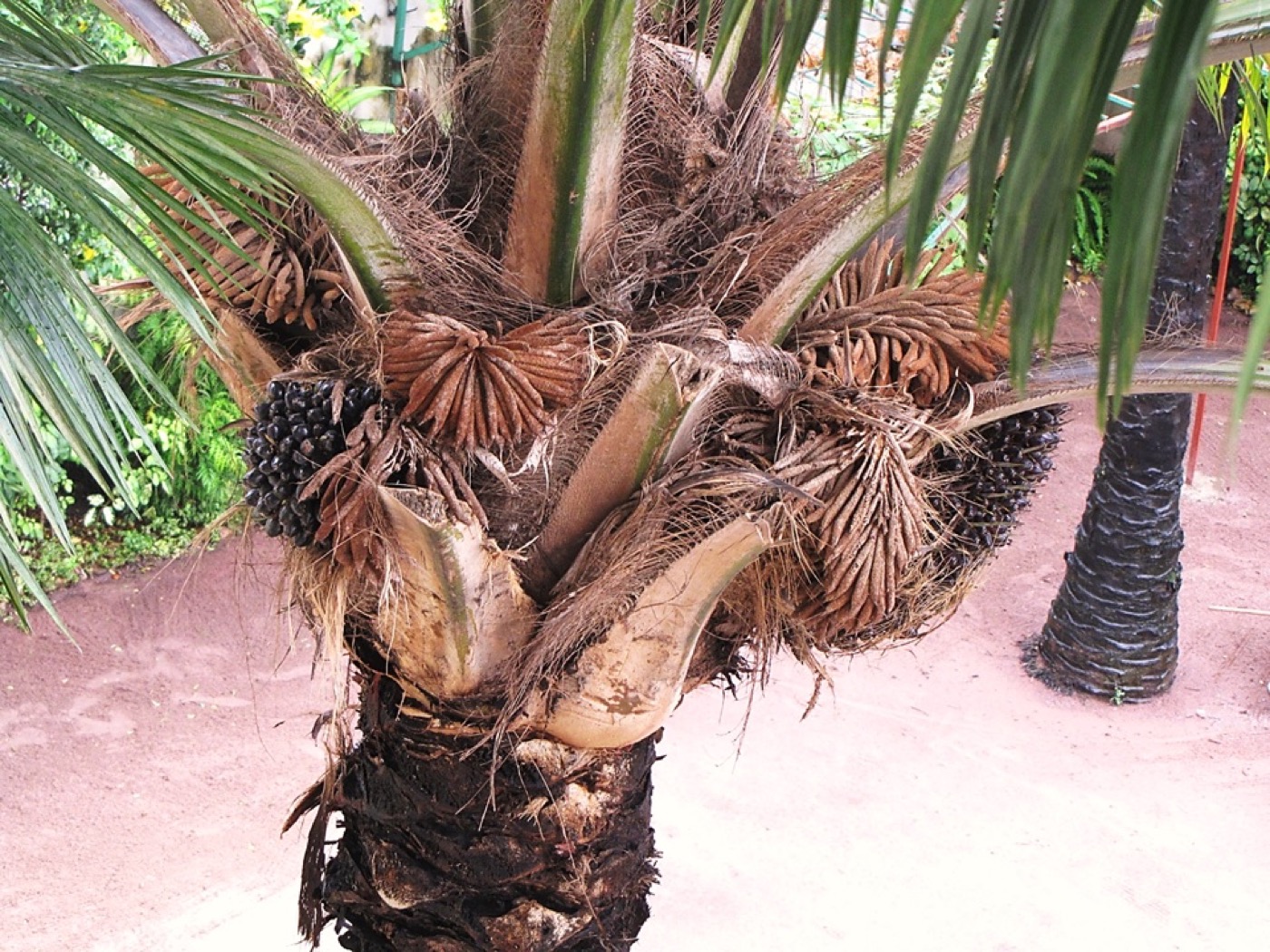
Photo: T.K. Naliaka, CC BY-SA 4.0 (Wikimedia Commons)
Oil palm produces far more oil from a single hectare of land than any other major oil crop grown anywhere in the world, and that one real, well-documented fact is the honest reason behind almost everything else this guide covers, good and difficult alike. Published 2016 figures put palm oil yield at approximately 4.17 tonnes of oil per hectare, against approximately 0.56 tonnes per hectare for sunflower, 0.39 tonnes per hectare for soybean and roughly 0.16 tonnes per hectare for groundnut -- commonly summarised as oil palm needing only around a ninth of the land soybean, sunflower or rapeseed would need to produce the same amount of oil (globalImportance). That real land efficiency, not marketing, is why palm oil has become the world's most widely produced vegetable oil, and why millions of smallholder families across West and Central Africa, Southeast Asia and Latin America now depend on this one crop for real cash income. Laisha's own curated crop-priority research independently finds oil palm ranked among the top ten crops grown in 27 of the world's 195 countries, and the single biggest crop of all in four of them: Gabon, Indonesia, Malaysia and Papua New Guinea. This guide states just as plainly, and just as early, the real other half of oil palm's global story: its own rapid expansion, especially across Indonesia and Malaysia, carries a well-documented, widely reported connection to tropical deforestation, peatland conversion and biodiversity loss, including habitat loss for the critically endangered Sumatran orangutan, and a real, growing sustainability certification response through schemes such as the Roundtable on Sustainable Palm Oil (RSPO) that this guide covers honestly in globalImportance rather than leaving out. A farming guide that told only the yield story, or only the deforestation story, would not be telling this crop's real story -- this one tells both, in proportion, the same honest standard this library's own cocoa guide holds to for that crop's own documented child-labour economics. As with every crop in this library, any agrochemical used on this crop must be handled exactly according to this guide's own chemicalSafetyRule below, bought only from a licensed dealer, and never guessed at from a name half-remembered from a neighbour.
Global Importance
Oil palm is grown overwhelmingly within roughly ten degrees of the equator, and one country alone -- Indonesia -- now grows well over half the entire world's supply. Its real global importance genuinely runs two directions at once: it is the world's single most land-efficient source of vegetable oil, and it is also the crop most frequently and most credibly linked to modern tropical deforestation. This guide states both honestly, in the same section, rather than separating the good news from the hard news.
Market Segments
One fresh fruit bunch genuinely feeds two separate real oil markets at once, from two different parts of the same fruit, and a third real market sits alongside them built specifically on how, not just what, the crop is grown. Understanding honestly which of these you are actually selling into shapes almost every later decision in this guide.
Growth Habit
Three real, foundational facts decide almost everything else an oil palm grower does: it is a monocot palm with exactly one growing point for its whole life, not a branching tree; the real dura, pisifera and tenera fruit genetics (botanicalIdentity) decide oil yield more than almost any later management choice; and, distinctively for this crop, a tiny African weevil genuinely pollinates most of the world's commercial oil palm today, a real, documented biological-control success story most growers of this crop have never been told in full.
Growing Oil palm, Stage by Stage
- 1. Choose land, climate, title and site — Confirm your own real climate genuinely suits oil palm, confirm real, clear land title before a single pit is dug, and lay out spacing to match your chosen planting material -- because, as with this library's own coconut guide, several of this stage's decisions cannot be corrected once palms are years into the ground.
- 2. Choose genuine, certified planting material — Buy only genuine, certified tenera seed from a known dura times pisifera cross, from a registered source -- because, as this guide's own botanicalIdentity explains, this single choice can change your own eventual oil yield by 30 percent or more, decades before it shows up in a harvest.
- 3. Nursery -- pre-nursery and main nursery — Raise germinated seed through a real, two-stage nursery -- a short pre-nursery, then a longer main nursery -- grading honestly for vigour before any seedling ever reaches the field, the same disciplined culling this library's own coconut guide teaches for its own nursery stage.
- 4. Field planting and establishment — Plant the selected seedling into its prepared pit at the start of a reliable rainy season, at the right depth, and protect it through its first fragile months, since the palm's whole later health traces back to how carefully this one transplant is done.
- 5. The juvenile years -- cover crop and a young palm that gives you nothing yet — Use the genuinely real wait before first bearing productively: establish and maintain a leguminous cover crop across the open ground, and consider a genuine food-crop intercrop for real income while the young planting establishes, since a straight three to four years of real cost with zero oil palm income is this crop's own single hardest honest fact for a smallholder family.
- 6. Early bearing -- flowering and how the flowers actually get fertilised — Recognise the palm's first real flower spike, understand honestly how the flowers actually get fertilised -- overwhelmingly through a tiny introduced weevil across most of the world today -- and expect early yields to build gradually rather than arrive all at once.
- 7. Feed the palm -- nitrogen, and the potassium this crop is genuinely hungry for — Oil palm is fed per palm, not per hectare, and it is genuinely one of the more potassium-hungry crops in this library -- published recommendations commonly dose potassium at roughly twice nitrogen or more on a weight basis for a mature bearing palm.
- 8. Water — A mature oil palm tolerates real short dry spells, but this crop's own real water need is genuinely higher and less forgiving than several other tropical crops in this library, and a young, non-bearing palm is considerably more drought-vulnerable than a mature one.
- 9. Weeds, cover crop maintenance and frond pruning — Keep a clean, weeded circle immediately around each palm while maintaining a genuine leguminous cover crop across the wider inter-row space, and prune old fronds on a real, regular schedule -- both routine jobs that protect real yield far more than their unglamorous, repetitive nature suggests.
- 10. Insect pests, stage by stage — Bagworms and nettle caterpillars do most of this crop's real leaf-eating damage, capable of stripping a palm's whole canopy in a bad outbreak, while the rhinoceros beetle -- a real, shared pest with this library's own coconut guide -- attacks the crown of young palms specifically.
- 11. Diseases, stage by stage — Ganoderma basal stem rot is oil palm's own single most economically serious disease across Southeast Asia, a real, slow, usually fatal fungal rot with no cure, alongside bud rot's own real, documented history of destroying tens of thousands of hectares in Latin America.
- 12. Harvest -- sickle, chisel, pole knife and the real 24-hour clock — Oil palm fruits continuously rather than in one seasonal flush, so harvesting is a repeating round every 7 to 10 days rather than a single annual event -- and once a bunch is cut, a real, unforgiving clock starts running that this guide will not understate.
- 13. The collection point -- do not store cut bunches, keep them moving to the mill — This crop breaks a rule almost every other guide in this library teaches: fresh fruit bunches are never genuinely stored the way grain or root crops are, because real oil quality falls with every passing hour, not every passing season, so this stage is honestly about a short, fast staging point, not a store.
- 14. Senescence and the replanting decision — Even a well-managed palm's yield eventually declines with genuine age, and, distinctively for this crop, replanting is driven at least as much by real, practical harvest height as by declining fruit production -- a real, staggered, decades-long planning problem this guide states plainly rather than reducing to a single fixed number.
Fertiliser Programme
Oil palm is genuinely one of the more nutrient-hungry crops in this library relative to its own growing area, and it is fed per palm, not per hectare -- the same real convention this library's own coconut guide describes for its own crop, for a related reason: both are widely spaced individual palms rather than a dense field stand.
Common Problems & Troubleshooting
If you see: A general, progressive decline that is genuinely easy to mistake for old age or poor nutrition at first -- reduced frond production, yellowing and premature drying of older, lower fronds, dropping bunch production, and, in advanced cases, visible rot at the trunk base or real bracket-shaped fungal fruiting bodies growing directly from it.
It likely means: Ganoderma basal stem rot, caused mainly by the fungus Ganoderma boninense -- this crop's own single most economically damaging disease across Malaysia and Indonesia, with a real, documented history of infecting an area equivalent to more than 65 million mature palms in Malaysia alone by 2020.
Do this: Confirm early where possible, since there is no cure once rot has progressed far into the trunk.
If you see: The spear leaf -- the newest, still-unopened leaf at the crown's centre -- wilting, yellowing or browning, and pulling out easily by hand, often with a foul smell of decay at its base.
It likely means: Bud rot, caused by the fungus Phytophthora palmivora, a real, documented disease that has destroyed more than 70,000 hectares of oil palm in Colombia's own recent epidemics, with localised outbreaks first recorded there as early as 1964. Because oil palm has no side branch and no second growing point, this disease reaching the crown's single meristem kills the whole palm outright.
Do this: Where caught genuinely early, remove and destroy the infected spear leaf and surrounding rotten tissue, then protect the wound from rain and further infection.
If you see: A real, ragged or skeletonised feeding pattern on frond leaflets, with the leaf's tougher veins left behind, and either small, spindle-shaped silk bags hanging from leaflets or flattened, often brightly coloured caterpillars visible on the frond itself.
It likely means: Bagworm (most significantly Metisa plana) or nettle caterpillar defoliation, two real, significant leaf-eating pest groups of oil palm. Nettle caterpillars additionally carry genuinely stinging hairs, a real direct skin-irritation hazard to anyone handling affected fronds.
Do this: Scout regularly for early signs rather than waiting for visible bare canopy.
If you see: A distinctive V-shaped or triangular cut pattern in unopened fronds, becoming a row of neat holes once the leaf later unfurls, most significantly on a young, juvenile palm.
It likely means: Rhinoceros beetle (Oryctes rhinoceros), a real, shared pest of both oil palm and this library's own coconut guide's crop, boring into the crown to feed on soft, unopened tissue.
Do this: Clear old stumps, decaying trunk material and old empty fruit bunch piles from the planting, since the beetle breeds in decaying organic matter, not the living palm itself.
If you see: A distinctive orange-yellow discolouration on older, lower fronds specifically, while younger fronds stay green.
It likely means: Magnesium deficiency, a real, common nutrient shortage on this crop, genuinely reducing bunch production if left uncorrected.
Do this: Apply magnesium fertiliser, commonly kieserite, at a rate matched to your own planting's current yield level (fertiliserProgramme).
If you see: Bunches with many unfertilised, shrivelled florets rather than a densely packed bunch of full, developed fruit.
It likely means: Poor pollination, most commonly because the pollinating weevil Elaeidobius kamerunicus is not yet established in your area, or because you are growing an OxG hybrid whose own natural fruit set is genuinely poorer regardless of weevil presence (growthHabitAndMethod).
Do this: Confirm honestly whether the pollinating weevil is established locally by asking your national palm oil board or extension service.
If you see: Fresh fruit bunches showing a strong, fermented or rancid smell, excessive loose fruit already rotting, or a mill grading and paying less than expected for a bunch that looked properly ripe when cut.
It likely means: Free fatty acid buildup from delayed or rough handling after cutting -- a real, fast-moving quality problem, not a field problem, since FFA content has been measured rising rapidly within minutes of bruising and climbing further the longer a cut bunch sits before milling.
Do this: Move cut bunches and loose fruit to the mill within roughly 24 hours of cutting, no exceptions where this is genuinely within your control.
Real Farm Economics
Oil palm's real economics carry a genuine, worldwide dual structure worth stating plainly: a large share of world production comes from real smallholder farmers, particularly across Indonesia, Malaysia and West Africa, standing alongside large plantation companies on the very same commodity market -- and both share the same real, multi-year establishment cost before a single tonne is sold.
Yield & Market Value
Growing the crop is only part of the job. The last part is knowing what a normal harvest looks like, and knowing what your fresh fruit bunches are actually worth before you agree a price with anybody -- and for this specific crop, this guide has good, honest news with one important real caveat: palm oil is one of the ten crops Laisha's own live Global Commodity Price service tracks directly, but that live price is for processed crude palm oil, not for the fresh fruit bunches almost every smallholder grower actually sells.
Remember It This Way
If you forget every other page of this guide, keep these lines. They are the whole crop, in order, short enough to carry in your head.
- One fruit, two real oils -- flesh for cooking, kernel for soap.
- Nine times less land than soybean for the same oil -- and a real forest cost too.
- A thick shell or a thin one, decided long before the seed is planted.
- Years of waiting, then decades of giving -- plant it for your grandchildren, not this season.
- A tiny weevil from Cameroon feeds the whole world's harvest now.
- Feed potassium first here, not nitrogen -- this crop's own hunger runs backwards.
- Cut it, then race it -- a bunch left a day too long is worth less every hour.
- One growing point, and no second chance -- a rotten bud kills the whole palm.
- Grown fast, but never forget what fast growth has genuinely cost some forests.
Test Yourself: Identification
What palm is this, with clusters of large, reddish-orange fruit bunches held against the trunk beneath the crown?
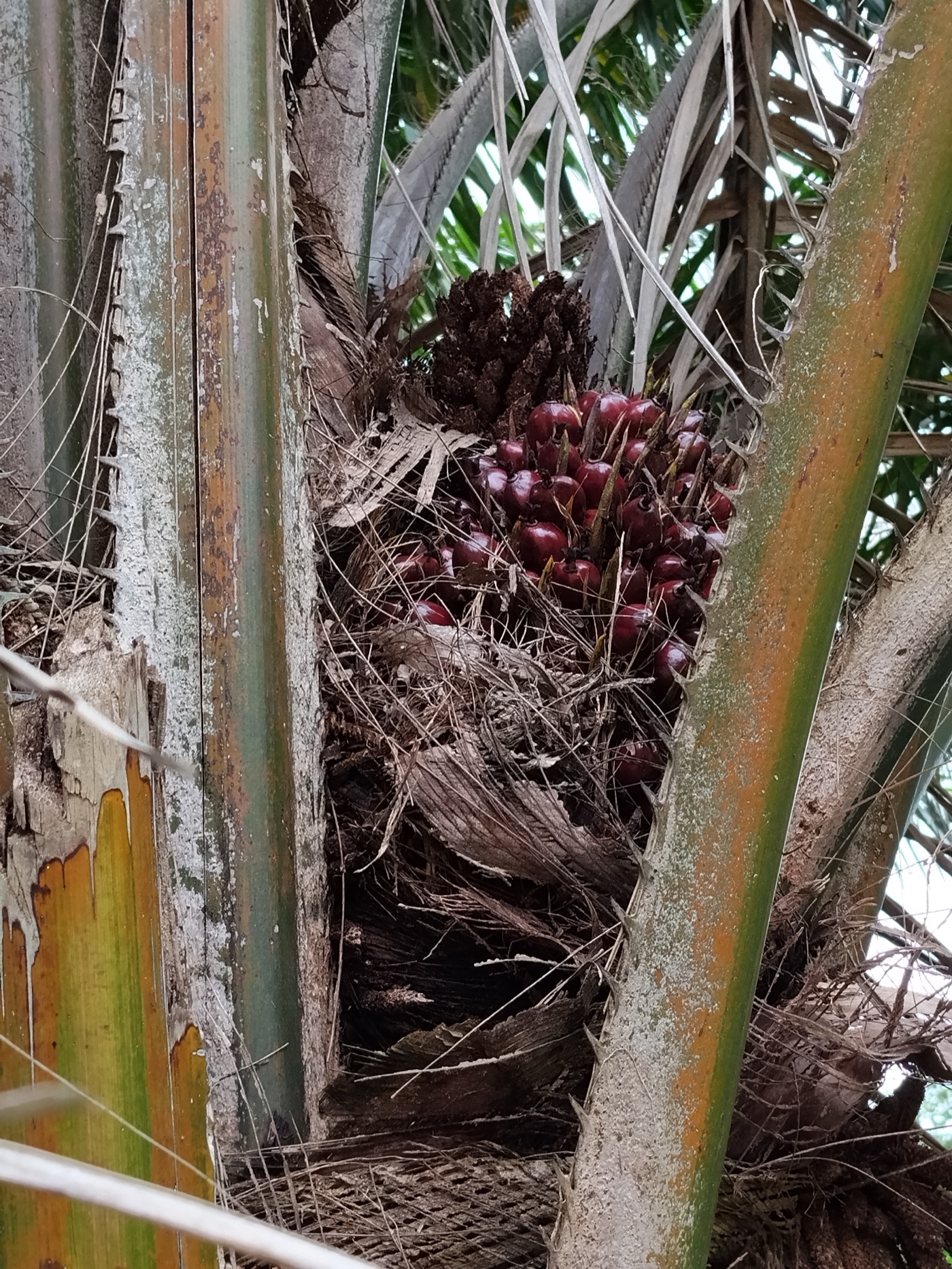
What is this large, dense cluster of small, reddish-orange fruit, freshly cut and ready for the mill?
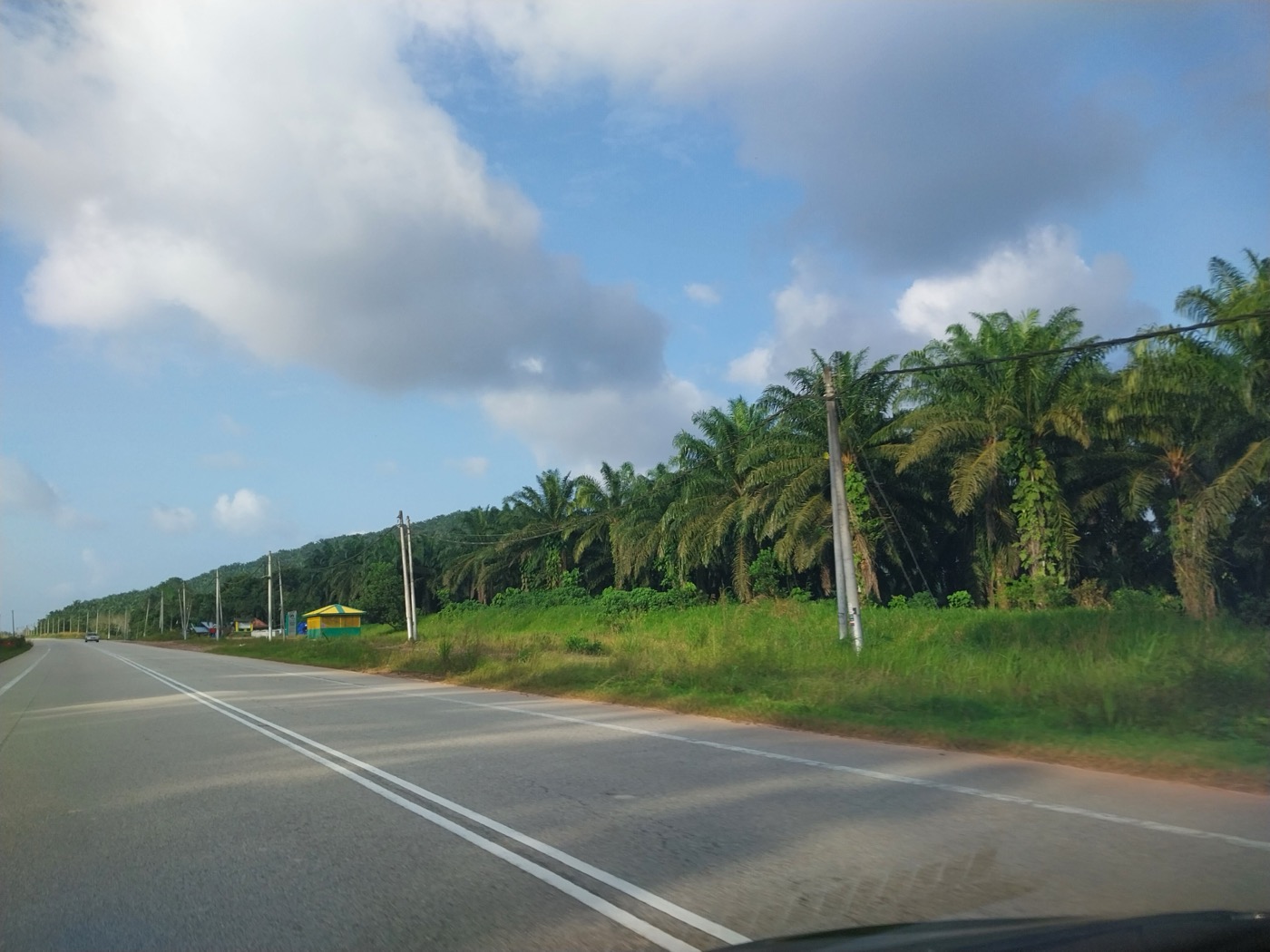
What kind of planting is this, with palms of consistent height planted in regular rows across open, cleared land?
Honest Limits of This Guide
- This guide's own world production and country-share figures for palm oil (globalImportance) describe the processed oil, compiled from a secondary source (Wikipedia's own maintained 'Palm oil' article), not a single live FAOSTAT fresh-fruit-bunch figure this session queried directly -- and this guide states plainly that fresh fruit bunch tonnage and oil tonnage are two genuinely different real figures, not interchangeable (yieldAndMarketValue).
- This guide does not print one single, unified per-hectare fresh-fruit-bunch yield figure for oil palm, because real yield varies by several times over between a large, well-managed commercial estate and a smallholder plot with limited fertiliser access -- averaging them into one number would honestly mislead more than it would inform (yieldAndMarketValue).
- No single, published per-hectare cost-of-production and returns dataset covering land preparation, nursery, labour and the full multi-year establishment period was found this session that honestly applies across this crop's genuinely different real smallholder and estate production systems, the same real, honest gap this library's own millet and cocoa guides record for their own crops (farmEconomics).
- This guide's own deforestation, peatland and biodiversity figures (globalImportance) are real, published figures from specific studies and specific years -- a 2019 Indonesian fire figure, a Cameroon ecosystem-quality study, a 2017 Indonesian land-dispute count -- and this guide does not claim they apply identically to every one of the 27 countries on its own top-ten-crop list, particularly the many West and Central African and Latin American countries on that list whose own production and land-use history genuinely differs from Indonesia and Malaysia's.
- This guide does not name any pesticide, fungicide or herbicide product or compound. It names mode-of-action groups and the toxicity colour-band principle only. If you decide to use a product, buy only from a licensed dealer and follow the label on the actual package.
- The toxicity colour band is a principle, not a fixed chemical-to-colour list. The same active substance can sit in a different band in a different formulation or country, and registrations change. Read the actual triangle on the actual package.
- This guide does not carry a real, published international seed-law-style certification standard for oil palm the way several major grain crops in this library describe. What genuinely exists instead -- national research institute breeding and certification programmes -- is named honestly in seedGradingAndCertification rather than overstated as formal law.
- This guide's own fertiliser figures (fertiliserProgramme) are drawn from published agronomic guidance rather than one single official national institute's own current recommendation table the way this library's own coconut guide could cite for CPCRI specifically -- real local recommendations genuinely vary by soil type and should be checked with your own national palm oil board or extension service.
- RSPO certification figures in this guide (globalImportance) describe RSPO's own reported 2024 member and certified-production share of the whole world market, not a claim about what share of any single country's own smallholders are certified -- certification density genuinely varies enormously by country and by scheme.
- This guide's own Elaeis oleifera and OxG hybrid coverage in botanicalIdentity focuses specifically on Latin America, where bud rot has driven real, documented OxG adoption since 2007 -- this guide does not claim OxG hybrids are common or necessary in Southeast Asia or Africa, where bud rot is genuinely not the same significant, established risk.
- This guide's real timing figures -- the 3-to-4-year establishment period, the flowering/early-bunch-development window, and the 7-to-14-day harvest cycle -- are given as real, published ranges rather than a fixed calendar, because oil palm's actual rhythm genuinely shifts by region, rainfall pattern and planting material: a grower should time irrigation, harvest rounds and the water-stress watch points in this guide against their own real local rainfall season and their own palms' own observed bearing pattern, not against a month number copied from a different climate.
Related Laisha Tools
- Global Market Price Outlook — Check today's price and trend
- Crop Calendar — Build a season-long sowing plan
- Pest & Disease Intelligence — Risk reasoning and a global pest & disease library
- Crop Health — Photo-based first read on a field problem
- Soil Health — Track soil test results across seasons
Open the free Applied Agriculture Library in the Laisha app →
Sources
- GBIF Backbone Taxonomy species-match record for Elaeis guineensis Jacq. (usage key 2731882) — Global Biodiversity Information Facility (GBIF), Copenhagen (source)
- World Checklist of Vascular Plants (WCVP) record for Elaeis guineensis Jacq., queried live through GBIF's own hosted copy of the checklist — Royal Botanic Gardens, Kew, hosted via GBIF (dataset f382f0ce-323a-4091-bb9f-add557f3a9a2) (source)
- GBIF Backbone Taxonomy species-match record for Elaeis oleifera (Kunth) Cortés (usage key 8791596) — Global Biodiversity Information Facility (GBIF), Copenhagen (source)
- World Checklist of Vascular Plants (WCVP) record for Elaeis oleifera (Kunth) Cortés, queried live through GBIF's own hosted copy of the checklist — Royal Botanic Gardens, Kew, hosted via GBIF (dataset f382f0ce-323a-4091-bb9f-add557f3a9a2) (source)
- Elaeis -- overview article — Wikipedia, citing a range of primary botanical and agronomic sources (source)
- Palm oil -- overview article — Wikipedia, citing FAOSTAT, industry, trade and academic sources (source)
- Laisha Global Crop Priority Research -- Oil palm entry — Laisha internal curated research (backend/database/globalCropPriorityResearch.json) (source)
- ACOP 2024: RSPO Market Trends Resilient Despite Global Challenges — Roundtable on Sustainable Palm Oil (RSPO) (source)
- Beyond four decades of Elaeidobius kamerunicus Faust (Coleoptera: Curculionidae) in the Malaysian oil palm industry: a review — Journal of Tropical Ecology, Cambridge University Press (source)
- Role of Pollinating Weevil (Elaeidobius kamerunicus), Seasonal Effect and Its Relation to Fruit Set in Oil Palm Area of FELDA Sahabat — Academia.edu / ResearchGate compiled agronomic study (source)
- Nursery practices in oil palm agronomy (compiled from multiple published nursery manuals, including CABI's 'Nursery Practices in Oil Palm: A Manual' and USAID/PROSPER Liberia smallholder nursery guidance) — Compiled from CABI Digital Library, USAID PROSPER Liberia and ASD Costa Rica nursery manuals (source)
- Oil palm field establishment, bearing and replanting agronomy (compiled from multiple published grower and industry sources, including Musim Mas's 'From Seed to Harvest' guide and M.P. Evans' 'Palm life cycle' reference) — Compiled from Musim Mas, M.P. Evans, EOS agronomy resources and academic replanting-ecology research (source)
- Oil palm mature-palm fertiliser recommendations (compiled from multiple published agronomic sources, including ICL Growing Solutions, the Smallholder Oil Palm Handbook, Akvopedia and K+S potassium/magnesium nutrition guidance) — Compiled from ICL, Wageningen University Smallholder Oil Palm Handbook, Akvopedia and K+S Minerals and Agriculture (source)
- Basal Stem Rot of Oil Palm: The Pathogen, Disease Incidence, and Control Methods, and Estimating the economic damage and treatment cost of basal stem rot striking the Malaysian oil palms (compiled) — APS Journals (Plant Disease) and ScienceDirect economic-impact research, compiled (source)
- Bud Rot Caused by Phytophthora palmivora: A Destructive Emerging Disease of Oil Palm — Phytopathology (APS Journals) (source)
- Response of various oil palm materials (Elaeis guineensis and Elaeis oleifera x Elaeis guineensis interspecific hybrids) to bud rot disease in the southwestern oil palm-growing area of Colombia — ResearchGate-hosted agronomic study (source)
- The Developmental Transcriptome of Bagworm, Metisa plana (Lepidoptera: Psychidae) and Insights into Chitin Biosynthesis Genes — Genes journal (MDPI), and general compiled oil palm bagworm/nettle-caterpillar pest literature (source)
- Oryctes rhinoceros pest biology, breeding-site ecology and biocontrol review (compiled, shared with this library's own coconut guide) — Compiled from published entomological and biocontrol literature (source)
- Study on Handing Process and Quality Degradation of Oil Palm Fresh Fruit Bunches (FFB), and Free Fatty Acid Formation Points in Palm Oil Processing and the Impact on Oil Quality — ResearchGate / MDPI Agriculture journal, compiled (source)
- National oil palm breeding and certified seed systems (compiled, including Indonesian Oil Palm Research Institute and Malaysian Palm Oil Board seed-certification practice) — Compiled from national palm oil research institute public guidance (source)
- Global Market Report: Palm Oil Prices and Sustainability, and compiled smallholder production-share research — International Institute for Sustainable Development (IISD) and compiled academic smallholder-palm-oil research (source)
- Laisha's own agrochemical safety reference: mode-of-action grouping and the India colour-band toxicity principle — Laisha internal curated reference, built from the Insecticides Act 1968 / Insecticide Rules 1971 (India) and IRAC/FRAC/HRAC mode-of-action classification systems (source)