Olea europaea · Also called: olive tree, common olive, olivo, olivier, Ölbaum, Olivenbaum, olijfboom, ulivo
Photo: Isiwal, CC BY-SA 4.0 (Wikimedia Commons)
Olive is a genuine Mediterranean staple tree crop, feeding two real, separate global industries at once -- olive oil and table olives -- across a belt that now reaches well beyond its own ancient homeland. A live-checked secondary compilation citing FAOSTAT records approximately 19,267,000 tonnes of world production in 2016, and by 2024, 58 countries across five continents maintained commercial olive groves covering approximately 11.6 million hectares. Laisha's own curated crop-priority research finds olive among the top ten crops grown in 20 of the world's 195 countries -- and, distinctively among this library's own tree-crop guides, olive genuinely IS the single biggest crop of all in 8 of those 20 countries: Greece, Jordan, Lebanon, Libya, Portugal, Spain, State of Palestine and Tunisia (globalImportance). Unlike almost every other crop in this library, a well-managed olive tree can remain productive for centuries, scientifically confirmed by tree-ring and radiocarbon dating to reach real ages of 300 to 500 years. It also carries a real, ongoing global crisis worth naming here rather than only deep in troubleshooting: Xylella fastidiosa, a bacterium with no known cure, had infected up to a million olive trees in Italy's Apulia region alone by 2015 and has since spread to France, Spain, Portugal and Israel (growthHabitAndMethod, troubleshooting). As with every crop in this library, any agrochemical used on this crop must be handled exactly according to this guide's own chemicalSafetyRule below, bought only from a licensed dealer, and never guessed at from a name half-remembered from a neighbour.
Global Importance
Olive is grown overwhelmingly across the Mediterranean basin and the Middle East, and this guide states honestly, up front, that the two real world figures it quotes below come from two genuinely different years, because that is honestly what a live check of the best available published sources this session actually returned.
Market Segments
One olive harvest genuinely feeds two real, separate major markets at once, and a smaller handful of real by-product markets besides, and each one judges the same fruit on something completely different -- one on how well it presses, the other on how well it cures.
Growth Habit
Three real, foundational facts decide almost everything else an olive grower does: it is a genuinely ancient, extraordinarily long-lived evergreen tree, not a fast-turnover crop; almost every commercial tree is grown from a rooted cutting or a graft of a known variety rather than from its own seed, and needs a real second, different variety planted nearby to fruit well; and, distinctively for this crop right now, one real, incurable bacterial disease shapes almost every serious modern planting decision in parts of the Mediterranean.
Growing Olive, Stage by Stage
1. Choose land, climate and site — Confirm your own real climate is genuinely Mediterranean in character, hot and sunny with a distinct cooler season, and choose land with real drainage, because both decisions are far harder to correct once a tree is decades into the ground.
2. Choose your planting material -- real rooted cuttings or grafted saplings of two varieties — Buy only real, rooted cuttings or grafted saplings of known, named varieties from a real, checkable nursery, and choose at least two genuinely compatible varieties, never a seed.
3. Plant the tree — Plant at the right depth, at the start of your local mild season, and protect the young tree through its first fragile months.
4. The juvenile years -- formative pruning and a tree that gives you nothing yet — Use the real wait before first bearing productively: shape the young tree's branches while they are still small, and consider a real intercrop for real income while it establishes.
5. Water — A young tree needs real, regular water to establish. A mature tree genuinely tolerates drought far better than most fruit trees in this library, but still needs real moisture through flowering and fruit development.
6. Weed the base and feed the tree — Keep the ground under the canopy clear of weeds, and feed an olive tree lightly while young, rising as it ages, adjusting to what your own tree and leaves actually show rather than a single fixed number.
7. Flowering and fruit set — Recognise the real flowering window, understand honestly that the wind, not an insect, carries this crop's own pollen, and know why a second variety nearby matters so much.
8. Manage the bearing tree -- pruning for a productive, long-lived canopy — Prune to keep the canopy open, manageable and productive for decades, and check for disease symptoms and fresh wounds every time you are in the grove.
9. Watch for Xylella and stop the other pests and diseases getting in — One real disease matters more than everything else in this crop right now. The rest are far easier to keep out or catch early than to clear once established.
10. Know when to harvest — Decide harvest timing by your own real target market, not by one fixed rule, since green, turning-colour and fully black fruit are all genuinely harvested on purpose, for different real products.
11. Harvest and handle carefully — Pick by hand where fruit quality matters most, or by shaking and netting at real commercial scale, and handle every fruit gently either way, since a bruise made at harvest shows up later as a real quality loss.
12. Cure it, or press it -- raw olives are never food — This is the single most important stage this guide can teach a new olive grower: the fruit you just picked is not edible yet, whichever real product you are making from it.
13. Grade, store and sell it — Know which real market you are selling into before you agree a price, since oil and table olives are judged, graded and stored in genuinely different ways.
Fertiliser Programme
Olive is fed lightly while young, rising gradually as the tree ages, timed around flowering and fruit development rather than spread evenly through the year -- this guide states honestly that no single universal national schedule with exact kilogram doses, comparable to this library's own citrus and mango guidance, could be independently confirmed live this session for olive (honestLimits).
Common Problems & Troubleshooting
If you see: Sudden withering and drying of the leafy tips of branches, starting patchily in one part of the canopy and spreading until the whole tree looks scorched and collapses, on a tree that is not actually short of water.
It likely means: Xylella fastidiosa subspecies pauca, the bacterium behind Olive Quick Decline Syndrome, spread mainly by xylem-feeding spittlebugs, most importantly the meadow spittlebug (Philaenus spumarius) -- this crop's own single most economically destructive disease worldwide, with no known cure.
Do this: Confirm the diagnosis with your local plant health authority immediately, since this is a quarantine pathogen in many countries and early confirmation is the only real tool that limits its spread.
If you see: A small hole with brown staining in the skin of a ripening fruit, or a soft, tunnelled fruit that drops early, sometimes with a small white to yellow maggot visible inside when cut open.
It likely means: Olive fruit fly (Bactrocera oleae), described by published extension research as the most serious pest of olives almost everywhere the crop is grown, laying its eggs only in fruit that has already reached a real minimum size.
Do this: Hang monitoring traps mid-canopy in the shade to track real, local fly numbers before deciding whether to act at all.
If you see: Round, black or dark olive-green spots, commonly 3 to 12 millimetres across and often ringed with a yellow halo, scattered across the upper surface of older leaves, worst after a wet autumn or winter.
It likely means: Peacock spot, caused by the fungus Spilocaea oleaginea, a real, common olive leaf disease that infects only after about 48 hours of continuous leaf wetness within a real, moderate temperature band.
Do this: Improve air movement through the canopy with real, regular pruning, since a dense, damp canopy holds the leaf wetness this fungus needs to infect.
If you see: Sudden wilting, yellowing and death of leaves and young shoots on one branch or one side of the tree first, while the rest of the canopy still looks healthy, with no sign of a chewing or boring pest.
It likely means: Verticillium wilt, a real, soil-borne fungal disease affecting more than 350 plant species with olive specifically named among the susceptible crops, blocking the tree's own internal water-carrying tissue from the roots upward.
Do this: Confirm with your local extension service, since these same symptoms can also come from root damage, waterlogging or drought stress.
If you see: Rough, woody, tumour-like swellings called knots or galls, from pea-sized to several centimetres across, on branches, twigs or the trunk, often starting at a pruning cut, a frost crack or another real wound.
It likely means: Olive knot, caused by the bacterium Pseudomonas savastanoi pv. savastanoi, published research names as the most economically significant bacterial disease of this specific tree, entering through wounds and using its own plant-hormone tricks to force the tree's tissue to swell.
Do this: Disinfect pruning tools between trees, especially after cutting a visibly infected branch, since contaminated tools are a real, common way this bacterium spreads.
If you see: Dark grey to brownish-black, dome-shaped bumps clustered along twigs and the underside of leaves, often sitting in a sticky coating with a real, sooty black mould growing on top of it.
It likely means: Black scale (Saissetia oleae), described by published research as one of the three main pest insects of this crop worldwide, sucking sap directly from the tree and excreting the sugary honeydew the sooty mould grows on.
Do this: Look for the real, natural enemies already at work first. A parasitic wasp introduced against this exact pest has dramatically cut its numbers in several regions.
Real Farm Economics
Olive's real economics carry a genuinely longer horizon than almost any other crop in this library: a multi-year wait before the first real harvest, followed by a tree that can go on earning for centuries, and, distinctively for this crop, a real, documented fraud risk sitting inside its own biggest market.
Yield & Market Value
Growing the crop is only part of the job. The last part is knowing what a normal harvest looks like, and knowing what your olive is actually worth before you agree a price with anybody -- and for this specific crop, this guide states a real, honest gap plainly: olive is not one of the crops Laisha's own live Global Commodity Price service currently tracks.
Remember It This Way
If you forget every other page of this guide, keep these lines. They are the whole crop, in order, short enough to carry in your head.
Root a cutting, or graft it. A seed alone gives a poor, unreliable tree.
Plant two real varieties, not one. The wind needs a second tree to carry pollen to.
This tree can outlive you. Choose the site and the variety like it matters.
Watch for shoot tips scorching on a tree that has plenty of water. That is the disease with no cure.
A raw olive is not food. Cure it, or press it, before anyone eats it.
Pick green for one product, black for another. Decide before you pick.
One tree, two real markets -- know whether you are feeding a press or a curing vat.
Real oil fraud is real money. Traceability back to your own grove is worth something.
Test Yourself: Identification
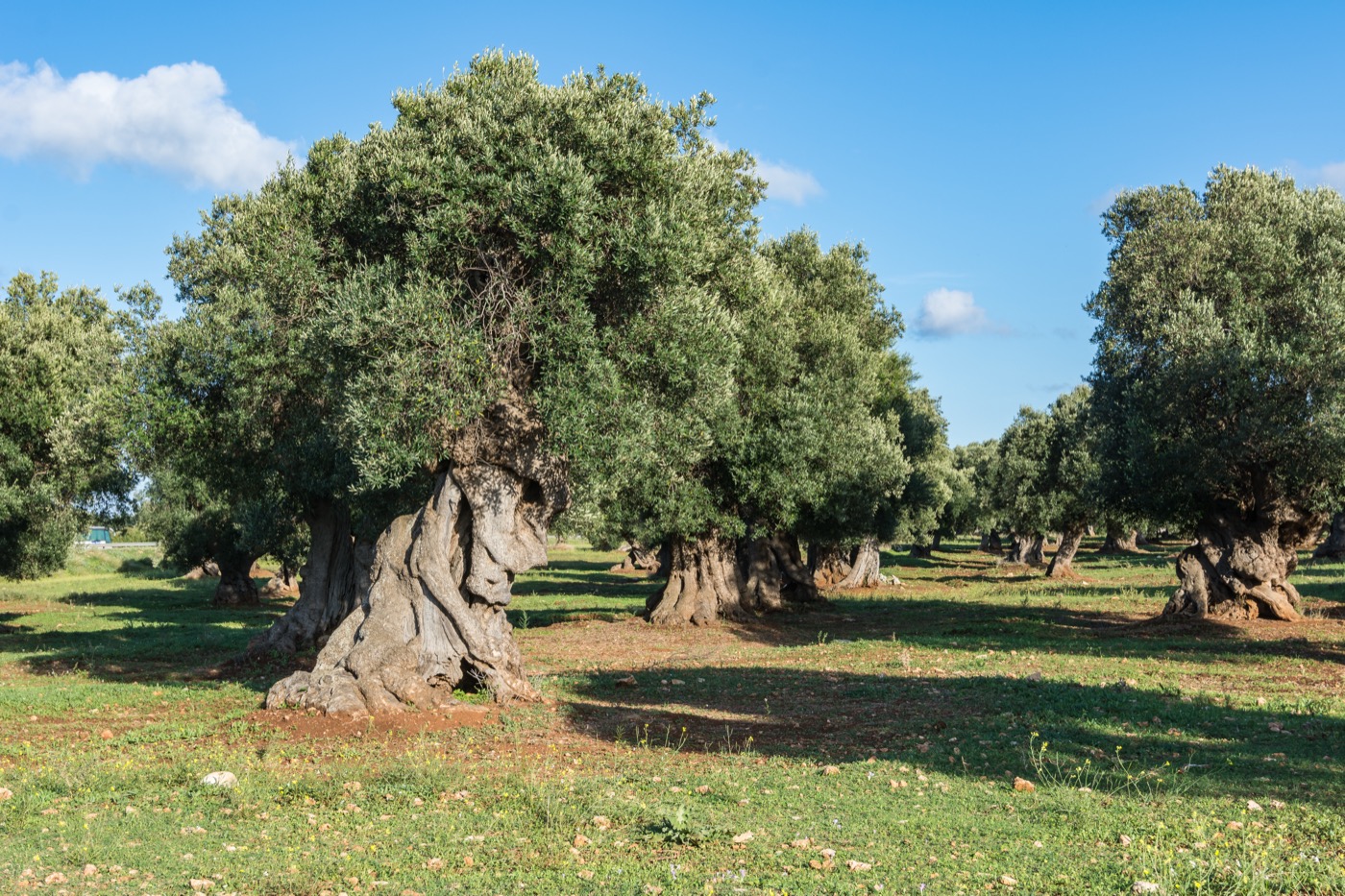
What crop is this, a moderate-sized evergreen tree with grey-green leaves growing in a planted grove on rocky, sun-baked ground?
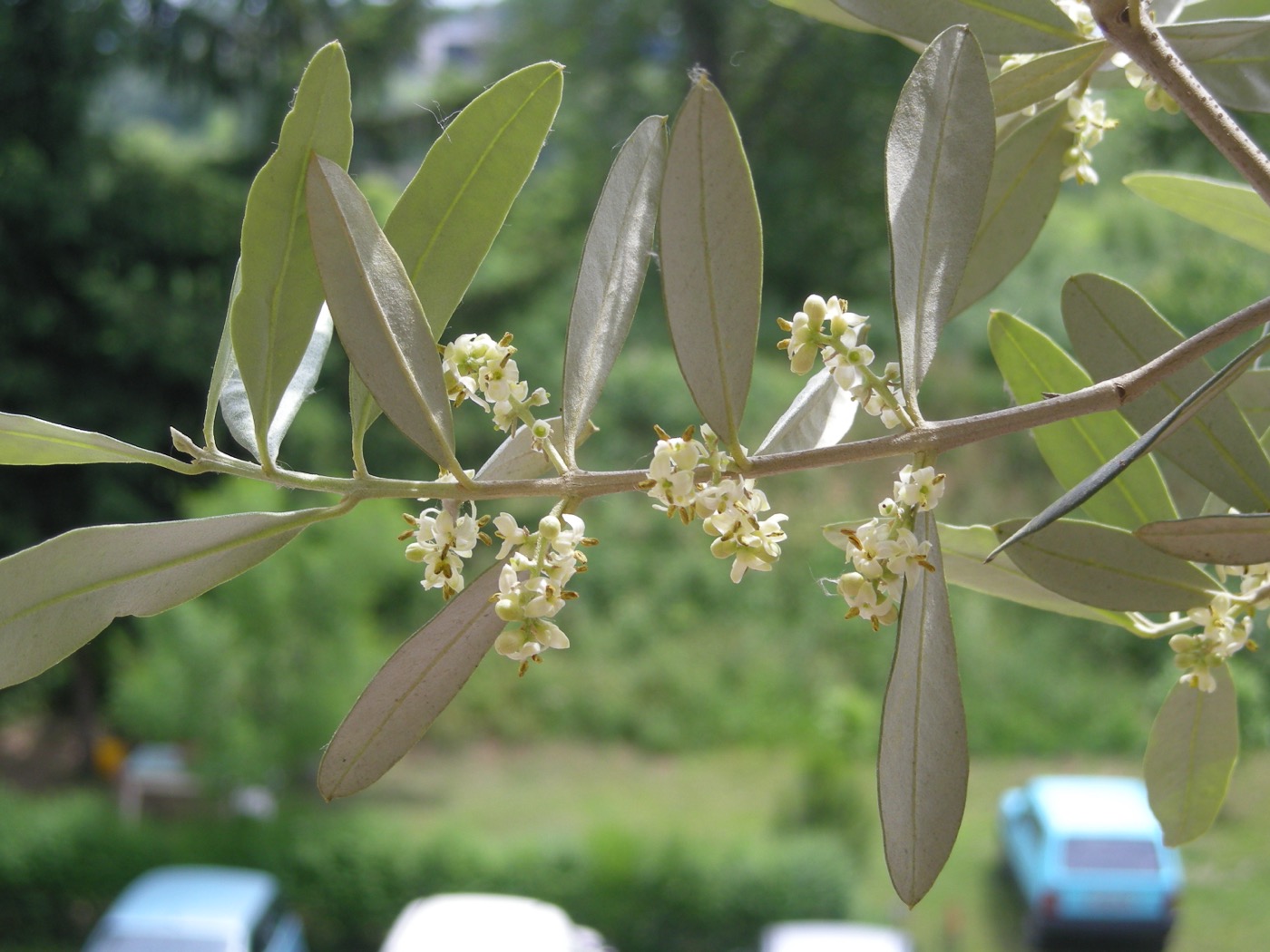
What is this small, cream-white flower growing in a branched cluster among grey-green leaves?
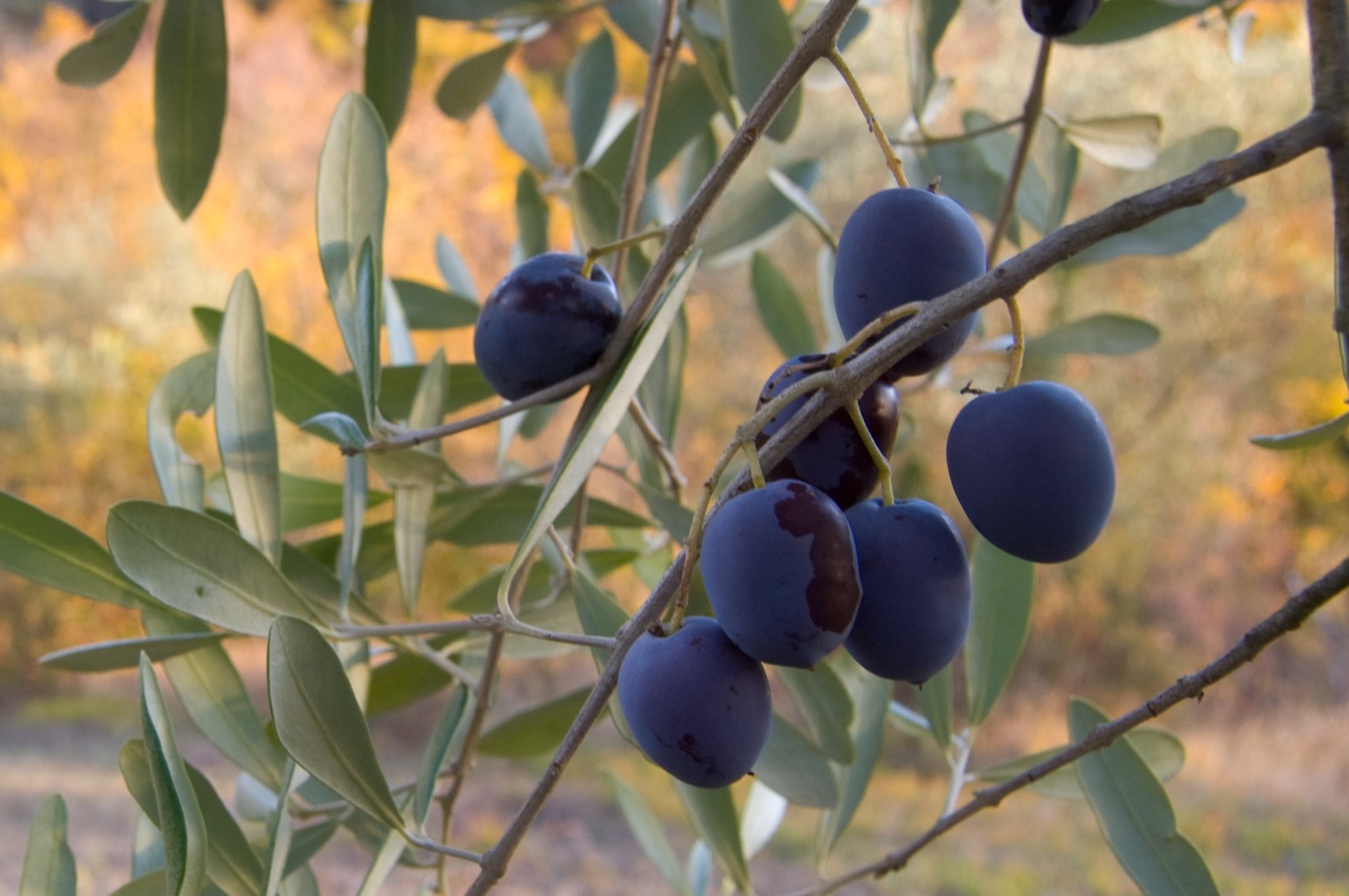
What are these small, oval green fruits still attached to the branch by a short stem, growing among narrow grey-green leaves?
Honest Limits of This Guide
This guide's own two real world figures (globalImportance) come from two genuinely different years -- 2016 for tonnage, 2024 for planted area -- because a live check this session found no single, more recent source giving both in the same year, and this guide states that honestly rather than blending them into one false current number.
No single, precise, universally-cited number of years from planting to first bearing could be independently confirmed live this session for olive, unlike the specific figures this library's own orange and mango guides carry (quickFacts, farmEconomics).
No single, universal national fertiliser schedule with exact kilogram doses by tree age, comparable to this library's own citrus and mango guidance, could be independently confirmed live this session for olive (fertiliserProgramme).
No single, universally applicable per-hectare or per-tree cost-of-production and returns dataset covering land preparation, planting material, fertiliser, pruning, harvest and curing or pressing was found this session that honestly applies across this crop's genuinely different real production systems worldwide, the same real, honest gap this library's own orange and mango guides record for their own crops (farmEconomics).
This guide does not name any pesticide, fungicide or herbicide product or compound. It names mode-of-action groups and the toxicity colour-band principle only. If you decide to use a product, buy only from a licensed dealer and follow the label on the actual package.
The toxicity colour band is a principle, not a fixed chemical-to-colour list. The same active substance can sit in a different band in a different formulation or country, and registrations change. Read the actual triangle on the actual package.
This guide's own seed and planting-material section (seedGradingAndCertification) names a real, honest gap rather than a single unified worldwide legal standard, because no such single standard for olive planting material was found this session, unlike the formal seed laws several grain and legume crops in this library carry.
No single, confirmed, quantified economic-loss figure for the Xylella fastidiosa outbreak in Italy's own olive groves could be independently confirmed live this session beyond the real, published tree-infection count quoted throughout this guide -- a grower should treat the true financial scale as genuinely severe but not printed here as an invented number.
This guide's own claimed olive-tree ages beyond 300 to 500 years (botanicalIdentity) are stated honestly as folk-claimed rather than scientifically confirmed by tree-ring or radiocarbon dating, since dating a genuinely ancient, often hollow-trunked olive is real and difficult, and this guide will not present an unconfirmed claim as a settled fact.
This guide's own real timing figures -- flowering and harvest windows -- are given as real, general seasonal shapes rather than a fixed calendar, because olive's actual rhythm genuinely shifts by region, variety and season: a grower should time flowering expectations and harvest against their own real local season, not against a month number copied from a different climate.
The rest of this Olive guide is inside Laisha
Every stage, the full fertiliser programme, the economics and the pest
diagnosis for Olive live in the app — alongside photo-based
diagnosis, live market prices, and an agronomist you can actually ask.
This guide's own two real world figures (globalImportance) come from two genuinely different years -- 2016 for tonnage, 2024 for planted area -- because a live check this session found no single, more recent source giving both in the same year, and this guide states that honestly rather than blending them into one false current number.
No single, precise, universally-cited number of years from planting to first bearing could be independently confirmed live this session for olive, unlike the specific figures this library's own orange and mango guides carry (quickFacts, farmEconomics).
No single, universal national fertiliser schedule with exact kilogram doses by tree age, comparable to this library's own citrus and mango guidance, could be independently confirmed live this session for olive (fertiliserProgramme).
No single, universally applicable per-hectare or per-tree cost-of-production and returns dataset covering land preparation, planting material, fertiliser, pruning, harvest and curing or pressing was found this session that honestly applies across this crop's genuinely different real production systems worldwide, the same real, honest gap this library's own orange and mango guides record for their own crops (farmEconomics).
This guide does not name any pesticide, fungicide or herbicide product or compound. It names mode-of-action groups and the toxicity colour-band principle only. If you decide to use a product, buy only from a licensed dealer and follow the label on the actual package.
The toxicity colour band is a principle, not a fixed chemical-to-colour list. The same active substance can sit in a different band in a different formulation or country, and registrations change. Read the actual triangle on the actual package.
This guide's own seed and planting-material section (seedGradingAndCertification) names a real, honest gap rather than a single unified worldwide legal standard, because no such single standard for olive planting material was found this session, unlike the formal seed laws several grain and legume crops in this library carry.
No single, confirmed, quantified economic-loss figure for the Xylella fastidiosa outbreak in Italy's own olive groves could be independently confirmed live this session beyond the real, published tree-infection count quoted throughout this guide -- a grower should treat the true financial scale as genuinely severe but not printed here as an invented number.
This guide's own claimed olive-tree ages beyond 300 to 500 years (botanicalIdentity) are stated honestly as folk-claimed rather than scientifically confirmed by tree-ring or radiocarbon dating, since dating a genuinely ancient, often hollow-trunked olive is real and difficult, and this guide will not present an unconfirmed claim as a settled fact.
This guide's own real timing figures -- flowering and harvest windows -- are given as real, general seasonal shapes rather than a fixed calendar, because olive's actual rhythm genuinely shifts by region, variety and season: a grower should time flowering expectations and harvest against their own real local season, not against a month number copied from a different climate.
Crop Health — Photo-based first read on a field problem
Soil Health — Track soil test results across seasons
Sources
GBIF Backbone Taxonomy species-match record for Olea europaea L. (usage key 5415040) — Global Biodiversity Information Facility (GBIF), Copenhagen (source)
World Checklist of Vascular Plants (WCVP) search results for Olea europaea, queried live through GBIF's own hosted copy of the checklist — Royal Botanic Gardens, Kew, hosted via GBIF (dataset f382f0ce-323a-4091-bb9f-add557f3a9a2) (source)
EPPO Global Database record for Olea europaea (EPPO code OLVEU) — European and Mediterranean Plant Protection Organization (EPPO) (source)
Olive (Olea europaea) — Wikipedia, citing FAOSTAT and other published sources (source)
Saissetia oleae (black scale) — Wikipedia (source)
The Olive Tree -- history and geographic spread of olive cultivation — International Olive Council (IOC) (source)
Laisha's own curated global crop build-priority research, built on FAOSTAT's own 'Olives' item category — Laisha (internal curated research, sourced from FAOSTAT QCL, area harvested averaged 2021-2023) (source)
Laisha's own curated agrochemical mode-of-action and hazard-band reference — Laisha (internal curated research) (source)
Laisha knows Olive better than this page can show.Photo diagnosis for pests and disease, live market prices, and an agronomist you can ask at two in the morning.Open Laisha
 Laisha
AI Operating System for Agriculture
Enter Laisha
Laisha
AI Operating System for Agriculture
Enter Laisha