How to Grow Sunflower
Helianthus annuus · Also called: sunflower, common sunflower, girasol, tournesol, Sonnenblume, zonnebloem, girasole, aycicegi
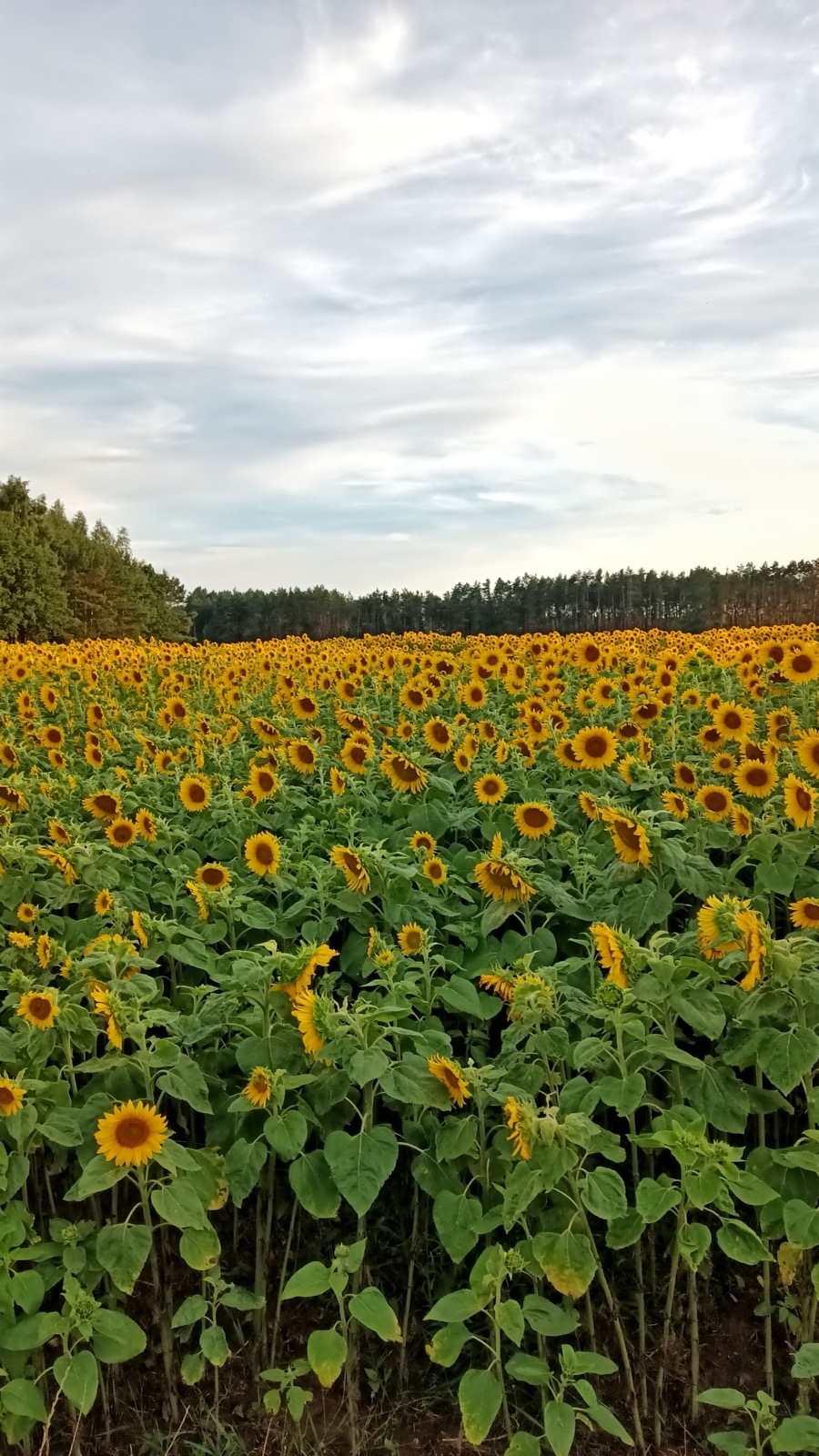
Photo: Fczarnowski, CC BY-SA 4.0 (Wikimedia Commons)
Sunflower is a real top-ten crop in 30 of the world's 195 countries, and the single biggest crop of all in exactly one of them: Ukraine. Real, published FAOSTAT-sourced data reports 2022 world sunflower seed production at approximately 54.3 million tonnes, and that single figure hides sunflower's own most important honest fact: this is genuinely one of the most geographically concentrated major crops in this whole library. Russia and Ukraine together account for roughly half of the entire world total between them in most recent years -- a real concentration this guide names honestly because it directly shapes the world price every grower using this guide is quoted, wherever they farm (globalImportance). Sunflower also carries a genuinely distinctive real double identity most people who eat its oil or snack on its seed have never been told: it is simultaneously the world's fourth-largest vegetable oil by consumption volume, pressed from oilseed varieties bred for high oil content, and a real, separately grown snack-food and birdseed crop, grown from genetically different, large-striped confectionery varieties bred for almost the opposite trait -- a big, visually appealing seed rather than a high-oil kernel (marketSegments). Unlike almost every other crop in this library, sunflower was genuinely domesticated in North America by Native American peoples, real, published archaeology placing its domestication in the region of modern Mexico and the southeastern United States several thousand years ago, before European contact ever carried it east across the Atlantic to become, centuries later, one of Eastern Europe's own most identity-defining crops. Sunflower's real biology also gives this guide two genuinely striking, checkable facts found nowhere else in this library: what looks like one flower is honestly a composite head of a thousand or more individual flowers arranged in a real, mathematically famous spiral, and a young plant genuinely tracks the sun across the sky each day before settling, once mature, into a fixed easterly stare it holds for the rest of its life (botanicalIdentity). And sunflower carries one more real, unusual claim to fame worth naming plainly: its own documented ability to pull heavy metals and radioactive contaminants out of soil and water was put to real, large-scale use following the 1986 Chernobyl nuclear disaster, a genuine environmental-science story this guide treats honestly, including its real limits (safetyWarningFirst). As with every crop in this library, any agrochemical used on this crop must be handled exactly according to this guide's own chemicalSafetyRule below, bought only from a licensed dealer, and never guessed at from a name half-remembered from a neighbour.
Global Importance
Sunflower is grown across a real, wide temperate and subtropical belt on every populated continent, but its true production is genuinely lopsided: two neighbouring countries, Russia and Ukraine, together account for roughly half of the entire world total, and the war between them since February 2022 has made that real concentration a live, ongoing risk to world sunflower oil supply and price rather than a historical curiosity.
Market Segments
Sunflower is not one market wearing one price tag. It splits into a real, fundamental divide between oil and food-as-a-snack that shapes variety choice from the very first seed bought, and, inside the oilseed side of that divide alone, a real, second, more recent split by the exact fatty-acid makeup the oil itself is bred to carry.
Growth Habit
Three real, foundational facts decide almost everything else a sunflower grower does: the plant's own real, staged life cycle from emergence to physiological maturity; its genuinely deep, drought-tolerant taproot; and the real, circadian sun-tracking behaviour this guide already explains in full (botanicalIdentity), which stops the moment the head genuinely matures.
Growing Sunflower, Stage by Stage
- 1. Choose your land, your market and your rotation — Decide honestly which real market and oil type this planting is for, confirm your land is genuinely free of contamination history, and plan a real rotation before a single seed goes in the ground.
- 2. Choose your variety and source quality seed — Get seed of a locally recommended variety from a known, reputable dealer, and understand honestly whether it is open-pollinated or hybrid seed before you plant.
- 3. Prepare the field and sow — Prepare a clean, well-drained seedbed and sow into genuinely warm soil at the start of your own real frost-free season, at a spacing matched to your own local system and chosen market.
- 4. Thin and establish the young stand — Thin to a real, sensible plant density where sowing was thicker than final stand requires, and protect the young, vulnerable stand through its first weeks in the field.
- 5. Feed the crop — Base your programme on a real soil test where possible, and pay particular attention to boron, a real, commonly reported micronutrient limitation in this specific crop.
- 6. Water — Protect water supply hardest through flowering and seed fill, since a real shortage at this window costs the most yield of the whole season, while leaning on the crop's own real, deep-rooted drought tolerance at other stages.
- 7. Weeds — Control weeds hardest in the first four to six weeks after sowing, when sunflower competes poorly, and keep the crop reasonably clear until canopy closure.
- 8. Insect pests, stage by stage — Scout the developing head and stem regularly from budding through seed fill, and know honestly which real insect pests are most likely in your own region.
- 9. Diseases, stage by stage — Sunflower's own worst disease, Sclerotinia, infects most readily through open flowers and has no real in-season cure -- genetic resistance, real rotation and careful moisture management are this guide's own strongest real defences against it and against this crop's other major diseases.
- 10. Protect the ripening head from birds — The exposed, seed-filled head becomes highly attractive to birds through the final weeks before harvest, a genuinely distinctive challenge specific to this crop -- plan for it deliberately rather than reacting once damage is already visible.
- 11. Harvest the mature heads — Harvest once the back of the head has turned brown and seed moisture has dropped to a real, safe combining range, choosing hand harvest or combine harvest to match your own real scale and equipment.
- 12. Dry, clean and store, or move to the crusher — Dry seed to a real, safe storage moisture promptly, clean out trash and damaged material, and know honestly which real product -- crushing oilseed or whole confectionery seed -- you are actually selling before you agree a price.
Fertiliser Programme
Sunflower is fed in real, staged amounts that rise through budding and flowering and peak at seed fill, with nitrogen driving vegetative and head-forming growth and boron deserving specific, deliberate attention as a real, commonly reported micronutrient limitation in this particular crop.
Common Problems & Troubleshooting
If you see: During or shortly after flowering, a real, watery, tan-to-brown rot starting on the back or face of the head, often spreading to soften and rot the whole head, sometimes with a visible white, cottony fungal growth and, inside rotted tissue, hard, black, irregular structures called sclerotia.
It likely means: Sclerotinia head rot (Sclerotinia sclerotiorum), this crop's own single most economically damaging disease, infecting most readily through open florets during flowering, especially under cool, wet or humid conditions.
Do this: Scout fields during and shortly after flowering specifically, since this is the real, most vulnerable infection window for this disease.
If you see: A real, water-soaked, bleached or tan lesion at or near the base of the stem, often girdling the whole stalk, causing the plant to wilt, break over, or lodge well before natural maturity, with hard black sclerotia sometimes visible inside the pith when the stem is split open.
It likely means: Sclerotinia basal stalk rot (also caused by Sclerotinia sclerotiorum), a real, separate expression of the same fungus behind head rot, infecting through the root or lower stem rather than through the flower.
Do this: Scout for early wilting or lodging in patches through the season, especially in low-lying or poorly drained parts of a field.
If you see: Stunted, pale yellow-green seedlings with thickened, distorted leaves early in the season, or, in a systemic infection reaching maturity, a real, distinctive white to grey downy fungal growth visible on the underside of leaves, most easily seen in cool, humid morning conditions.
It likely means: Downy mildew (Plasmopara halstedii), a real, seed- and soil-borne pathogen capable of both early seedling loss and reduced yield in surviving, systemically infected plants.
Do this: Plant a real, resistant variety recommended for your own region, and ask specifically which local downy mildew race that resistance was bred against, since new virulent races have already overcome older resistant varieties in some regions.
If you see: Small, raised, rust-orange to reddish-brown pustules scattered across leaves and, in a severe case, stems, which can be rubbed off onto a finger as a real, powdery orange residue, most visible from mid-season onward.
It likely means: Sunflower rust (Puccinia helianthi), a real, widely distributed fungal disease reducing leaf area and photosynthesis, most damaging when it builds up early relative to flowering.
Do this: Scout leaves regularly from mid-season onward, especially in warm, humid conditions this fungus favours.
If you see: A plant that wilts and dies suddenly, especially during drought stress, and, when the lower stem is split open, small black dots (microsclerotia) scattered through shredded, greyish-black pith tissue, giving it a real, distinctive charcoal-dusted appearance.
It likely means: Charcoal rot (Macrophomina phaseolina), a real, soil-borne fungus most damaging under drought stress, genuinely shared with sorghum, maize, soybean and groundnut elsewhere in this library.
Do this: Split a suspect lower stem lengthways and look specifically for shredded pith with black, pepper-like microsclerotia -- this is the real, diagnostic sign that distinguishes this disease from ordinary drought death.
If you see: Stunted plants with visibly smaller heads, and, on close inspection near the plant's own base or in the surrounding soil, low, leafless, fleshy, brownish or purplish shoots that are clearly not an ordinary green weed.
It likely means: Broomrape (Orobanche cumana), a real, parasitic flowering plant, not a fungus, that attaches directly to sunflower roots underground and draws water and nutrients straight from the host plant, historically most severe around the Black Sea region and across parts of Europe, though real, documented reports now extend to other regions including Morocco.
Do this: Plant a real, currently resistant variety recommended for your own region, and stay in contact with local extension guidance, since this parasite has a real, documented history of evolving new virulent races that overcome older resistant varieties within a few growing seasons.
If you see: Small caterpillars or fine webbing among the florets of a developing or open head, sometimes with visible frass (insect droppings), or, separately, tunnelling damage and weakened, occasionally lodged stems when a stalk is split open.
It likely means: Sunflower moth or head moth (Homoeosoma electellum in North America, related species elsewhere), whose larvae feed directly on developing seed inside the head, or one of several real regional stem-boring or stem weevil species that tunnel inside the stalk.
Do this: Scout heads during and shortly after flowering for small caterpillars or webbing among the florets, since damage found only at harvest is damage already done.
If you see: Heads with real, visible patches of missing or hollowed-out seed, most often starting at the head's own edge and spreading inward, concentrated in the final weeks before harvest, sometimes with birds directly observed feeding on standing heads.
It likely means: Bird feeding damage, most widely documented from blackbirds (family Icteridae) in major North American growing regions, though the real, specific species responsible genuinely varies by region -- a genuinely distinctive management challenge for this crop rather than an insect pest or a disease.
Do this: Scout fields regularly in the final weeks before harvest specifically for bird activity, since damage concentrates fast once a flock finds an attractive field (Stage 10).
Real Farm Economics
Sunflower's real economics carry a genuinely different input-intensity story from a thirstier or more crop-protection-heavy crop elsewhere in this library -- its own real, moderate water need and deep, drought-tolerant taproot (growthHabitAndMethod) have earned it a widely cited real reputation as a lower-input rotation or break crop in several production systems, alongside two real, distinctive cost lines few other crops in this library carry at all: a genuine bird-damage cost concentrated in the final weeks of the season, and a genuine exposure to a single regional war shaping world price.
Yield & Market Value
Growing the crop is only part of the job. The last part is knowing what a normal harvest looks like, and knowing what your sunflower is actually worth before you agree a price with anybody -- and for this specific crop, this guide states an honest, direct gap plainly: sunflower is not one of the crops Laisha's own live commodity price service currently tracks.
Remember It This Way
If you forget every other page of this guide, keep these lines. They are the whole crop, in order, short enough to carry in your head.
- The flower is a lie -- it is really a thousand tiny flowers wearing one yellow face.
- As a child it chases the sun all day. As an adult it stops, and stares only east.
- Two crops share one name: a tiny black seed for oil, a big striped seed for snacks.
- It once helped clean a poisoned river -- never grow it for food on poisoned ground.
- Its worst enemy needs no legs at all -- a fungus that strikes through the open flower itself.
- The birds do not wait for harvest day. Plan for them before the season even starts.
- Ask for the oil number, not just the weight -- two full sacks can be worth two different prices.
Test Yourself: Identification
What crop is growing on this farm?
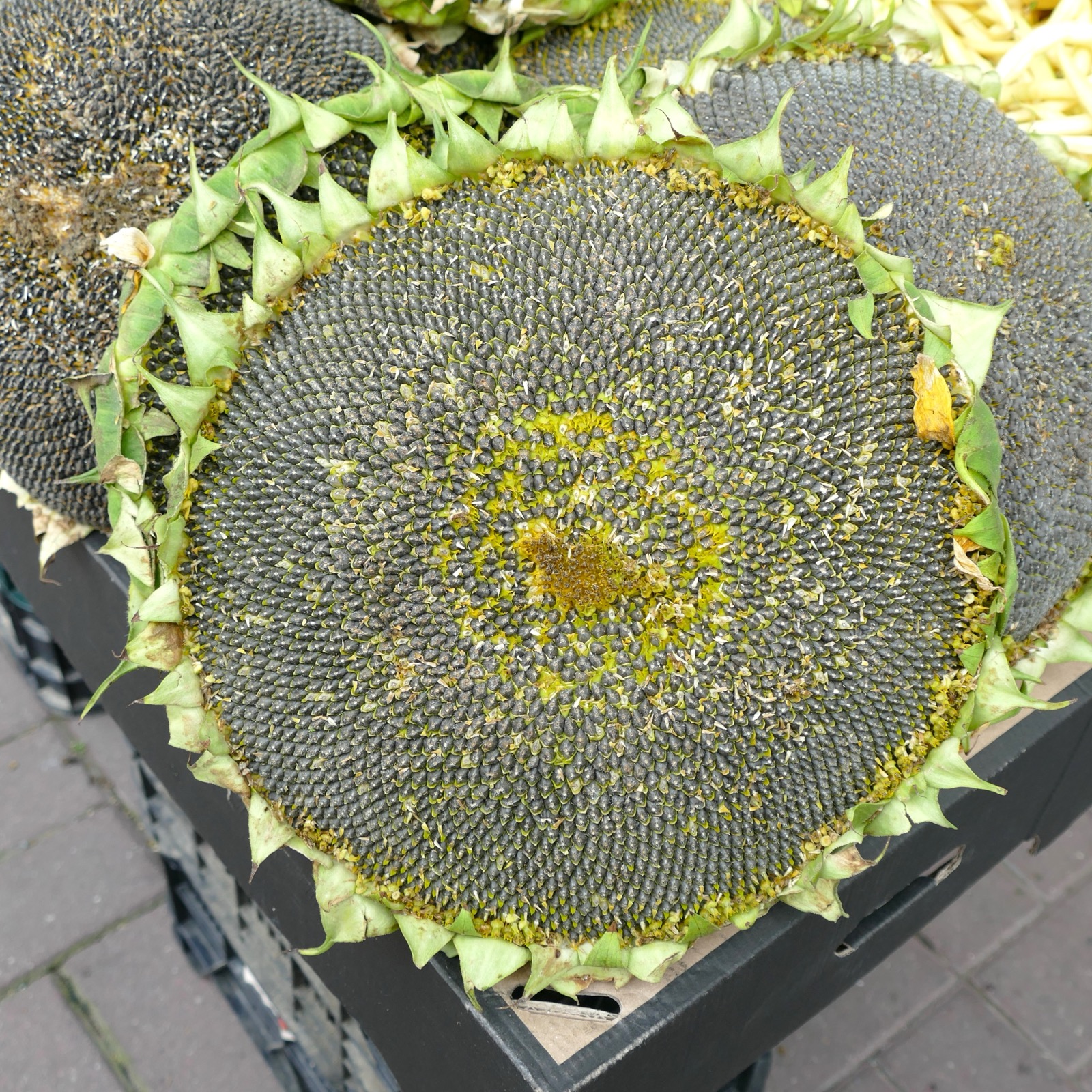
Why does this one 'flower' look like it is made of hundreds of tiny flowers?
Why do young plants face different directions through the day, while mature heads all face the same way?
Honest Limits of This Guide
- The right planting month is different in every real sunflower-growing region, because it depends on your own local last-frost date and soil warming, not a fixed calendar date. This guide gives you the rule (Stage 3) instead of a date.
- World production figures in this guide come from a secondary compilation that itself cites FAOSTAT's own 'Sunflower seed' 2022 dataset directly, because this session did not find a way to query FAOSTAT's own bulk data service for sunflower, the same real limitation this library's own cotton and soybean guides record for their own figures. 2022 also sits inside a real, ongoing regional war that has already measurably moved the numbers since (globalImportance).
- This guide does not print a single, unified per-hectare yield figure for sunflower, because real yield differs by a large factor between irrigated, well-managed systems and rainfed, moisture-limited systems -- averaging them into one number would honestly mislead more than it would inform (yieldAndMarketValue).
- Sunflower is honestly NOT one of the ten crops Laisha's own live Global Commodity Price service currently tracks. This guide states that gap plainly in yieldAndMarketValue rather than inventing a number or implying a live reference exists where none currently does.
- This guide does not name any pesticide, fungicide, herbicide or seed-treatment product or compound. It names mode-of-action groups and general practice categories, and the toxicity colour-band principle, only. If you decide to use a product, buy only from a licensed dealer and follow the label on the actual package.
- The toxicity colour band is a principle, not a fixed chemical-to-colour list. The same active substance can sit in a different band in a different formulation or country, and registrations change. Read the real triangle on the real package.
- This guide's own real Indian seed-certification figures (70 percent minimum germination, 98 percent physical purity, 9 percent maximum moisture) are drawn from India's own published Minimum Seed Certification Standards and may differ from another country's own real, separate national sunflower seed-certification standard, which this session did not independently confirm for every country in this guide's own 30-country list.
- This guide names Sclerotinia stalk rot, charcoal rot and broomrape honestly in words, but no adequately licensed, freely reusable Commons photograph could be found this session specifically showing any of their own field symptoms, nor for bird feeding damage itself; a grower facing a suspected case of any of them should confirm with a real local extension visit rather than relying on this guide's written description alone to self-diagnose (troubleshooting, images).
- No single, detailed, published per-hectare cost-of-production and returns dataset covering land, water, crop protection and labour together across this guide's own diverse 30-country list was found this session, unlike this library's own soybean guide's single-country dataset (farmEconomics).
- The exact real percentage figures cited for Russia and Ukraine's combined world production and export share move year to year, and more sharply than usual since the 2022 war began -- this guide states the general, recent, honestly sourced range rather than one precise figure that would likely already be out of date by the time this guide is read (globalImportance).
Related Laisha Tools
- Global Market Price Outlook — Check today's price and trend
- Crop Calendar — Build a season-long sowing plan
- Pest & Disease Intelligence — Risk reasoning and a global pest & disease library
- Crop Health — Photo-based first read on a field problem
- Seed Quality Intelligence — Check a seed lot before you plant it
Open the free Applied Agriculture Library in the Laisha app →
Sources
- GBIF Backbone Taxonomy species-match record for Helianthus annuus L. (usage key 9206251) — Global Biodiversity Information Facility (GBIF), Copenhagen (source)
- EPPO Global Database taxon record for Helianthus annuus, code HELAN — European and Mediterranean Plant Protection Organization (EPPO), Paris (source)
- Sunflower -- overview article — Wikipedia, citing a wide range of primary botanical, agronomic, historical and trade sources including FAOSTAT (source)
- Sunflower seed production in major countries, 2022 (secondary compilation citing FAOSTAT) — Multiple real, published secondary trade and statistics sources compiling FAOSTAT's own 'Sunflower seed' dataset (source)
- Review of Ukraine and Russia's real, published shares of world sunflower oil production and export, and the impact of the 2022 war on Black Sea sunflower trade — Multiple real, published trade-press and market-research sources, cross-checked in this session (source)
- Circadian regulation of sunflower heliotropism, floral orientation, and pollinator visits — Atamian, H.S. et al., Science, 2016 (peer-reviewed) (source)
- Mature Sunflower Inflorescences Face Geographical East to Maximize Absorbed Light Energy: Orientation of Helianthus annuus Heads Studied by Drone Photography — PMC (PubMed Central), peer-reviewed (source)
- East-facing Helianthus annuus has maximal number and mass of kernel-filled seeds: Seed traits versus head orientation — PMC (PubMed Central), peer-reviewed (source)
- Review of the real, published mathematics of the Fibonacci spiral floret arrangement in sunflower seed heads — Multiple real, cross-checked academic and popular-science sources on phyllotaxis and the golden angle (source)
- Review of the real, published distinction between oilseed and confectionery (non-oil) sunflower market segments, seed traits and pricing — Multiple real, cross-checked agronomic and trade-press sources (source)
- Review of the real, published hull-to-kernel weight ratio in sunflower seed and its effect on crushing-plant pressing capacity — Multiple real, cross-checked peer-reviewed agronomic and food-science sources including the Journal of the American Oil Chemists' Society (source)
- Review of the real, published history and fatty-acid composition of NuSun (mid-oleic) sunflower oil and its relationship to traditional linoleic and high-oleic sunflower oil — Multiple real, cross-checked industry and extension sources including the National Sunflower Association and Purdue University (source)
- Review of the real, published fatty-acid profile and market positioning of high-oleic sunflower oil — Oklahoma State University Extension and other real, cross-checked academic sources (source)
- Sunflower oil production makes up 9 percent of all vegetable oil produced globally — USDA Economic Research Service (source)
- Sclerotinia Diseases of Sunflower, and related real, published research on Sclerotinia head rot and basal stalk rot yield loss — American Phytopathological Society (APS) Education Center, and cross-checked peer-reviewed research including BMC Plant Biology (source)
- Plant Disease Management: Downy Mildew of Sunflower — North Dakota State University (NDSU) Extension Service (source)
- Review of the real, published biology, geographic spread, yield-loss severity and resistance-breakdown history of sunflower broomrape (Orobanche cumana) — Multiple real, cross-checked peer-reviewed sources including Frontiers in Plant Science and Nuseed Europe (source)
- The economic impacts of blackbird (Icteridae) damage to sunflower in the USA, and related real, published bird-management research — Peer-reviewed research published in Pest Management Science, and USDA APHIS Wildlife Services (source)
- Bird damage to sunflower: international situation and prospects — OCL -- Oilseeds and fats, Crops and Lipids, peer-reviewed (source)
- Review of the real, published seasonal water-requirement range for sunflower and its comparative drought tolerance from deep taprooting — Multiple real, cross-checked agronomic extension sources (source)
- Yield, harvest, storage of Sunflower, and related real, published rainfed-versus-irrigated yield-range sources — Wikifarmer, and cross-checked against Our World in Data's own sunflower seed yield series (source)
- Review of real, published sunflower combine harvest moisture targets, header requirements and lodging-risk management — Multiple real, cross-checked agronomic extension sources (source)
- Review of real, published sunflower crushing-industry oil-content premium and discount schedules — Multiple real, cross-checked commodity trading and crushing-industry sources (source)
- Review of real, published sunflower planting depth, spacing, soil pH and general field-establishment agronomy — Multiple real, cross-checked extension and horticultural sources including Wikifarmer and university extension services (source)
- Review of the real, published standard sunflower growth-staging system (VE to R9) and typical days-to-maturity range — Multiple real, cross-checked university extension and agronomic sources (source)
- Review of real, published major sunflower insect pests including sunflower moth, stem weevils and cutworms — Multiple real, cross-checked university extension sources including NDSU's Sunflower Disease and Insect Diagnostic Series (source)
- CA Fertilization Guidelines -- Sunflower Nitrogen Uptake and Partitioning — California Department of Food and Agriculture (CDFA), Fertilizer Research and Education Program (FREP) (source)
- Sunflower -- Agronomy information, nutrient requirements and fertiliser advice — Yara UK (source)
- Laisha's own curated Seed Certification Standards reference -- Sunflower (Helianthus annuus) entry — Laisha internal curated reference (backend/database/seedCertificationStandards.json), sourced from India's Minimum Seed Certification Standards (IMSCS) (source)
- Laisha Global Crop Priority Research -- Sunflower entry — Laisha internal curated research (backend/database/globalCropPriorityResearch.json) (source)
- Laisha Leaf Visual Diagnostic Reference — Laisha internal curated reference (backend/database/leafVisualDiagnosticReference.json) (source)
- Laisha's own agrochemical safety reference: mode-of-action grouping and the India colour-band toxicity principle — Laisha internal curated reference, built from the Insecticides Act 1968 / Insecticide Rules 1971 (India) and IRAC/FRAC/HRAC mode-of-action classification systems (source)