How to Grow Sweet potato
Ipomoea batatas · Also called: sweetpotato, sweet potatoes, kumara, kumar, camote, batata, batata doce, boniato
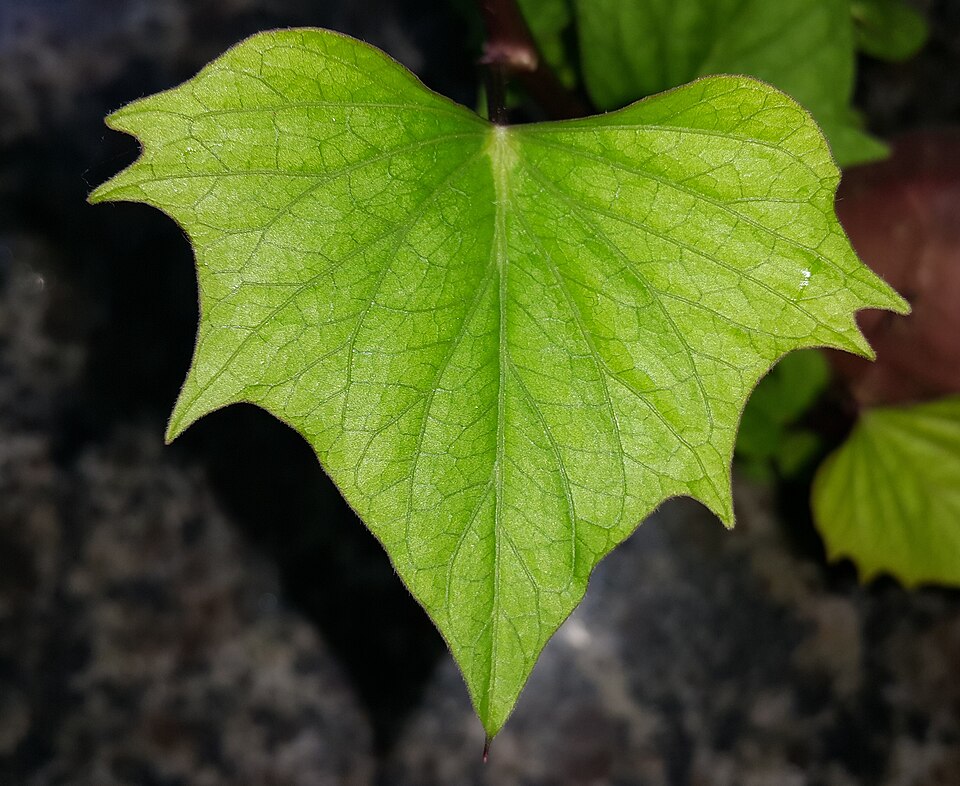
Photo: Themium, CC0 (Wikimedia Commons)
Sweet potato feeds people on land and in years where other crops give up. It grows on poor soil, it stands a dry spell, and it gives more food energy from one piece of land in one day than wheat, rice or cassava do. You do not buy seed for it. You cut a piece of vine from a healthy plant. And the orange fleshed kinds carry so much of what the body turns into vitamin A that a single small serving can cover a young child's need for the day.
Global Importance
Sweet potato is grown in more developing countries than any other root crop. It is a top ten crop by land area in 31 of the world's 195 countries, and those 31 are spread across Africa, the Americas, Asia and the Pacific islands. It is nobody's number one crop by area, and that is part of its story: it is almost always the crop standing quietly behind the main crop, ready when the main crop fails.
Growing Sweet potato, Stage by Stage
- 1. Get the land ready — Loosen the soil deeply, then heap it into mounds or ridges so the roots have somewhere soft and dry to swell.
- 2. Choose your vine cuttings — This is the most important choice you will make all season. A sick vine gives a sick field, and you cannot fix it later.
- 3. Carry vine over to next season — In a place with one long dry season, the hardest part of this crop is simply having any vine left when the rains come. There are real, tested, cheap ways to solve it.
- 4. Plant the cuttings — Push them in shallow with at least two leaf joints buried, one cutting per hole, a hand span apart along the mound or ridge.
- 5. Water — It needs rain to get established and again when the roots begin to form. After that it copes with dry weather better than most crops.
- 6. Weeds, vine lifting and hilling up — The first two months are the fight. After that the vines close over and shade the weeds out themselves — but you still have to keep soil over the roots.
- 7. Feed the crop — Sweet potato wants more potassium and less nitrogen than a cereal does. Getting that backwards is the single most common way farmers grow beautiful vines and no food.
- 8. Watch for pests and diseases — Two problems account for most of the loss in this crop worldwide: the sweet potato weevil, and sweet potato virus disease. Both are beaten mainly by things that cost no money.
- 9. Harvest, and cure the roots — Cut the vines off a few days early, dig gently, and then keep the roots warm and damp for a few days. That last step heals the skin and it is worth more than almost anything else you can do.
- 10. Store it, and turn it into food that keeps — A fresh root left in the open goes bad fast. Sand storage, pit storage or drying into chips all turn a few days into months.
Common Problems & Troubleshooting
If you see: Plants much smaller and more stunted than their neighbours. Leaves narrow, puckered, distorted or crumpled at the edges. Yellowing between the veins, or clear vein-clearing where the veins look pale and see-through. Worst on the newest growth. Almost no roots underneath.
It likely means: Sweet potato virus disease, usually called SPVD. It is the most serious disease of this crop anywhere in the world. It happens when two viruses infect the same plant at once — one carried by aphids, one carried by whiteflies. Neither alone does this much damage; together they are devastating.
Do this: You cannot cure a plant that has it. Do not waste effort trying.
If you see: Small round holes in the storage roots. Dark winding tunnels through the flesh when you cut one open. A bad, strong smell. A bitter taste that makes the root inedible. Sometimes small ant-shaped beetles with a long snout on the vines. Vines with tunnels in them too.
It likely means: Sweet potato weevil. Three species matter: one across Asia and the tropics, and two across Africa, one of which is recorded in 24 countries and the other in 9. The adult bites a hole in the vine or root and lays an egg inside it. The larva that hatches tunnels through the root.
Do this: The bitterness is not spoilage. It is the plant's own defence chemistry, released in response to the tunnelling. Do not eat those roots and do not feed them out.
If you see: Tall, thick, dark green, healthy looking vines everywhere. Then you dig, and there is almost nothing under them worth eating.
It likely means: The plant put its energy into leaves and stems instead of roots. The usual causes are too much nitrogen, not enough nodes buried at planting, shading by a taller crop, or vines rooting along their length where they touch damp soil.
Do this: Stop applying nitrogen to this crop. Heavy nitrogen has been measured shutting down the plant's own starch making in the roots.
If you see: Short vines with unusually short gaps between the leaves. Small leaves, darker green than normal, especially at the edges. Small shiny brown spots on the underside of older leaves. Older leaves going yellow or reddish from the tip and edges inward. Plants wilting quickly and leaves dropping easily. Underground, few storage roots and the ones there are, are long and thin.
It likely means: Potassium hunger. Sweet potato takes more potassium out of the soil than a cereal does, so this is a common shortage in a crop nobody has fertilised.
Do this: Apply a potassium fertiliser such as muriate of potash, about 160 kg on a hectare, which works out at about 5 g per mound or 48 g per 10 metres of row.
If you see: Leaves turning light green to yellowish and looking dull. Vine growth slow. Older leaves going reddish at the edges, yellow in the middle, then reddish-brown all over. Stems of older plants turning reddish. Short leaf stalks. Symptoms starting at the base of the plant and spreading upward.
It likely means: Nitrogen hunger. Note that the symptoms start at the bottom of the plant and move up — that is what tells you it is nitrogen and not something else.
Do this: Apply a nitrogen fertiliser such as urea, about 65 kg on a hectare, which is about 2 g per mound or 20 g per 10 metres of row.
If you see: Weeks after planting, many cuttings have not sprouted. When you pull them, they are dry, shrivelled, blackened or rotten at the buried end.
It likely means: The cuttings were poor, or dried out before planting, or planted too shallow, or planted into ground that then went dry, or into ground that was waterlogged.
Do this: Fill the gaps now with fresh cuttings. An empty space grows nothing all season.
If you see: Dark spots on leaves, leaf stalks and stems. Leaves falling. Whole vines dying back. Worst in wet, cool, high altitude places.
It likely means: Alternaria leaf and stem blight, sometimes just called blight. It is a fungal disease and it is a serious problem in moist highland environments, though usually not a problem at lower altitudes.
Do this: Ask your local agricultural officer whether a resistant or tolerant variety is available for your area.
If you see: Roots that were fine when dug going soft, watery and foul inside within days. Sometimes white fluffy tufts growing out of the root, often starting at the pointed end. Or the tissue turning yellowish, then reddish-brown, then black, with the rot firm and moist, and the root completely gone within about two weeks.
It likely means: Storage rots. The soft watery one with white tufts is soft rot. The one that goes black and dries out is black rot. Both get in through wounds in the skin.
Do this: Cure the roots. Curing at about 30°C and 85 to 90% humidity for 3 to 5 days after harvest heals the wounds the fungi enter through, and it genuinely reduces rot. This is the main answer.
If you see: Vines chewed off, roots dug up and eaten, holes and tunnels in the ground, whole sections of the field flattened.
It likely means: Animals. Sweet potato attracts a lot of them: porcupines, monkeys, baboons, elephants, goats, cattle, guinea fowl, rats and mole rats.
Do this: Put up thorn fences or plant hedges. Tether domestic animals.
Yield & Market Value
Growing the crop is only part of the job. The last part is knowing what a normal harvest looks like, and knowing what your roots are worth before you agree a price with anybody.
Remember It This Way
If you forget every other page of this guide, keep these lines. They are the whole crop, in order, short enough to carry in your head.
- It is not a potato. It is a root with no eyes, in the morning glory family.
- You plant a piece of vine, not a seed and not the root you eat.
- Take it from the tip, never from the bottom of the vine, and never from a sick plant.
- About a forearm long, with three to five leaf joints on it, at least two of them buried.
- Grow it on mounds or ridges. Standing water rots the roots.
- Give it potassium, not a lot of nitrogen. Nitrogen makes vine, not food.
- Keep soil over the roots and cracks filled. That is how you beat the weevil.
- Cut the vines off a few days before you dig.
- Then keep the dug roots warm and damp for a few days to heal the skin.
- Never feed rotten roots to cattle.
Test Yourself: Identification
This leaf is of which plant?
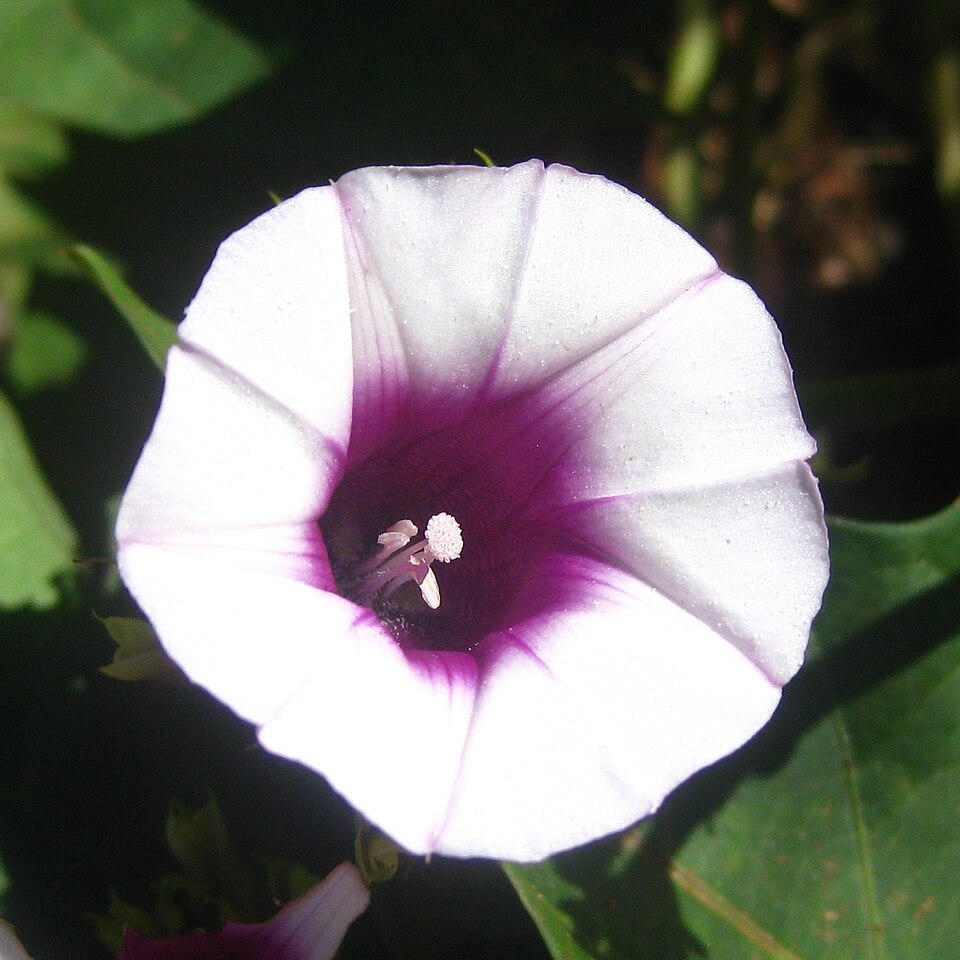
Which crop is this flower from?
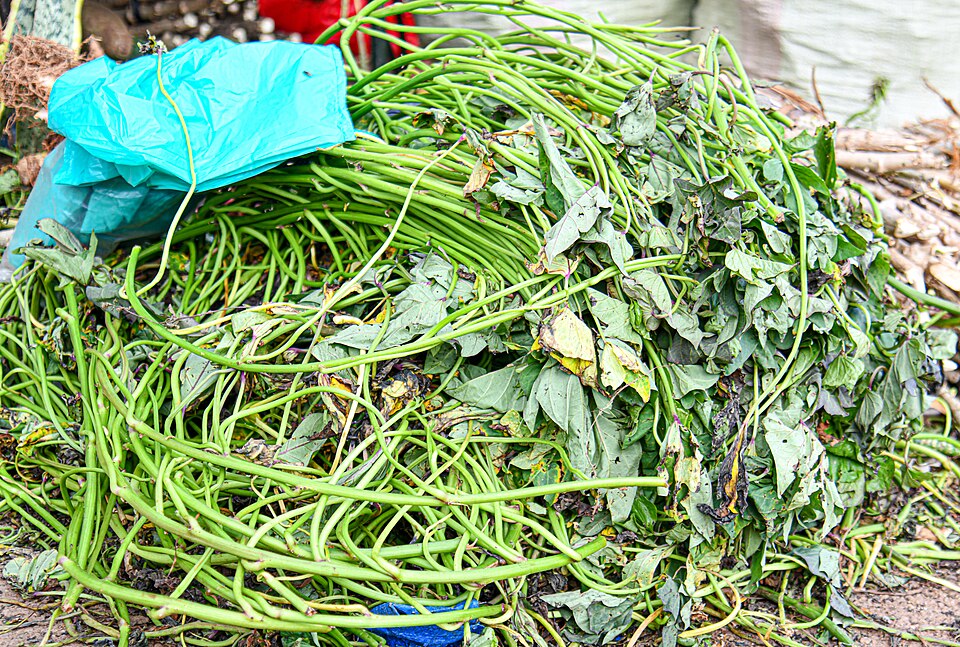
Which crop is planted from these?
Honest Limits of This Guide
- Sweet potato is not a potato and this guide will not work for true potato. If you actually want Solanum tuberosum, ask for potato by that name and do not use anything on this page.
- The right planting month is different everywhere. The rule that is true everywhere is: plant at the start of your rains.
- No single fertiliser recommendation is honest for the whole world. Published trial results vary widely across sub-Saharan Africa alone. The principles here — more potassium, moderate nitrogen, potassium applied late — hold. The exact amounts do not.
- Which varieties resist sweet potato virus disease, and which orange fleshed varieties are released, depends entirely on your country. Ask your local agricultural officer.
- This guide does not print a cost of cultivation or a profit figure. Laisha looked for a citable general set and did not find one honest enough to print. What it gives instead is the real calculation method and one real measured investment case.
- This guide names no pesticide, herbicide or fungicide product, brand or rate anywhere. It names mode-of-action groups only. If you decide to use a chemical, buy only from a licensed dealer, prefer the lowest hazard colour band on the label that will do the job, and follow that label.
- Laisha will not tell you which toxicity colour band a named compound falls into. That is a property of the specific registered product and it is printed on the package. Read the triangle.
Related Laisha Tools
- Global Market Price Outlook — Check today's price and trend
- Crop Calendar — Build a season-long sowing plan
- Pest & Disease Intelligence — Risk reasoning and a global pest & disease library
- Crop Health — Photo-based first read on a field problem
- Post-Harvest Loss Prevention — Real storage science by crop
Open the free Applied Agriculture Library in the Laisha app →
Sources
- GBIF Backbone Taxonomy record for Ipomoea batatas (L.) Lam. — Global Biodiversity Information Facility (GBIF), Copenhagen (source)
- World Checklist of Vascular Plants (WCVP), the checklist behind Plants of the World Online — Royal Botanic Gardens, Kew (source)
- Sweetpotato cropping guide — Africa Soil Health Consortium (ASHC), Nairobi, coordinated by CABI, with the International Potato Center (CIP); funded by the Bill & Melinda Gates Foundation (source)
- Sweetpotato (crop page) — International Potato Center (CIP), Lima, Peru (source)
- Vitamin A Sweet Potato (crop page) — HarvestPlus (source)
- Sweet potato production (dataset), built on FAOSTAT: Production, Crops and livestock products — Food and Agriculture Organization of the United Nations, with major processing by Our World in Data (source)
- Global Crop Priority Research dataset (backend/database/globalCropPriorityResearch.json), built from FAOSTAT QCL area-harvested rankings — Laisha, from Food and Agriculture Organization of the United Nations data (source)
- Global Seed Certification Standards dataset (backend/database/globalSeedCertificationStandards.json) — Laisha, compiled from the EU seed directives, India's Seeds Rules 1968 and Indian Minimum Seed Certification Standards, Canada's Seeds Regulations and FAO Plant Production and Protection Paper 185 (source)
- Agrochemical Reference dataset (backend/database/agrochemicalReference.json) — Laisha, compiled from IRAC, FRAC and HRAC mode-of-action classifications and India's Insecticides Act 1968 / Insecticide Rules 1971 (Central Insecticides Board & Registration Committee) (source)
- Breeding Cultivars for Resistance to African Sweetpotato Weevils — Insects (MDPI) (source)
- Decoding phenotypic signatures of Cylas formicarius resistance — Frontiers in Plant Science (source)
- The Spread and Transmission of Sweet Potato Virus Disease (SPVD) and Its Effect on the Gene Expression Profile in Sweet Potato — Plants (MDPI), 9(4):492 (source)
- Efficiency of insect-proof net tunnels in reducing virus-related seed degeneration in sweet potato — Plant Pathology (source)
- Effect of potassium fertilization on storage root number and yield in sweetpotato — Frontiers in Plant Science (source)
- SUS and AGPase family members respond to excessive nitrogen in sweet potato — International Journal of Molecular Sciences (MDPI) (source)
- Effects of nitrogen, phosphorus, and potassium fertilizers on storage root yield in sweet potato — BMC Plant Biology (source)
- Effects of node number of vine cuttings and planting methods on endogenous hormone contents at nodes and storage root formation in sweet potato — PLOS ONE (source)
- Genotype × harvest time effects on yield, root size distribution, and sensory quality in sweet potato — BMC Plant Biology (source)
- Review of knowledge to guide product development and breeding for sweetpotato frying quality in West Africa — International Journal of Food Science & Technology (source)
- Fried sweetpotato user preferences identified in Nigeria and Ghana and implications for trait evaluation — International Journal of Food Science & Technology (source)
- Postharvest quality of two orange-fleshed sweet potato [Ipomoea batatas (L) Lam] cultivars as influenced by organic soil amendment treatments — Food Science & Nutrition (source)
- Effect of Traditional Processing on Beta-Carotene Content of Sweet Potato Products: A Systematic Review with Implications for Vitamin A Deficiency in Nigeria — Research Square (preprint) (source)
- Evaluation of nutritional value, consumer preference, and profitability of orange-fleshed sweet potato puree-incorporated bread and injera — Crop Science (source)
- Improving the nutritional quality, and contribution to recommended dietary allowances of cassava and orange-fleshed sweet potato fufu flour blends for adults and children — BMC Nutrition (source)
- Evaluation of the performance and stability of early maturing orange-fleshed sweetpotato genotypes in selected areas in Ethiopia — PLOS ONE (source)
- Study on dynamic expansion and β-carotene accumulation in storage root of orange-fleshed sweetpotato, and screening of germplasm resources with high rate of medium-sized storage roots — Frontiers in Plant Science (source)
- Comprehensive review of sweetpotato flavor compounds: Opportunities for developing consumer-preferred varieties — Comprehensive Reviews in Food Science and Food Safety (source)
- Toxic interstitial lung disease in cattle; and Characterization of Mycotoxin and Furanoterpenoid Production by Fusarium Species Infecting Sweetpotato — Journal of Veterinary Diagnostic Investigation; and Phytopathology (source)
- Guide for Trainers — Sweetpotato Planting Material Conservation, Triple S method: Sand, Storage, Sprouting — International Potato Center (CIP) (source)