 Laisha
AI Operating System for Agriculture
Ask Laisha
Laisha
AI Operating System for Agriculture
Ask Laisha
Passalora arachidicola and Nothopassalora personata Passalora arachidicola (Hori) U. Braun (early leaf spot); Nothopassalora personata (Berk. & M.A. Curtis) U. Braun et al. (late leaf spot) · formerly or also: Cercospora arachidicola (sexual stage Mycosphaerella arachidis), Cercosporidium personatum, Phaeoisariopsis personata (sexual stage Mycosphaerella berkeleyi)
Early and late leaf spot are the most widespread diseases of groundnut (peanut). Both cause brown to black spots on leaves that lead to heavy leaf drop, and together with rust they can halve yields where groundnut is grown without fungicides. Early leaf spot makes lighter brown spots with a yellow halo; late leaf spot makes darker, almost black spots with little halo. Pods left on defoliated plants are lost at harvest because the pegs weaken.
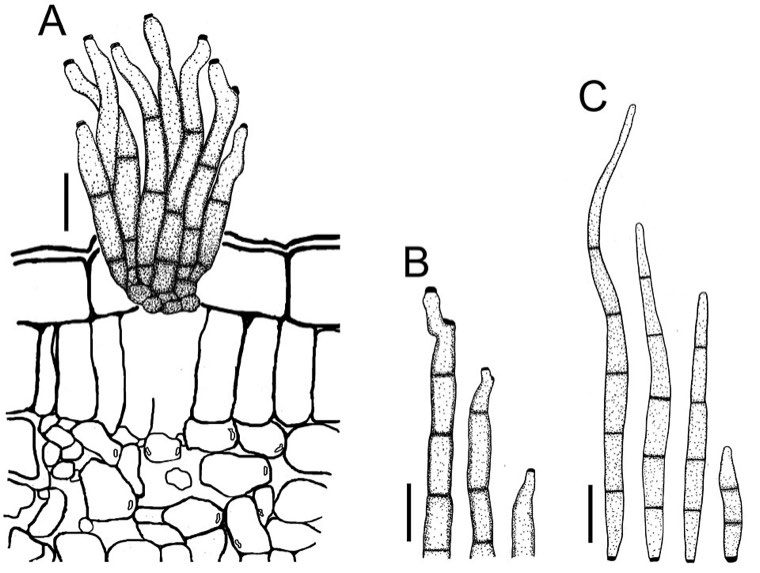
Early and late leaf spot of groundnut is caused by Passalora arachidicola and Nothopassalora personata Passalora arachidicola (Hori) U. Braun (early leaf spot); Nothopassalora personata (Berk. & M.A. Curtis) U. Braun et al. (late leaf spot), a fungi (ascomycetes) (order Mycosphaerellales, family Mycosphaerellaceae).
Older or alternative scientific names: Cercospora arachidicola (sexual stage Mycosphaerella arachidis), Cercosporidium personatum, Phaeoisariopsis personata (sexual stage Mycosphaerella berkeleyi).
Found wherever groundnut is grown, in Asia, Africa, the Americas and Oceania; which species dominates depends on region and season.
| Region | Status |
|---|---|
| Asia | Widespread; major in India and China |
| Africa | Widespread; major on smallholder farms |
| Americas | Widespread; major in the US South-East and Argentina |
| Oceania | Present |
Both fungi produce spores on tufts on the leaf spots. Early leaf spot sporulates mostly on the upper surface of the leaf; late leaf spot sporulates mostly on the lower surface, in concentric rings of dark tufts. A microscope or hand lens helps tell them apart. Late leaf spot usually appears later in the season and is often the more damaging of the two in hot, humid regions.
| Crop stage | What you see |
|---|---|
| Early leaf spot | Round, light to reddish-brown spots 1-10 mm across, usually with a distinct yellow halo; spore tufts mostly on the upper surface. |
| Late leaf spot | Round, dark brown to black spots 1-6 mm across, usually without a clear halo; rough dark spore tufts in rings on the lower surface. |
| Severe infection | Spots on stems, petioles and pegs; heavy leaf drop from the bottom of the plant upwards; weakened pegs that break at harvest. |
The fungi survive on infected groundnut residue in soil and on volunteer plants. In warm, humid weather, spores are splashed and blown onto leaves, and new spots produce spores within about two weeks, giving several cycles per season. Spread is greatest in long-season crops in humid climates.
| Stage | Duration | Notes |
|---|---|---|
| Survival on residue and volunteers | Between seasons | Main sources. |
| Infection | After long periods of high humidity | Leaves wet or humid for many hours. |
| Spot development and sporulation | About 10-20 days | Repeated cycles. |
| Defoliation | Mid to late season | Main cause of yield loss. |
Most severe at warm temperatures (about 20-30 °C) with high humidity, rain or heavy dew.
Several cycles per season.
Short rotations with groundnut, residues left on the surface, volunteer groundnut, warm humid weather and long-duration varieties.
There is no single numeric economic threshold; fungicide programmes start at a set time after planting or are guided by weather-based advisories, and timing differs between regions.
Thresholds are local. They depend on crop price, control cost, variety and natural-enemy activity, so use the figure your local extension service publishes where one exists.
Defoliation reduces pod yield and quality; losses of 50% or more occur in susceptible varieties without fungicides, especially when leaf spots and rust occur together. Losses come mainly from leaf drop during pod filling and from pods left in the soil when weakened pegs break at digging.
Control works best as a sequence: prevent, monitor, then act only when a threshold or a risk forecast says so, using the least disruptive option that works.
Protective sprays repeated through the season are the main method in commercial production; on small farms, resistant varieties and rotation are more practical. What is registered differs by country and changes over time; follow the label and your local plant-protection authority.
| Scheme | Group | Mode of action | Notes |
|---|---|---|---|
| FRAC | M05 | Chloronitriles (multi-site) | Protectant. |
| FRAC | 3 | Demethylation inhibitors (DMI) | Often with sulfur as partner. |
| FRAC | 11 | Quinone outside inhibitors (QoI) | Resistance risk; use in mixtures. |
| FRAC | M02 | Inorganic (sulfur) - multi-site | Mixing partner. |
Groundnut (Arachis hypogaea) and wild Arachis species.
How to grow the crop well is the first line of defence. Laisha's free grow guides cover each crop from sowing to harvest:
Written by Laisha from the sources above, in its own words. This page is general reference, not a prescription: confirm identification locally and follow the label and your plant-protection authority.