 Laisha
AI Operating System for Agriculture
Ask Laisha
Laisha
AI Operating System for Agriculture
Ask Laisha
Athelia rolfsii Athelia rolfsii (Curzi) C.C. Tu & Kimbr., 1978 (asexual stage Sclerotium rolfsii Sacc.) · formerly or also: Sclerotium rolfsii, Agroathelia rolfsii
Stem rot, also called southern blight or white mould, is caused by a soil fungus that attacks groundnut stems, pegs and pods at the soil surface. Branches or whole plants suddenly wilt and yellow, a white, fan-shaped mould grows over the stem base and soil, and round, mustard-seed-like resting bodies form on it. The same fungus attacks more than 500 plants, including tomato, pepper, beans, sugar beet and many vegetables, in warm, humid conditions.
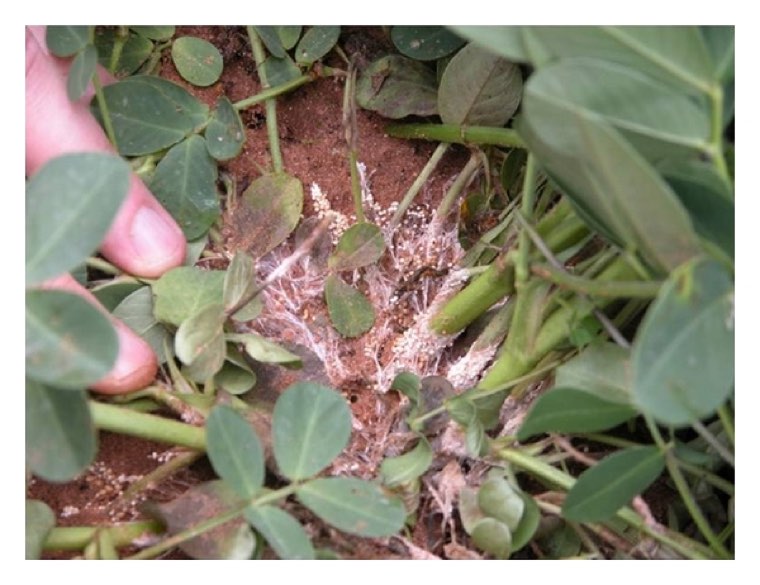
Stem rot of groundnut is caused by Athelia rolfsii Athelia rolfsii (Curzi) C.C. Tu & Kimbr., 1978 (asexual stage Sclerotium rolfsii Sacc.), a fungus (basidiomycete, soil-borne) (order Atheliales, family Atheliaceae).
Older or alternative scientific names: Sclerotium rolfsii, Agroathelia rolfsii.
Found in warm temperate, subtropical and tropical regions worldwide.
| Region | Status |
|---|---|
| Americas | Widespread; major disease of peanut in the south-eastern United States |
| Asia | Widespread; important in groundnut in India and China |
| Africa | Widespread |
| Europe and Oceania | Present in warm areas |
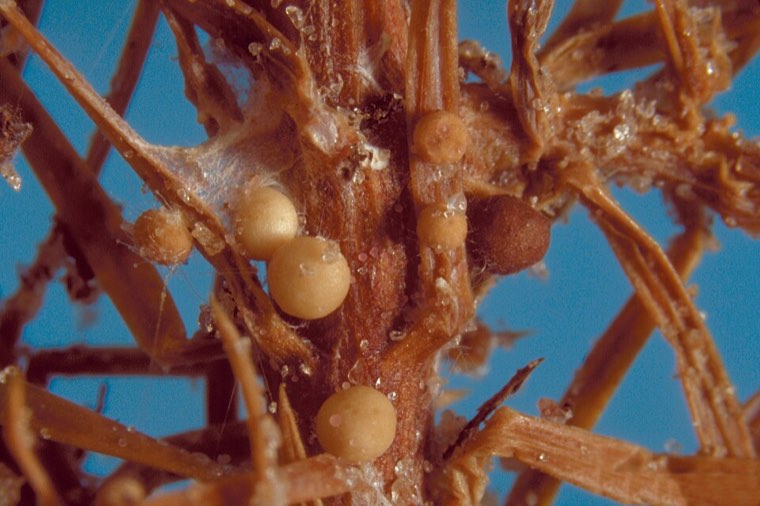
The fungus forms coarse white threads that spread over the soil and plant base in fan-like patterns, and many small round sclerotia, about 1-2 mm across, which are white at first and turn tan to dark brown, like mustard seeds. The sclerotia survive in soil and residue for years. In the field, the fungus has been found on roots and crowns some weeks before wilting appears.
| Crop stage | What you see |
|---|---|
| Early infection | Sudden wilting and yellowing of one branch or the whole plant, often in hot weather. |
| At the soil line | Brown lesions on stems and pegs covered with white fan-shaped mould; small round tan to brown sclerotia on the mould and soil. |
| Pods | Pegs rot, so pods are left in the soil at digging; pods rot with white mould. |
Sclerotia in soil and plant debris germinate in warm, moist conditions, especially when organic matter is present at the soil surface. The fungus grows across the soil and infects stems, pegs and pods. New sclerotia form on infected tissue and return to the soil. It spreads with soil, water, infected transplants and equipment.
| Stage | Duration | Notes |
|---|---|---|
| Sclerotia in soil and residue | Survive several years | Main source. |
| Germination and growth over soil | Warm, moist periods | Favoured by debris at the surface. |
| Infection of stems, pegs and pods | Days | Wilting follows quickly. |
| New sclerotia | On infected tissue | Build up soil inoculum. |
Most severe at about 25-35 °C with high humidity, often after dry spells followed by rain or irrigation.
One main cycle per crop, with spread along rows.
Hot, humid weather; light sandy soils; undecomposed organic matter at the soil surface; soil thrown onto plant stems during cultivation; short rotations with susceptible crops.
There is no numeric economic threshold; fungicide programmes and rotations are planned from field history and risk factors.
Thresholds are local. They depend on crop price, control cost, variety and natural-enemy activity, so use the figure your local extension service publishes where one exists.
Losses of 10-25% are common in affected groundnut fields and can be higher in hot, humid seasons; pod losses at digging add to the damage. Disease levels vary greatly from year to year with planting date, soil moisture and temperature.
Control works best as a sequence: prevent, monitor, then act only when a threshold or a risk forecast says so, using the least disruptive option that works.
Soil-directed fungicides applied during the season reduce stem rot in commercial groundnut. What is registered differs by country and changes over time; follow the label and your local plant-protection authority.
| Scheme | Group | Mode of action | Notes |
|---|---|---|---|
| FRAC | 7 | Succinate dehydrogenase inhibitors (SDHI) | Soil-directed. |
| FRAC | 3 | Demethylation inhibitors (DMI) | Often combined with leaf spot programmes. |
| FRAC | 11 | Quinone outside inhibitors (QoI) | Use in mixtures. |
More than 500 plant species, including groundnut, tomato, pepper, eggplant, beans, soybean, sugar beet, potato, carrot, onion, cucurbits and ornamentals.
How to grow the crop well is the first line of defence. Laisha's free grow guides cover each crop from sowing to harvest:
Written by Laisha from the sources above, in its own words. This page is general reference, not a prescription: confirm identification locally and follow the label and your plant-protection authority.