How to Grow Groundnut
Arachis hypogaea · Also called: peanut, peanuts, groundnuts, ground nut, ground nuts, monkey nut, monkey nuts, earthnut
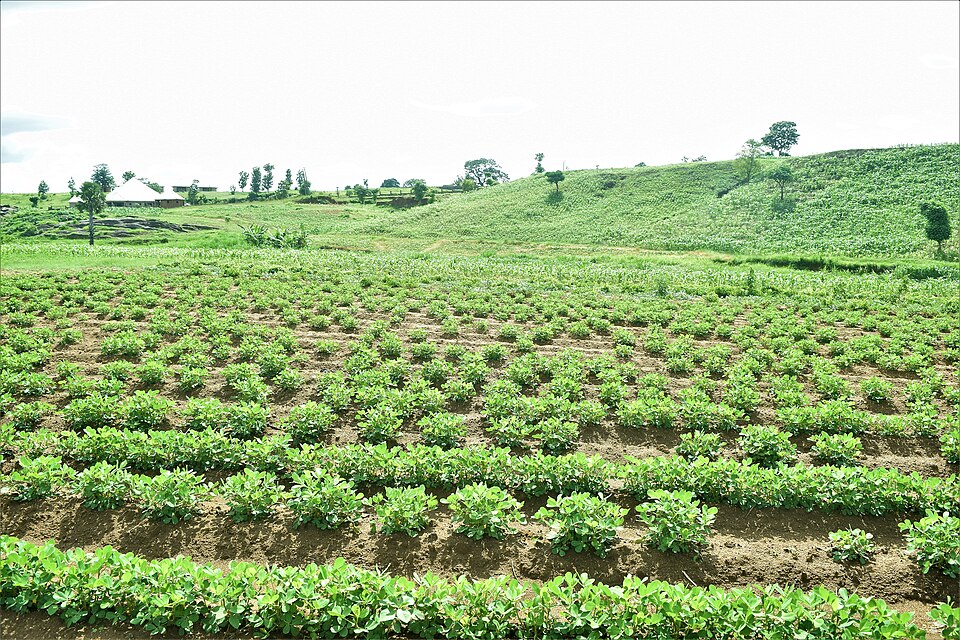
Photo: Kambai Akau, CC BY-SA 4.0 (Wikimedia Commons)
Groundnut is one of the few crops that is food, cooking oil, animal feed and cash income all at the same time, from one planting. It is a top-ten crop in 48 of the world's 195 countries, and the single biggest crop of all in two of them: the Gambia and Senegal. In West and Central Africa it is often called a women's crop, because women do most of the growing, processing and selling, and in many households it is the main source of cash money in the year. It is also one of the crops that feeds children back to health: the ready-to-use paste used worldwide to treat severe child malnutrition is made from groundnut.
Global Importance
Groundnut is grown on about 31 million hectares of the world's land and gives about 58 million tonnes of pods a year. Half the world's groundnut land is in Africa, but Africa harvests only about a third of the world's groundnut. That gap is not about the soil or the people. It is about seed, spacing, calcium and disease, and every one of those is in this guide.
Market Segments
Groundnut is not one product. It is sold into four or five genuinely different markets, and they pay differently for genuinely different things. If you know which market you are growing for before you choose your seed, you will make more money from the same hectare. Every scale below is a real, published one that you or a buyer could look up and check.
Growth Habit
Groundnut plants come in two shapes, and the shape changes how you space them, how you weed them, and how you get them out of the ground. Choosing the wrong spacing for your shape is one of the most common and most expensive mistakes in this crop.
Growing Groundnut, Stage by Stage
- 1. Get the land ready — Make the top of the soil loose and crumbly, deeper than you would for maize. The crop has to be able to push into it.
- 2. Choose and prepare your seed — Keep the seed in its shell until just before sowing, and sow more of it than feels right.
- 3. Sow — Sow into moist soil, about 5 cm deep, and closer together than most people do.
- 4. Feed the crop — and the one thing everyone gets wrong — Do not waste money on nitrogen. Do spend it on calcium, in the top hand's depth of soil, when the flowers come.
- 5. Water — Groundnut takes some drought, but not while the pods are filling. Dry pods at filling time means poison as well as loss.
- 6. Weeds — and when to stop touching the soil — Weed hard and early. Then, once the pegs go down, stop disturbing the ground completely.
- 7. Insect pests, stage by stage — Walk your field twice a week. Most groundnut insects are best handled by looking early, not by spraying often.
- 8. Diseases, stage by stage — Two leaf spots and one virus take most of the world's lost groundnut. All three are fought mainly before you plant, not after.
- 9. Know when to lift — the hardest judgement in the crop — You cannot see the crop, so you have to go and look. Scrape a few pods and read the colour inside.
- 10. Lift, dry and store without making poison — The most valuable two weeks of your year. Everything here is free, and everything here decides what your crop is worth.
- 11. Grade it and sell it well — Sort by size before you sell, know which market you are in, and never sell to the first buyer without asking a second.
Fertiliser Programme
Groundnut is fed differently from maize, rice or wheat, and getting this wrong is expensive in both directions: people buy nitrogen they do not need, and skip the calcium they do.
Common Problems & Troubleshooting
If you see: The plants looked healthy and green all season, but when you lift them many pods are flat, papery and light, with nothing inside. Others have only one small kernel where there should be two or three. The shelling percentage is poor.
It likely means: Calcium shortage in the pegging zone. The pods formed but were never fed. Empty pods like this are called pops in the trade.
Do this: Nothing will fix this crop now. The pods are already made. Read this for next season and act early.
If you see: Dark round spots 1 to 10 mm across on the leaflets, many with a bright yellow ring around them. Later the leaves fall off and the plant is left half bare, often from the bottom up.
It likely means: Early or late leaf spot, the two most damaging fungal diseases of groundnut worldwide.
Do this: Turn a leaf over. If the fuzzy spore growth is mainly on the UNDER side and the yellow ring is faint or missing, it is late leaf spot. If the bright yellow halo is obvious and the fuzz is mainly on top, it is early leaf spot.
If you see: Scattered plants are stunted and bushy, with the stem sections shortened so small, distorted leaves crowd together at the top. Either the older leaflets are yellow BUT the veins stay green, or the older leaves are small, very deep green with the edges rolled inward. No spots, and nothing rubs off.
It likely means: Groundnut rosette disease — the most important virus disease of groundnut in Africa. It is carried by the groundnut aphid, and needs three things present together: the rosette virus, its satellite RNA, and an assistor virus.
Do this: Pull out and destroy the affected plants now, before the aphids move off them. This is called roguing and it genuinely helps.
If you see: Pale blotchy dead patches inside the leaflets, as if something has eaten between the two skins of the leaf. Later, two or more leaflets stuck together with webbing, brown and shrivelled inside.
It likely means: Groundnut leafminer. The young larva tunnels inside the leaflet, then comes out, webs leaflets together and feeds inside the bundle. Mature larvae are only 6 to 8 mm long.
Do this: Walk the rows and squash the stuck-together leaflets between finger and thumb. The larva is inside.
If you see: New leaves emerging crinkled, slightly cupped and deformed on young plants in the first month. Tiny slender insects, only 1.5 to 2 mm long, in the growing tips.
It likely means: Thrips. They scrape the surface of the developing tips and drink the fluid that comes out.
Do this: Most likely: nothing. Several studies have found that thrips injury by itself does NOT significantly reduce pod yield. The crop grows out of it.
If you see: Leaflets turning yellow from a point out towards the tip in a clear V shape. Small wedge-shaped green or yellow insects, 3 to 5 mm long, on the undersides.
It likely means: Leafhoppers, also called jassids. The V-shaped yellowing is a recognised symptom with its own name: hopper burn. It is thought to be caused by a toxin in the insect's saliva.
Do this: Check the undersides of the leaflets to confirm the insects are actually there before doing anything.
If you see: Plants wilting and dying in patches. At the base of the stem, at soil level, white thread-like fungal growth, and sometimes small round tan or brown resting bodies about the size of a mustard seed.
It likely means: Stem rot or collar rot — soil fungi that attack the stem at ground level. The resting bodies survive in soil for years.
Do this: Pull out and destroy affected plants along with the soil immediately around the stem base.
If you see: Small raised brown pustules, mostly on the lower surface of the leaflets, that rub off onto your finger as a rusty brown powder.
It likely means: Groundnut rust. It usually travels together with the leaf spots.
Do this: Manage it the same way as leaf spot: rotate out of groundnut for 2 to 3 years, and remove or bury the residue that carries it over.
If you see: Green or grey fuzzy growth on kernels. Shrivelled, discoloured or bored kernels. A musty smell. Warm or damp patches deep in the bag.
It likely means: Storage mould, and a real risk of aflatoxin. The green growth is likely Aspergillus, the mould that makes the poison.
Do this: Take the whole lot out and sort it hard. Remove every mouldy, shrivelled, discoloured, cracked and insect-bored kernel.
If you see: After lifting, a lot of pods still in the ground when you scratch the row. Plants coming up with bare pegs and no pods on the ends.
It likely means: The pods snapped off during lifting — usually because the soil was too dry and hard, the row was not loosened first, or the crop was left too long and the pegs had weakened.
Do this: Go back over the rows now and pick up what is there. On spreading types this can be a large share of the crop.
If you see: Plants pale and yellowish overall, growing slowly. You dig one up and wash the roots, and there are few or no small round lumps on them — or the lumps are white or green inside when you cut them.
It likely means: The nitrogen-fixing partnership has not formed. Either the right bacteria are not in your soil, or something has stopped the nodules working.
Do this: Cut a nodule open to check. Pink or red inside means it is working. White, green or grey inside means it is not.
If you see: Pods scarred, eaten or holed on the outside when lifted. Soil tunnels or earth sheeting on the stems. Plants wilting for no visible above-ground reason.
It likely means: Soil pests — termites, white grubs, or the lesser cornstalk borer, depending on where you are. Termites are recorded as important pests of groundnut across both Africa and Asia.
Do this: Lift promptly. Damage accumulates the longer the mature crop sits in the ground.
Real Farm Economics
Real cost and return figures for groundnut, from a real published trial rather than a guess. These are from ICRISAT's plant-density experiments at its Mali station, in the Sudan Savannah zone. They are given in US dollars per hectare as published.
Yield & Market Value
Growing the crop is only part of the job. The last part is knowing what a normal harvest looks like, and knowing what your groundnut is worth before you agree a price with anybody.
Remember It This Way
If you forget every other page of this guide, keep these lines. They are the whole crop, in order, short enough to carry in your head.
- Loose sandy ground, worked deep. The crop has to get in.
- Leave the seed in its shell until the week you sow it.
- Sow early, sow close. Thin and late is what disease waits for.
- The roots feed the plant. The soil feeds the pod. Put calcium where the pods will be.
- Water at flowering, or lose the filling.
- Hoe hard before the pegs go down, and never after.
- Scrape a pod. Dark inside means lift now.
- Pods to the sky, never in a heap, never on bare soil.
- Throw the bad kernels away. Do not eat what you would not sell.
Test Yourself: Identification
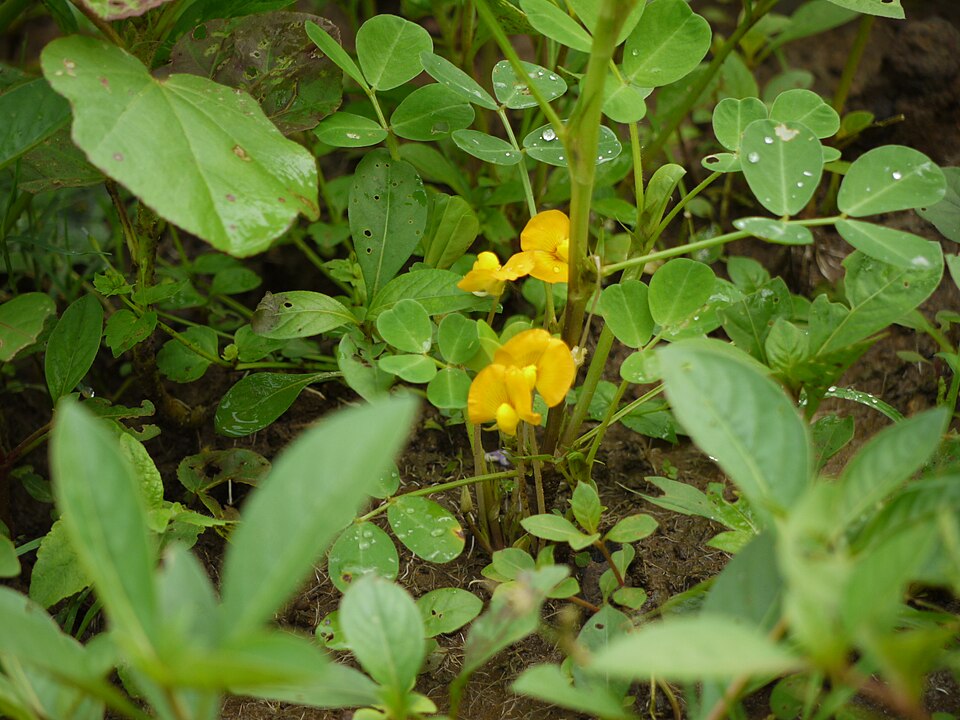
This leaf is of which plant?
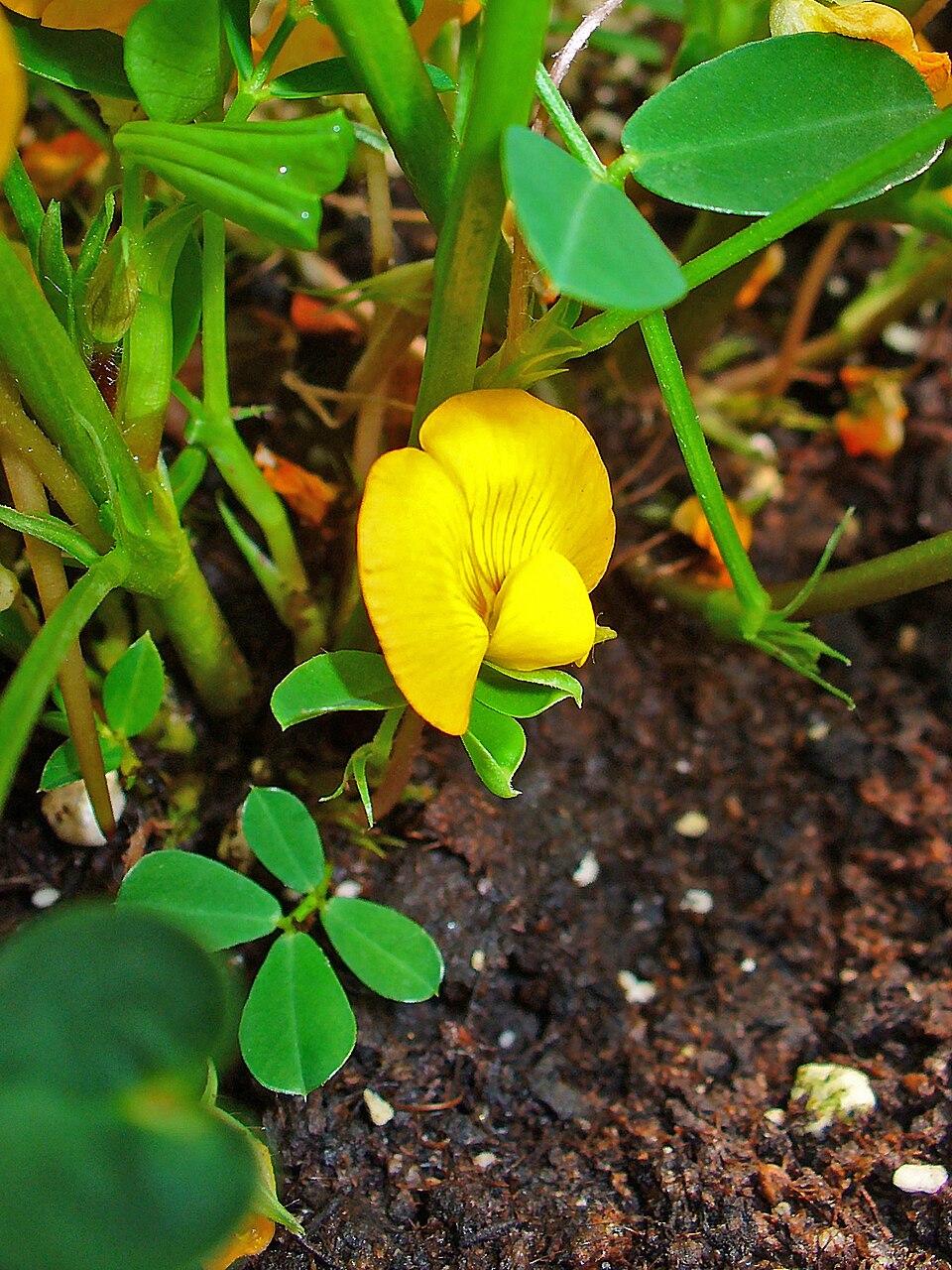
Which crop's flower is this?
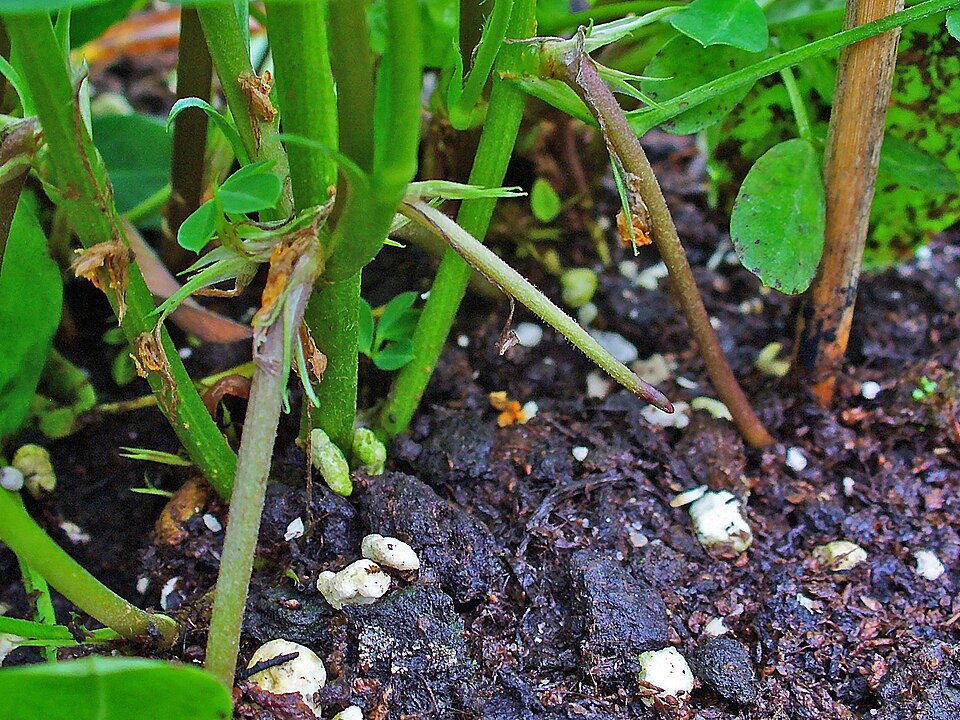
What is this stalk growing downwards into the soil, and why does it matter more than anything else on the plant?
Honest Limits of This Guide
- The right month to plant is different in every country and even in every valley. This guide gives you the rule instead: sow so the crop flowers and fills its pods inside your reliable rains, and ripens as the land dries.
- Plant spacing genuinely differs between countries for real reasons. The published national recommendations gathered here range from about 100,000 to 330,000 plants per hectare. Take your local one from your extension office; use the numbers here to understand the pattern, not to override local advice.
- Gypsum rates in this guide are the range published across real trials, roughly 200 to 500 kg per hectare. The right rate for your field depends on how much calcium your soil already has, which only a soil test can tell you.
- The exact percentage of dark-scraped pods that should trigger lifting differs by variety and region. This guide teaches the method and deliberately does not invent a threshold.
- The economic figures are from one research station in Mali, in specific years, in US dollars, and their own authors did not count unpaid family labour. They show the shape of groundnut economics honestly; they are not a forecast for your farm.
- Variety names are local. Ask your neighbours and your local agricultural officer which released variety does well on land like yours, whether it is high-oleic, and how many days it needs.
- This guide does not name any pesticide, fungicide or herbicide product or compound. It names mode-of-action groups and the toxicity colour-band principle only. If you decide to use a product, buy only from a licensed dealer and follow the label on the actual package.
- The toxicity colour band is a principle, not a fixed chemical-to-colour list. The same active substance can sit in a different band in a different formulation or country, and registrations change. Read the real triangle on the real package.
- On aflatoxin, this guide states the European Union limits because it read them directly in Commission Regulation (EU) 2023/915, and the Kenyan, US and broad African figures because a CGIAR farmer training manual states them. It does NOT state a Codex figure for groundnut, because Laisha has repeatedly failed to retrieve Codex CXS 193-1995 — the document endpoints return HTTP 403. That gap is disclosed rather than filled with a guess.
- No photograph can confirm or rule out aflatoxin. Visible mould, insect boring and caked kernels are real risk indicators that justify laboratory testing. They are not a measurement, and their absence is not safety.
- FAOSTAT itself marks some of the biggest groundnut production figures in the world as estimated, imputed or supplied by an external organization rather than officially reported. Those markings are reproduced in this guide rather than hidden.
Related Laisha Tools
- Global Market Price Outlook — Check today's price and trend
- Crop Calendar — Build a season-long sowing plan
- Pest & Disease Intelligence — Risk reasoning and a global pest & disease library
- Crop Health — Photo-based first read on a field problem
- Seed Quality Intelligence — Check a seed lot before you plant it
- Post-Harvest Loss Prevention — Real storage science by crop
Open the free Applied Agriculture Library in the Laisha app →
Sources
- GBIF Backbone Taxonomy record for Arachis hypogaea L. (usage key 5353770) — Global Biodiversity Information Facility (GBIF), Copenhagen (source)
- World Checklist of Vascular Plants (WCVP), the checklist behind Plants of the World Online — record for Arachis hypogaea L. — Royal Botanic Gardens, Kew (source)
- EPPO Global Database entry for Arachis hypogaea (EPPO code ARHHY) — European and Mediterranean Plant Protection Organization (EPPO), Paris (source)
- FAOSTAT: Production — Crops and livestock products, item 242 'Groundnuts, excluding shelled' (full normalized bulk data file, released 2025-12-23) — Food and Agriculture Organization of the United Nations, Rome (source)
- Global Crop Priority Research (globalCropPriorityResearch.json) — Laisha internal reference data set, built on FAOSTAT (source)
- Compendium of Peanut Diseases, Second Edition — APS Press, The American Phytopathological Society, St. Paul, Minnesota. Edited by N. Kokalis-Burelle (Auburn University), D. M. Porter (USDA Agricultural Research Service), R. Rodriguez-Kabana (Auburn University), D. H. Smith (Texas A&M University) and P. Subrahmanyam (ICRISAT, Lilongwe, Malawi). Open copy hosted by the Open Access Repository of ICRISAT. (source)
- Desmae, H., Sako, D. and Konate, D. (2022). Optimum Plant Density for Increased Groundnut Pod Yield and Economic Benefits in the Semi-Arid Tropics of West Africa. Agronomy 12(6):1474 — MDPI, on behalf of the International Crops Research Institute for the Semi-Arid Tropics (ICRISAT), Bamako, Mali, and the Institut d'Economie Rurale (IER), Kayes, Mali. Open access under CC BY 4.0. (source)
- Kadirimangalam, S. R., Sawargaonkar, G. and Choudhari, P. (2022). Morphological and molecular insights of calcium in peanut pod development. Journal of Agriculture and Food Research 9:100320 — Elsevier, authored at the International Crops Research Institute for the Semi-Arid Tropics (ICRISAT), Patancheru, Hyderabad, India. Open access under CC BY-NC-ND 4.0. (source)
- Davis, J. P., Price, K. M., Dean, L. L., Sweigart, D. S., Cottonaro, J. M. and Sanders, T. H. (2016). Peanut Oil Stability and Physical Properties Across a Range of Industrially Relevant Oleic Acid/Linoleic Acid Ratios. Peanut Science 43(1):1-11 — American Peanut Research and Education Society, work carried out at the USDA Agricultural Research Service Market Quality and Handling Research Unit, Raleigh, North Carolina (source)
- Williams, E. J. and Drexler, J. S. (1981). A Non-Destructive Method for Determining Peanut Pod Maturity. Peanut Science 8(2) — American Peanut Research and Education Society (source)
- IITA (2018). Atehnkeng, J., Mutegi, C., Ortega-Beltran, A., Augusto, J., Akande, A., Senghor, L. A., Falade, T., Akello, J., Cotty, P. J. and Bandyopadhyay, R. Management of Aflatoxins in Maize and Groundnuts in Kenya: A Farmers' Training Manual. 25 pp. ISBN 978-978-131-350-9 — International Institute of Tropical Agriculture (IITA), Ibadan, Nigeria, with the Kenya Agricultural and Livestock Research Organisation (KALRO), Nairobi. Hosted on CGSpace, the CGIAR repository. (source)
- Commission Regulation (EU) 2023/915 of 25 April 2023 on maximum levels for certain contaminants in food, Annex I section 1.1 (Aflatoxins) and Article 6 (labelling provisions for groundnuts, other oilseeds, derived products and cereals) — European Commission, Official Journal of the European Union (source)
- Council Directive 2002/57/EC on the marketing of seed of oil and fibre plants, Annex II sections I(1) and I(4)(A) — groundnut (Arachis hypogaea) entry (consolidated version of 2024-12-24) — Council of the European Union, Official Journal of the European Union (source)
- Global Seed Certification Standards (globalSeedCertificationStandards.json) — Laisha internal reference data set, compiled from the primary legal instruments it cites (source)
- Leaf Visual Diagnostic Reference (leafVisualDiagnosticReference.json), entry 'groundnut-rosette' within its 53 named diseases — Laisha internal reference data set (source)
- Grain Visual Diagnostic Reference (grainVisualDiagnosticReference.json), its aflatoxin honesty rules and its cross-standard consensus analysis — Laisha internal reference data set (source)
- Agrochemical Reference (agrochemicalReference.json) — IRAC, FRAC and HRAC mode-of-action classifications, and the India Insecticides Act 1968 / Insecticide Rules 1971 colour-coded hazard triangle — Laisha internal reference data set, built on IRAC, FRAC, HRAC and the Central Insecticides Board & Registration Committee (CIBRC), Government of India (source)