LAISHA
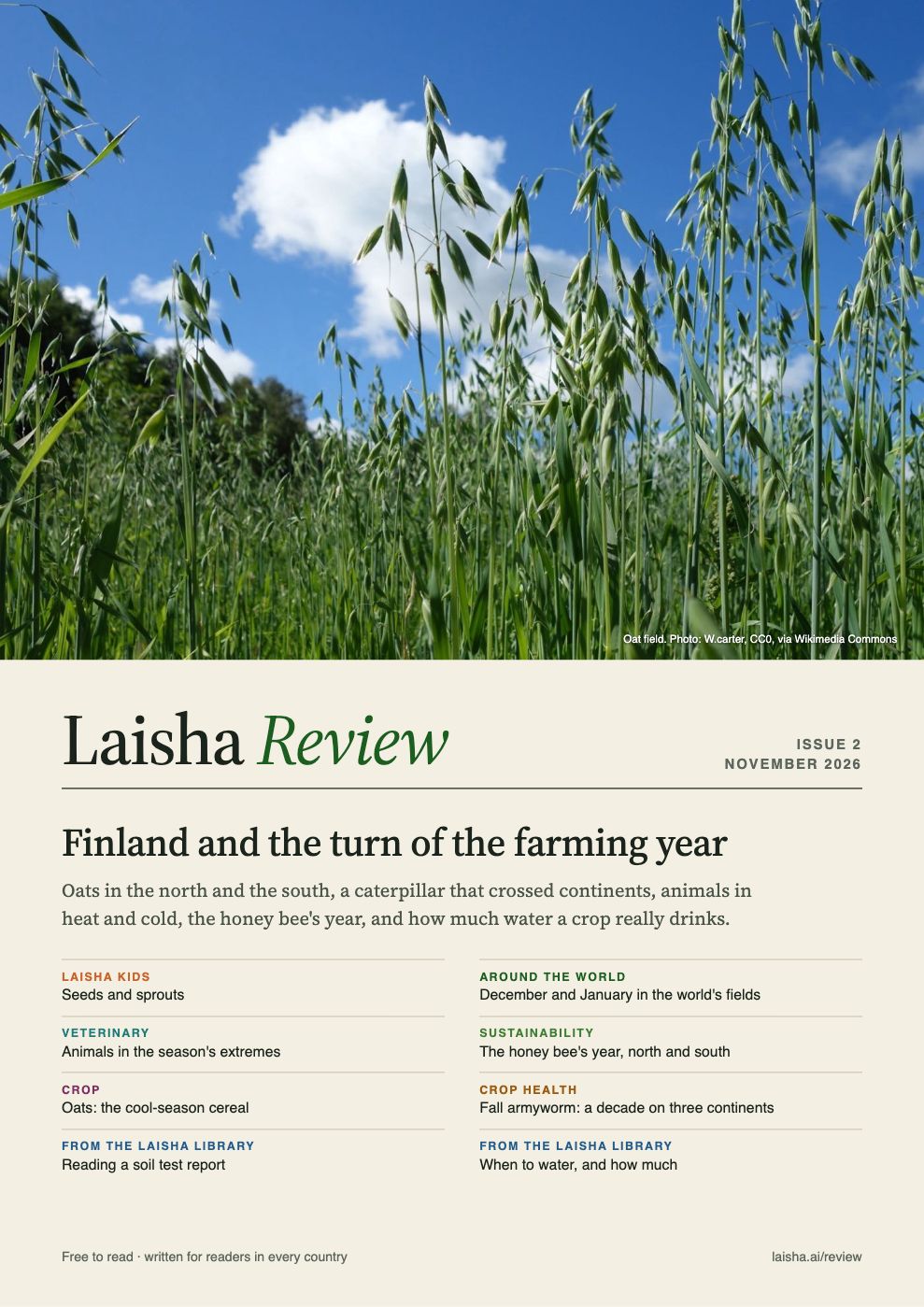
Cover of Laisha Review Issue 2, 18 November 2026: Finland and the turn of the farming year

Issue 2 · 18 November 2026 · 51 pages

Finland and the turn of the farming year

Oats in the north and the south, a caterpillar that crossed continents, animals in heat and cold, the honey bee's year, and how much water a crop really drinks.

Laisha Review · Monthly

Get the next issue by email

One email a month when a new issue is out: a degree manual, a crop from field to harvest, an app inside Laisha, a new Laisha Kids book and one of the world's happiest countries.

We will first email you a link to confirm; nothing is sent until you do. Every email has a one-click unsubscribe link. We use your address only to send the magazine. Privacy

Welcome

One magazine, two seasons

December is early summer in the south and early winter in the north. This issue is written for both.

This issue reaches you at the turn of the farming year, and the turn looks different depending on where you stand. South of the equator, December is early summer: maize is racing up in southern Africa and South America, oats are being harvested across Australia, beehives are at their busiest, and dairy cows are looking for shade. North of it, the fields are resting, hives are clustered against the cold, cattle are on winter feed, and farmers are planning next season at the kitchen table.

So Issue 2 is written for both halves of the world at once. Our crop health story follows the fall armyworm, a caterpillar that has crossed continents in a decade, and what a careful farmer can do about it. Our crop is the oat, sown in spring in Finland and harvested in early summer in Australia. Our veterinary pages are about animals in the season's extremes, heat in one hemisphere and cold in the other. The bees get their own story, and so does the water: how to work out how much your crop drinks, with nothing more than a weather figure and a pencil.

Our happy country this time is Finland, ranked first in the World Happiness Report 2026 for a record ninth year in a row. Its farmers make the most of a short summer, under a sun that in the far north does not set at all for weeks. Children get a story of seeds and sprouts, with a bean to grow on a windowsill. And we show you the parts of Laisha that cost nothing at all.

This is also a bigger issue than our first, with more to keep and use. A tour of the world's fields in December and January opens it. There is a guide to reading a soil test report, a chapter on keeping the harvest you grew, and a farm cash book worked through line by line. Students get 33 exam-style practice questions with answers, and a glossary at the back explains every technical word in the issue. Several pages are made to be copied into a notebook: a fall armyworm scouting sheet, a water balance, a table of crop coefficients and a season checklist for each kind of livestock.

Tell us what to write next

This magazine is made for you, so we would like to hear from you. Which article did you read to the end? Which one did you skip? What should we explain next: a crop from your country, a pest in your fields, a question your teacher could not answer? Write to us at the address on laisha.ai/contact, or, if you have a Laisha account, through Feedback and Ideas in the app. Every message is read, and the best ideas become articles.

If this issue was useful, pass it on to one person who grows, studies or simply loves plants. It is free, and it stays free.

— The Laisha team
In this issue

Page numbers as in print

  1. 4Laisha KidsSeeds and sproutsInside every dry bean is a baby plant with a packed lunch. What wakes it up, which part comes out first, and a bean in a jar to watch on your windowsill.
  2. 7Around the worldDecember and January in the world's fieldsPlanting in the southern rains, harvest across Australia and Argentina, rice in the Asian lowlands and winter wheat asleep under snow: what is happening in the fields of every region this month and next.
  3. 10VeterinaryAnimals in the season's extremesDecember brings summer heat to cattle in the south and winter cold to herds in the north. How to read an animal's comfort, and the simple things that keep it inside its comfort zone.
  4. 14SustainabilityThe honey bee's year, north and southIn December one half of the world's hives are clustered against the cold while the other half are at their busiest. What bees do in each season, and what farmers can do for them.
  5. 17CropOats: the cool-season cerealSown in spring in Finland and harvested at the start of summer in Australia, the oat is a hardy grain with a long record on poorer soils. How it is grown, and what to watch for.
  6. 21Crop healthFall armyworm: a decade on three continentsA caterpillar from the Americas reached Africa in 2016 and has since spread across Asia and into Australia. How to recognise it, how to scout for it, and why spraying first is rarely the answer.
  7. 25From the Laisha LibraryReading a soil test reportpH, organic matter, CEC, salinity and the nutrient numbers: how to take a sample the laboratory can trust, and what each line on the report means for your field.
  8. 28From the Laisha LibraryWhen to water, and how muchHow much water does a crop really use in a day? The FAO method the world's irrigation engineers use, done with a weather figure, a crop coefficient and a pencil. A tour of Laisha's manual on Irrigation Engineering.
  9. 32After the harvestKeeping the harvest you grewA large share of food is lost between the field and the market. Drying, clean stores, airtight bags and a few habits that keep grain and fresh produce safe.
  10. 35Farm businessA farm cash book, worked throughWhich crop made money, and which quietly lost it? A notebook, ten minutes a week and a gross margin will tell you. A worked example from Laisha's manual on Farm Management.
  11. 38Free in LaishaThe tools that cost nothingLand unit conversions, bags in a stack, a farm diary, libraries of guides and pests, and a few questions a day to Ask Laisha: the parts of Laisha that are free, and stay free.
  12. 40Country FunFinland: forests, lakes and the midnight sunA northern land of almost 188,000 lakes, wild berries anyone may pick, reindeer and a short, bright farming summer. Say “Hei!” to this issue's happy country.
  13. 42StudentsTest yourself: 33 exam-style questionsWater, animals, pollinators, soil and grain: practice questions from Laisha's question banks on the topics in this issue, with answers and explanations.
  14. 48ReferenceWords in this issueFrom avenin to the winter cluster: the technical terms in Issue 2, explained in plain language, with the article each one comes from.
  15. 51Back pageThe Issue 2 quizFive questions, one from each corner of this issue.

Laisha Kids · Class 1 · Ages 6–7

Seeds and sprouts

Inside every dry bean is a baby plant with a packed lunch. What wakes it up, which part comes out first, and a bean in a jar to watch on your windowsill.

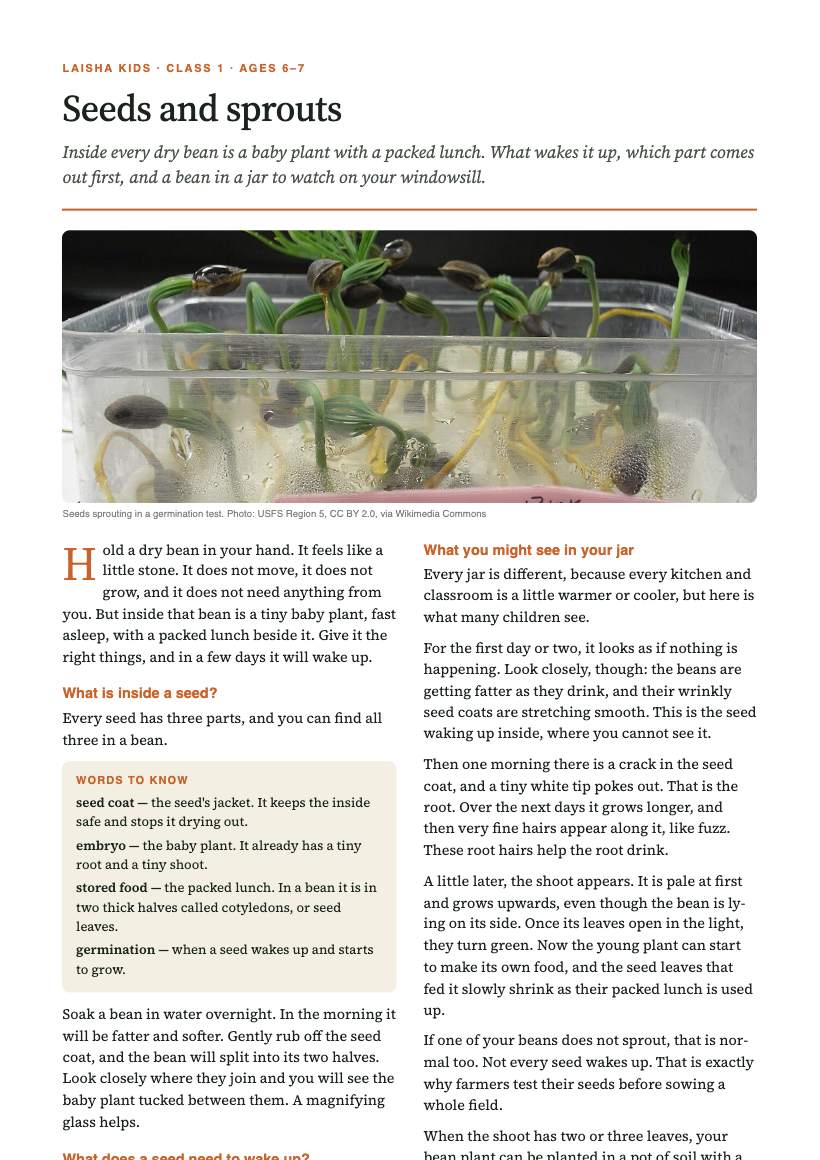
Hold a dry bean in your hand. It feels like a little stone. It does not move, it does not grow, and it does not need anything from you. But inside that bean is a tiny baby plant, fast asleep, with a packed lunch beside it. Give it the right things, and in a few days it will wake up.

Every seed has three parts, and you can find all three in a bean.

Continue reading →Read the Class 1 book on laisha.ai

Page 4 of Laisha Review Issue 2: Seeds and sprouts

Page 4 in print

Around the world · Crop calendar

December and January in the world's fields

Planting in the southern rains, harvest across Australia and Argentina, rice in the Asian lowlands and winter wheat asleep under snow: what is happening in the fields of every region this month and next.

On any day of the year, somebody somewhere is sowing, somebody is weeding and somebody is harvesting. December and January show it more clearly than any other months, because the two hemispheres are at opposite ends of their seasons. This article takes a tour of the world's fields in these two months, region by region, using the crop monitoring reports of the Food and Agriculture Organization of the United Nations (FAO), the GEOGLAM Crop Monitor and national agencies.

Two kinds of source stand behind it. For the usual timing of each season we use FAO's GIEWS country briefs, the early warning system's notes on each country's crops, some of them written during last year's season; they show the normal rhythm, so we describe them as what typically happens. For this season, 2026/27, we use the November 2026 GEOGLAM Crop Monitor reports and the latest national releases. Local timing always varies with altitude, rainfall and variety, so treat this as a map, not a timetable.

Continue reading →December's farming calendar on laisha.ai

Page 7 of Laisha Review Issue 2: December and January in the world's fields

Page 7 in print

Veterinary · Degree manual

Animals in the season's extremes

December brings summer heat to cattle in the south and winter cold to herds in the north. How to read an animal's comfort, and the simple things that keep it inside its comfort zone.

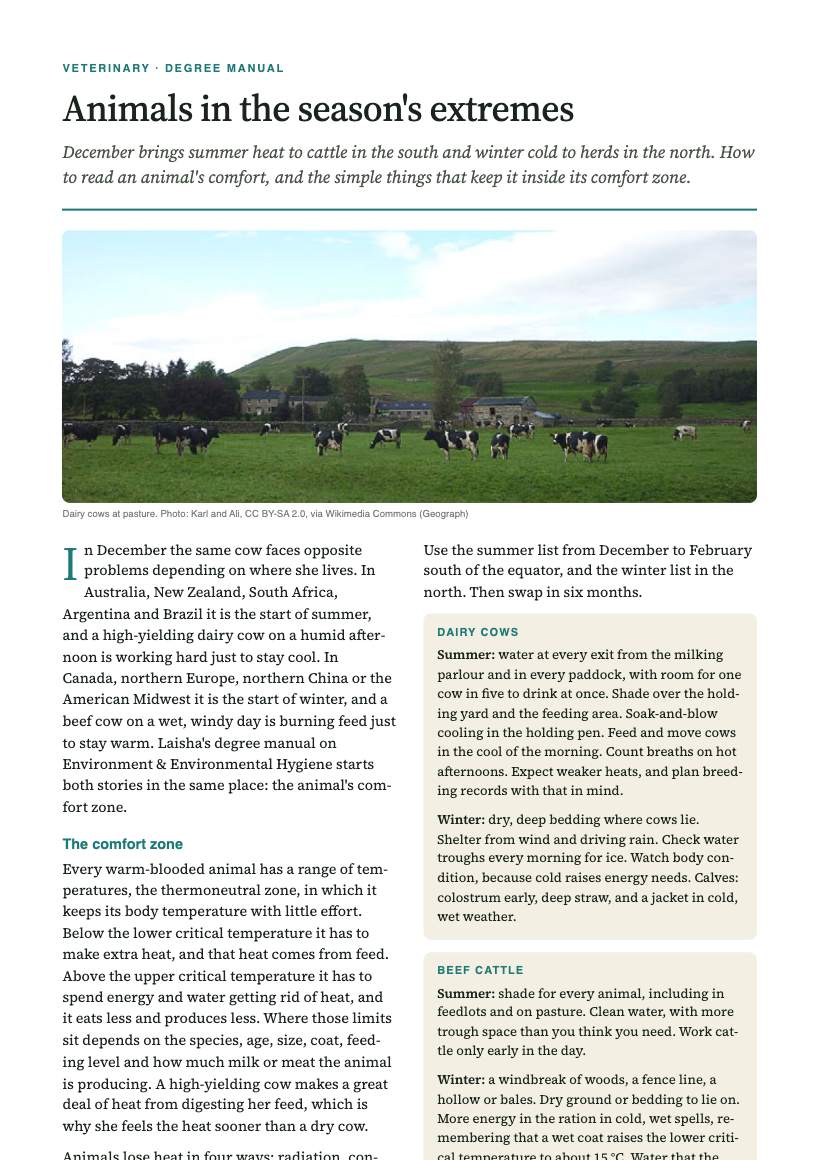
In December the same cow faces opposite problems depending on where she lives. In Australia, New Zealand, South Africa, Argentina and Brazil it is the start of summer, and a high-yielding dairy cow on a humid afternoon is working hard just to stay cool. In Canada, northern Europe, northern China or the American Midwest it is the start of winter, and a beef cow on a wet, windy day is burning feed just to stay warm. Laisha's degree manual on Environment & Environmental Hygiene starts both stories in the same place: the animal's comfort zone.

Every warm-blooded animal has a range of temperatures, the thermoneutral zone, in which it keeps its body temperature with little effort. Below the lower critical temperature it has to make extra heat, and that heat comes from feed. Above the upper critical temperature it has to spend energy and water getting rid of heat, and it eats less and produces less. Where those limits sit depends on the species, age, size, coat, feeding level and how much milk or meat the animal is producing. A high-yielding cow makes a great deal of heat from digesting her feed, which is why she feels the heat sooner than a dry cow.

Continue reading →Read the full manual on laisha.ai

Page 10 of Laisha Review Issue 2: Animals in the season's extremes

Page 10 in print

Sustainability · Degree manual

The honey bee's year, north and south

In December one half of the world's hives are clustered against the cold while the other half are at their busiest. What bees do in each season, and what farmers can do for them.

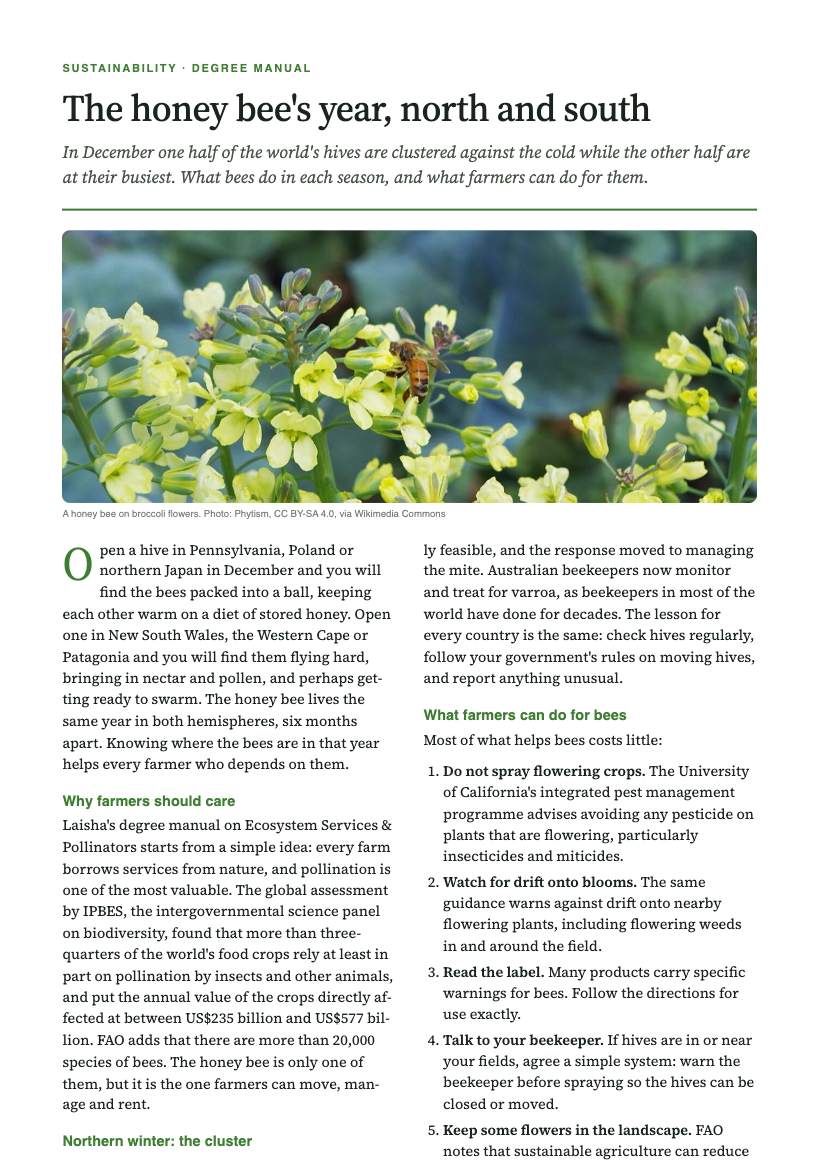
Open a hive in Pennsylvania, Poland or northern Japan in December and you will find the bees packed into a ball, keeping each other warm on a diet of stored honey. Open one in New South Wales, the Western Cape or Patagonia and you will find them flying hard, bringing in nectar and pollen, and perhaps getting ready to swarm. The honey bee lives the same year in both hemispheres, six months apart. Knowing where the bees are in that year helps every farmer who depends on them.

Laisha's degree manual on Ecosystem Services & Pollinators starts from a simple idea: every farm borrows services from nature, and pollination is one of the most valuable. The global assessment by IPBES, the intergovernmental science panel on biodiversity, found that more than three-quarters of the world's food crops rely at least in part on pollination by insects and other animals, and put the annual value of the crops directly affected at between US$235 billion and US$577 billion. FAO adds that there are more than 20,000 species of bees. The honey bee is only one of them, but it is the one farmers can move, manage and rent.

Continue reading →Read the full manual on laisha.ai

Page 14 of Laisha Review Issue 2: The honey bee's year, north and south

Page 14 in print

Crop · Grow guide

Oats: the cool-season cereal

Sown in spring in Finland and harvested at the start of summer in Australia, the oat is a hardy grain with a long record on poorer soils. How it is grown, and what to watch for.

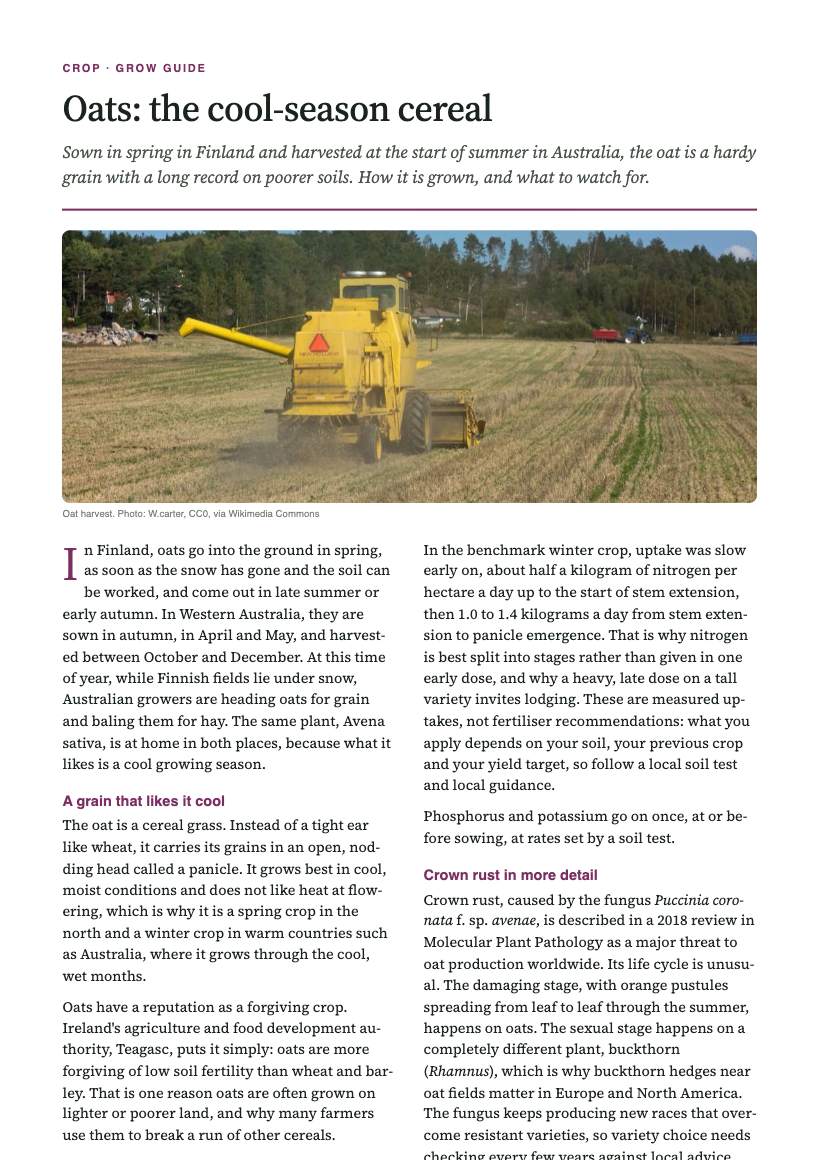
In Finland, oats go into the ground in spring, as soon as the snow has gone and the soil can be worked, and come out in late summer or early autumn. In Western Australia, they are sown in autumn, in April and May, and harvested between October and December. At this time of year, while Finnish fields lie under snow, Australian growers are heading oats for grain and baling them for hay. The same plant, Avena sativa, is at home in both places, because what it likes is a cool growing season.

The oat is a cereal grass. Instead of a tight ear like wheat, it carries its grains in an open, nodding head called a panicle. It grows best in cool, moist conditions and does not like heat at flowering, which is why it is a spring crop in the north and a winter crop in warm countries such as Australia, where it grows through the cool, wet months.

Continue reading →Read the full grow guide on laisha.ai

Page 17 of Laisha Review Issue 2: Oats: the cool-season cereal

Page 17 in print

Crop health · Pest watch

Fall armyworm: a decade on three continents

A caterpillar from the Americas reached Africa in 2016 and has since spread across Asia and into Australia. How to recognise it, how to scout for it, and why spraying first is rarely the answer.

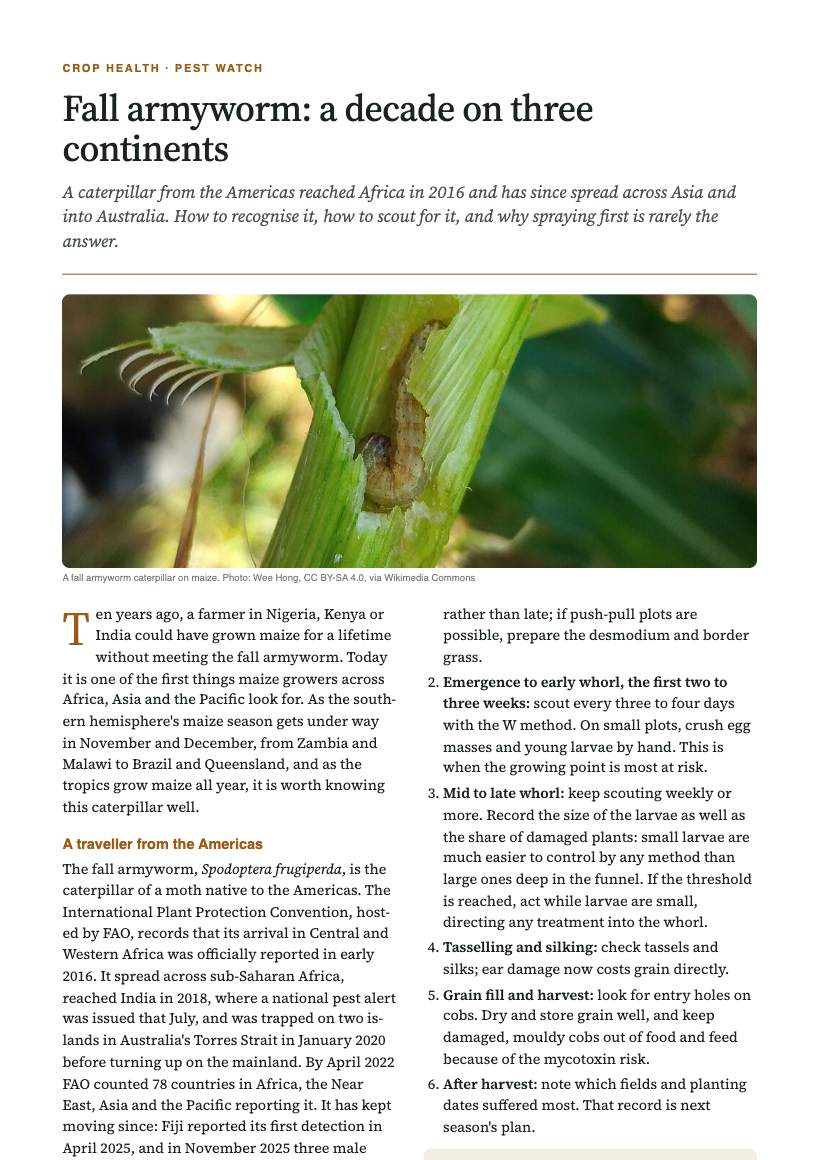
Ten years ago, a farmer in Nigeria, Kenya or India could have grown maize for a lifetime without meeting the fall armyworm. Today it is one of the first things maize growers across Africa, Asia and the Pacific look for. As the southern hemisphere's maize season gets under way in November and December, from Zambia and Malawi to Brazil and Queensland, and as the tropics grow maize all year, it is worth knowing this caterpillar well.

The fall armyworm, Spodoptera frugiperda, is the caterpillar of a moth native to the Americas. The International Plant Protection Convention, hosted by FAO, records that its arrival in Central and Western Africa was officially reported in early 2016. It spread across sub-Saharan Africa, reached India in 2018, where a national pest alert was issued that July, and was trapped on two islands in Australia's Torres Strait in January 2020 before turning up on the mainland. By April 2022 FAO counted 78 countries in Africa, the Near East, Asia and the Pacific reporting it. It has kept moving since: Fiji reported its first detection in April 2025, and in November 2025 three male moths were caught in a trap in a maize field in southern Spain, a find the European plant protection organisation lists as transient and under surveillance.

Continue reading →Read the pest page on laisha.ai

Page 21 of Laisha Review Issue 2: Fall armyworm: a decade on three continents

Page 21 in print

From the Laisha Library · Soil science

Reading a soil test report

pH, organic matter, CEC, salinity and the nutrient numbers: how to take a sample the laboratory can trust, and what each line on the report means for your field.

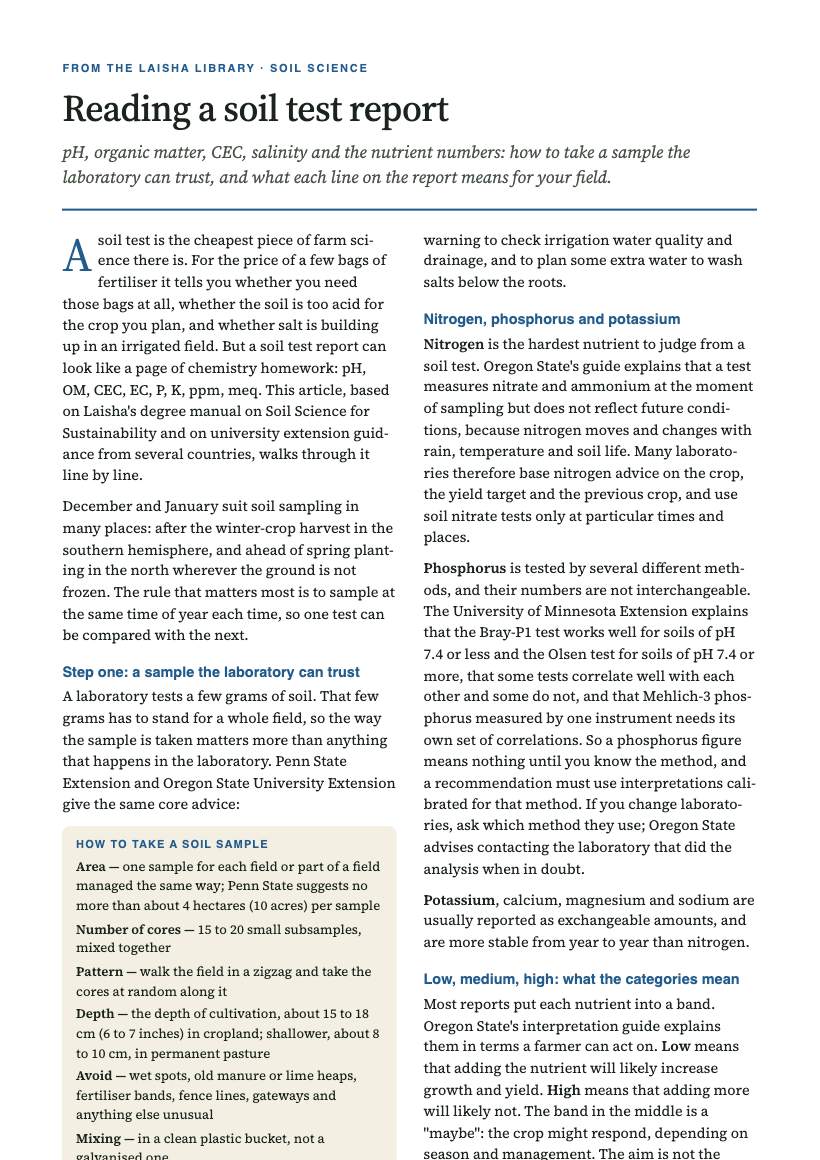
A soil test is the cheapest piece of farm science there is. For the price of a few bags of fertiliser it tells you whether you need those bags at all, whether the soil is too acid for the crop you plan, and whether salt is building up in an irrigated field. But a soil test report can look like a page of chemistry homework: pH, OM, CEC, EC, P, K, ppm, meq. This article, based on Laisha's degree manual on Soil Science for Sustainability and on university extension guidance from several countries, walks through it line by line.

December and January suit soil sampling in many places: after the winter-crop harvest in the southern hemisphere, and ahead of spring planting in the north wherever the ground is not frozen. The rule that matters most is to sample at the same time of year each time, so one test can be compared with the next.

Continue reading →Read the full manual on laisha.ai

Page 25 of Laisha Review Issue 2: Reading a soil test report

Page 25 in print

From the Laisha Library · Agricultural engineering

When to water, and how much

How much water does a crop really use in a day? The FAO method the world's irrigation engineers use, done with a weather figure, a crop coefficient and a pencil. A tour of Laisha's manual on Irrigation Engineering.

December pulls the world's fields in two directions. South of the equator it is early summer: maize in Brazil, Argentina and southern Africa is growing fast, orchards in Australia, Chile and South Africa are carrying fruit, and the sun is close to its highest. North of it, most fields are resting, winter wheat is barely growing, and the work is planning next season's water. Both halves are asking the same question: how much water does this crop actually use, and when should I put it back?

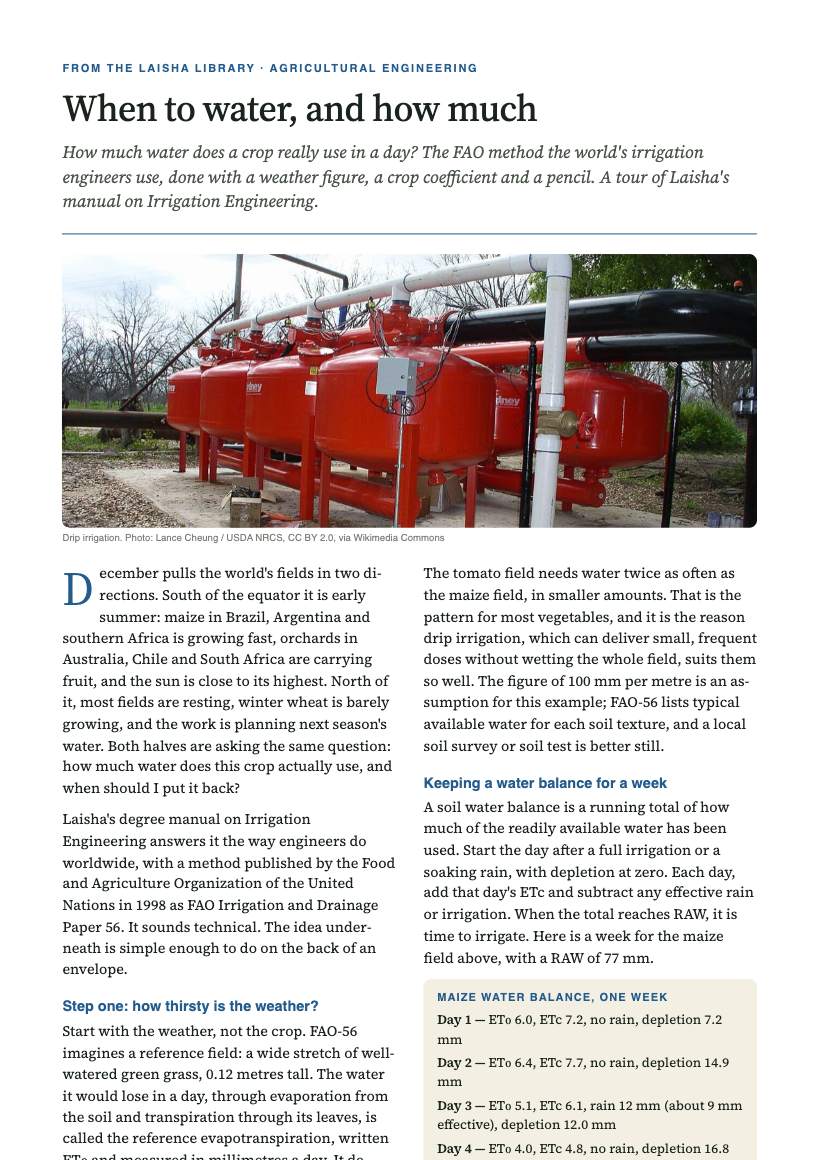
Laisha's degree manual on Irrigation Engineering answers it the way engineers do worldwide, with a method published by the Food and Agriculture Organization of the United Nations in 1998 as FAO Irrigation and Drainage Paper 56. It sounds technical. The idea underneath is simple enough to do on the back of an envelope.

Continue reading →Read the full manual on laisha.ai

Page 28 of Laisha Review Issue 2: When to water, and how much

Page 28 in print

After the harvest · Storage

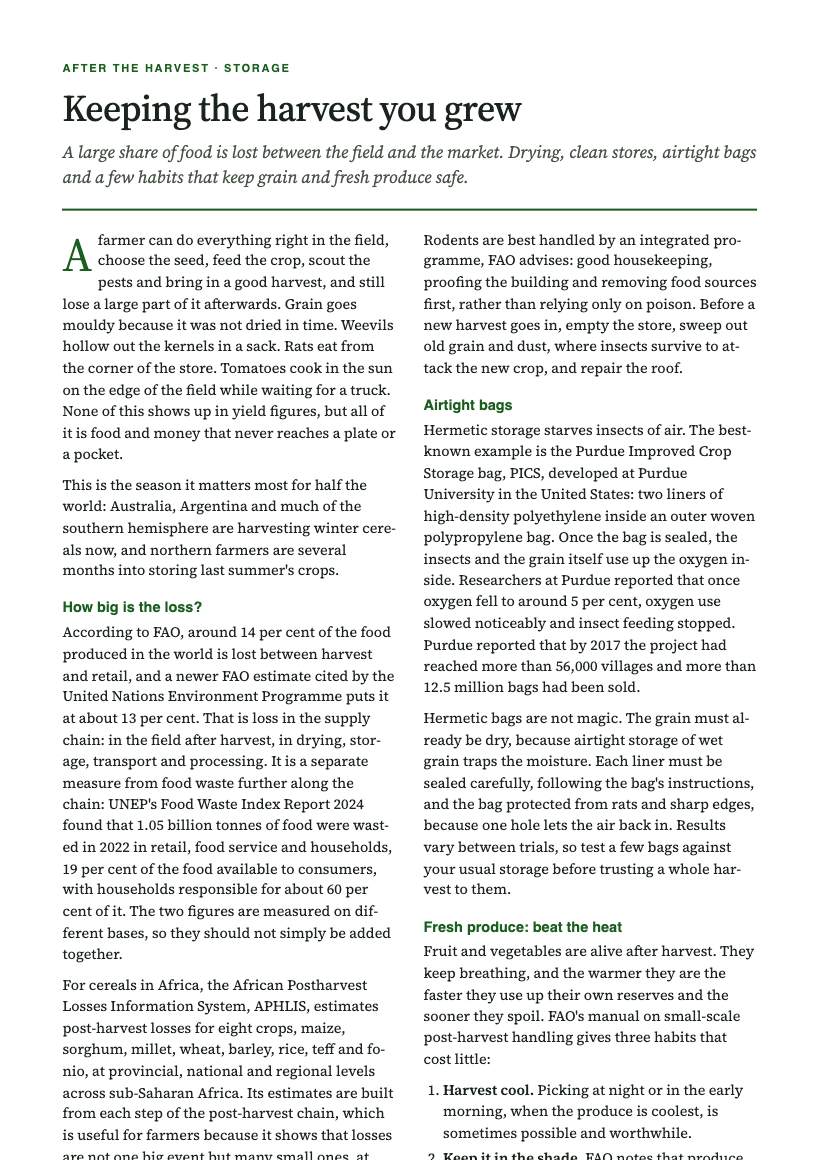
Keeping the harvest you grew

A large share of food is lost between the field and the market. Drying, clean stores, airtight bags and a few habits that keep grain and fresh produce safe.

A farmer can do everything right in the field, choose the seed, feed the crop, scout the pests and bring in a good harvest, and still lose a large part of it afterwards. Grain goes mouldy because it was not dried in time. Weevils hollow out the kernels in a sack. Rats eat from the corner of the store. Tomatoes cook in the sun on the edge of the field while waiting for a truck. None of this shows up in yield figures, but all of it is food and money that never reaches a plate or a pocket.

This is the season it matters most for half the world: Australia, Argentina and much of the southern hemisphere are harvesting winter cereals now, and northern farmers are several months into storing last summer's crops.

Continue reading →Post-harvest guidance on laisha.ai on laisha.ai

Page 32 of Laisha Review Issue 2: Keeping the harvest you grew

Page 32 in print

Farm business · Degree manual

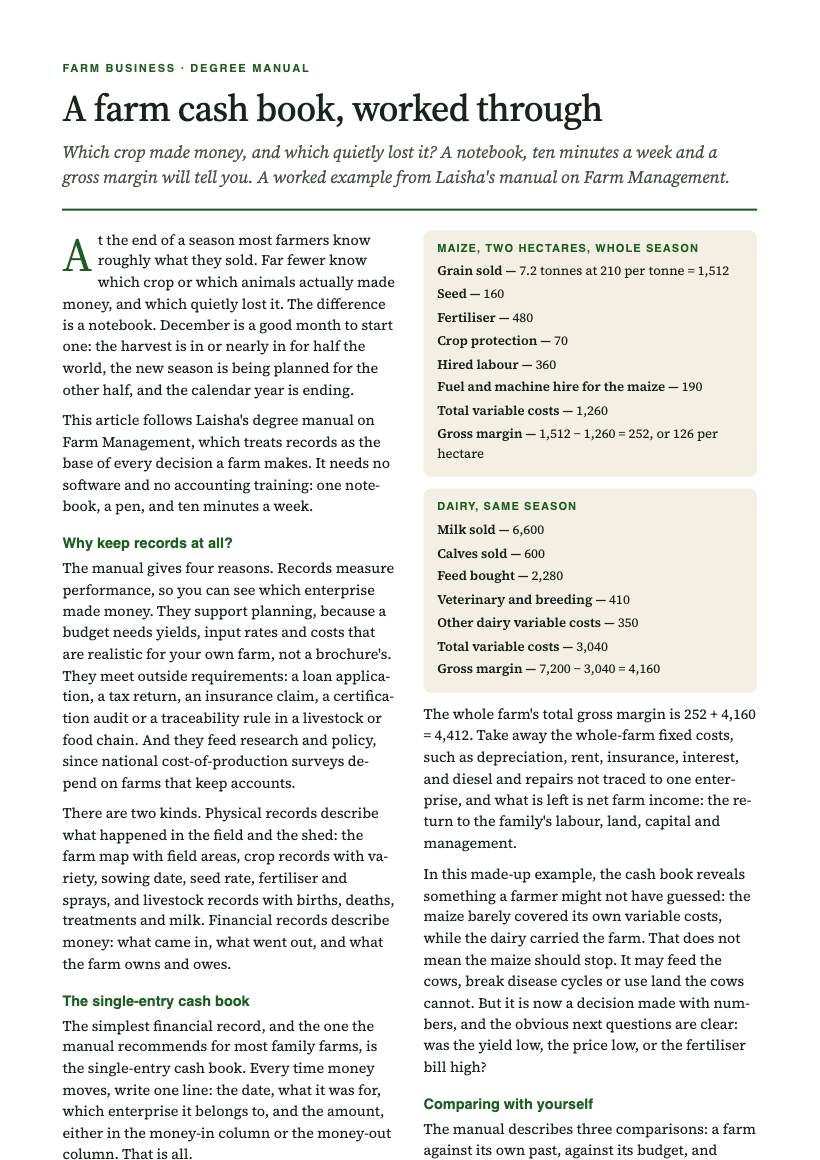
A farm cash book, worked through

Which crop made money, and which quietly lost it? A notebook, ten minutes a week and a gross margin will tell you. A worked example from Laisha's manual on Farm Management.

At the end of a season most farmers know roughly what they sold. Far fewer know which crop or which animals actually made money, and which quietly lost it. The difference is a notebook. December is a good month to start one: the harvest is in or nearly in for half the world, the new season is being planned for the other half, and the calendar year is ending.

This article follows Laisha's degree manual on Farm Management, which treats records as the base of every decision a farm makes. It needs no software and no accounting training: one notebook, a pen, and ten minutes a week.

Continue reading →Read the full manual on laisha.ai

Page 35 of Laisha Review Issue 2: A farm cash book, worked through

Page 35 in print

Free in Laisha · Tools

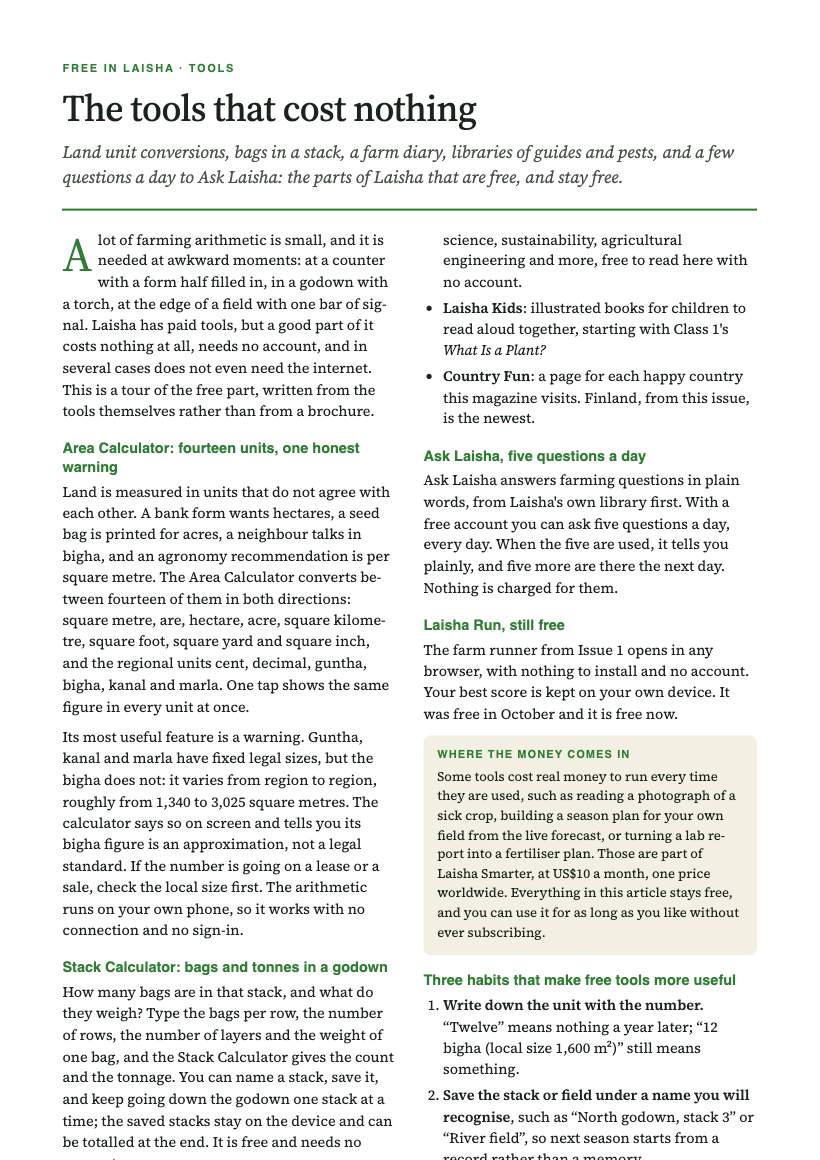
The tools that cost nothing

Land unit conversions, bags in a stack, a farm diary, libraries of guides and pests, and a few questions a day to Ask Laisha: the parts of Laisha that are free, and stay free.

A lot of farming arithmetic is small, and it is needed at awkward moments: at a counter with a form half filled in, in a godown with a torch, at the edge of a field with one bar of signal. Laisha has paid tools, but a good part of it costs nothing at all, needs no account, and in several cases does not even need the internet. This is a tour of the free part, written from the tools themselves rather than from a brochure.

Land is measured in units that do not agree with each other. A bank form wants hectares, a seed bag is printed for acres, a neighbour talks in bigha, and an agronomy recommendation is per square metre. The Area Calculator converts between fourteen of them in both directions: square metre, are, hectare, acre, square kilometre, square foot, square yard and square inch, and the regional units cent, decimal, guntha, bigha, kanal and marla. One tap shows the same figure in every unit at once.

Continue reading →See every Laisha tool on laisha.ai

Page 38 of Laisha Review Issue 2: The tools that cost nothing

Page 38 in print

Country Fun · Issue 2

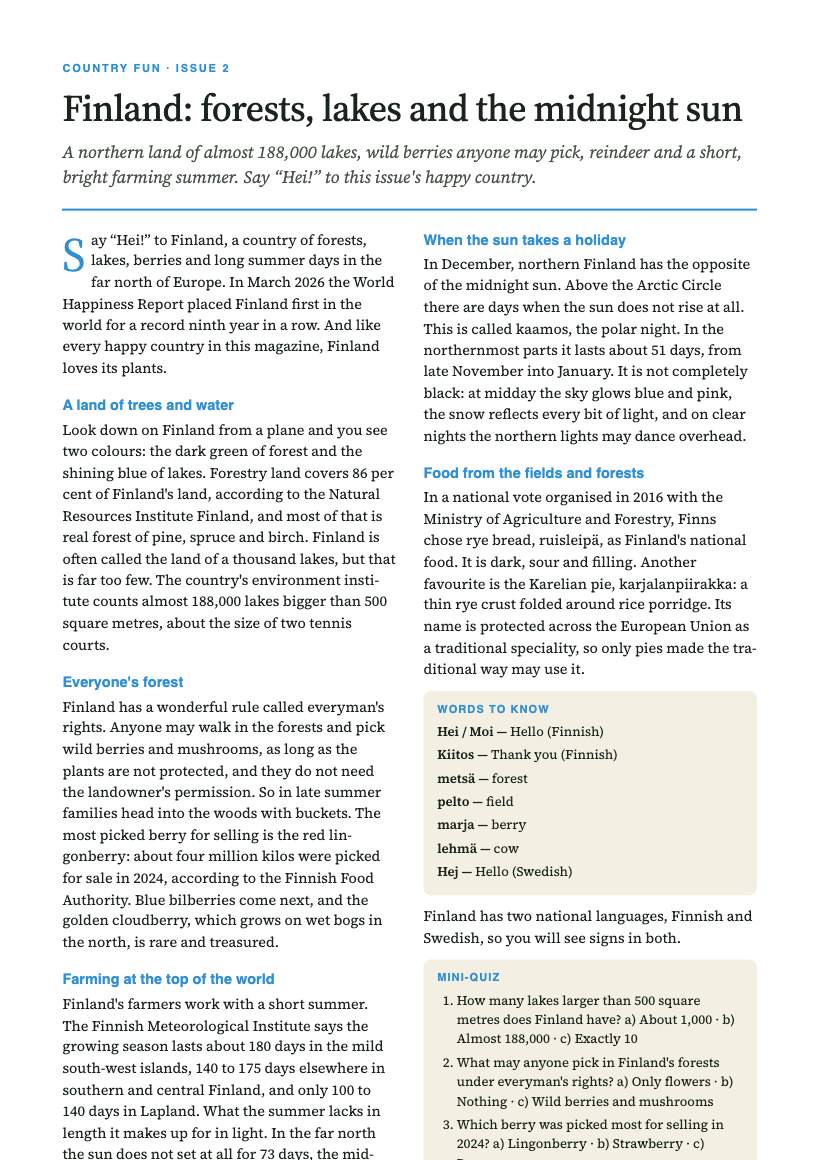
Finland: forests, lakes and the midnight sun

A northern land of almost 188,000 lakes, wild berries anyone may pick, reindeer and a short, bright farming summer. Say “Hei!” to this issue's happy country.

Say “Hei!” to Finland, a country of forests, lakes, berries and long summer days in the far north of Europe. In March 2026 the World Happiness Report placed Finland first in the world for a record ninth year in a row. And like every happy country in this magazine, Finland loves its plants.

Look down on Finland from a plane and you see two colours: the dark green of forest and the shining blue of lakes. Forestry land covers 86 per cent of Finland's land, according to the Natural Resources Institute Finland, and most of that is real forest of pine, spruce and birch. Finland is often called the land of a thousand lakes, but that is far too few. The country's environment institute counts almost 188,000 lakes bigger than 500 square metres, about the size of two tennis courts.

Continue reading →More Country Fun on laisha.ai

Page 40 of Laisha Review Issue 2: Finland: forests, lakes and the midnight sun

Page 40 in print

Students · Practice questions

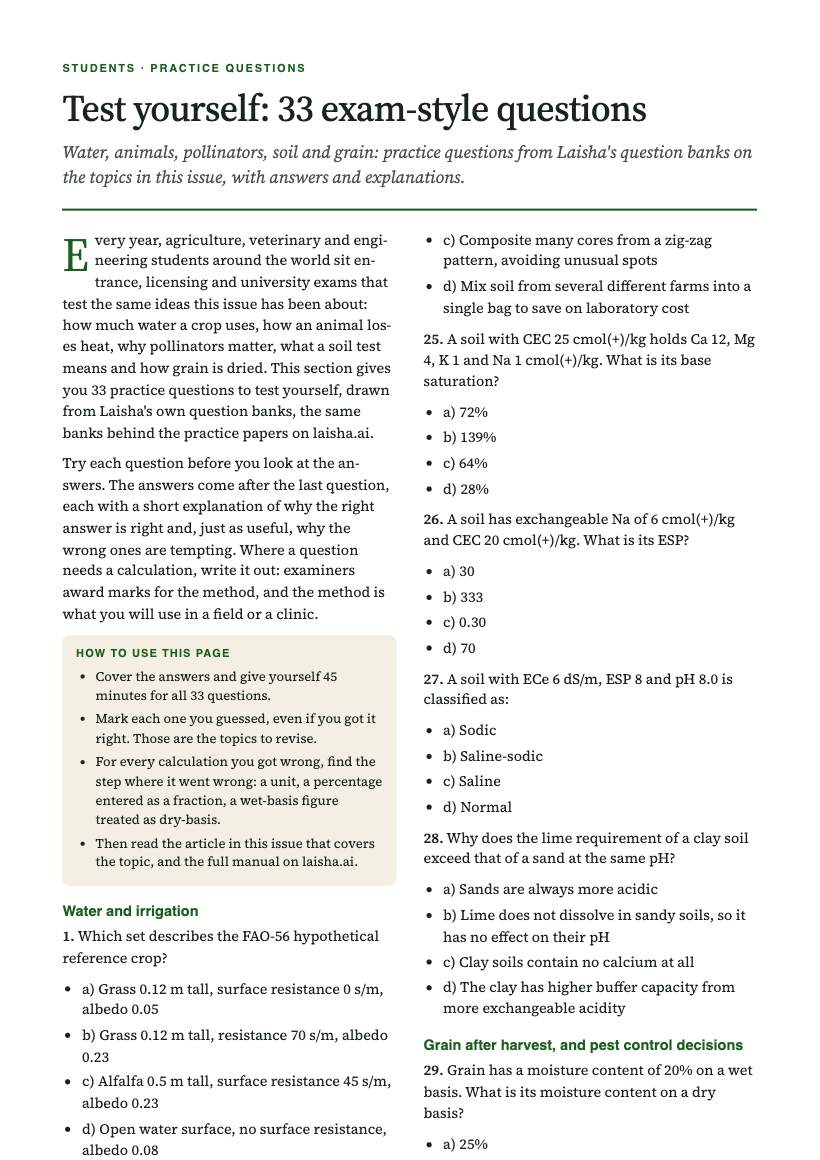
Test yourself: 33 exam-style questions

Water, animals, pollinators, soil and grain: practice questions from Laisha's question banks on the topics in this issue, with answers and explanations.

Every year, agriculture, veterinary and engineering students around the world sit entrance, licensing and university exams that test the same ideas this issue has been about: how much water a crop uses, how an animal loses heat, why pollinators matter, what a soil test means and how grain is dried. This section gives you 33 practice questions to test yourself, drawn from Laisha's own question banks, the same banks behind the practice papers on laisha.ai.

Try each question before you look at the answers. The answers come after the last question, each with a short explanation of why the right answer is right and, just as useful, why the wrong ones are tempting. Where a question needs a calculation, write it out: examiners award marks for the method, and the method is what you will use in a field or a clinic.

Continue reading →More practice questions on laisha.ai

Page 42 of Laisha Review Issue 2: Test yourself: 33 exam-style questions

Page 42 in print

Reference · Glossary

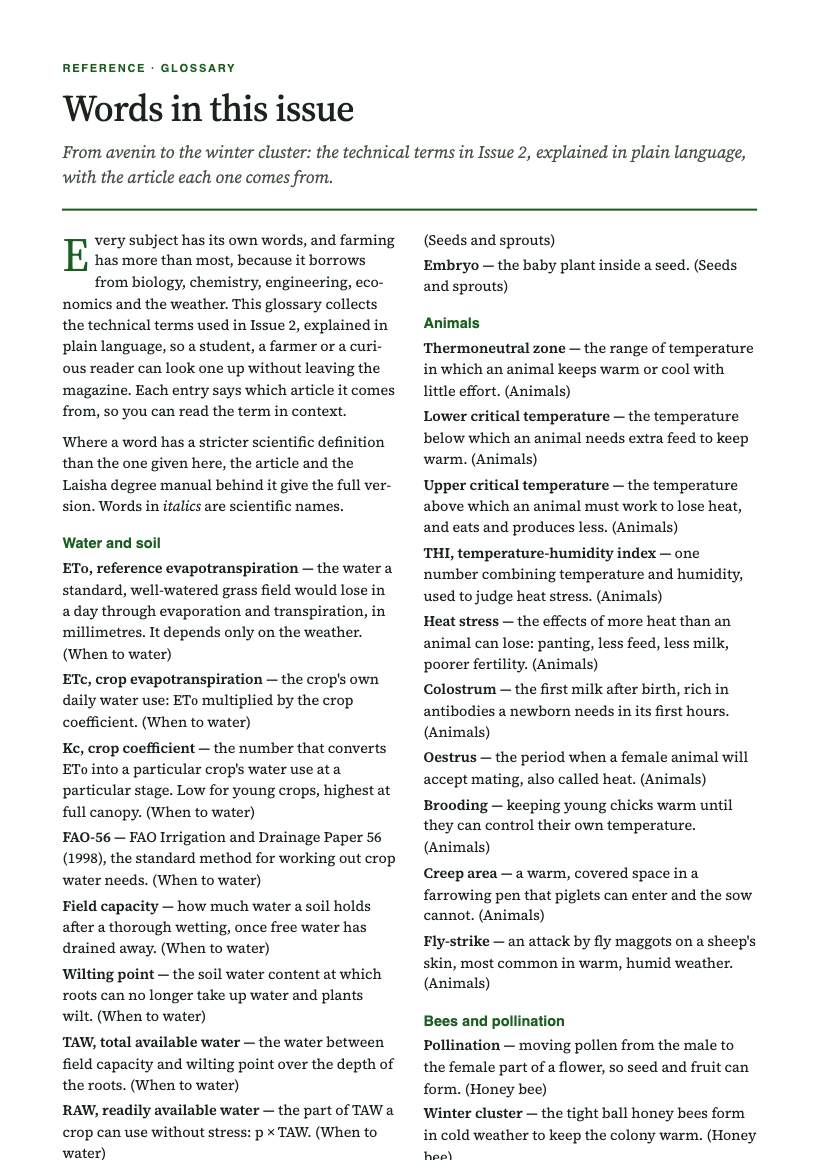
Words in this issue

From avenin to the winter cluster: the technical terms in Issue 2, explained in plain language, with the article each one comes from.

Every subject has its own words, and farming has more than most, because it borrows from biology, chemistry, engineering, economics and the weather. This glossary collects the technical terms used in Issue 2, explained in plain language, so a student, a farmer or a curious reader can look one up without leaving the magazine. Each entry says which article it comes from, so you can read the term in context.

Where a word has a stricter scientific definition than the one given here, the article and the Laisha degree manual behind it give the full version. Words in italics are scientific names.

Continue reading →Laisha Explains on laisha.ai

Page 48 of Laisha Review Issue 2: Words in this issue

Page 48 in print

Back page · page 51

The Issue 2 quiz

Five questions, one from each corner of this issue.

  1. 1 · Laisha Kids

    Which part of a sprouting seed comes out first?

    a) The leaves · b) The root · c) The flower
  2. 2 · Library

    In the FAO-56 method, a crop's water use is ETc = Kc × …

    a) ET₀, the reference evapotranspiration · b) The rainfall last month · c) The field's area
  3. 3 · Crop health

    Where is the fall armyworm native to?

    a) Africa · b) The Americas · c) Australia
  4. 4 · Crop

    When are oats harvested in southern Australia?

    a) Late spring and early summer · b) Midwinter · c) They are never harvested
  5. 5 · Country Fun

    What may anyone pick in Finland's forests under everyman's rights?

    a) Wild berries and mushrooms · b) Only pine cones · c) Nothing at all
Show the answers

1 b (The root) · 2 a (ET₀, the reference evapotranspiration) · 3 b (The Americas) · 4 a (Late spring and early summer) · 5 a (Wild berries and mushrooms)

Coming next issue

Laisha Kids

Another story for young readers, with something to grow or make at home or at school.

A new happy country

Another of the world's happiest countries, and the plants its people love. Can you guess which?

← Previous issueIssue 1: Luxembourg Next issueComing next month

Last updated · How Laisha writes and checks its pages · Report a mistake

Go further with Laisha Smarter

US$10 a month · one price worldwide · cancel any time

  • A dated season plan for your own crop and location
  • Pest and disease alerts as the season moves
  • Ask Laisha about what you read or see in your field — up to 1,000 questions a month
10 days free for every new account, no card.