 Laisha
AI Operating System for Agriculture
Ask Laisha
Laisha
AI Operating System for Agriculture
Ask Laisha
Spodoptera frugiperda (J.E. Smith, 1797) · formerly or also: Laphygma frugiperda
Fall armyworm is a moth whose caterpillars eat into the funnel of young maize and other grasses, leaving ragged leaves and wet, sawdust-like droppings. Native to the Americas, it reached Africa in 2016 and Asia and Oceania within four years. Adults fly hundreds of kilometres and breed all year wherever it is warm, so once established it has to be managed every season.
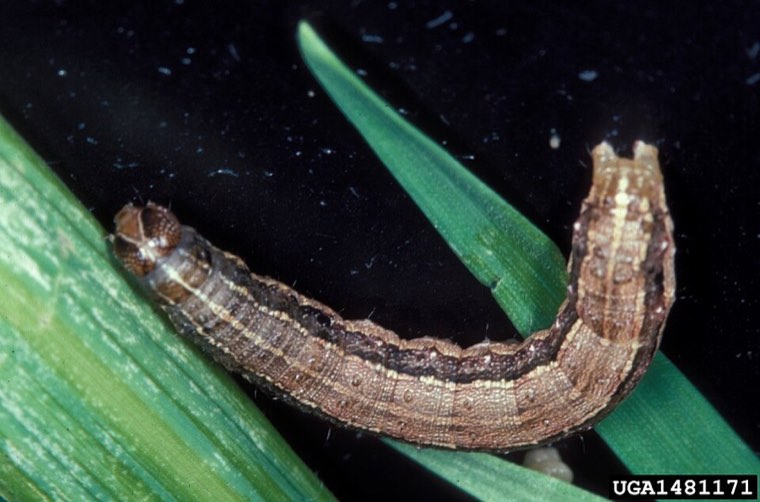
The scientific name of fall armyworm is Spodoptera frugiperda (J.E. Smith, 1797), in the order Lepidoptera, family Noctuidae.
Older or alternative scientific names: Laphygma frugiperda.
Native to the tropical and subtropical Americas, with seasonal migration into temperate North and South America. First reported in West and Central Africa in 2016, it spread across sub-Saharan Africa by 2018, South Asia in 2018, Southeast and East Asia by 2019 and Australia in 2020. It is a regulated quarantine pest in many regions.
| Region | Status |
|---|---|
| Americas (tropical and subtropical) | Native; breeds year-round in the warm zone, migrates north and south each summer |
| Sub-Saharan Africa | Invasive since 2016; established in nearly every maize-growing country |
| South and Southeast Asia | Invasive since 2018; widespread on maize and present on sorghum, millets and sugarcane |
| East Asia | Invasive since 2019; seasonal northward migration from the tropical south |
| Oceania | Invasive since 2020; established in northern Australia and parts of the Pacific |
| Near East, North Africa and Europe | Present in parts of the Near East and North Africa; regulated in Europe, with findings in a few southern countries |
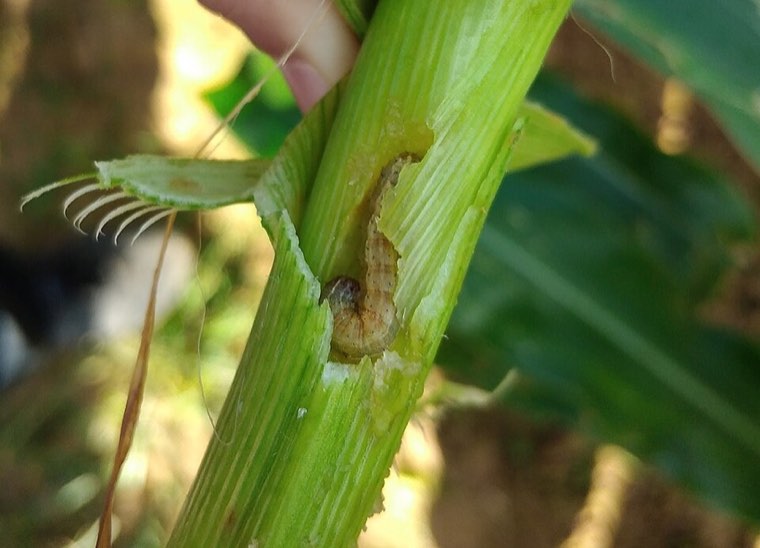
Eggs are laid in masses of roughly 100-200, usually covered with greyish scales from the female. Older larvae are brown to greyish green, up to about 4 cm long, with two telltale marks: a pale inverted 'Y' on the dark head, and four large dark spots forming a square on top of the eighth abdominal segment. The adult is a grey-brown moth with a wingspan of about 3-4 cm; the male's forewing has a pale oblique patch and a white spot near the tip.
| Crop stage | What you see |
|---|---|
| Seedling (emergence to about 4 leaves) | Small 'windowpanes' where young larvae scrape away the leaf surface but leave the transparent membrane. Heavy feeding may cut seedlings or kill the growing point, giving a dead heart. |
| Early to late whorl (vegetative) | Ragged, elongated holes in leaves that appear as the whorl unrolls; moist, sawdust-like frass packed in the funnel; usually only one or two large larvae per whorl because older larvae are cannibalistic. |
| Tasselling and silking | Larvae feed on the tassel before it emerges and on silks, which can reduce pollination. |
| Cob or ear (grain fill) | Larvae bore through the husk or enter from the tip and eat the kernels; frass at the entry hole; damaged ears are more likely to be invaded by ear-rot fungi and contaminated with mycotoxins. |
A generation takes about 30 days in warm weather, about 60 days in mild spring or autumn and 80-90 days when cool. Each female can lay well over a thousand eggs. Larvae pass through six instars, then drop to pupate 2-8 cm deep in the soil. There is no diapause, so the pest cannot survive prolonged frost and re-invades cold regions each season.
| Stage | Duration | Notes |
|---|---|---|
| Egg mass | 2-3 days at 25-30 °C; longer in cool weather | Laid on leaves, often on the underside near the base of young plants. |
| Larva (6 instars) | About 14 days at 25-30 °C; up to about 30 days in cool weather | Young larvae may disperse on silk threads; the last two instars do most of the damage. |
| Pupa in soil | About 8-9 days in warm weather; 20-30 days when cool | Reddish-brown pupa in an earthen cell; rarely in plant debris. |
| Adult moth | About 10-21 days | Nocturnal; begins laying a few days after emergence; capable of flights of hundreds of kilometres on wind. |
Development is fastest at about 25-30 °C and slows sharply below about 15 °C; published lower developmental thresholds for the whole cycle lie roughly between 10 and 13 °C depending on population and stage. Sustained frost kills all stages, which is why the pest is permanent only where winters are mild and migrates seasonally elsewhere.
Breeds continuously in the tropics, with overlapping generations whenever host plants are available; in seasonally cold regions it arrives by migration and completes only a few generations before winter.
Warm weather with dry spells between rains favours outbreaks; heavy rain drowns young larvae in the whorl. Staggered planting gives the pest a continuous supply of young maize, and late-planted fields usually suffer most. Broad-spectrum spraying that kills parasitoids and predators makes outbreaks more likely.
Thresholds are based on the percentage of plants with fresh feeding damage, scouted by stage, not on moth counts. Maize tolerates considerable whorl-stage leaf loss, so late-whorl thresholds are higher than for young plants. Published values differ by region and farming system and are still being validated in Africa and Asia.
| Crop | Threshold | Unit | Crop stage | Region | Source |
|---|---|---|---|---|---|
| Maize | About 20% (range 10-30%) | % of plants with fresh whorl damage | Emergence to early whorl (first 2-3 weeks) | Sub-Saharan Africa (smallholder guidance) | Prasanna et al. (eds) 2018, Fall Armyworm in Africa: A Guide for Integrated Pest Management, CIMMYT |
| Maize | About 40% (range 30-50%) | % of plants with fresh whorl damage | Mid to late whorl, before tasselling | Sub-Saharan Africa (smallholder guidance) | Prasanna et al. (eds) 2018, CIMMYT |
| Maize | 5% cut plants; 20% plants infested; 40% plants damaged with live larvae | % of plants | Seedling; early whorl; late whorl | Australia and New Zealand (grower guidance) | Foundation for Arable Research (NZ), fall armyworm management thresholds |
| Maize | 10% before mid-whorl; 20% after mid-whorl | % of plants with fresh damage | Whorl | South Asia (national maize research guidance) | ICAR-Indian Institute of Maize Research, fall armyworm identification and management |
Thresholds are local. They depend on crop price, control cost, variety and natural-enemy activity, so use the figure your local extension service publishes where one exists.
Larvae destroy leaf area, kill growing points of young plants and feed on tassels and ears. Because maize compensates for much whorl-stage defoliation, visual damage often overstates the loss. Field studies and farmer surveys in Africa and Asia report average losses from under 10% to around 30% in affected fields, with total failure in some late-planted, heavily infested smallholder fields. Ear feeding also invites ear rots and aflatoxin.
Control works best as a sequence: prevent, monitor, then act only when a threshold or a risk forecast says so, using the least disruptive option that works.
Justified only when scouting shows the threshold is reached and larvae are still small; sprays must reach into the whorl. What is registered differs by country and changes over time; follow the label and your local plant-protection authority.
| Scheme | Group | Mode of action | Notes |
|---|---|---|---|
| IRAC | 28 | Ryanodine receptor modulators (diamides) | Resistance reported in some populations. |
| IRAC | 5 | Nicotinic acetylcholine receptor allosteric modulators, site I (spinosyns) | Relatively selective. |
| IRAC | 6 | Glutamate-gated chloride channel allosteric modulators (avermectins) | Larvicide. |
| IRAC | 22A | Voltage-dependent sodium channel blockers (oxadiazines) | Larvicide. |
| IRAC | 11A | Microbial disruptors of insect midgut membranes (Bacillus thuringiensis) | Biological; best on young larvae. |
| IRAC | 31 | Baculoviruses | Species-specific virus products where registered. |
More than 350 host plants have been recorded, but the pest strongly prefers grasses: maize above all, then sorghum, millets, sugarcane, rice and pasture grasses. Cotton, soybean, groundnut and many vegetables are attacked mainly when preferred hosts are scarce. A 'corn strain' and a 'rice strain' with different host preferences are recognised.
How to grow the crop well is the first line of defence. Laisha's free grow guides cover each crop from sowing to harvest:
Written by Laisha from the sources above, in its own words. This page is general reference, not a prescription: confirm identification locally and follow the label and your plant-protection authority.