Bird Flu (H5N1) in Dairy Cows and Mammals: Is Milk Safe? A One Health Story
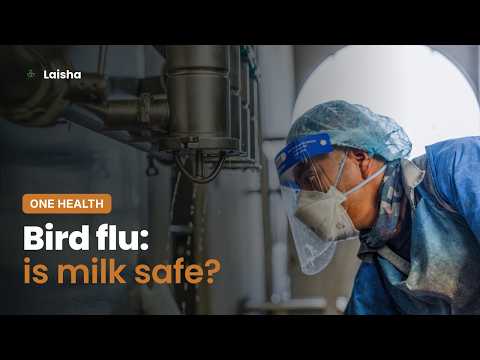
For decades, H5N1 bird flu was mainly a poultry problem. Since 2020, clade 2.3.4.4b has spread through wild birds worldwide, killed sea lions and elephant seals, and in March 2024 was confirmed in US dairy cattle. This guide covers what zoonoses and One Health mean, how influenza A viruses are named, the spread into wild mammals, dairy cattle as a new host (signs, how it spreads between and within herds), whether milk is safe (pasteurised: yes; raw: no), human cases and the pandemic question, biosecurity on dairy and poultry farms, and the One Health response.
Chapters
- 0:00A poultry virus in cows
- 1:15What One Health means
- 2:28The virus
- 3:29Into wild mammals
- 4:14Dairy cattle: a new host
- 5:25Is milk safe?
- 6:23What about people?
- 7:30Biosecurity on the farm
- 8:40The One Health response
- 9:35Recap
Transcript
For decades, the H5N1 bird flu virus was mainly a poultry problem. Outbreaks led to the culling of millions of birds,
and occasionally to severe infections in people who handled sick poultry.
Since about twenty twenty, a new lineage has behaved differently.
It spread through wild birds to every continent except Australia. It killed sea lions, seals and other wild mammals.
And in March twenty twenty-four, it was confirmed in dairy cattle in the United States, a host never seen before for this virus.
A virus moving from wild birds, to poultry, to wild mammals, to farm animals in daily contact with people, is a textbook One Health problem. In this video: what One Health means, the virus, its spread into mammals and cattle, whether milk is safe, the risk to people, and what farms can do. The facts come from Laisha's own fact-checked pages. Your veterinary and public health authorities always come first.
Diseases that pass naturally between animals and people are called zoonoses.
Studies have estimated that about sixty per cent of known human infectious diseases are zoonotic, and around seventy-five per cent of newly emerging ones have animal origins.
Think of rabies from dog bites, brucellosis from raw milk, or anthrax from the carcass of an animal that died suddenly.
Because people, animals and the environment are so closely linked,
the One Health approach brings doctors, veterinarians and environmental scientists together. In twenty twenty-two, four international agencies, the FAO, UNEP, the WHO and the World Organisation for Animal Health, launched a joint One Health plan of action.
In practice, One Health means joint surveillance in animals and people,
a coordinated response to outbreaks, and controlling disease at its animal source, which is often cheaper and more effective than treating people.
Influenza A viruses are named after two proteins on their surface.
Haemagglutinin, the H, binds to the host's cells.
Neuraminidase, the N, releases new virus particles.
Wild waterbirds, such as ducks, geese and gulls, are the natural reservoir of most of these viruses.
Highly pathogenic strains, mainly of the H5 and H7 types, kill most infected chickens within days.
H5N1 first emerged as a highly pathogenic strain in China in nineteen ninety-six, and it has evolved into many branches, called clades, since.
One of them, clade 2.3.4.4b, spread rapidly with migratory birds from twenty twenty.
It is now established in wild birds across Europe, Africa, Asia and the Americas.
Mammals have been infected mainly by eating sick or dead birds.
Infections have been recorded in foxes, otters and bears,
in mink and ferrets on fur farms, and in cats.
The virus reached South America in late twenty twenty-two.
In twenty twenty-three, tens of thousands of sea lions and elephant seals died along the coasts of Peru, Chile and Argentina.
And the pattern of deaths suggested that, in some colonies,
the virus was spreading from mammal to mammal.
That matters, because every infection of a mammal gives the virus another chance to adapt to mammals.
In early twenty twenty-four, dairy herds in Texas showed a puzzling drop in milk production, thick, yellowish milk, and reduced appetite.
In March, tests confirmed H5N1.
Genetic analysis showed a single spillover from birds into cattle, probably in late twenty twenty-three.
At least one further, independent spillover, of another genotype, was detected in early twenty twenty-five.
Between herds, the virus spread through cattle movement, shared equipment, people and vehicles.
Within a herd, it spread mainly through milk and milking equipment.
The virus multiplies in the udder and reaches very high levels in raw milk.
By twenty twenty-five, it had been confirmed in more than one thousand herds, in over a dozen US states.
Most infected cows recovered, though with milk losses, and few died. But cats on affected farms died after drinking raw milk, and infections were also found in poultry flocks near affected dairies.
So, is milk safe?
Pasteurised milk is.
Studies of milk from shops found fragments of the virus's genetic material, but no infectious virus, in pasteurised products.
Standard pasteurisation, seventy-two degrees Celsius for fifteen seconds or an equivalent, inactivates it.
Raw milk is a different story.
Raw milk from infected cows can contain very high levels of infectious virus,
and it has killed cats.
Health authorities strongly advise against drinking raw milk. On the farm, never feed raw milk from sick cows to calves or cats.
Milk from sick cows is kept out of the food supply.
And properly cooked poultry and eggs are safe too, because normal cooking temperatures kill influenza viruses.
Dozens of human infections were reported in the United States in twenty twenty-four and twenty twenty-five, most of them in dairy and poultry workers.
Most were mild, often conjunctivitis, an eye infection, from milk splashing into the eyes. A severe case, and at least one death, linked to backyard poultry, were also reported. There has been no sustained spread from person to person.
The main fear is that the virus could learn to spread efficiently between people. That would need changes, such as binding to the type of receptor found in the human upper airway instead of the bird type.
And if a person or animal is infected with seasonal flu and bird flu at once, the two viruses could swap gene segments.
For now, the WHO and national agencies assess the risk to the general public as low. The risk to exposed workers is higher, and that is where protection matters most.
What can a farm do? Take a dairy farm near an affected area.
It tests bulk-tank milk regularly, and requires tests before buying or moving cattle.
Milking clusters are cleaned and disinfected between cows.
Milk from sick cows is discarded safely, and raw milk is never fed to calves or cats.
Visitors and vehicles are limited.
Wild birds are kept out of feed and water.
And the people are protected.
Workers wear eye protection, gloves and aprons in the milking parlour. Anyone with conjunctivitis or flu-like symptoms is tested.
On poultry farms, the same logic applies: keep wild birds and their droppings away, with closed houses and covered feed and water. Wear protection when handling sick or dead birds, and wash your hands.
And if you see sudden deaths in birds, or a sudden drop in milk with thick milk in cows, report it at once to your veterinarian or veterinary authority.
The response to H5N1 shows One Health in action.
Surveillance runs across species: wild birds, poultry, cattle, pigs, cats and people, with genetic sequences shared openly.
Animal control includes culling and movement restrictions for infected poultry, quarantine and milk testing for cattle herds,
and, in some countries, such as China, Egypt and France, poultry vaccination under controlled programmes.
Workers are protected with equipment, testing,
and in some countries vaccination.
Food is protected by pasteurisation, and by keeping milk from sick animals out of the supply.
And human, animal and environmental agencies coordinate, nationally and internationally.
To recap.
H5N1 clade 2.3.4.4b spread worldwide through wild birds from twenty twenty,
and into wild mammals and, in twenty twenty-four, dairy cattle. In cows, it spreads mainly through milk and milking equipment.
Pasteurised milk is safe; raw milk is not, so never drink it or feed it to calves or cats.
Human cases have been mostly mild, in farm workers, with no sustained spread between people.
Protect your eyes and hands, keep wild birds away, and report sudden deaths or milk drops at once.
For more on animal health and One Health, visit laisha.ai. Thank you for watching.
Last updated · How Laisha writes and checks its pages · Report a mistake
Go further with Laisha Smarter
US$10 a month · one price worldwide · cancel any time
- Ask Laisha about what you watched — up to 1,000 questions a month
- Your own crop calendar and pest alerts
- Every calculator and tool