How to Grow Banana
Musa × paradisiaca · Also called: banana plant, banane, kela, vazhai, ndizi, pisang, platano, plátano
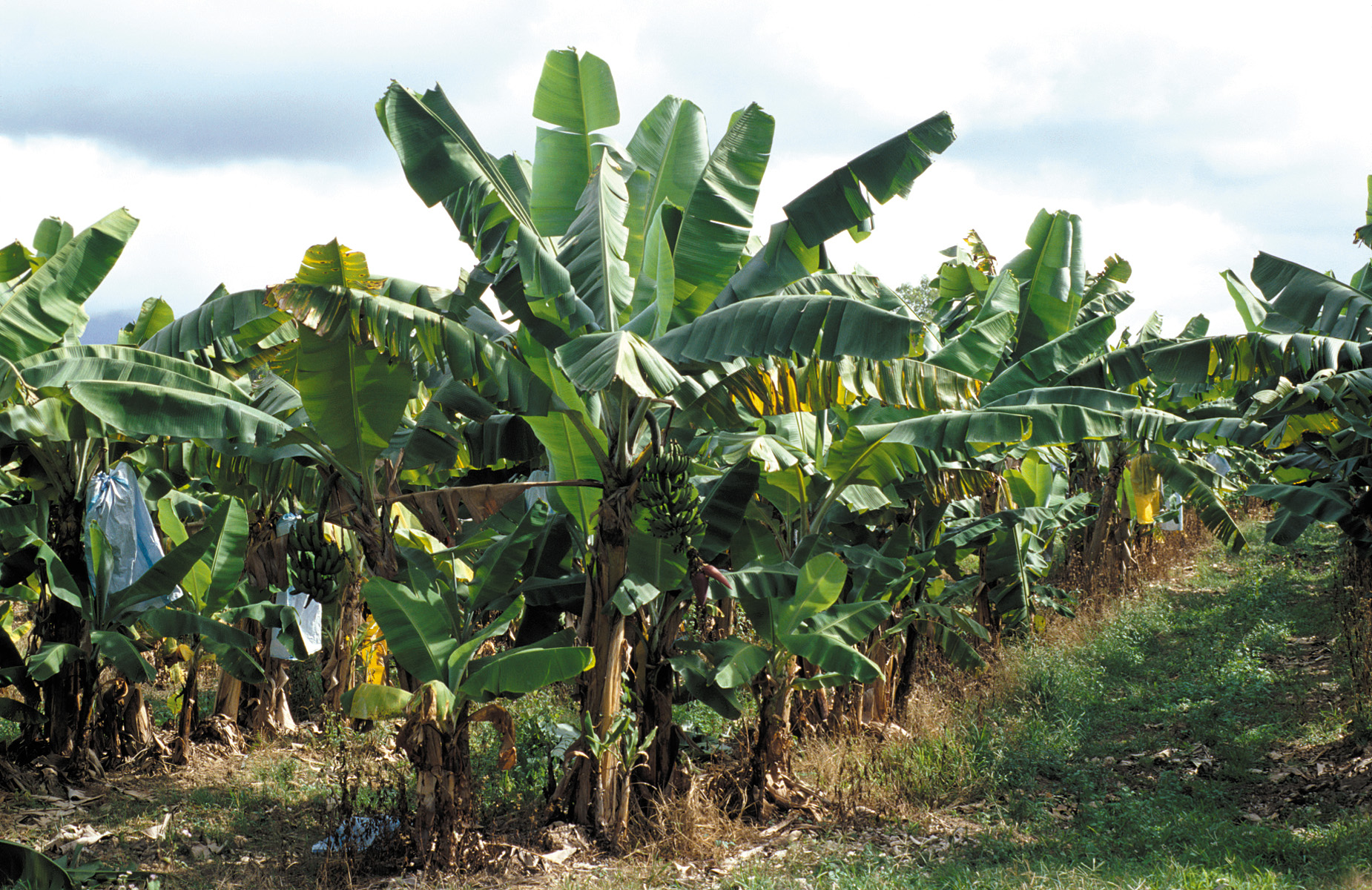
Photo: Willem van Aken, CSIRO, CC BY 3.0 (Wikimedia Commons)
One planting of banana feeds a family for years, not for one season. It does not need to be sown again every year, it carries food in the dry months when the grain store is empty, and it gives a bunch that can weigh as much as a small child. It is a top-ten crop in fifty-four of the world's countries as a sweet banana and in another thirty-six as a cooking banana or plantain, and it is the single biggest crop in Saint Vincent and the Grenadines, in Tuvalu and in Uganda. In Africa, bananas and plantains provide more than a quarter of the daily food energy for over seventy million people. Very little of it is exported. Most of the world's bananas are eaten within a short walk of where they grew.
Global Importance
Banana is one of the biggest food crops on earth, and almost none of it is the banana that people in rich countries picture. The export trade is the small, loud corner of a very large, quiet crop.
Growing Banana, Stage by Stage
- 1. Get the land ready — Banana roots are shallow and greedy. Give them deep, loose, well-drained soil and a big hole full of good food, and plan for the wind before you plant.
- 2. Choose your suckers or tissue-culture material — This is the most important decision in the whole crop. Almost every serious banana disease travels inside the piece you plant, and you cannot see it from the outside.
- 3. Plant the suckers — Right way up, firmed in hard, and far enough apart that light and air get down to the ground between them.
- 4. Water — Banana drinks more than almost any crop you will grow, and it dies just as fast in standing water. Steady and never soaked is the whole rule.
- 5. Weeds and feeding — Keep the ground clean and covered for the first months, and remember the one number that matters: banana wants about three times as much potash as nitrogen.
- 6. Look after the mat, the bunch and the follower — From here on you are managing a family, not a plant. Choose which sucker lives, hold the plant up, and protect the bunch while it fills.
- 7. Stop the pests and the diseases getting in — Two pests and four diseases matter more than everything else. All of them are far easier to keep out than to get rid of.
- 8. Know when to harvest — Banana is never cut ripe. It is cut green and full, and the judgement is made by looking down the edge of a finger.
- 9. Cut the bunch, carry it and grade it — Every bruise you put on a banana becomes a rot within a week. Cutting and carrying carefully is worth more than anything you can buy.
- 10. Ripen it, keep it and make it last — Fresh banana keeps for days, not months. Understanding ripening is what turns those days into a real choice about when you sell.
Common Problems & Troubleshooting
If you see: Older leaves turning yellow from the edges inward, then the leaf stalk bending so the leaf hangs down flat against the trunk. The plant ends up standing upright inside a skirt of dead hanging leaves, and it works upward from the oldest leaves to the youngest.
It likely means: Panama disease, a soil fungus also called Fusarium wilt. This is the most serious thing that can happen to a banana field anywhere in the world.
Do this: Cut the trunk straight across with a clean knife and look at the cut face. Reddish-brown streaks in the water pipes confirm it. This cut is the test and a photograph of the leaves is not.
If you see: Leaves yellowing and wilting one after another, the flower bracts and the male bud shrivelling, and a bunch ripening early and unevenly with some fingers yellow and others still green. Cut anything and a yellow sticky ooze appears within minutes.
It likely means: Banana Xanthomonas wilt, a bacterial disease. The ooze within minutes is the sign that separates it from Panama disease, which stains but never oozes.
Do this: Uproot and destroy the whole mat including the underground corm, on the spot. Burn or bury the debris where it stands.
If you see: New leaves coming out narrower and shorter than the ones below them, with yellow edges, standing stiffly upright so the top of the plant bunches into a tight rosette. Look closely at the leaf stalk in good light for short dark green streaks like dots and dashes.
It likely means: Banana bunchy top virus, carried from plant to plant by a small dark aphid that lives in the crown. There is no cure and there are no resistant varieties.
Do this: Kill the aphids on the infected plant first, before you touch anything else. A soap or oil spray does it. If you cut the plant down first, the aphids fly away carrying the virus into your healthy plants.
If you see: Faint rusty-brown specks like flecks of paint on the underside of the leaves, stretching into narrow dark streaks that run along the veins, then darkening and sinking into the leaf until whole leaves die and hang down. Worst in hot, wet, still weather.
It likely means: Black Sigatoka, also called black leaf streak. It is now the dominant banana disease in the world, and it works by taking away the leaves that fill your bunch.
Do this: Cut off and remove every leaf that is more than about half dead, and any leaf heavily marked. Do this every week or two, all year. This is called deleafing and it is the core control.
If you see: Plants falling over, often just as the bunch is filling, with the whole root plate lifting out of the ground. Or plants snapping off cleanly at the base. Growth was already poor and the plants looked hungry however much you fed them.
It likely means: Two different underground problems that look the same above ground. Either the burrowing nematodes, which are worms far too small to see, eating the roots away. Or banana weevil grubs tunnelling inside the corm.
Do this: Dig up one fallen plant and look. Dark red-brown or black dead patches along roots that snap easily means nematodes. Dark ragged tunnels you could put a pencil into inside the corm means weevil grubs.
If you see: A plant that looks big and healthy but throws a small bunch with few hands, and fingers that stay short and thin and never fill out and round off. Often the oldest leaves have orange-yellow scorched edges while the young leaves look fine.
It likely means: Almost always a shortage of potash, the plant food that fills fruit. Sometimes crowding, or too many suckers left on the mat, or a dry spell at flowering.
Do this: Look at the ratio you are feeding. Banana wants about three times as much potash as nitrogen. Most disappointing banana fields in the world are short of potash.
If you see: Fruit that was fine when cut, but within days the cut crown where the hand was separated turns black and soft and the rot works down into the fingers. Or many small dark round spots appearing on the skin as the fruit ripens. Or finger tips going dry and dark like the ash on a cigar.
It likely means: After-harvest rots. Crown rot is a group of fungi entering through the cut. Anthracnose lies hidden in the skin from the field and shows as the fruit ripens. Cigar-end rot attacks the flower end of the finger.
Do this: Almost all of this is caused by handling, not by bad luck. Every bruise and every ragged cut is an open door.
If you see: Fruit that stays green and hard and never colours properly, or that goes dull grey or brown under the skin, or ripe fruit that turns a smoky dull brown and bruises at the lightest touch. Sometimes the flesh is soft while the skin is still green.
It likely means: Temperature damage. Cold below about thirteen degrees injures banana even after picking, and the damage often does not show for a day or so. Heat above about twenty-five to thirty degrees during ripening does the opposite kind of damage.
Do this: Never put bananas in an ordinary household fridge. That is well below the temperature at which banana is damaged.
Yield & Market Value
Growing the crop is only part of the job. The last part is knowing what a normal harvest looks like, and knowing what your fruit is worth before you agree a price with anybody.
Remember It This Way
If you forget every other page of this guide, keep these lines. They are the whole crop, in order, short enough to carry in your head.
- You plant a piece of a plant, never a seed. What you plant decides everything.
- Look at the field your suckers come from. Cut one trunk. Walk away from streaks or ooze.
- Fat sword suckers with narrow leaves. Pare them white. Hot water dip. Never a broad-leaved water sucker.
- It drinks a lot and dies in standing water. Steady moisture, never a puddle.
- Three times as much potash as nitrogen. Wood ash is free potash.
- Three plants to a mat and no more. Mother, daughter, granddaughter.
- Clean your knife between every plant. That habit alone stops bacterial wilt.
- Prop it before the bunch is heavy, and never stand under a bunch you are cutting.
- Cut it green when the fingers stop being cornered and go round.
- Never chill it below thirteen degrees. Dry it or fry it if you cannot sell it.
Test Yourself: Identification
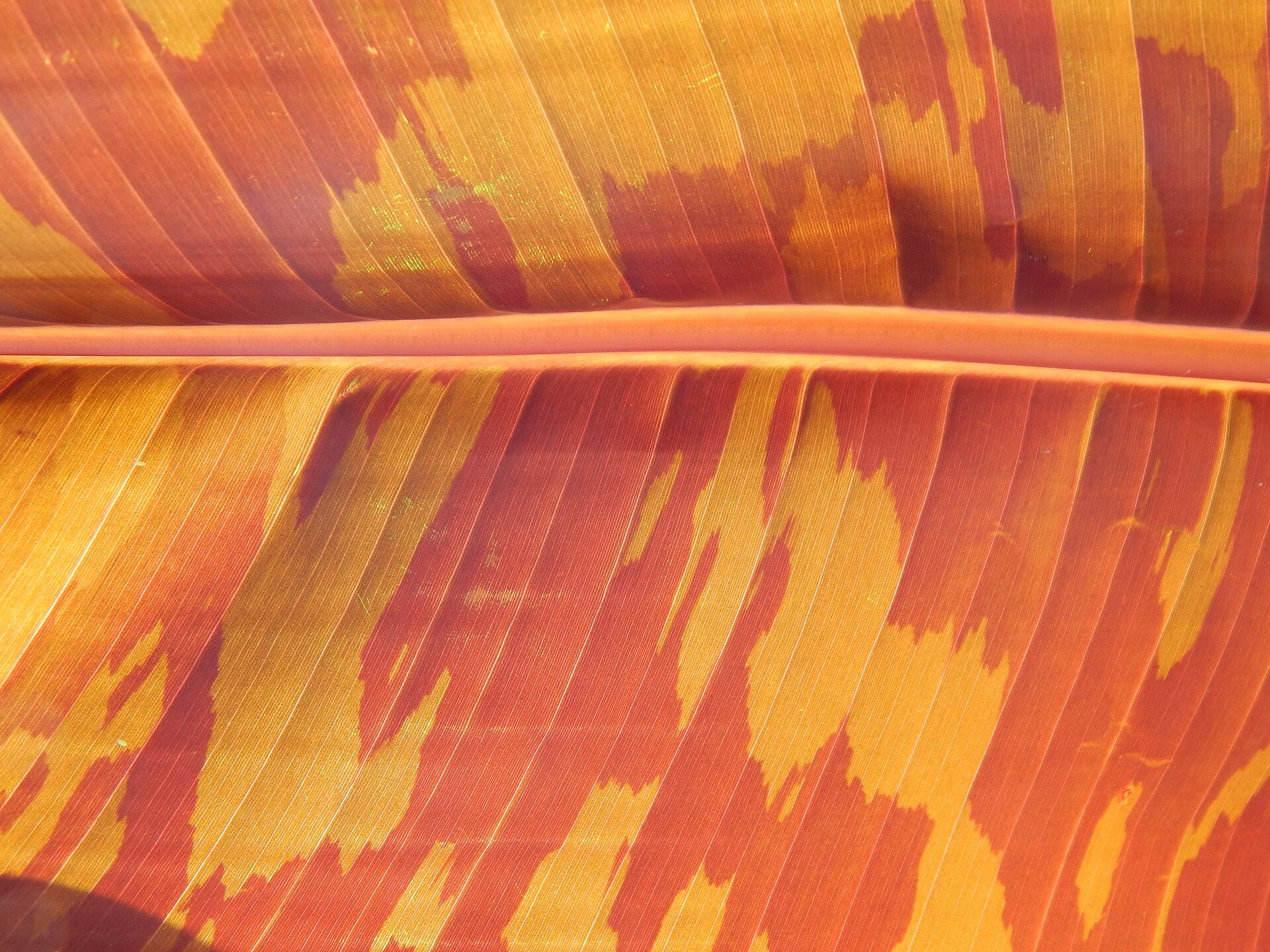
This leaf is of which plant?
Which crop is this field of, and is that a tree?
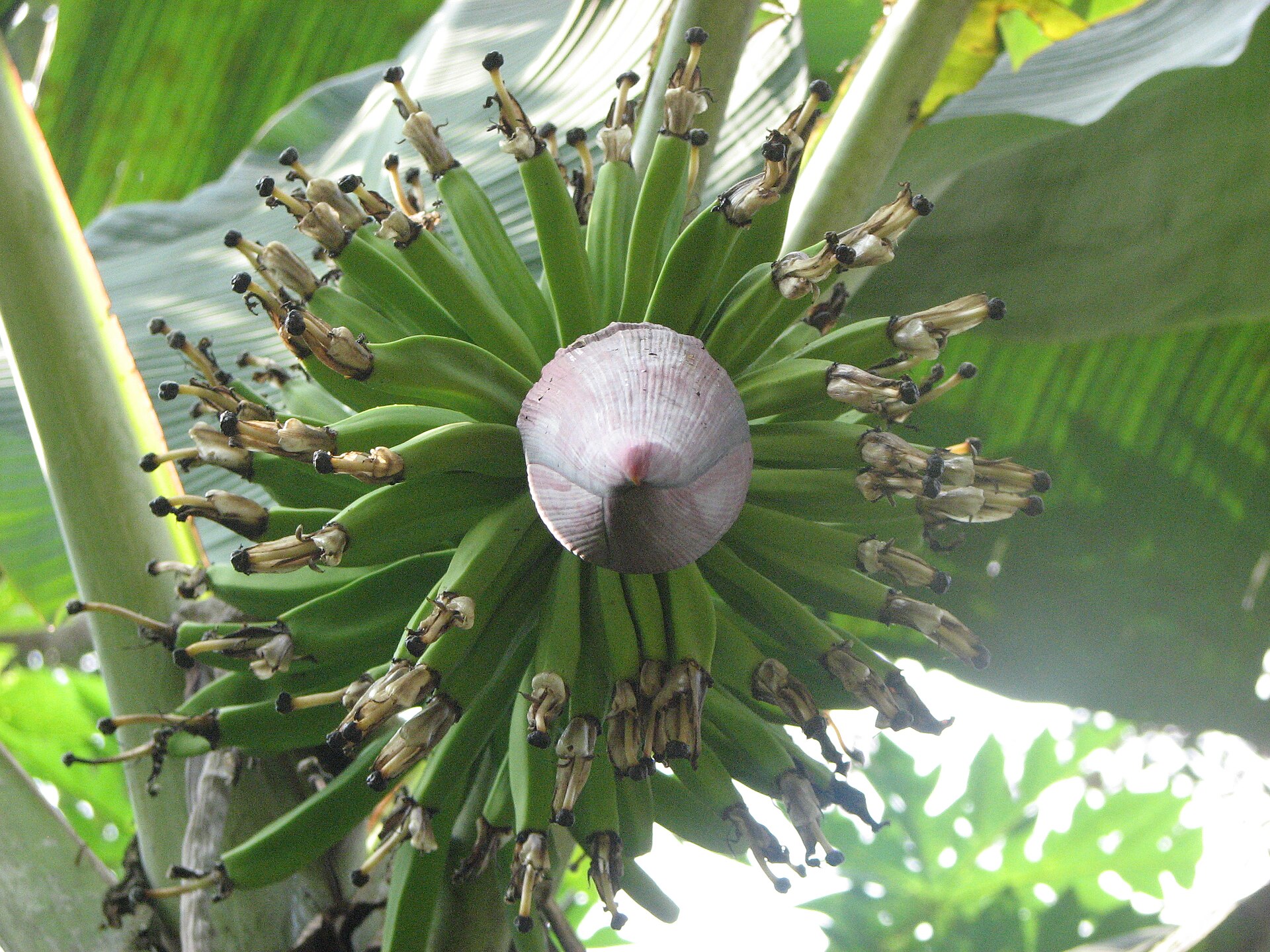
What is the large purple pointed thing hanging below the fruit, and what should you do with it?
Honest Limits of This Guide
- The right planting month is different everywhere. The rule that is true everywhere is to plant so the bunch fills during your reliable wet season and not during your worst dry spell.
- The fertiliser rates in this guide are real published national recommendations for one major banana-growing region. Your own country's recommendation may differ. What holds everywhere is the ratio, with potash about three times the nitrogen.
- The spacings in this guide are real published figures for named varieties. Your variety may want different spacing. When in doubt, err on the wide side.
- Which varieties resist which disease depends entirely on your country and region. Ask your local agricultural officer, and ask by variety name.
- This guide gives the European Union's banana marketing standard figures because that document could be read live in full. The Codex Alimentarius standard for bananas could not be reached at the time of writing, and rather than quote figures from memory and attribute them to Codex, this guide says so plainly.
- ProMusa, which is the main open reference network for banana genetic diversity, refused every request made to it while this guide was written. That is disclosed here rather than hidden, and the genome group material comes from other real, cited sources instead.
- This guide does not name any pesticide, weedkiller or fungicide product or active ingredient. It names mode of action groups and hazard colour bands instead. If you decide to use a treatment, buy only from a licensed dealer and follow the label.
- Nobody can honestly tell you from a photograph whether your plant has Panama disease or bacterial wilt. Both need a cut across the pseudostem, and Moko and bacterial wilt genuinely need a laboratory to separate. Where this guide cannot be certain, it says so.
Related Laisha Tools
- Global Market Price Outlook — Check today's price and trend
- Crop Calendar — Build a season-long sowing plan
- Pest & Disease Intelligence — Risk reasoning and a global pest & disease library
- Crop Health — Photo-based first read on a field problem
- Post-Harvest Loss Prevention — Real storage science by crop
Open the free Applied Agriculture Library in the Laisha app →
Sources
- GBIF Backbone Taxonomy records for Musa × paradisiaca L., Musa acuminata Colla and Musa balbisiana Colla — Global Biodiversity Information Facility (GBIF), Copenhagen (source)
- World Checklist of Vascular Plants (WCVP), the checklist behind Plants of the World Online — Royal Botanic Gardens, Kew (source)
- Banana production and banana yields (datasets), built on FAOSTAT: Production, Crops and livestock products — Food and Agriculture Organization of the United Nations, with major processing by Our World in Data (source)
- Bananas — Markets and Trade commodity page — Food and Agriculture Organization of the United Nations, Rome (source)
- World Banana Forum — Food and Agriculture Organization of the United Nations, Rome (source)
- The world banana economy 1985-2002 (FAO Commodity Studies) — Food and Agriculture Organization of the United Nations, Rome (source)
- The Commercial Storage of Fruits, Vegetables, and Florist and Nursery Stocks, Agriculture Handbook 66, chapter 'Banana and Plantain' — United States Department of Agriculture, Agricultural Research Service (source)
- Commission Implementing Regulation (EU) No 1333/2011 laying down marketing standards for bananas — European Union, Official Journal of the European Union (source)
- Banana crop production guidance, TNAU Agritech Portal — Tamil Nadu Agricultural University, Coimbatore, India (source)
- Laisha's own curated named-disease reference, leafVisualDiagnosticReference.json, banana entries — Laisha (AgriMind), internal curated knowledge base, itself sourced and tiered (source)
- Laisha's own global crop priority research, globalCropPriorityResearch.json, banana and plantain entries — Laisha (AgriMind), internal curated research built on FAOSTAT and national statistical returns (source)
- Laisha's own agrochemical mode-of-action and hazard-labelling reference, agrochemicalReference.json — Laisha (AgriMind), internal curated reference built on IRAC, FRAC, HRAC and the Indian Insecticides Act 1968 (source)
- Encyclopedia article: Banana — Wikipedia (English) (source)
- Encyclopedia article: List of banana cultivars — Wikipedia (English) (source)
- Encyclopedia article: Cavendish banana — Wikipedia (English) (source)
- Encyclopedia article: Cooking banana — Wikipedia (English) (source)
- Encyclopedia article: Panama disease — Wikipedia (English) (source)
- Encyclopedia article: Mycosphaerella fijiensis (Pseudocercospora fijiensis) — Wikipedia (English) (source)
- Encyclopedia article: Banana Xanthomonas wilt — Wikipedia (English) (source)
- Encyclopedia article: Banana bunchy top virus — Wikipedia (English) (source)
- Encyclopedia article: Banana root borer (Cosmopolites sordidus) — Wikipedia (English) (source)
- Encyclopedia article: Radopholus similis — Wikipedia (English) (source)
- Encyclopedia article: Micropropagation — Wikipedia (English) (source)
- Encyclopedia article: Banana chip — Wikipedia (English) (source)
- Encyclopedia article: True plantains — Wikipedia (English) (source)
- Banana and plantain — crop programme page — International Institute of Tropical Agriculture (IITA) (source)
- Encyclopedia article: Tostones — Wikipedia (English) (source)
- Encyclopedia article: Kelewele — Wikipedia (English) (source)
- Encyclopedia article: Mofongo — Wikipedia (English) (source)
- Encyclopedia article: Banana flour — Wikipedia (English) (source)