How to Grow Cotton
Gossypium hirsutum · Also called: cotton, upland cotton, American cotton, seed cotton, kapas, rui, kapaas, pamba
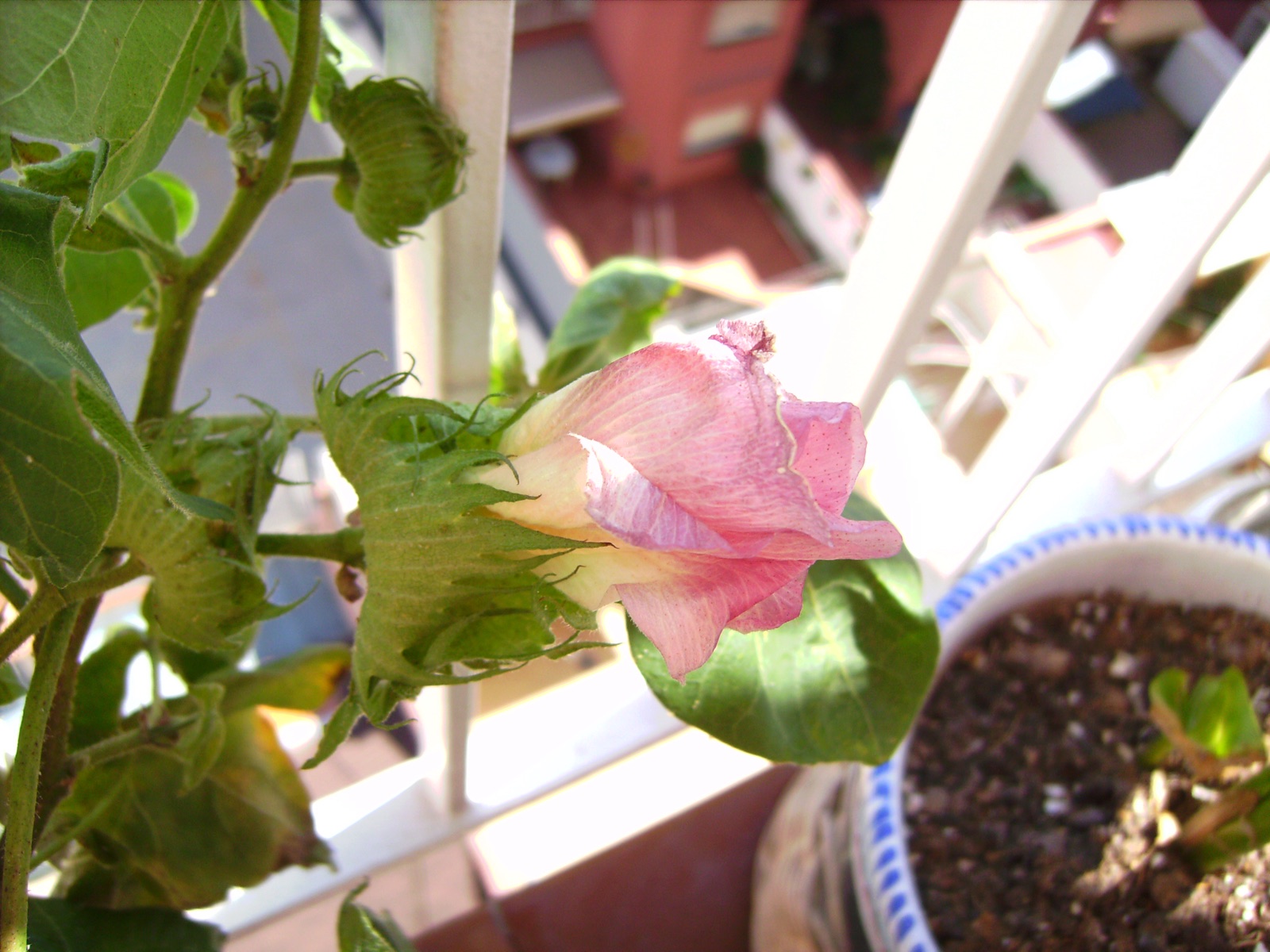
Photo: Victor M. Vicente Selvas, Public Domain (Wikimedia Commons)
Cotton is a real top-ten crop in 33 of the world's 195 countries, and the single biggest crop of all in exactly one of them: Antigua and Barbuda. Real, published FAOSTAT data reports 2022 world production of seed cotton (unginned, meaning the raw harvested boll contents before the fibre and seed are separated) at approximately 69.7 million tonnes, led by China with roughly 26 percent of the world total, followed by India (roughly 22 percent) and the United States (roughly 12 percent). That single figure hides cotton's own most important honest fact: unlike almost every food crop in this library, cotton is genuinely a two-product crop from the very first step of processing. Seed cotton straight off the plant is not one thing but two, physically bound together inside the same boll -- the lint (the soft fibre spun into yarn and cloth) and the cottonseed (crushed for edible oil and livestock feed, marketSegments and processingAndEndUses) -- and no honest guide to this crop can treat the fibre as the whole story. Cotton also carries a real, genuinely unusual economic footprint for a single crop: independent research cited by the State of Sustainability Initiatives programme estimates cotton provides a livelihood, directly or indirectly, for up to 1 billion people worldwide, including some 100 million smallholder farming families who grow it. Real, published botany and archaeology also make cotton one of the very few crops in this library with two entirely separate, well-documented domestication events on two separate continents thousands of years apart -- Gossypium hirsutum in Mexico around 3400 to 2300 BC, and the wholly separate species Gossypium barbadense in Peru even earlier still (botanicalIdentity) -- a real, checkable double origin most people who wear cotton clothing every day have never been told. And cotton's own real modern history carries one of the most economically consequential pest stories in all of world agriculture: the boll weevil's arrival in the United States from Mexico in the 1890s did not merely damage the American Cotton Belt, it measurably reshaped its whole economy and society for decades, a real, documented history this guide treats with the same seriousness coffee's own guide gives coffee leaf rust in Ceylon (safetyWarningFirst, troubleshooting). As with every crop in this library, any agrochemical used on this crop must be handled exactly according to this guide's own chemicalSafetyRule below, bought only from a licensed dealer, and never guessed at from a name half-remembered from a neighbour.
Global Importance
Cotton is grown across a real, wide tropical and subtropical belt on every populated continent except Europe's own cold north and Antarctica, but its true production is anything but even: three countries alone -- China, India and the United States -- account for roughly 60 percent of the entire 2022 world total, and the crop's own honest global importance rests as much on how many smallholder economies across Africa and Central Asia genuinely depend on it as their leading cash export as on its raw tonnage.
Market Segments
Cotton is not judged by taste or by a single grade name the way a food crop in this library is. It is judged by a real, standardised set of measured fibre properties -- and, before any of that, by the equally real fact that every harvest is genuinely two products bound together, not one.
Growth Habit
Three real, foundational facts decide almost everything else a cotton grower does: the plant's own real, five-stage life cycle from germination to boll opening; its genuine status as a warm-season, frost-intolerant, thirsty crop grown as an annual despite being a true perennial by nature (botanicalIdentity); and the real, continuous way a healthy cotton plant keeps producing new fruiting growth for as long as conditions allow, much like this library's own indeterminate tomato varieties.
Growing Cotton, Stage by Stage
- 1. Choose your land, your species and your market — Decide honestly which real species and quality tier this planting is for, and confirm your land offers a genuinely long, frost-free, well-drained season before a single seed goes in the ground.
- 2. Choose your variety and source quality seed — Get seed of a locally recommended variety from a known, reputable dealer, and understand honestly whether a Bt insect-resistance trait is part of that variety before you plant.
- 3. Prepare the field and sow — Prepare a clean, well-drained seedbed and sow into genuinely warm soil at the start of your own real frost-free season, at a spacing matched to your own local system and intended harvest method.
- 4. Thin and establish the young stand — Thin to a real, sensible plant density where sowing was thicker than final stand requires, and protect the young, vulnerable stand through its first weeks in the field.
- 5. Feed the crop — Base your programme on a real soil test where possible, and understand that cotton's own real nutrient demand rises sharply through squaring, flowering and boll fill, not evenly across the season.
- 6. Water — Protect water supply hardest through squaring, flowering and boll fill, since a real shortage at this window costs the most yield and fibre quality of the whole season.
- 7. Weeds — Control weeds hardest in the first six to eight weeks after sowing, when cotton competes poorly, and keep the crop reasonably clear through to canopy closure.
- 8. Manage vegetative growth through squaring and flowering — Watch plant height and vegetative vigour through squaring and flowering, since cotton left to grow too tall or too leafy genuinely sheds fruit and becomes harder to manage and harvest.
- 9. Insect pests, stage by stage — Cotton carries one of the longest, most historically significant real insect pest lists in this whole library. Scout squares, flowers and young bolls continuously from squaring through boll fill, and know honestly which pests a Bt trait does and does not protect against.
- 10. Diseases, stage by stage — Cotton's own worst diseases are overwhelmingly soil-borne vascular wilts or whitefly-transmitted, and genetic resistance and clean, rotated land are this guide's own strongest real defences against both.
- 11. Harvest the mature bolls — Harvest once bolls have opened fully and dried down, choosing hand-picking or mechanical harvest to match your own real scale, labour and equipment, and destroy old stalks completely once harvest is finished.
- 12. Gin, class and store — Move seed cotton to the gin promptly to separate lint from cottonseed, understand your own real classed grade before you sell, and store both real products correctly.
Fertiliser Programme
Cotton is fed in real, staged amounts that scale up through squaring and flowering and peak at boll fill, with nitrogen driving vegetative and fruiting growth and potassium becoming genuinely critical as bolls fill -- and, unlike this library's own legume crops, cotton has no nitrogen-fixing partner of its own, so every unit it uses has to come from the soil or from what a grower applies.
Common Problems & Troubleshooting
If you see: Squares (young flower buds) with a small feeding or egg-laying puncture near the tip, turning yellow and dropping from the plant, alongside young bolls showing similar puncture damage.
It likely means: Boll weevil (Anthonomus grandis), a real beetle native to Mexico that migrated into the United States in the late 19th century and had infested every US cotton-growing area by the 1920s -- historically the single most economically destructive cotton insect pest in the Americas, real, documented economic history recording it was consuming an estimated 8 percent of the entire US crop annually by 1922.
Do this: Scout squares and young bolls regularly through the whole squaring-to-boll-fill window rather than waiting for widespread square drop to appear.
If you see: Small entry holes in green bolls, and, when opened, tunnelling damage and webbing among the developing seed and lint inside, with damaged locks of lint often stained and stuck together (a symptom sometimes called 'rosetted' flowers where larvae feed inside a bloom before it opens).
It likely means: Pink bollworm (Pectinophora gossypiella), a real, major global cotton pest whose larvae feed inside the boll on developing seed and lint, historically severe across South Asia and parts of the Americas.
Do this: Scout bolls regularly through boll development, opening a sample of green bolls to check for internal larval damage rather than relying on external symptoms alone.
If you see: Round or irregular feeding holes in squares, flowers and bolls from outside, with caterpillars of varying size visible inside damaged fruiting structures.
It likely means: Cotton bollworm or American bollworm (Helicoverpa species), among the most widely targeted pests by commercial Bt cotton traits worldwide.
Do this: Scout squares, flowers and bolls regularly through the whole flowering-to-boll-fill window.
If you see: Small, white, moth-like insects clustering on the underside of leaves that fly up in a visible cloud when the plant is disturbed, often alongside sticky honeydew and black sooty mould on leaves.
It likely means: Whitefly (Bemisia tabaci), a real, sap-feeding pest causing direct feeding damage and, separately and importantly, acting as the real transmitting vector for cotton leaf curl virus in several major growing regions.
Do this: Check the underside of leaves regularly, especially in warm, dry conditions this pest favours.
If you see: Small green or black insects clustering on new growth and leaf undersides, sticky honeydew and sooty mould on leaves (aphids); or leaves showing yellowing and a distinctive downward cupping or curling at the margins, sometimes called 'hopper burn' (jassids/leafhoppers).
It likely means: Aphids or cotton jassids (leafhoppers), both real, common sap-feeding pests of cotton, genuinely more chronic than acutely destructive in most seasons but capable of real, significant cumulative damage under heavy, sustained infestation.
Do this: Scout regularly through the season, since both pests can build up gradually rather than appearing suddenly.
If you see: Yellowing beginning on lower or older leaves, progressing to wilting, and, when a stem is cut open, a real, visible internal vascular discolouration (browning) inside the stem tissue.
It likely means: Fusarium wilt (Fusarium oxysporum f. sp. vasinfectum), a real, soil-borne fungal vascular disease, often worsened where root-knot nematode is also present, and genuinely persistent in soil for years once established.
Do this: Plant a real, resistant variety recommended for your own region where local disease pressure is known, since genetic resistance is currently the most durable defence.
If you see: Yellowing and wilting of leaves, often starting as a mottled or mosaic-like yellow pattern between leaf veins before browning, with internal vascular discolouration visible in a cut stem, historically severe in parts of Central Asia and the United States.
It likely means: Verticillium wilt (Verticillium dahliae), another real, soil-borne vascular wilt fungus, similarly persistent in soil once established and similarly worsened by continuous cotton cropping.
Do this: Plant a real, resistant or tolerant variety recommended for your own region where this disease is a known local threat.
If you see: Small, angular, water-soaked spots on leaves that follow the leaf's own vein pattern, sometimes turning dark brown or black, and, in a severe case, spreading to stems as a real, dark, sunken lesion (the historic 'black arm' phase) and to bolls as dark, water-soaked spots.
It likely means: Bacterial blight, caused by the bacterium Xanthomonas citri pv. malvacearum (recorded in older literature as Xanthomonas campestris pv. malvacearum) -- a real, potentially seed-borne bacterial disease.
Do this: Plant a real, resistant variety recommended for your own region where this disease is a known local threat, since resistance is a genuinely effective defence.
If you see: Upward or downward curling of leaves, thickened, dark green veins on the underside of leaves (vein thickening), and stunted overall plant growth, most often building up gradually across a field.
It likely means: Cotton leaf curl virus, a real, whitefly-transmitted begomovirus, a major, historically documented disease in South Asian cotton production, responsible for severe, real economic losses in Pakistan's own Punjab region from the early 1990s onward as resistance in popular varieties broke down over time.
Do this: Plant a real, currently resistant variety recommended for your own region, and stay in contact with local extension guidance, since resistance to this virus has a real, documented history of breaking down over time as the virus itself changes.
If you see: A seed bag, dealer or extension leaflet describing a variety as 'Bt cotton' or naming an insect-resistance trait.
It likely means: A real, widely adopted genetically modified cotton technology: the plant carries a gene from the naturally occurring soil bacterium Bacillus thuringiensis (Bt), which produces a protein toxic to certain caterpillar pests (notably bollworms) when they feed on the plant, while being harmless to most other organisms including humans, livestock and most beneficial insects. Bt cotton is real and widely adopted in several major cotton-producing countries, including the United States, India, China, Pakistan, Australia, Brazil and Argentina among others; this guide states that adoption fact plainly and neutrally, the same honest, non-advocacy posture this library's own soybean guide takes on genetically modified soybean, without taking any position on the wider genetically modified crop debate.
Do this: Ask your dealer or extension service exactly which pests a specific Bt trait does and does not protect against before relying on it (Stage 2, Stage 9).
Real Farm Economics
Cotton's real economics carry a genuinely higher input-intensity story than a cereal crop elsewhere in this library -- real water demand, a historically heavy real crop-protection spend, and a world market shaped for decades by rich-country subsidy disputes this guide already names honestly in globalImportance -- alongside one real, documented modern shift worth stating plainly: widely adopted Bt cotton has measurably reduced insecticide use in several major producing countries.
Yield & Market Value
Growing the crop is only part of the job. The last part is knowing what a normal harvest looks like, and knowing what your cotton is actually worth before you agree a price with anybody -- and for this specific crop, this guide has good, honest news: cotton is one of the ten crops Laisha's own live Global Commodity Price service tracks directly.
Remember It This Way
If you forget every other page of this guide, keep these lines. They are the whole crop, in order, short enough to carry in your head.
- It grows a fibre, not a food -- and its harvest is genuinely two products in one boll.
- Four real cotton plants exist. One of them grows nine bolls in every ten on Earth.
- It is a true perennial the whole world grows as an annual, on purpose, to starve out its own pests.
- The flower lies about its own age: white on day one, pink on day two, red by day three.
- A boll does not become cloth on its own -- it must be ginned first.
- One tiny beetle once rewrote an entire region's economy -- and taught the world to scout first.
- The seed you throw away is worth almost as much as the fibre you keep.
Test Yourself: Identification
What crop is growing on this farm?
Why do these flowers look different colours on the same plant?
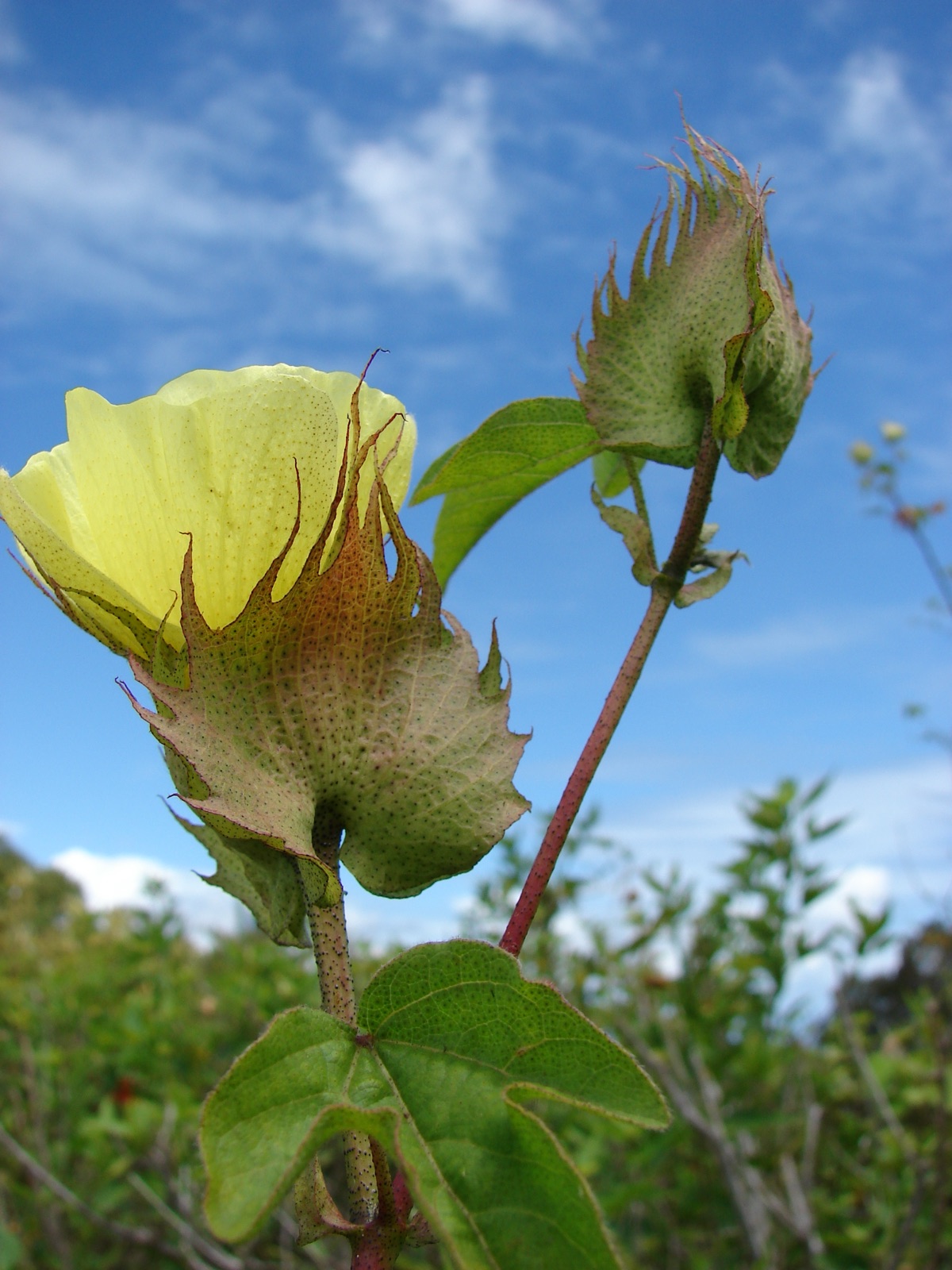
Is this upland cotton or extra-long-staple cotton?
Honest Limits of This Guide
- The right planting month is different in every real cotton-growing region, because it depends on your own local last-frost date and soil warming, not a fixed calendar date. This guide gives you the rule (Stage 3) instead of a date.
- World production figures in this guide come from a Wikipedia country-production table that itself cites FAOSTAT's own 'Seed cotton, unginned' 2022 dataset directly, because this session did not find a way to query FAOSTAT's own bulk data service for cotton, the same real limitation this library's own tomato and coffee guides record for their own figures.
- This guide does not print a single, unified per-hectare yield figure for cotton, because real yield differs by a large factor between irrigated, mechanised commercial systems and rainfed smallholder systems -- averaging them into one number would honestly mislead more than it would inform (yieldAndMarketValue).
- The real gin turnout range (roughly 33 to 40 percent lint by weight) and the real micronaire-and-premium principle in marketSegments are stated as general, honest ranges and principles from published references rather than one live, universal schedule confirmed this session, since actual classing schedules are set and revised by national classing bodies and change over time.
- No single, detailed, published per-hectare cost-of-production and returns dataset covering land, water, crop protection and labour together across this guide's own diverse 33-country list was found this session, unlike this library's own soybean guide's single-country dataset (farmEconomics).
- This guide does not name any pesticide, fungicide, herbicide or plant growth regulator product or compound. It names mode-of-action groups and general practice categories, and the toxicity colour-band principle, only. If you decide to use a product, buy only from a licensed dealer and follow the label on the actual package.
- The toxicity colour band is a principle, not a fixed chemical-to-colour list. The same active substance can sit in a different band in a different formulation or country, and registrations change. Read the real triangle on the real package.
- This guide's own real Indian seed-certification figures (65 percent minimum germination, 98 percent physical purity, 10 percent maximum moisture) are drawn from India's own published Minimum Seed Certification Standards and may differ from another country's own real, separate national cotton seed-certification standard, which this session did not independently confirm for every country in this guide's own 33-country list.
- This guide names cotton leaf curl virus, Fusarium wilt, Verticillium wilt and bacterial blight honestly in words, but no adequately licensed, freely reusable Commons photograph could be found this session specifically showing any of their own symptoms; a grower facing a suspected case of any of them should confirm with a real local extension visit rather than relying on this guide's written description alone to self-diagnose (troubleshooting, images).
- Bt cotton adoption and the real, documented emergence of field resistance to some Bt traits in some regional pest populations are both named honestly and neutrally in this guide, without this guide taking any position on the wider genetically modified crop debate, the same neutral posture this library's own soybean guide takes on genetically modified soybean.
Related Laisha Tools
- Global Market Price Outlook — Check today's price and trend
- Crop Calendar — Build a season-long sowing plan
- Pest & Disease Intelligence — Risk reasoning and a global pest & disease library
- Crop Health — Photo-based first read on a field problem
- Seed Quality Intelligence — Check a seed lot before you plant it
Open the free Applied Agriculture Library in the Laisha app →
Sources
- GBIF Backbone Taxonomy species-match record for Gossypium hirsutum L. (usage key 3152661) — Global Biodiversity Information Facility (GBIF), Copenhagen (source)
- EPPO Global Database taxon record for Gossypium hirsutum, code GOSHI — European and Mediterranean Plant Protection Organization (EPPO), Paris (source)
- GBIF Backbone Taxonomy species-match record for Gossypium barbadense L. (usage key 3152666) — Global Biodiversity Information Facility (GBIF), Copenhagen (source)
- EPPO Global Database taxon record for Gossypium barbadense, code GOSBA — European and Mediterranean Plant Protection Organization (EPPO), Paris (source)
- Cotton -- overview article — Wikipedia, citing a wide range of primary botanical, archaeological, agronomic, historical and trade sources including FAOSTAT (source)
- Cotton classing — Wikipedia, citing USDA, UNCTAD and published textile-science references (source)
- Boll weevil — Wikipedia, citing peer-reviewed economic-history sources including the Journal of Economic History (source)
- World Water Week (cotton water-footprint figures) — CottonConnect, corroborated against The Guardian's 'World Water Day: the cost of cotton in water-challenged India' (2015) (source)
- World Water Day: the cost of cotton in water-challenged India — The Guardian (source)
- Laisha's own curated Seed Certification Standards reference -- Cotton (Gossypium spp.) entry — Laisha internal curated reference (backend/database/seedCertificationStandards.json), sourced from India's Minimum Seed Certification Standards (IMSCS) (source)
- Laisha's own curated Fertilizer Database -- Cotton flowering entry — Laisha internal curated reference (backend/database/fertilizerDatabase.json) (source)
- Laisha Global Crop Priority Research -- Cotton entry — Laisha internal curated research (backend/database/globalCropPriorityResearch.json) (source)
- Laisha Leaf Visual Diagnostic Reference — Laisha internal curated reference (backend/database/leafVisualDiagnosticReference.json) (source)
- Laisha's own agrochemical safety reference: mode-of-action grouping and the India colour-band toxicity principle — Laisha internal curated reference, built from the Insecticides Act 1968 / Insecticide Rules 1971 (India) and IRAC/FRAC/HRAC mode-of-action classification systems (source)