How to Grow Millet
Cenchrus americanus · Also called: pearl millet, bajra, bajri, sajje, kambu, cumbu, bulrush millet, cattail millet
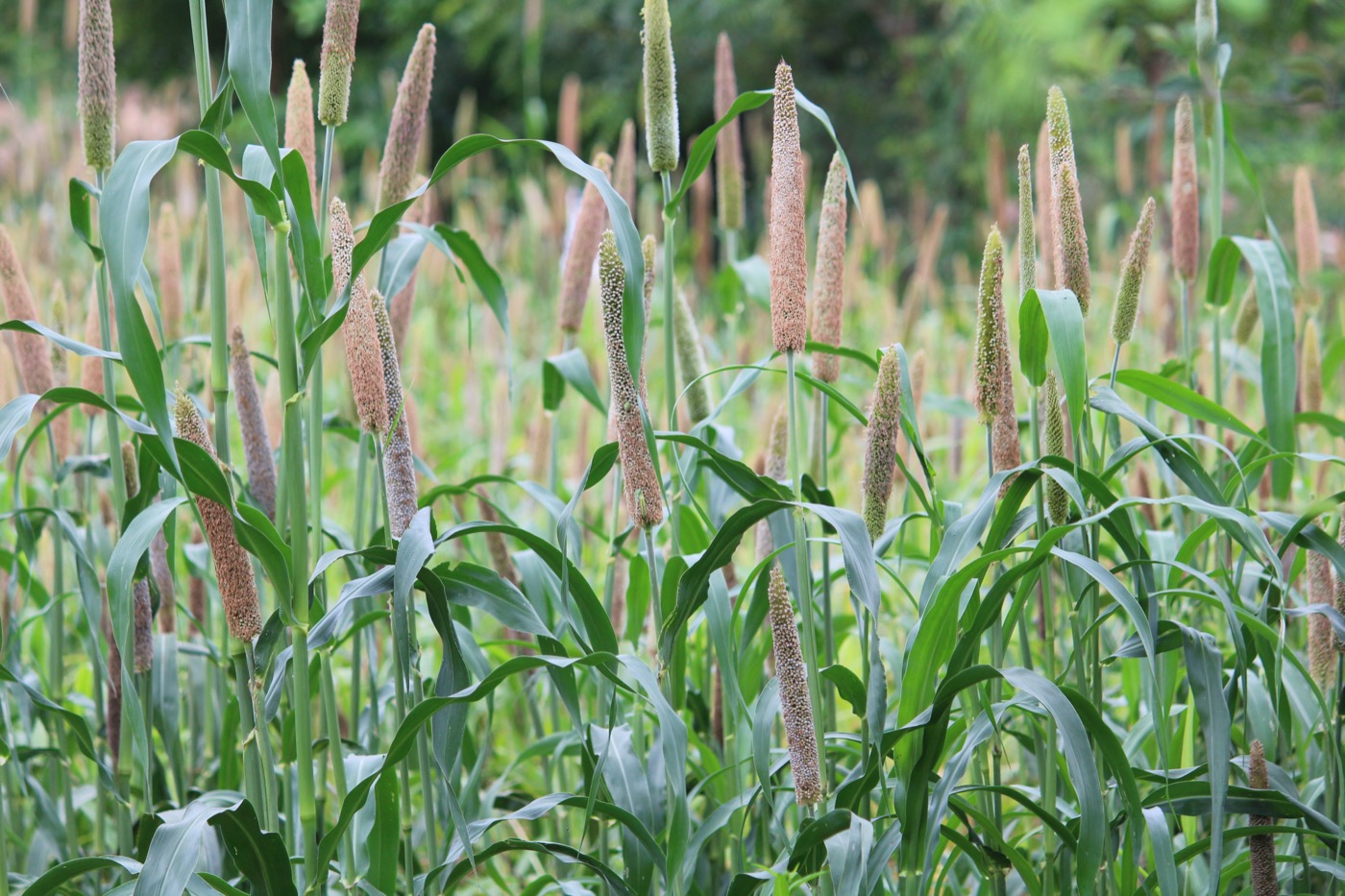
Photo: Shanmugamp7, CC BY-SA 3.0 (Wikimedia Commons)
Millet is the crop that keeps growing when the rain millions of smallholder families depend on genuinely fails to arrive. Pearl millet and finger millet are both real C4 grasses, a genuinely efficient photosynthetic pathway shared with maize, sorghum and sugarcane, but pearl millet in particular is honestly among the most drought-tolerant and heat-tolerant cereal grains cultivated anywhere in the world -- it performs on marginal, low-fertility, sandy soils and in growing seasons with rainfall too short, too late or too unreliable for maize, and often too short even for sorghum, this library's own other great dryland cereal (growthHabitAndMethod). That real, well-documented hardiness is not a minor agronomic footnote -- it is the honest reason millet remains a critical food-security crop across the semi-arid Sahel and wider dryland Africa, and across the drier tracts of South Asia, in exactly the marginal growing conditions this whole project's own founding mission is built around, even though millet is genuinely far less internationally traded than wheat, rice or maize. FAOSTAT's own 2022 figures record 30.9 million tonnes of world millet production, led overwhelmingly by India at 11.8 million tonnes -- some 38 percent of the world total, nearly triple its nearest rival -- with eight of the remaining nine top-ten producing countries in Africa (globalImportance). Laisha's own curated crop-priority research independently finds millet ranked among the top ten crops grown in 27 of the world's 195 countries, and the single biggest crop of all in four of them: Chad, Mali, Namibia and Niger. Millet also carries a real, genuinely different second story worth stating honestly alongside its staple food-security role: in wealthier markets it has seen a real, recent resurgence as a health-food 'ancient grain', driven partly by real gluten-free demand from people managing coeliac disease and other gluten-related conditions, and formally recognised by the United Nations Food and Agriculture Organization, which declared 2023 the International Year of Millets specifically to raise this crop's own profile (marketSegments). As with every crop in this library, any agrochemical used on this crop must be handled exactly according to this guide's own chemicalSafetyRule below, bought only from a licensed dealer, and never guessed at from a name half-remembered from a neighbour.
Global Importance
Millet grows across a real, genuinely wide dryland belt spanning semi-arid Africa and South Asia, but its true weight within that belt is honestly lopsided toward one country: India alone grows well over a third of the world's total, and eight of the other nine top-ten producing countries are African.
Market Segments
Millet genuinely sits in two real, very different markets at once, and understanding honestly which one you are actually farming for shapes almost every later decision in this guide -- a distinction closer in spirit to cocoa's own bulk-versus-fine-flavour split elsewhere in this library than to a simple single-market staple grain.
Growth Habit
Three real, foundational facts decide almost everything else a millet grower does: millet's own real C4 photosynthetic efficiency and genuinely deep, extensive root system, which together explain its real drought and heat tolerance better than any single fixed water figure could; the real, visibly different growth habit of pearl millet's tall, single candle-shaped panicle against finger millet's short, branching, distinctively finger-shaped ear; and the real, honest fact that both crops are grown almost entirely by direct sowing into the field, with no nursery stage at all, unlike several tree and vegetable crops elsewhere in this library.
Growing Millet, Stage by Stage
- 1. Choose your land, climate, and which real crop to grow — Confirm your own real climate genuinely suits millet, choose honestly between pearl millet and finger millet based on your own local conditions and market, and choose land before a single seed is sown.
- 2. Choose and get your seed — Local varieties can genuinely be saved and resown for both crops. Choose for your own real rainfall length, for birds, and honestly for downy mildew resistance if you are growing pearl millet.
- 3. Get the land ready — Loosen the soil, remove the weeds, and catch every drop of rain you can -- millet tolerates poor soil, but it still establishes best on a genuinely well-prepared seedbed.
- 4. Sow the seed — Shallow, into moist soil, several seeds per spot, then thin later -- millet's own seed is genuinely small and cannot be sown deep.
- 5. Water — Millet handles dry weather better than almost any other cereal in this library. Do not panic when it looks stressed -- but do not neglect it right at flowering.
- 6. Weeds — Weed early and hard. Millet's own small seedlings and, for finger millet, genuinely slow early growth both compete poorly against weeds -- and in dry country a weed is stealing water, not just food.
- 7. Feed the crop — Base your programme on a real soil test where possible, and understand honestly that millet is genuinely more input-tolerant of poor soil than most cereals, but still responds meaningfully to real feeding where inputs are available.
- 8. Insect pests, stage by stage — Shoot fly matters most in young pearl millet, killing the growing point of a seedling before it can recover. Stem borers matter across both crops later in the season, tunnelling inside the stem itself.
- 9. Diseases, stage by stage — Downy mildew is pearl millet's own single most historically damaging disease, capable of collapsing a national harvest within one season. Blast is finger millet's own single most significant disease. Ergot and smut both affect the grain itself and carry real safety implications.
- 10. Keep the birds off — Exactly as in sorghum, birds are the biggest single real threat to a ripening millet crop. Plan for it before you plant, not after.
- 11. Know when to harvest — Cut when the grain is hard and the head has changed colour, and do not leave a ripe crop standing in the field.
- 12. Dry it and store it so you do not lose it — Dry it hard, pack it tight, keep it whole rather than milled -- millet stores genuinely well as whole grain, and finger millet in particular is prized for its exceptionally long safe storage life.
Fertiliser Programme
Millet is genuinely more tolerant of low soil fertility than almost any other cereal in this library, but that tolerance is a survival trait, not proof that feeding it is wasted effort -- a fed millet crop still yields meaningfully more than an unfed one on the same real land.
Common Problems & Troubleshooting
If you see: Part or all of a pearl millet panicle transformed into a mass of small, distorted, leaf-like green structures in place of normal grain, sometimes alongside pale streaking and stunted, bushy growth in younger plants.
It likely means: Downy mildew ('green ear'), caused by the oomycete Sclerospora graminicola -- pearl millet's own single most economically important disease worldwide, with a real, documented history of collapsing India's own national harvest by more than 40 percent within a single season when a genetically uniform susceptible hybrid was widely planted.
Do this: Remove and destroy infected plants showing green-ear symptoms promptly, before the disease's own spores spread further.
If you see: Grey-green to grey-brown spindle-shaped lesions on finger millet leaves, or infection at the neck of the panicle or on individual finger spikes causing the head to dry out and snap.
It likely means: Finger millet blast, caused by the fungus Magnaporthe grisea (asexual stage Pyricularia grisea) -- the same real fungal genus responsible for rice blast, and finger millet's own single most significant disease, with published yield losses of up to 80 percent reported in bad years in Uganda specifically.
Do this: Remove and destroy severely infected plants and residue rather than leaving them in the field.
If you see: Hard, dark, elongated bodies replacing individual grains on a pearl millet head, standing out clearly from normal, healthy grain.
It likely means: Ergot, caused by the fungus Claviceps fusiformis in pearl millet -- these dark bodies (sclerotia) carry real, genuinely toxic alkaloids, the same real fungal genus responsible for classical ergotism in human agricultural history.
Do this: Inspect grain heads before harvest and again before storage, and hand-sort out any affected heads or grain.
If you see: Individual grains on a pearl millet head replaced by dark, powdery fungal masses that burst into black powder when crushed.
It likely means: Grain smut, caused by the fungus Moesziomyces bullatus (also recorded under the older name Tolyposporium penicillariae) -- a real disease that, like sorghum's own smut, travels forward on infected seed.
Do this: Never save seed from a head or a field that showed this symptom.
If you see: A young pearl millet seedling's central leaf dead and withered, pulling out easily by hand while the outer leaves stay green.
It likely means: Shoot fly (Atherigona species) -- a small fly whose larva tunnels down inside the seedling's central shoot and kills its growing point, a real, well-documented early-season pest of pearl millet.
Do this: Pull out and destroy any seedling showing this deadheart symptom. The shoot itself will not recover.
If you see: Small holes in a line across a young leaf as it unrolls, and later stems that snap over easily in wind with visible tunnels inside when cut open.
It likely means: A stem borer caterpillar has tunnelled inside the stem, weakening it and interrupting nutrient flow to the developing head, a real pest affecting both pearl and finger millet later in the season.
Do this: Pull out and destroy plants whose stem shows fresh tunnelling and structural weakness.
If you see: Heads bare on one side or bare at the top, with grain gone but the head still standing, and flocks of small birds lifting off the field as you approach.
It likely means: Birds -- exactly as in this library's own sorghum guide, the single biggest cause of loss in most millet-growing areas, since the grain sits fully exposed at the top of the plant for both pearl and finger millet.
Do this: Guard the field at dawn and late afternoon, the main real feeding times.
If you see: Pale, yellowish-green leaves across the field, short stunted plants, and visibly smaller-than-expected heads at maturity despite otherwise reasonable growing conditions.
It likely means: The crop is short of nitrogen, common on the genuinely poor, sandy soils millet is typically grown on.
Do this: Apply manure, compost or a nitrogen fertiliser, concentrated in the planting spot rather than spread thinly, before the crop heads.
If you see: Small beetles or moths in the store, grain with holes, fine powder at the bottom of the container, webbing on the surface.
It likely means: Storage insects, usually brought in with the grain or carried over in the store from the previous season.
Do this: Take the grain out and spread it in the sun again -- heat and sunlight genuinely knock storage insects back.
If you see: Patchy, uneven emergence after sowing, with visible unbroken soil crust over parts of the field where seedlings never appeared.
It likely means: Soil surface crusting, a real, common problem on millet's own typically light, sandy soils when a hard rain compacts the bare surface before tiny seedlings have the strength to push through it.
Do this: Sow shallow, as this guide's own Stage 4 instructs -- deeper-sown seed has even less strength to break through a crusted surface.
Real Farm Economics
Millet's real economics carry one honest, defining fact this guide states plainly rather than softening: its true economic value to a smallholder family is often measured less in a printed market price and more in real, documented reliability when every other crop on the same land has already failed.
Yield & Market Value
Growing the crop is only part of the job. The last part is knowing what a normal harvest looks like, and knowing what your millet is actually worth before you agree a price with anybody -- and for this specific crop, this guide has an honest, direct answer that matters a great deal: millet is not one of the crops Laisha's own live commodity price service tracks by name.
Remember It This Way
If you forget every other page of this guide, keep these lines. They are the whole crop, in order, short enough to carry in your head.
- One name, two real plants -- a tall candle and a short open hand.
- Where sorghum waits out a dry spell, millet waits out a worse one.
- No nursery, no waiting years -- straight into the ground it grows.
- A green ear is not a harvest. It is a disease wearing grain's own colour.
- One hybrid, one bad season, and a nation's harvest can fall by half.
- Birds are the real thief. Guard from flowering to the last cut head.
- Dark grains, hard grains -- ergot and smut, never eaten, never saved.
- Store it whole. Milled flour dies fast, but whole grain can outlive a season.
- In the worst year, this is the crop still standing in the field.
Test Yourself: Identification
What crop is growing in this field, with tall stems topped by narrow, candle-shaped heads?
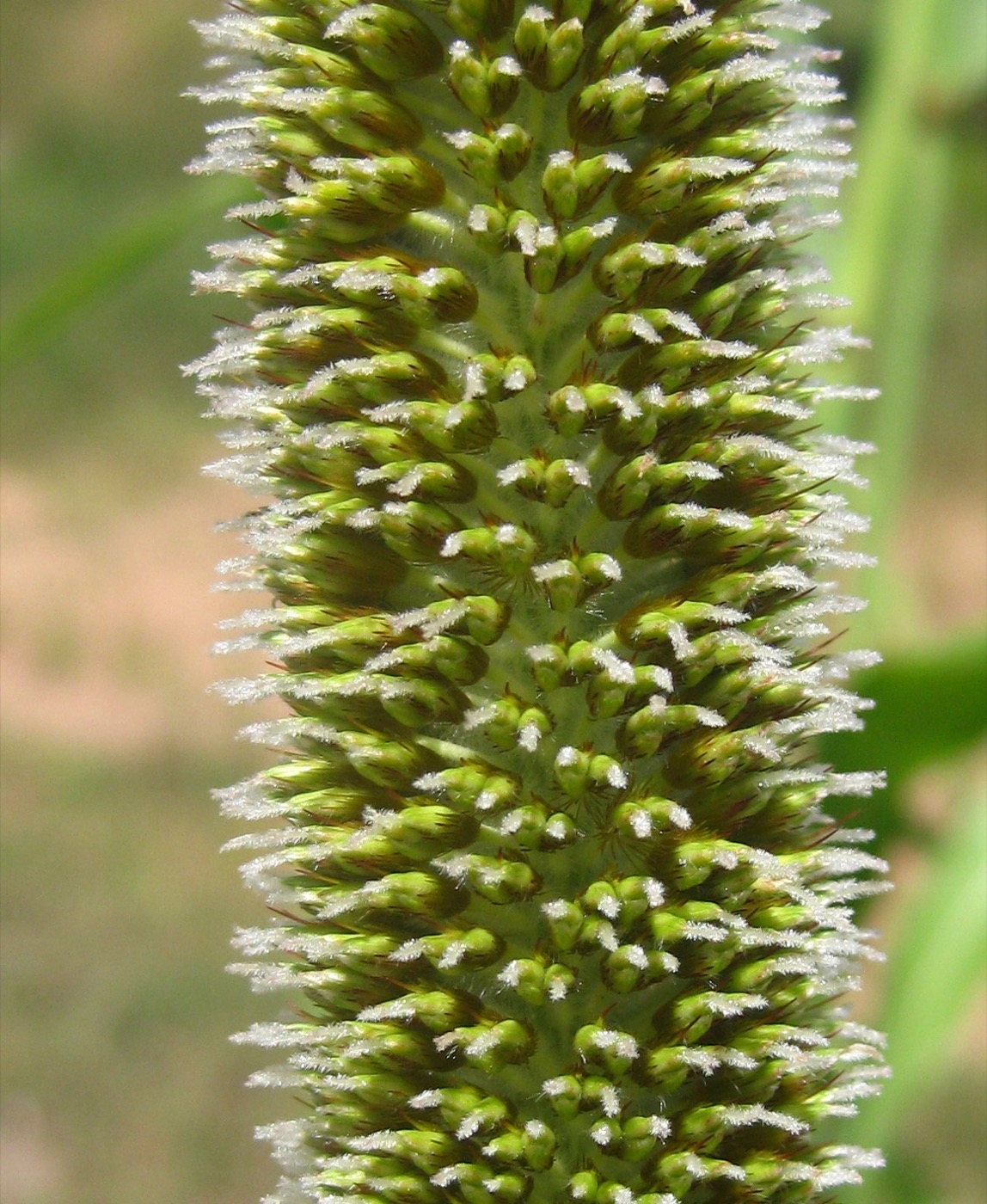
What is this narrow, spiky, candle-shaped head close up?
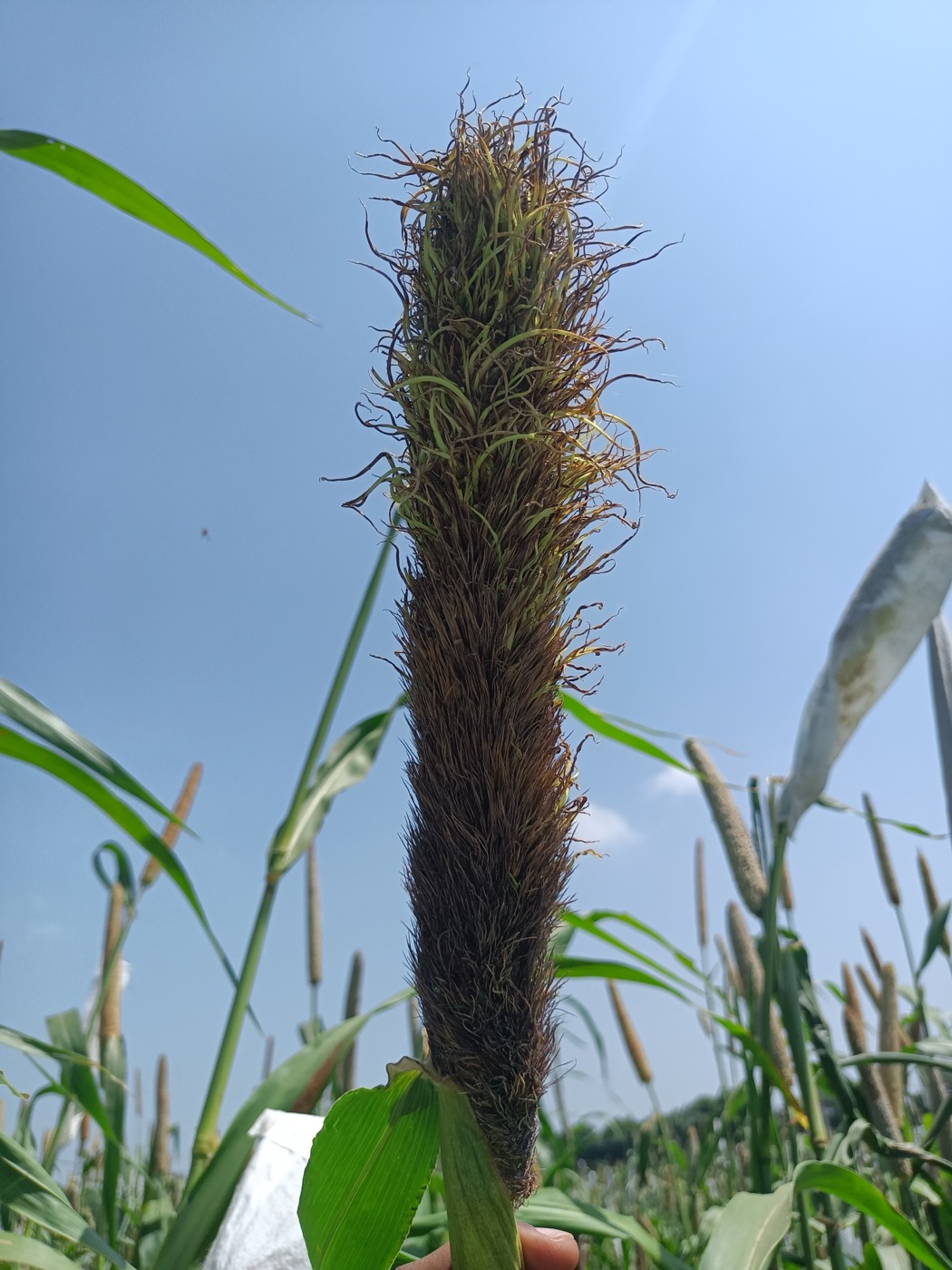
What has happened to this pearl millet head, which looks leafy and green instead of grain-filled?
Honest Limits of This Guide
- The right planting month is different in every real millet-growing region, because it depends on your own local rainy season, not a fixed calendar date. This guide gives you the rule (Stage 1) instead of a date.
- World production and area figures in this guide come from FAOSTAT's own combined 'Millet' statistical category, which genuinely bundles pearl millet, finger millet and other real cultivated millet species together into one figure -- this session did not find a way to split that category cleanly by species for every country, and states that honestly rather than inventing a false per-species breakdown (globalImportance, yieldAndMarketValue).
- This guide does not print one single, unified per-hectare yield figure for millet, because real yield varies by several times over between the driest Sahelian countries and better-managed South Asian systems -- averaging them into one number would honestly mislead more than it would inform (yieldAndMarketValue).
- No detailed, published per-hectare cost-of-production and returns dataset specific to millet, covering land preparation, labour and storage costs together, was found this session, the same real honest gap this library's own cocoa guide records for its own crop (farmEconomics).
- Millet is not one of the ten crops Laisha's own live Global Commodity Price service tracks by name (wheat, rice, cotton, palm oil, maize, sorghum, barley, soybean, groundnut and sugar). This guide states that plainly in yieldAndMarketValue rather than guessing at a world reference price that does not actually exist inside Laisha's own live data for this crop.
- This guide does not name any pesticide, fungicide or herbicide product or compound. It names mode-of-action groups and the toxicity colour-band principle only. If you decide to use a product, buy only from a licensed dealer and follow the label on the actual package.
- The toxicity colour band is a principle, not a fixed chemical-to-colour list. The same active substance can sit in a different band in a different formulation or country, and registrations change. Read the actual triangle on the actual package.
- This guide does not carry a real, published EU, US or Canadian seed-law-style certification standard for millet the way several other crops in this library do, because no such formal legal standard was found to exist for millet seed the way it does for major cereal seed (seedGradingAndCertification). This is stated honestly as a real gap in the world's own millet seed systems, not a gap in this guide's own research.
- This guide's own foxtail millet, proso millet, barnyard millet and kodo millet mentions in botanicalIdentity are honest acknowledgements that the umbrella term 'millet' covers real species beyond pearl and finger millet -- this guide does not cover their own separate agronomy in depth, and a grower of one of those other real species should not assume every instruction here transfers directly.
- The India downy mildew epidemic figures named in this guide's own safetyWarningFirst and troubleshooting sections describe a specific, real, documented 1970-71 to 1971-72 season in India; this guide does not claim identical figures apply to every country or every season on its own 27-country list, and states that honestly rather than generalising one country's documented history into a universal claim.
Related Laisha Tools
- Global Market Price Outlook — Check today's price and trend
- Crop Calendar — Build a season-long sowing plan
- Pest & Disease Intelligence — Risk reasoning and a global pest & disease library
- Crop Health — Photo-based first read on a field problem
- Post-Harvest Loss Prevention — Real storage science by crop
Open the free Applied Agriculture Library in the Laisha app →
Sources
- GBIF Backbone Taxonomy species-match record for Cenchrus americanus (L.) Morrone (usage key 5828197), and its recorded synonym Pennisetum glaucum (L.) R.Br. (usage key 2706141) — Global Biodiversity Information Facility (GBIF), Copenhagen (source)
- World Checklist of Vascular Plants (WCVP) record for Cenchrus americanus (L.) Morrone, queried live through GBIF's own hosted copy of the checklist — Royal Botanic Gardens, Kew, hosted via GBIF (dataset f382f0ce-323a-4091-bb9f-add557f3a9a2) (source)
- GBIF Backbone Taxonomy species-match record for Eleusine coracana (L.) Gaertn. (usage key 2705957) — Global Biodiversity Information Facility (GBIF), Copenhagen (source)
- World Checklist of Vascular Plants (WCVP) record for Eleusine coracana (L.) Gaertn., queried live through GBIF's own hosted copy of the checklist — Royal Botanic Gardens, Kew, hosted via GBIF (dataset f382f0ce-323a-4091-bb9f-add557f3a9a2) (source)
- Millet -- overview article — Wikipedia, citing FAOSTAT 2022 production data and a wide range of primary botanical, agronomic and nutritional sources (source)
- Pearl millet -- overview article — Wikipedia, citing a wide range of primary agronomic and entomological sources (source)
- Finger millet -- overview article — Wikipedia, citing a wide range of primary botanical, agronomic and nutritional sources (source)
- Pearl millet downy mildew research in India: progress and perspectives — International Crops Research Institute for the Semi-Arid Tropics (ICRISAT) (source)
- Integrated Blast and Weed Management and Microdosing in Finger Millet: A HOPE Project Manual for Increasing Finger Millet Productivity in Eastern Africa — International Crops Research Institute for the Semi-Arid Tropics (ICRISAT) (source)
- Sorghum and millets in human nutrition — FAO Food and Nutrition Series No. 27, Food and Agriculture Organization of the United Nations, Rome (source)
- Towards integrated commodity and pest management in grain storage — FAO in collaboration with NAPHIRE, Rome (source)
- Purdue Improved Crop Storage (PICS) hermetic bags — Purdue University PICS network (source)
- Millet yields (dataset), built on FAOSTAT: Production, Crops and livestock products — Food and Agriculture Organization of the United Nations, with major processing by Our World in Data (source)
- Laisha Global Crop Priority Research -- Millet (pearl / finger) entry — Laisha internal curated research (backend/database/globalCropPriorityResearch.json) (source)
- International Year of Millets 2023 -- IYM 2023: Unleashing the potential of millets for the well-being of people and the environment — Food and Agriculture Organization of the United Nations (source)
- Laisha's own agrochemical safety reference: mode-of-action grouping and the India colour-band toxicity principle — Laisha internal curated reference, built from the Insecticides Act 1968 / Insecticide Rules 1971 (India) and IRAC/FRAC/HRAC mode-of-action classification systems (source)