How to Grow Tomato
Solanum lycopersicum · Also called: tomato, tomatoes, love apple, wolf peach, tomate, tomates, Tomate, Tomaten
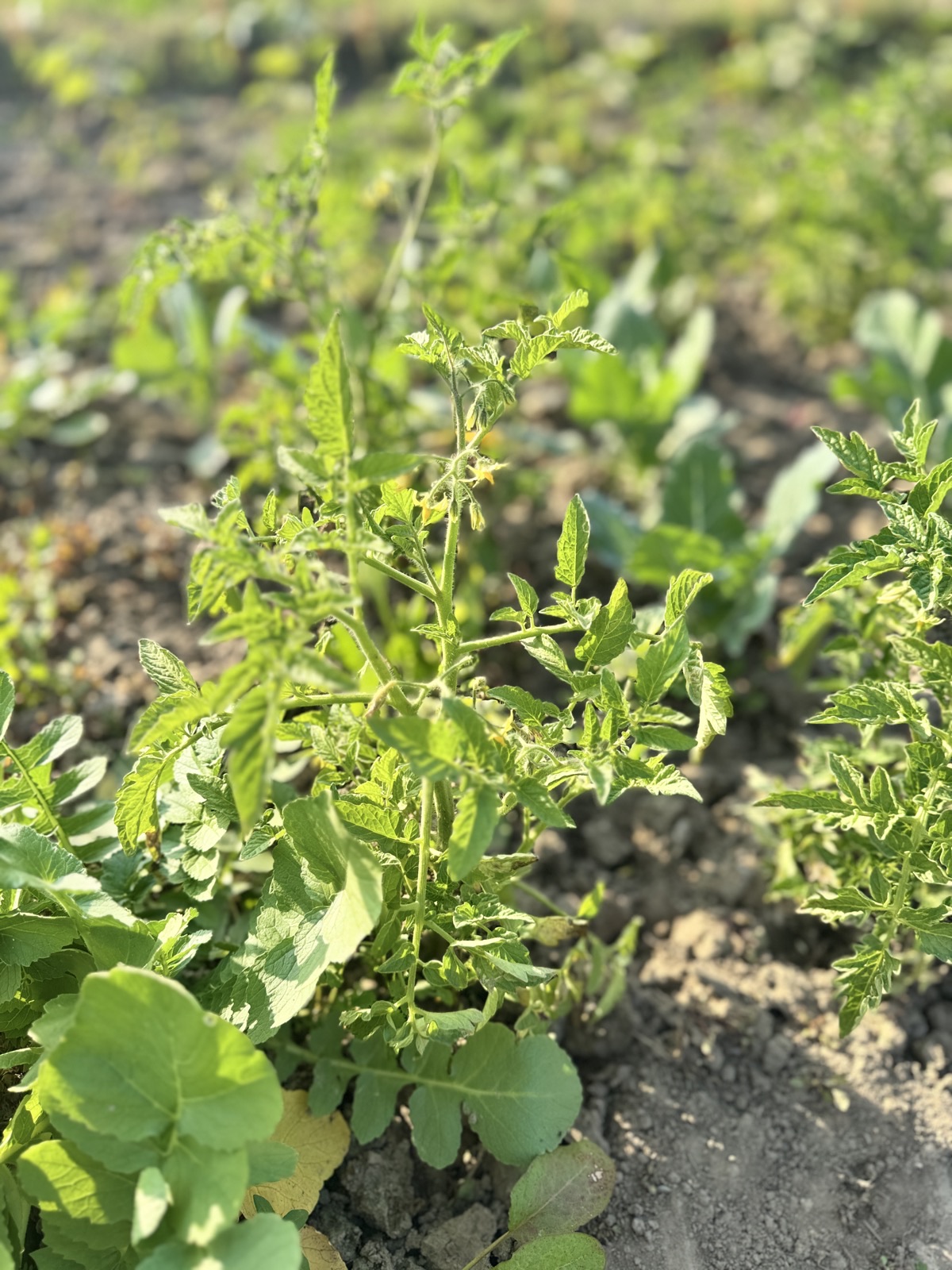
Photo: EarthyVibes, CC BY-SA 4.0 (Wikimedia Commons)
Tomato is a real top-ten crop in 35 of the world's 195 countries, and the single biggest crop of all in one of them: Malta. World production reached approximately 192.3 million tonnes in 2023, led overwhelmingly by China at roughly 70.1 million tonnes -- 36 percent of the entire world total on its own -- followed at real distance by India (approximately 29.4 million tonnes), Turkey, the United States, Egypt and Mexico. That scale makes tomato one of the most widely grown vegetable crops on Earth by tonnage, genuinely comparable to several of the staple grain crops elsewhere in this library despite tomato itself being, by strict botanical definition, a fruit rather than a vegetable at all -- specifically a berry, the ripened ovary of the flower together with its seeds. That single fact once reached the United States Supreme Court: in Nix v. Hedden (1893), the Court unanimously ruled that tomato counted as a vegetable for tariff purposes under the ordinary, everyday meaning of the word, not the technical botanical one -- a real, checkable piece of legal history that captures honestly how differently science and everyday life can classify the exact same fruit. Tomato also carries a genuinely unusual double identity that shapes almost everything else in this guide: the same species is grown as two largely separate real industries, fresh-market tomato (bred and handled for appearance, firmness and shelf life, very often trellised and hand-picked over many weeks) and processing tomato (bred as compact, determinate bushes that ripen their whole crop at once for a single mechanical harvest, destined for paste, sauce, ketchup and canned products) -- two enterprises grown from the same species that genuinely call for different varieties, different spacing, different equipment and different economics (marketSegments). Botanically, tomato's own naming history is one of the more tangled in this library: named Solanum lycopersicum by Linnaeus in 1753, moved to its own genus as Lycopersicon esculentum in 1768, and only returned to Solanum by genetic evidence within recent decades (botanicalIdentity) -- and tomato's closest real relative in this collection is not another fruiting vegetable at all, but potato, a fellow member of the nightshade family that shares tomato's own most economically damaging disease, late blight, the very pathogen behind the 1845-1852 Irish Potato Famine (troubleshooting, safetyWarningFirst).
Global Importance
Tomato is grown on every inhabited continent, in open fields, in simple smallholder plots and in some of the most intensively engineered greenhouse systems in all of agriculture -- but this guide states plainly, rather than inflating tomato's honest position, that its real top-ten-crop presence (35 countries) is concentrated overwhelmingly in island states, Mediterranean and Gulf economies rather than across the largest agricultural land areas of the world, and that a small handful of countries account for the overwhelming majority of its real world tonnage.
Market Segments
Tomato is not one crop grown one way. It splits into real, materially different production systems, and more sharply than for almost any other crop in this library, the variety, the spacing, the support structure and the harvest method are all decided by which of these systems a grower is actually in -- not by preference, but by what the buyer at the other end genuinely needs.
Growth Habit
Two real, foundational facts about tomato's own biology decide almost everything else a grower does with this crop: whether the variety is determinate or indeterminate, which drives every staking, pruning and harvest decision that follows; and the fact that almost every commercial tomato crop in the world begins life not as a seed sown directly in the field, but as a nursery-raised transplant.
Growing Tomato, Stage by Stage
- 1. Choose your land, decide your market, and plan the rotation — Pick land free of recent nightshade cropping, and decide before anything else whether this crop is genuinely for fresh-market or processing, and determinate or indeterminate -- tomato's own real markets and its own real disease list both make this an early, not a late, decision.
- 2. Raise a real nursery: seed the tray and grow strong transplants — Start seed in a protected nursery roughly 6 to 8 weeks before your planned transplanting date, and grow strong, stocky, healthy seedlings rather than tall, thin, stretched ones.
- 3. Harden off and transplant into the field — Move hardened-off transplants into warm, well-prepared soil at real, sensible spacing, and water them in immediately.
- 4. Stake, trellis or leave sprawling -- matched to your growth habit and market — An indeterminate, fresh-market crop genuinely needs real support installed early; a determinate, processing crop normally needs none at all. Know honestly which one you are growing before deciding what to build.
- 5. Feed the crop — Base your programme on a real soil test, start with roughly half your total fertiliser at planting, and watch calcium and consistent watering together, since tomato's most visible nutrition-linked problem is not a simple deficiency at all.
- 6. Water — Tomato needs real, consistent moisture from transplanting through to the end of harvest, and the single most common water-linked failure in this crop is not too little water overall, but water that swings between too dry and too wet.
- 7. Weeds — Control weeds hardest in the first weeks after transplanting, while the young crop is still small and slow to close its own canopy, and keep weedy nightshade relatives out of and around the field year-round.
- 8. Insect pests, stage by stage — Tomato carries a genuinely long real pest list, but three matter more than the rest: Tuta absoluta, a devastating, globally spreading invasive leafminer; whitefly, because of the viruses it carries rather than the sap it removes; and the large, dramatic-looking hornworm caterpillars.
- 9. Diseases -- and the real physiological disorder that is not a disease at all — Late blight is the single most historically significant threat in this whole guide, sharing its exact causal genus with the pathogen behind the Irish Potato Famine. Alongside it, early blight, bacterial wilt, Fusarium and Verticillium wilts and whitefly-borne viruses take much of the world's remaining lost tomato yield -- and blossom-end rot, genuinely alarming to see, is not caused by any of them.
- 10. Harvest, ripen and store without losing quality — How and when tomato is harvested genuinely depends on which market it is grown for, more sharply than for almost any other crop in this library -- a fresh-market crop is hand-picked repeatedly over many weeks; a processing crop is machine-harvested once.
Fertiliser Programme
Tomato is fed in real, staged amounts through a genuinely long season, starting from a soil test and split between an at-planting base and in-season top-ups -- and, more than for most crops in this library, one specific nutrient (calcium) is as much a watering-consistency story as a fertiliser-rate story.
Common Problems & Troubleshooting
If you see: Dark, water-soaked blotches spread on leaves and stems, often starting at leaf tips and edges, with a white, fuzzy fungal growth on the underside of infected leaves in humid weather, and firm, dark, greasy-looking blotches spreading across fruit.
It likely means: Late blight, caused by the oomycete (a fungus-like organism) Phytophthora infestans -- the identical pathogen genus behind the 1845-1852 Irish Potato Famine and the wider 1840s European and 1846 Highland potato famines, since tomato and potato are both close relatives in the Solanaceae family.
Do this: Check leaves and fruit regularly in cool, humid weather, especially after rain, since this pathogen favours moist conditions and can complete its whole life cycle on the crop in about five days under ideal conditions.
If you see: Dark, concentric-ringed ('target-spot') lesions appear on older, lower leaves first, gradually spreading upward through the canopy over the season.
It likely means: Early blight, caused by the fungus Alternaria solani -- a real, separate disease from late blight despite the similar common name, and sometimes also confusingly called 'potato blight' in some regions since it affects potato too.
Do this: Check older, lower leaves specifically, since this disease characteristically starts there before moving upward.
If you see: Sudden wilting of the whole plant, or of one side of it, with no preceding yellowing of the leaves, often progressing to plant death within days.
It likely means: Bacterial wilt, a real, serious soil-borne bacterial disease that blocks the plant's own water-conducting tissue, frequently fatal once established.
Do this: Confirm the diagnosis where possible by cutting a lower stem crosswise and checking for a discoloured, water-soaked ring inside, then suspending the cut stem in clear water and watching for a milky bacterial ooze -- a real, simple field test.
If you see: Progressive yellowing and wilting of leaves, often starting on one side of the plant or one part of the canopy and worsening over days to weeks, with the wilting sometimes most visible during the heat of the day.
It likely means: Fusarium wilt or Verticillium wilt, two real, separate soil-borne fungal diseases that block the plant's own water-conducting tissue from within, both persisting in soil for years once established.
Do this: Confirm by cutting a lower stem lengthwise and checking for discoloured, browned vascular tissue running up the inside of the stem.
If you see: A dark, sunken, leathery patch develops at the blossom end of the fruit (the end opposite the stem), often starting small and expanding as the fruit grows, with no fungal growth or insect damage visible at the site.
It likely means: Blossom-end rot -- genuinely NOT caused by any pathogen at all, but a real physiological disorder caused by a localised calcium shortage inside the developing fruit tissue itself, most often triggered by inconsistent watering rather than a true soil calcium deficiency.
Do this: Check your own real watering consistency first, before assuming a soil calcium problem. Watering that swings between too dry and too wet is the single most common real trigger.
If you see: Irregular, pale, winding mines through leaf tissue, small entry holes bored into stems, and tunnelling damage directly inside green and ripe fruit, often with visible frass (insect droppings) near the wound.
It likely means: Tuta absoluta (the tomato leafminer or South American tomato pinworm), a small moth whose larvae mine and tunnel through leaves, stems and fruit, capable of causing up to 100 percent yield loss if left uncontrolled -- one of the most economically devastating tomato pests in the world today.
Do this: Use pheromone traps as a real, low-cost early-warning tool, since damage is often noticed only after significant loss has already occurred.
If you see: Leaves curl upward and inward, often with yellowing along the margins or between veins, plants become stunted, and small, white, moth-like insects fly up in a cloud when the foliage is disturbed.
It likely means: A whitefly-transmitted virus, most importantly tomato yellow leaf curl virus, spread by the whitefly Bemisia tabaci while feeding -- a real, serious viral disease with no direct chemical cure once a plant is infected.
Do this: Understand that the virus itself cannot be treated by any spray once a plant is infected -- only the whitefly vector can be managed, and only before infection happens.
If you see: Leaves show a mottled, mosaic-like pattern of light and dark green patches, sometimes with distorted, narrowed or fern-like leaflets, and stunted overall growth.
It likely means: Tobacco mosaic virus, a real, common tomato disease genuinely distinctive for how it can spread: handling cigarettes and other tobacco products that carry the virus, then touching tomato plants, is a documented real transmission route, alongside ordinary plant-to-plant contact and contaminated tools.
Do this: Wash hands thoroughly with soap, not just water, before handling tomato plants if you or anyone working the field smokes or handles tobacco products, since the virus can survive on hands and be transferred directly.
If you see: The topmost leaves of the plant wrinkle, curl and grow abnormally, with the whole plant's normal growth pattern visibly interrupted, often appearing suddenly on scattered plants across a field.
It likely means: Curly top, a real, serious viral disease carried by the beet leafhopper, which transmits the virus while feeding and genuinely interrupts the plant's own normal growth cycle.
Do this: Understand that the virus itself cannot be treated by any spray once a plant is infected -- only the beet leafhopper vector can be managed, and only before infection happens.
If you see: Flowers form normally but then wither, turn yellow and drop from the plant without ever setting fruit, especially during a real spell of high daytime or nighttime heat.
It likely means: Blossom drop caused by heat stress -- flowers genuinely fail to be pollinated or fertilised properly, and the plant sheds them, when temperatures rise much above about 90 degrees Fahrenheit (32 degrees Celsius) during the day or stay too warm overnight.
Do this: Understand this is a real, direct temperature response rather than a disease or nutrient problem, and no spray or fertiliser application fixes it.
Real Farm Economics
Real, published United States figures show honestly just how differently fresh-market and processing tomato are actually valued and worked, and this guide states that split plainly rather than averaging two genuinely different businesses into one misleading number.
Yield & Market Value
Growing the crop is only part of the job. The last part is knowing what a normal harvest looks like, and knowing what your tomato is actually worth before you agree a price with anybody -- and for this specific crop, this guide has an honest, direct answer that matters a great deal: tomato is not one of the crops Laisha's own live commodity price service tracks by name.
Remember It This Way
If you forget every other page of this guide, keep these lines. They are the whole crop, in order, short enough to carry in your head.
- It grows in a tray for two months before it ever touches your field.
- Determinate stops and ripens all at once. Indeterminate never stops -- and never stands up on its own.
- The same mould that starved Ireland still visits your tomato whenever the weather turns cool and wet.
- A dark patch on the fruit's bottom is thirst, not disease. Water evenly before you spray anything.
- Fresh pays more per acre. Processing costs less labour. Neither one is the better crop.
- One small moth from South America can still eat your whole crop if you let it.
- The court once ruled it a vegetable. The flower still says it is a fruit.
- It once had a green shoulder and real sweetness. Breeding for a uniform red picture took some of both away.
Test Yourself: Identification
What crop is growing in this field?
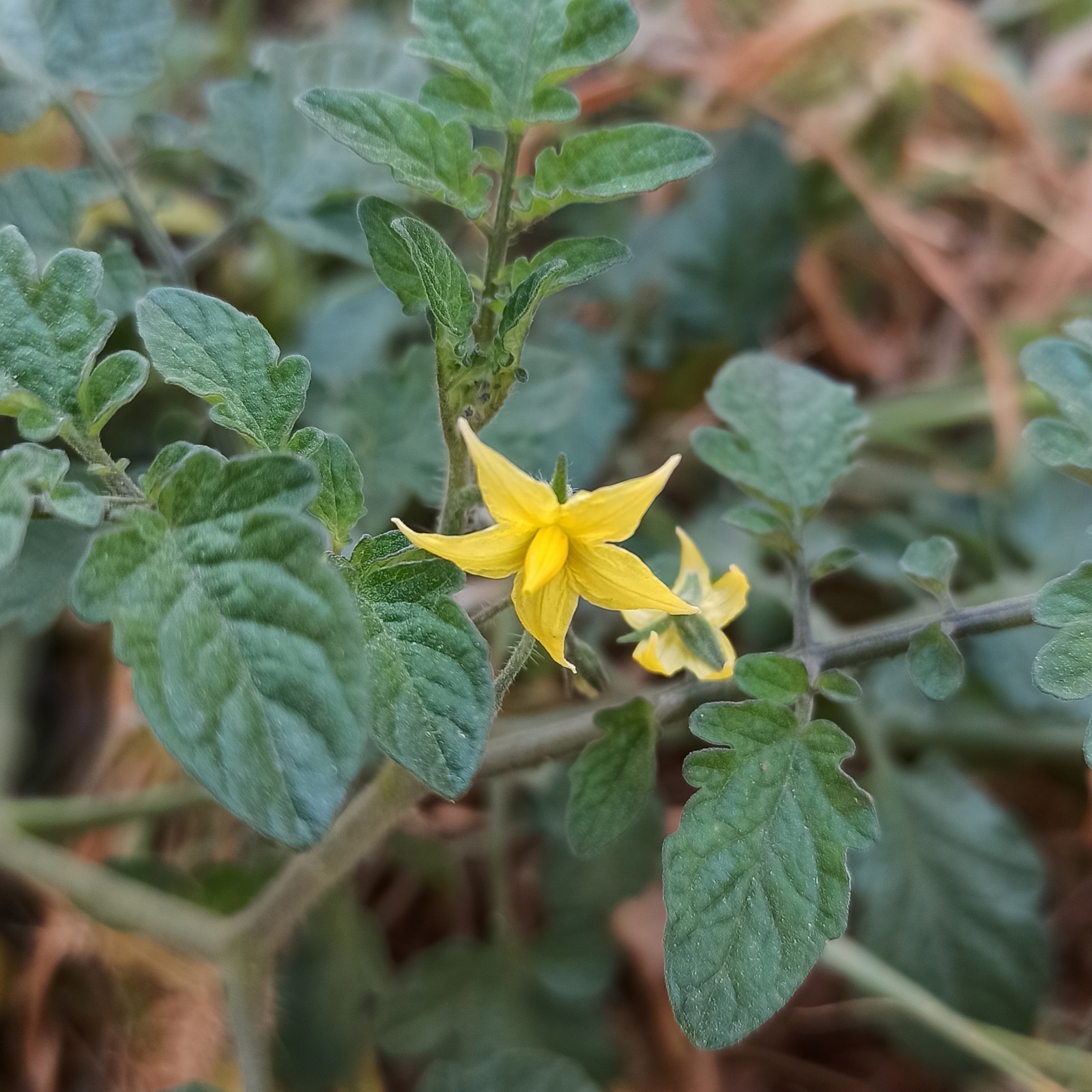
What is this flower, and why does it matter?
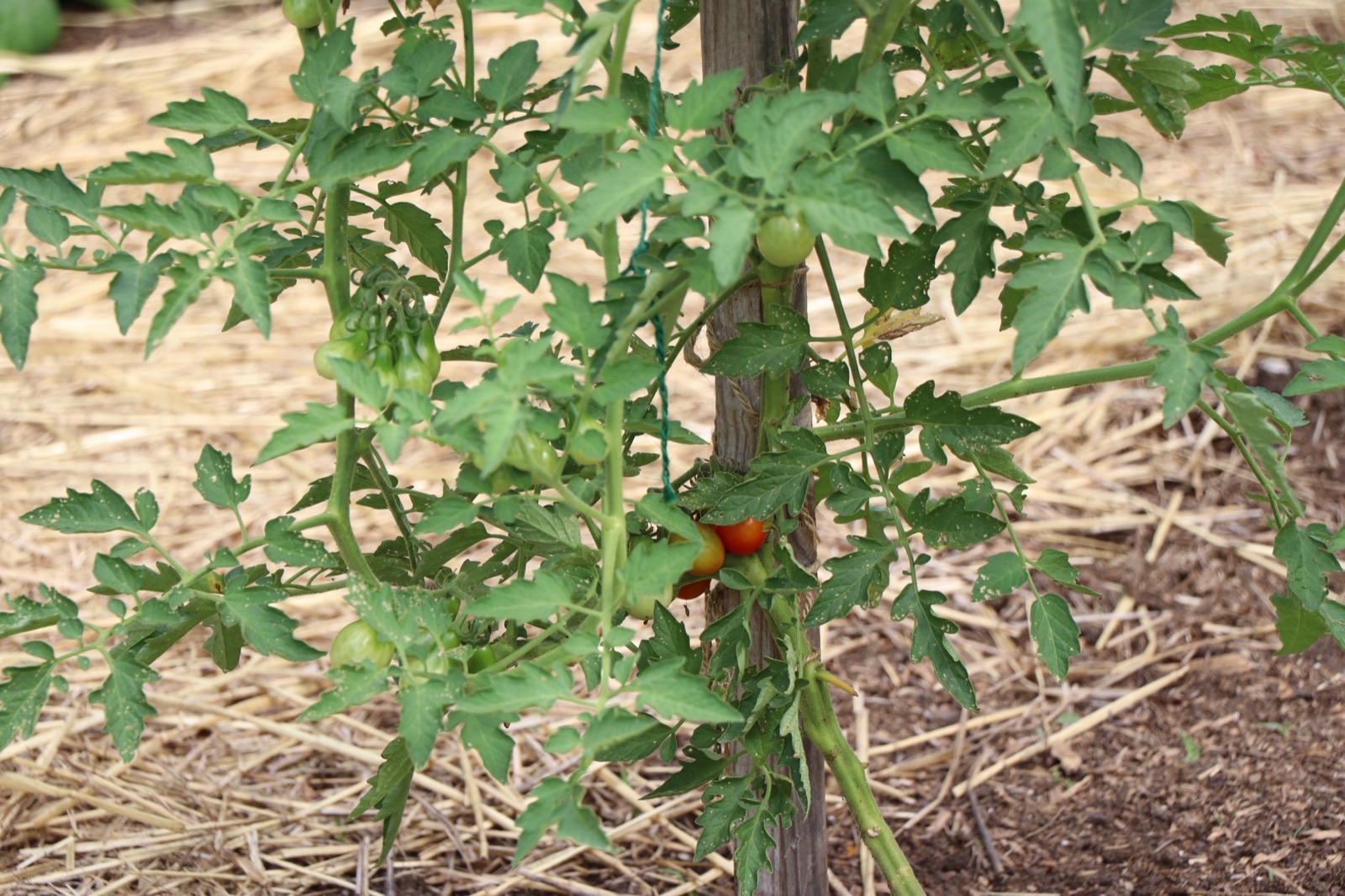
What is this, and is it ready to pick?
Honest Limits of This Guide
- The right transplanting month is different in every country, and even in every region within a country, because it depends on your own real last-frost date and your own soil warming up, not a fixed calendar date. This guide gives you the rule (Stage 3) instead of a date.
- World production figures in this guide come from a Wikipedia production table that itself cites FAOSTAT's own 2023 dataset directly, because a direct, live query to FAOSTAT's own bulk and API services returned a server error rather than usable data this session, the same real limitation this library's own oat guide records for its own figures.
- This guide does not print a single, unified per-hectare yield figure for tomato, because tomato is genuinely grown across open-field, protected and full greenhouse systems whose real yields can differ by a factor of ten or more -- averaging them into one number would honestly mislead more than it would inform (yieldAndMarketValue).
- The detailed agronomic figures in this guide -- transplant timing, spacing, staking dimensions, and per-acre fertiliser rates -- come from one specific, real, published United States extension source (Pennsylvania State University Extension's own Tomato Production guidance) describing commercial fresh-market and processing systems in one temperate country. No comparably detailed, published dataset was found this session for smallholder open-field tomato agronomy in other climates or regions specifically.
- No detailed, published per-hectare cost-of-production and returns dataset specific to tomato, covering staking materials, spray programmes and labour together, was found this session, unlike this library's own soybean guide. This guide states that gap honestly in farmEconomics rather than presenting an invented or borrowed figure as tomato's own.
- Tomato is not one of the ten crops Laisha's own live Global Commodity Price service tracks by name (wheat, rice, cotton, palm oil, maize, sorghum, barley, soybean, groundnut and sugar). This guide states that plainly in yieldAndMarketValue rather than guessing at a world reference price that does not actually exist inside Laisha's own live data for this crop.
- This guide does not name any pesticide, fungicide or herbicide product or compound. It names mode-of-action groups and the toxicity colour-band principle only. If you decide to use a product, buy only from a licensed dealer and follow the label on the actual package.
- The toxicity colour band is a principle, not a fixed chemical-to-colour list. The same active substance can sit in a different band in a different formulation or country, and registrations change. Read the real triangle on the real package.
- Late blight, bacterial wilt, and Fusarium and Verticillium wilt cannot be reliably diagnosed from this guide's photographs alone in every case, since early or mild infection of the vascular wilts specifically can produce ambiguous symptoms easily confused with simple water stress. A real local extension visit or laboratory test remains the honest way to know for certain in a borderline case.
- This guide's own real Tuta absoluta global-spread account is drawn from published entomological and regulatory sources current as of recent years; this pest's own real distribution continues to expand, and a grower in a region not yet named in this guide should not assume it will never arrive.
- The 'u' uniform-ripening mutation's real 10 to 15 percent sugar-reduction figure, and the real linkage-drag flavour and nutrition trade-offs named in consumerDemandAndSeedFeedbackLoop, are drawn from published plant-breeding research on this general phenomenon; this guide does not claim every individual modern commercial variety carries an identical measured flavour loss, since breeding outcomes genuinely vary variety by variety.
Related Laisha Tools
- Global Market Price Outlook — Check today's price and trend
- Crop Calendar — Build a season-long sowing plan
- Pest & Disease Intelligence — Risk reasoning and a global pest & disease library
- Crop Health — Photo-based first read on a field problem
- Seed Quality Intelligence — Check a seed lot before you plant it
- Post-Harvest Loss Prevention — Real storage science by crop
Open the free Applied Agriculture Library in the Laisha app →
Sources
- GBIF Backbone Taxonomy species-match record for Solanum lycopersicum L. (usage key 2930137) — Global Biodiversity Information Facility (GBIF), Copenhagen (source)
- EPPO Global Database taxon record for Solanum lycopersicum, code LYPES — European and Mediterranean Plant Protection Organization (EPPO), Paris (source)
- Tomato -- overview article — Wikipedia, citing a wide range of primary botanical, agronomic, historical and nutritional sources, including FAOSTAT for its own 2023 production table (source)
- Phytophthora infestans -- overview article — Wikipedia, citing plant pathology literature (source)
- Tuta absoluta -- overview article — Wikipedia, citing entomological and plant-protection literature (source)
- Nix v. Hedden, 149 U.S. 304 (1893) — Wikipedia, summarising the real United States Supreme Court decision and its official case citation (source)
- Tomato Production — Pennsylvania State University Extension (source)
- Laisha Global Crop Priority Research -- Tomato entry — Laisha internal curated research (backend/database/globalCropPriorityResearch.json) (source)
- Laisha Global Seed Certification Standards -- EU vegetable seed directive, US Federal Seed Act, and Canada vegetable seed grade table entries for tomato — Laisha internal curated reference (backend/database/globalSeedCertificationStandards.json) (source)
- Laisha's own agrochemical safety reference: mode-of-action grouping and the India colour-band toxicity principle — Laisha internal curated reference, built from the Insecticides Act 1968 / Insecticide Rules 1971 (India) and IRAC/FRAC/HRAC mode-of-action classification systems (source)