 Laisha
AI Operating System for Agriculture
Ask Laisha
Laisha
AI Operating System for Agriculture
Ask Laisha
Ascochyta rabiei Ascochyta rabiei (Pass.) Labr. (sexual stage Didymella rabiei (Kovatsch.) Arx) · formerly or also: Didymella rabiei, Mycosphaerella rabiei, Phoma rabiei
Ascochyta blight is the most destructive disease of chickpea worldwide. It causes round, tan spots with rings of tiny black dots on leaves, pods and stems; stems are girdled and break, and whole plants collapse in patches that look scorched. In cool, wet seasons it can destroy entire crops. The fungus is carried in seed and survives on chickpea stubble, so clean seed, rotation and resistant varieties are central to control.
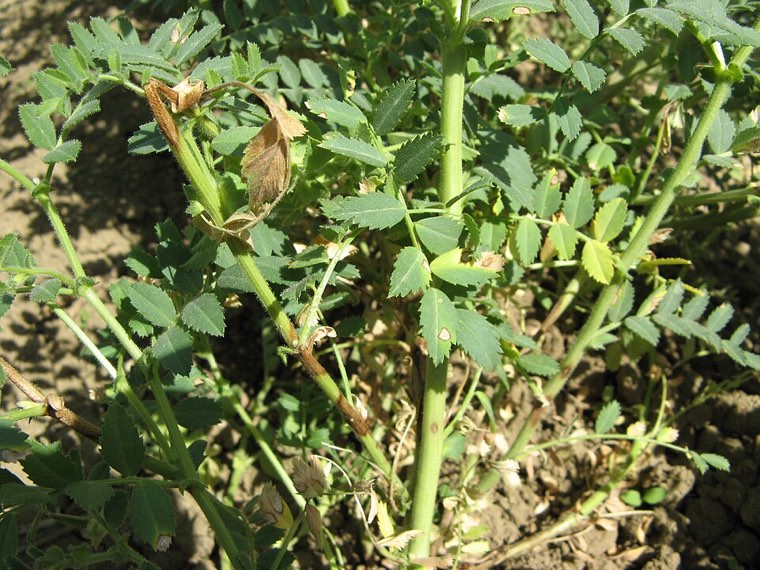
Ascochyta blight of chickpea is caused by Ascochyta rabiei Ascochyta rabiei (Pass.) Labr. (sexual stage Didymella rabiei (Kovatsch.) Arx), a fungus (ascomycete) (order Pleosporales, family Didymellaceae).
Older or alternative scientific names: Didymella rabiei, Mycosphaerella rabiei, Phoma rabiei.
Found in nearly all chickpea-growing regions: South Asia, West Asia and North Africa, the Mediterranean, East Africa, Australia, and North America (the Pacific Northwest and the Canadian prairies).
| Region | Status |
|---|---|
| South Asia | Present; severe in cool, wet winters in the north-west |
| West Asia, North Africa and the Mediterranean | Widespread; major |
| North America | Widespread in chickpea areas |
| Oceania | Widespread in Australian chickpea |
A fungus that forms tiny dark flask-shaped fruiting bodies (pycnidia) arranged in rings within lesions. In wet weather they ooze spores that are spread by rain splash. Where both mating types occur, a sexual stage on overwintered stubble releases airborne spores that can travel several kilometres.
| Crop stage | What you see |
|---|---|
| Seedlings | Brown lesions at the stem base of seedlings grown from infected seed; seedlings collapse. |
| Leaves and stems | Round to oval tan or brown spots with dark borders and concentric rings of black dots; stem lesions girdle and break stems; patches of dead, scorched-looking plants. |
| Pods and seed | Round lesions with black dots on pods; shrivelled, discoloured seeds that carry the fungus. |
Infected seed and chickpea stubble carry the fungus between seasons. Rain splashes spores from infected seedlings or stubble onto nearby plants, and each rain event can start a new cycle of spread. Sexual spores from stubble can blow into new fields. Pod infection late in the season leads to infected seed.
| Stage | Duration | Notes |
|---|---|---|
| Survival on seed and stubble | Between seasons (stubble for 1-2 years or more) | Main sources. |
| Infection | After leaves stay wet for several hours | Cool, wet weather. |
| Lesions with pycnidia | About 5-10 days | Spores spread by rain splash. |
| Pod and seed infection | Late season | Carries the fungus to the next crop. |
Most severe at about 15-25 °C with frequent rain or long periods of leaf wetness.
Many cycles in wet seasons, linked to rain events.
Infected seed, chickpea stubble from previous seasons nearby, cool and wet weather especially at flowering and podding, dense canopies, and susceptible varieties.
There is no numeric economic threshold; protection is preventive, with fungicide timing linked to the first lesions and forecast rain in susceptible varieties.
Thresholds are local. They depend on crop price, control cost, variety and natural-enemy activity, so use the figure your local extension service publishes where one exists.
Losses range from slight to complete crop failure in cool, wet seasons; infected seed lowers quality and spreads the disease.
Control works best as a sequence: prevent, monitor, then act only when a threshold or a risk forecast says so, using the least disruptive option that works.
Seed treatments reduce seed-borne infection; foliar protectant fungicides are applied before rain in susceptible varieties, and systemic products after infection events. What is registered differs by country and changes over time; follow the label and your local plant-protection authority.
| Scheme | Group | Mode of action | Notes |
|---|---|---|---|
| FRAC | M05 | Chloronitriles (multi-site) | Protectant before rain. |
| FRAC | M03 | Dithiocarbamates and relatives (multi-site) | Protectant. |
| FRAC | 3 | Demethylation inhibitors (DMI) | Systemic. |
| FRAC | 11 | Quinone outside inhibitors (QoI) | Resistance reported in some regions; use in mixtures. |
Chickpea is the only important host; a few wild Cicer species and some other legumes can be infected in tests.
How to grow the crop well is the first line of defence. Laisha's free grow guides cover each crop from sowing to harvest:
Written by Laisha from the sources above, in its own words. This page is general reference, not a prescription: confirm identification locally and follow the label and your plant-protection authority.