 Laisha
AI Operating System for Agriculture
Ask Laisha
Laisha
AI Operating System for Agriculture
Ask Laisha
Sclerotinia sclerotiorum Sclerotinia sclerotiorum (Lib.) de Bary, 1884 · formerly or also: Whetzelinia sclerotiorum
Sclerotinia white mould is a fungal disease that rots the stems, heads, pods and fruit of more than 400 plant species, including soybean, oilseed rape, sunflower, beans, lettuce, carrot, potato and many vegetables. Infected tissue becomes soft and watery, then covered with white cottony mould, and hard black resting bodies (sclerotia) form on and inside stems. The sclerotia survive in soil for years and produce tiny mushroom-like cups whose spores infect plants at flowering in cool, wet weather.
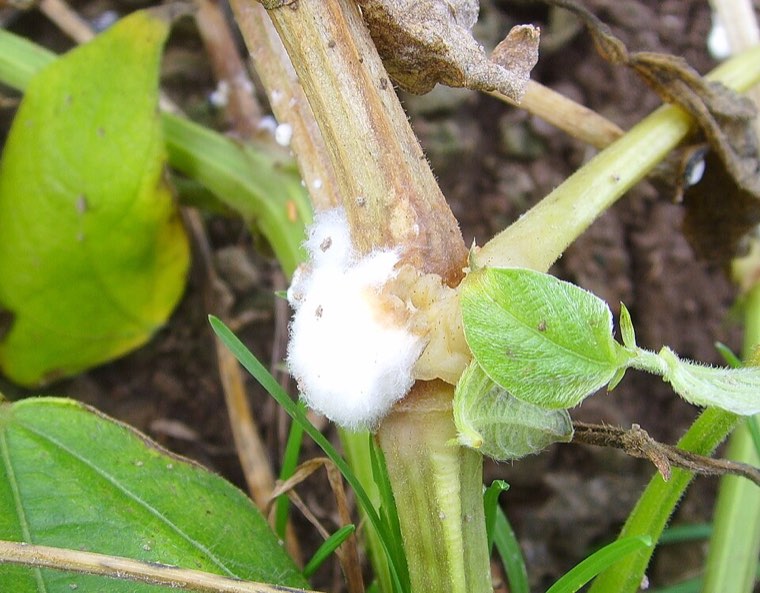
Sclerotinia white mould is caused by Sclerotinia sclerotiorum Sclerotinia sclerotiorum (Lib.) de Bary, 1884, a fungus (ascomycete, soil-borne) (order Helotiales, family Sclerotiniaceae).
Older or alternative scientific names: Whetzelinia sclerotiorum.
Found worldwide, most damaging in cool, humid temperate regions and in irrigated or high-altitude crops in warmer regions.
| Region | Status |
|---|---|
| Europe and North America | Widespread; major in oilseed rape, soybean, sunflower and beans |
| South America | Widespread; important in Brazilian soybean |
| Asia | Widespread; major in oilseed rape in China |
| Africa and Oceania | Present |
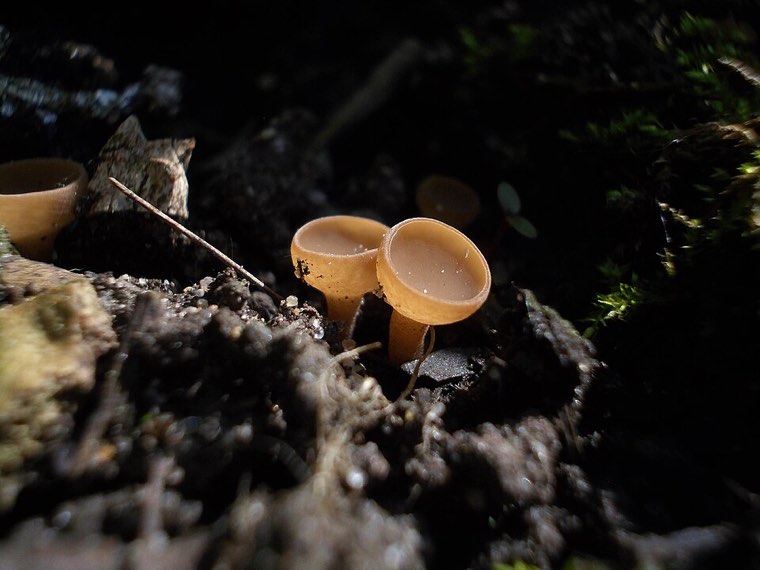
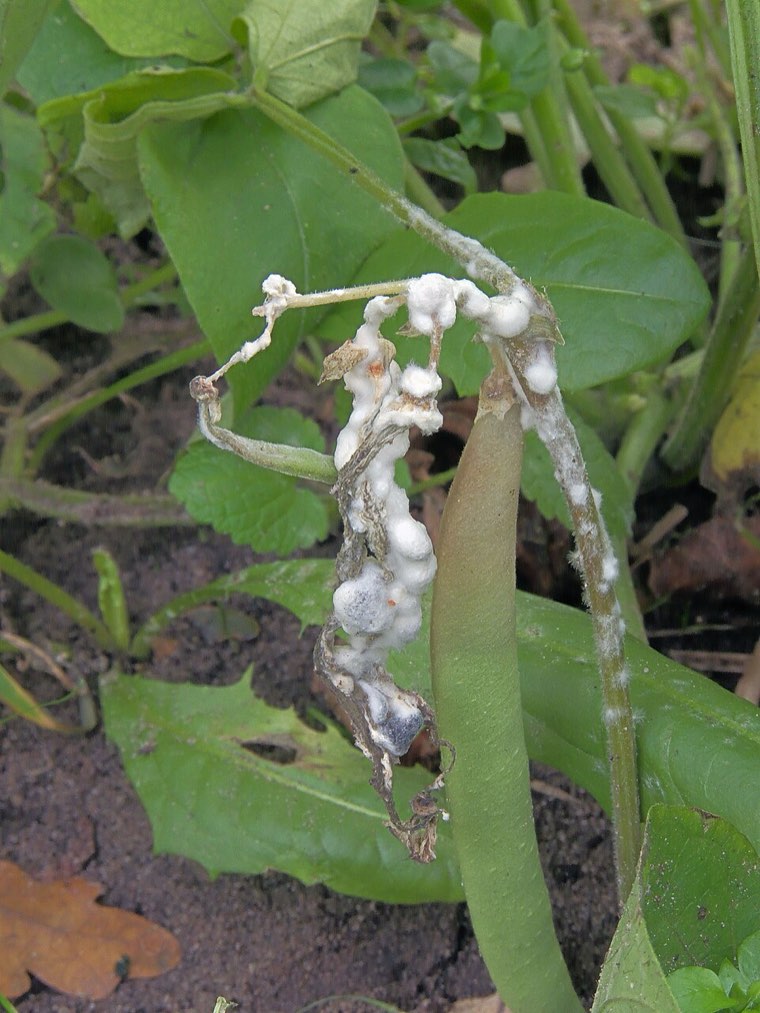
The fungus forms black, irregular sclerotia about 2-20 mm long, white inside, on and in infected tissue. In moist soil, sclerotia near the surface produce small tan cup-shaped fruiting bodies (apothecia), 2-10 mm across, which release airborne spores. Sclerotia can also infect roots and stem bases directly.
| Crop stage | What you see |
|---|---|
| Flowering crops (soybean, beans, oilseed rape) | Water-soaked lesions on stems and branches, often starting at nodes where petals have fallen; lesions turn pale or bleached. |
| Advanced infection | White cottony mould on stems and pods in humid conditions; stems shredded and bleached; wilting and death of branches; black sclerotia inside hollow stems. |
| Lettuce, sunflower and vegetables | Lettuce plants collapse ('lettuce drop'); sunflower heads rot and stem bases wilt; carrots and cabbages rot in the field or in storage with white mould and sclerotia. |
Sclerotia in soil survive for several years. After a period of cool, moist conditions, sclerotia close to the surface produce apothecia that release spores over several weeks. The spores need dead or dying tissue, such as fallen petals, to start infection, then the fungus invades healthy tissue. New sclerotia form in infected plants and return to the soil at harvest.
| Stage | Duration | Notes |
|---|---|---|
| Sclerotia in soil | Survive about 3-8 years | Main source of disease. |
| Apothecia and spore release | Several weeks around crop flowering | Needs moist soil under a closed canopy. |
| Infection via petals and senescent tissue | After long leaf wetness | Cool, wet weather. |
| New sclerotia | Late season | Returned to soil with residue. |
Most severe at cool to moderate temperatures (about 15-25 °C) with frequent rain, dew or irrigation during flowering.
Usually one main cycle per crop, starting at flowering.
Frequent susceptible crops in the rotation, dense canopies and narrow rows that keep the soil surface moist, irrigation or rain during flowering, and high soil inoculum from previous crops.
There is no numeric economic threshold; spray decisions use field history, crop stage (flowering), canopy closure and weather-based risk models, which differ between crops and regions.
Thresholds are local. They depend on crop price, control cost, variety and natural-enemy activity, so use the figure your local extension service publishes where one exists.
Losses range from small to more than half of the crop in wet seasons; seed contaminated with sclerotia loses value, and stored vegetables rot.
Control works best as a sequence: prevent, monitor, then act only when a threshold or a risk forecast says so, using the least disruptive option that works.
Fungicides are applied at early to full flowering to protect petals and stems; timing matters more than the number of sprays. What is registered differs by country and changes over time; follow the label and your local plant-protection authority.
| Scheme | Group | Mode of action | Notes |
|---|---|---|---|
| FRAC | 7 | Succinate dehydrogenase inhibitors (SDHI) | At flowering. |
| FRAC | 3 | Demethylation inhibitors (DMI) | At flowering. |
| FRAC | 2 | Dicarboximides | Resistance reported in some regions. |
| FRAC | 12 | Phenylpyrroles | Often in mixtures. |
More than 400 plant species, mainly broad-leaved plants: soybean, oilseed rape, sunflower, beans, peas, chickpea, lentil, lettuce, carrot, potato, tomato, crucifers, cucurbits and many weeds. Cereals and grasses are not hosts.
How to grow the crop well is the first line of defence. Laisha's free grow guides cover each crop from sowing to harvest:
Written by Laisha from the sources above, in its own words. This page is general reference, not a prescription: confirm identification locally and follow the label and your plant-protection authority.