 Laisha
AI Operating System for Agriculture
Ask Laisha
Laisha
AI Operating System for Agriculture
Ask Laisha
Parthenium hysterophorus L., 1753
An aggressive annual weed from the Americas with finely divided carrot-like leaves and many small white flower heads. It invades crops, pastures, roadsides and towns, produces huge numbers of seeds, suppresses other plants through chemicals in its tissues, and causes skin allergies, hay fever and asthma in people and taints the milk and meat of animals that eat it. It is among the world's worst invasive weeds.
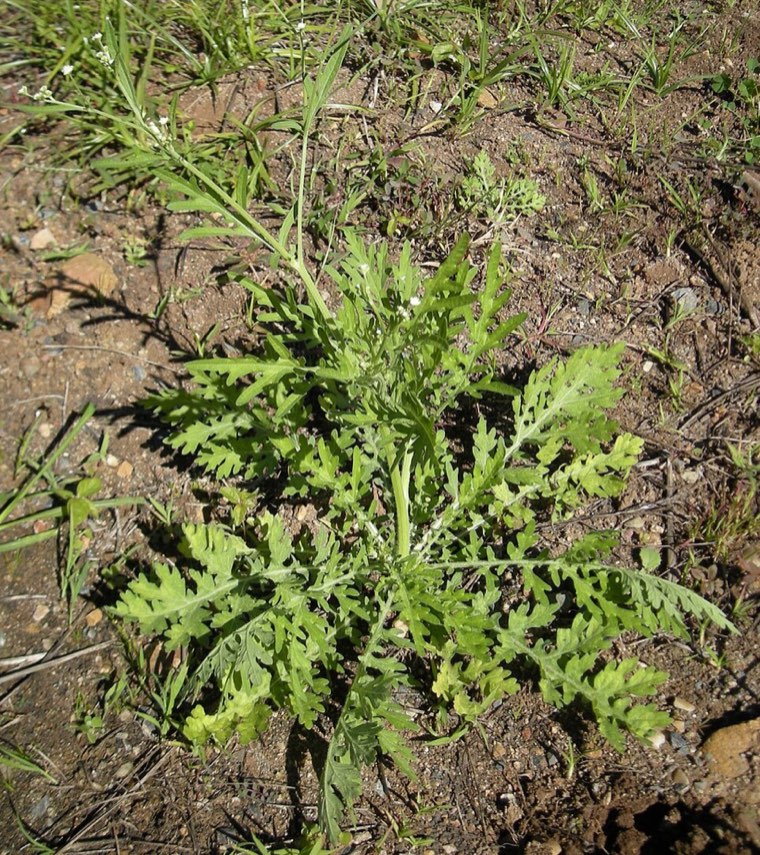
The scientific name of parthenium weed is Parthenium hysterophorus L., 1753, in the order Asterales, family Asteraceae.
Native to the region around the Gulf of Mexico and Central and South America. It spread to South Asia (first widely noticed in the 1950s), Australia, East and southern Africa (Ethiopia from the 1980s), the Middle East, Southeast Asia and Pacific islands, often with grain shipments and machinery. It is a declared or regulated weed in many countries.
| Region | Status |
|---|---|
| South Asia | Widespread; one of the most common weeds of crops and wasteland |
| East and southern Africa | Invasive and spreading; major in Ethiopia, Kenya, South Africa |
| Oceania | Invasive in Queensland and other parts of Australia; declared weed |
| Middle East and Southeast Asia | Invasive in several countries |
| Americas | Native |
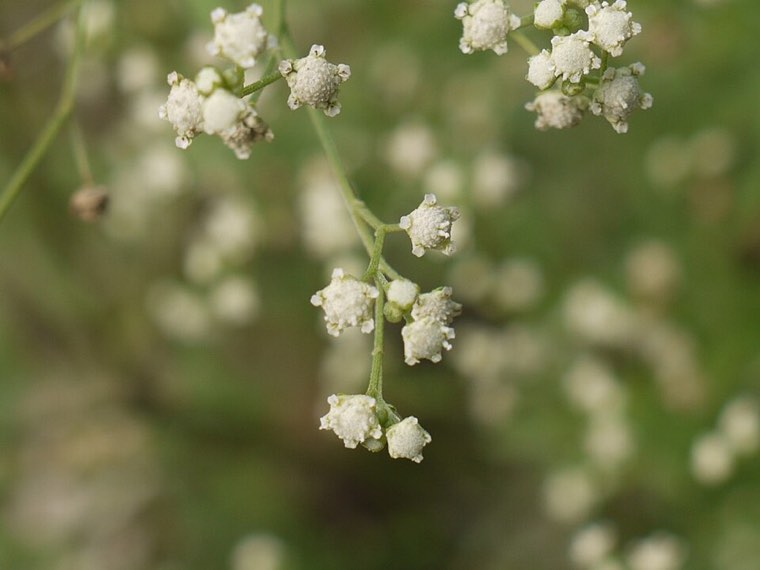
An erect, branched annual herb, usually 0.5-1.5 m (sometimes 2 m) tall. Young plants form a flat rosette of pale green, deeply lobed leaves; mature plants have hairy, ridged stems and many small (3-5 mm) white flower heads, each with five tiny 'petals'. Each plant can produce 10,000-25,000 seeds, or more, which persist in soil for several years.
| Crop stage | What you see |
|---|---|
| Crop emergence and early growth | Rosettes of lobed leaves among crop seedlings; dense stands after the first rains. |
| Crop vegetative growth | Tall, branched parthenium competing with the crop for water and nutrients and suppressing crop growth through allelopathic chemicals. |
| Pasture and grazing land | Dense stands replacing grasses; cattle avoid it, and milk from animals that eat it can be bitter. |
Seeds germinate after rain throughout warm seasons, and plants can flower within 4-6 weeks and continue flowering for months, producing several flushes of seed. Seeds spread on wind, water, vehicles, machinery, animals and in contaminated grain, hay and seed. A persistent soil seed bank allows rapid reinfestation.
| Stage | Duration | Notes |
|---|---|---|
| Seed in soil | Several years | Persistent seed bank. |
| Germination and rosette | After rain; about 2-4 weeks as a rosette | Many flushes per season. |
| Flowering | Begins about 4-6 weeks after emergence; continues for months | Thousands of seeds per plant. |
| Senescence | Several months; may persist longer in mild climates | Seeds shed continuously. |
Grows over a wide range of temperatures (about 10-35 °C) and is drought-tolerant; germination is favoured by warm, moist conditions after rain.
Two or more generations a year where rainfall allows.
Disturbed or overgrazed land, bare soil after drought, roadsides and field margins, poor weed control in crops, and movement of contaminated machinery, seed and fodder.
There is no general numeric economic threshold; because of its health effects and seed production, control is recommended before flowering wherever it occurs, and some jurisdictions require landholders to control it.
Thresholds are local. They depend on crop price, control cost, variety and natural-enemy activity, so use the figure your local extension service publishes where one exists.
Crop yield losses of up to about 40-90% have been reported in heavily infested sorghum and other crops in East Africa and South Asia, and pasture carrying capacity can fall sharply. Contact causes allergic dermatitis and respiratory problems in people.
Control works best as a sequence: prevent, monitor, then act only when a threshold or a risk forecast says so, using the least disruptive option that works.
Herbicides are most effective on rosettes and young plants before flowering; repeated treatment is needed because of the seed bank. What is registered differs by country and changes over time; follow the label and your local plant-protection authority.
| Scheme | Group | Mode of action | Notes |
|---|---|---|---|
| HRAC | 9 | Inhibition of EPSP synthase | Non-selective; on non-crop land and before crop emergence. |
| HRAC | 4 | Auxin mimics | Selective in grass crops and pastures. |
| HRAC | 5 | Inhibition of photosynthesis at photosystem II (serine 264 binders) | Pre- or early post-emergence in some crops. |
| HRAC | 2 | Inhibition of acetolactate synthase (ALS) | Used in some crops and pastures. |
As a weed it infests field crops (sorghum, maize, wheat, cotton, legumes, vegetables), orchards, pastures and rangelands, and disturbed land such as roadsides, rail lines and urban wasteland.
How to grow the crop well is the first line of defence. Laisha's free grow guides cover each crop from sowing to harvest:
Written by Laisha from the sources above, in its own words. This page is general reference, not a prescription: confirm identification locally and follow the label and your plant-protection authority.