 Laisha
AI Operating System for Agriculture
Ask Laisha
Laisha
AI Operating System for Agriculture
Ask Laisha
Helicoverpa armigera (Hübner, 1808) · formerly or also: Heliothis armigera
A moth whose caterpillars bore into the fruiting parts of cotton, chickpea, pigeon pea, tomato, maize and dozens of other crops: squares and bolls, pods, fruit and cobs. It is one of the most polyphagous and damaging pests in the Old World, flies long distances, and has a long history of developing resistance to insecticides. It invaded South America in the early 2010s.
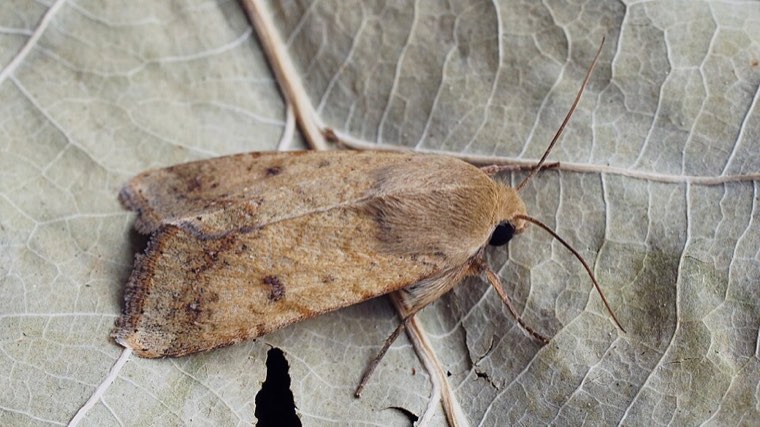
The scientific name of cotton bollworm is Helicoverpa armigera (Hübner, 1808), in the order Lepidoptera, family Noctuidae.
Older or alternative scientific names: Heliothis armigera.
Widespread across Africa, southern Europe, the Middle East, Asia and Oceania. It was confirmed in Brazil in 2013 and has since been reported across much of South America and parts of the Caribbean, where it can hybridise with the native corn earworm (Helicoverpa zea). It is a regulated pest in North America and parts of Europe.
| Region | Status |
|---|---|
| Africa | Native; widespread |
| Southern Europe and the Mediterranean | Native; regular migrant further north |
| South, Southeast and East Asia | Native; key pest of cotton, chickpea, pigeon pea and vegetables |
| Oceania | Native; key pest of cotton and grains in Australia |
| South America and the Caribbean | Invasive since about 2013; widespread in soybean, cotton and maize regions |
Eggs are laid singly, dome-shaped, ribbed and about 0.5 mm across, white turning brown before hatching. Larvae vary from green to yellow, brown or nearly black, with darker and paler lines along the body and a whitish band along each side; mature larvae reach 3.5-4 cm. The skin carries tiny spines that feel slightly rough. The moth is stout, about 3.5-4 cm across the wings; forewings are yellowish brown (orange-brown in females) with a dark kidney-shaped mark, and hindwings are pale with a broad dark margin enclosing a pale patch.
| Crop stage | What you see |
|---|---|
| Vegetative growth | Young larvae feed on tender shoots and leaves, leaving small holes; damage is usually minor. |
| Flowering and squaring (cotton) / flowering (legumes) | Bored flower buds and squares, often flared, yellowed and shed. |
| Boll, pod and fruit set | Round, clean-edged holes with frass at the entrance; the larva's head and front body inside a pod, boll or fruit; one larva damages several fruits. |
| Maize and sorghum heads | Larvae feed on silks, cob tips and developing grain, or within sorghum panicles. |
Females lay several hundred to over a thousand eggs, mostly singly on flowers, young leaves and fruiting structures. Larvae pass through six instars (sometimes five or seven) and pupate in an earthen cell several centimetres deep. In regions with cold or dry seasons, pupae can enter diapause. Adults are strong fliers and migrate on wind systems across regions.
| Stage | Duration | Notes |
|---|---|---|
| Egg | About 2-4 days at 25 °C; longer when cool | Laid singly, often on flowers and young growth. |
| Larva (usually 6 instars) | About 2-3 weeks at 25 °C | Last two instars cause most damage. |
| Pupa in soil | About 10-14 days; months in diapause | Facultative diapause induced by short days and low temperature. |
| Adult moth | About 1-2 weeks | Feeds on nectar; nocturnal; migrates. |
Development runs from a lower threshold of roughly 11-12 °C, with an optimum around 25-30 °C. A full generation takes about 4-6 weeks in warm conditions. Pupal diapause in autumn lets the pest survive winter in temperate regions.
From 2-5 generations in temperate and subtropical areas to 8-11 in the tropics where hosts are available all year.
Warm, dry weather; a landscape with a succession of flowering hosts (for example maize, sorghum and chickpea before cotton); high nitrogen and lush crops; and destruction of natural enemies by broad-spectrum sprays. Moth flights often peak after rain triggers pupal emergence.
Thresholds are set as larvae per metre of row or per plant during the fruiting period, or as a percentage of fruiting parts damaged. They depend strongly on crop value, control cost and crop stage, and differ between regions; Australian growers use online calculators that set the threshold from current prices.
| Crop | Threshold | Unit | Crop stage | Region | Source |
|---|---|---|---|---|---|
| Chickpea | About 1 larva (0.7-1.6 in field studies) | larvae per metre of row | Podding | South Asia | Field ETL studies in Bangladesh (Bangladesh J. Agric. Res.) and northern India |
| Chickpea | Calculated from control cost and grain price; 1 larva per m² ≈ 20 kg/ha loss | larvae per m² | Podding | Australia | Queensland DAF 'Beatsheet' economic threshold calculator |
| Cotton | About 1 medium-sized larva | larvae per metre of row | Fruiting (transgenic Bt cotton) | Australia | University of New England study of the Bt cotton threshold |
Thresholds are local. They depend on crop price, control cost, variety and natural-enemy activity, so use the figure your local extension service publishes where one exists.
Larvae destroy flower buds and fruiting structures, which directly removes yield. In cotton, one larva may damage several squares and bolls and admit boll rots. In chickpea and pigeon pea, losses of 20-50% are commonly reported in unprotected crops in South Asia, with near-total loss in outbreak years. Tomato fruit with feeding holes is unmarketable.
Control works best as a sequence: prevent, monitor, then act only when a threshold or a risk forecast says so, using the least disruptive option that works.
Sprays should be aimed at eggs and small larvae, before larvae are inside bolls or pods. Repeated use of one group has repeatedly produced resistance in this species. What is registered differs by country and changes over time; follow the label and your local plant-protection authority.
| Scheme | Group | Mode of action | Notes |
|---|---|---|---|
| IRAC | 28 | Ryanodine receptor modulators (diamides) | Effective larvicides; monitor for resistance. |
| IRAC | 5 | Nicotinic acetylcholine receptor allosteric modulators, site I (spinosyns) | Larvicide. |
| IRAC | 22A | Voltage-dependent sodium channel blockers (oxadiazines) | Larvicide. |
| IRAC | 6 | Glutamate-gated chloride channel allosteric modulators (avermectins) | Larvicide. |
| IRAC | 15 | Inhibitors of chitin biosynthesis, CHS1 (benzoylureas) | Act on moulting larvae; slow. |
| IRAC | 31 | Baculoviruses | Helicoverpa nucleopolyhedrovirus where registered. |
Recorded on well over 100 cultivated and wild plants. Major crops include cotton, chickpea, pigeon pea, tomato, maize, sorghum, soybean, sunflower, groundnut, common bean, okra, tobacco and many vegetables and cut flowers. Larvae prefer the reproductive parts of plants that are rich in nitrogen.
How to grow the crop well is the first line of defence. Laisha's free grow guides cover each crop from sowing to harvest:
Written by Laisha from the sources above, in its own words. This page is general reference, not a prescription: confirm identification locally and follow the label and your plant-protection authority.