 Laisha
AI Operating System for Agriculture
Ask Laisha
Laisha
AI Operating System for Agriculture
Ask Laisha
Callosobruchus maculatus and Callosobruchus chinensis Callosobruchus maculatus (Fabricius, 1775); Callosobruchus chinensis (Linnaeus, 1758) · formerly or also: Bruchus maculatus, Chinese bruchid (C. chinensis)
Pulse beetles are small beetles whose grubs develop inside stored seeds of cowpea, chickpea, mung bean, black gram, pigeon pea, lentil and other pulses. Each infested seed ends up with a round exit hole, loses weight and often cannot germinate. Infestation starts in the field on ripening pods and multiplies quickly in storage, so unprotected cowpea can be destroyed within a few months. Airtight (hermetic) storage is one of the simplest and most effective controls.
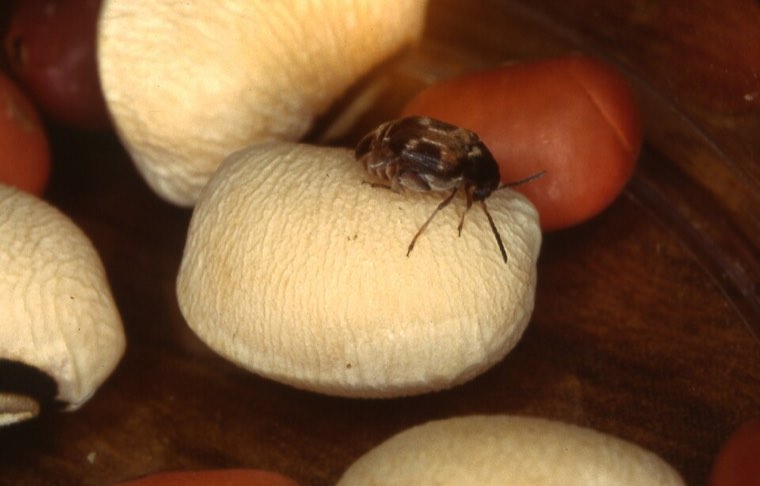
The scientific name of pulse beetles is Callosobruchus maculatus and Callosobruchus chinensis Callosobruchus maculatus (Fabricius, 1775); Callosobruchus chinensis (Linnaeus, 1758), in the order Coleoptera, family Chrysomelidae (subfamily Bruchinae).
Older or alternative scientific names: Bruchus maculatus, Chinese bruchid (C. chinensis).
Found worldwide in tropical and subtropical regions and in stores of imported pulses elsewhere; both species have spread with the trade in pulses.
| Region | Status |
|---|---|
| Africa | Widespread; C. maculatus major in cowpea |
| South and East Asia | Both species widespread |
| Americas and Europe | Present in stores |
| Oceania | Present |
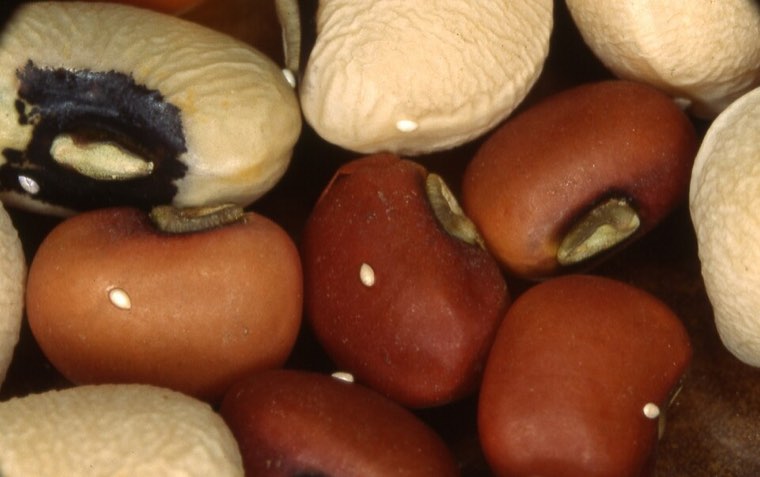
Adults are about 2-4 mm long, reddish-brown to dark, with short wing covers that leave the tip of the abdomen exposed; C. maculatus has two large dark patches on the wing covers. Adults live only about one to two weeks and do not need to feed. Eggs are tiny, white and glued onto the seed surface, where they look like white specks.
| Crop stage | What you see |
|---|---|
| Field (mature pods) | Eggs on dry pods and seeds; infestation carried unseen into storage. |
| Storage | White eggs glued to seeds; round 'windows' in the seed coat where adults are about to emerge; round exit holes; live beetles running on the surface of stored grain. |
| Severe infestation | Seeds riddled with holes, powdery and light; warm, damp grain; loss of germination and food value. |
Females glue eggs singly onto seeds. The grub bores straight into the seed and feeds and pupates inside. The adult cuts a round window and emerges, mates and lays eggs within a day or two, so populations multiply rapidly in storage.
| Stage | Duration | Notes |
|---|---|---|
| Egg (glued to seed) | About 4-6 days | White specks. |
| Larva (inside seed) | About 2-3 weeks | Hidden from contact treatments. |
| Pupa (inside seed) | About 5-7 days | Under a thin window. |
| Adult | About 1-2 weeks | Females lay 50-100 eggs. |
One generation takes about three to five weeks at 25-30 °C and high humidity; development slows greatly in cool, dry storage.
Many generations per year in warm stores.
Warm, humid storage; seed stored in open sacks or baskets; mixing new and old stocks; late harvest that allows field infestation; and dirty stores with old infested seed.
There is no field threshold; any infestation in stored seed grows quickly, so management is preventive from harvest onward.
Unprotected cowpea can lose much or all of its value within three to six months of storage; infested seed loses weight, nutritional value, germination and market price.
Control works best as a sequence: prevent, monitor, then act only when a threshold or a risk forecast says so, using the least disruptive option that works.
Fumigation and grain protectants are used in commercial stores and must be applied only by trained people because of health risks; hermetic storage avoids chemicals altogether. What is registered differs by country and changes over time; follow the label and your local plant-protection authority.
| Scheme | Group | Mode of action | Notes |
|---|---|---|---|
| IRAC | 24A | Mitochondrial complex IV electron transport inhibitors (phosphides), fumigation | Highly toxic; trained applicators only; resistance reported. |
| IRAC | 3A | Sodium channel modulators (pyrethroids), grain protectant | Where registered for stored pulses. |
Stored seeds of cowpea, chickpea, mung bean, black gram, pigeon pea, lentil, adzuki bean and other pulses; C. chinensis has a somewhat wider range and also attacks peas and beans.
How to grow the crop well is the first line of defence. Laisha's free grow guides cover each crop from sowing to harvest:
Written by Laisha from the sources above, in its own words. This page is general reference, not a prescription: confirm identification locally and follow the label and your plant-protection authority.