 Laisha
AI Operating System for Agriculture
Ask Laisha
Laisha
AI Operating System for Agriculture
Ask Laisha
Banana bunchy top virus ICTV species: Babuvirus musae · formerly or also: BBTV
Banana bunchy top is the most destructive virus disease of banana and plantain. Infected plants grow narrow, upright, bunched leaves with dark green streaks, and stop producing fruit. The virus is spread by the banana aphid and, above all, by people planting infected suckers. There is no cure: infected plants must be destroyed, and clean planting material is the foundation of control.
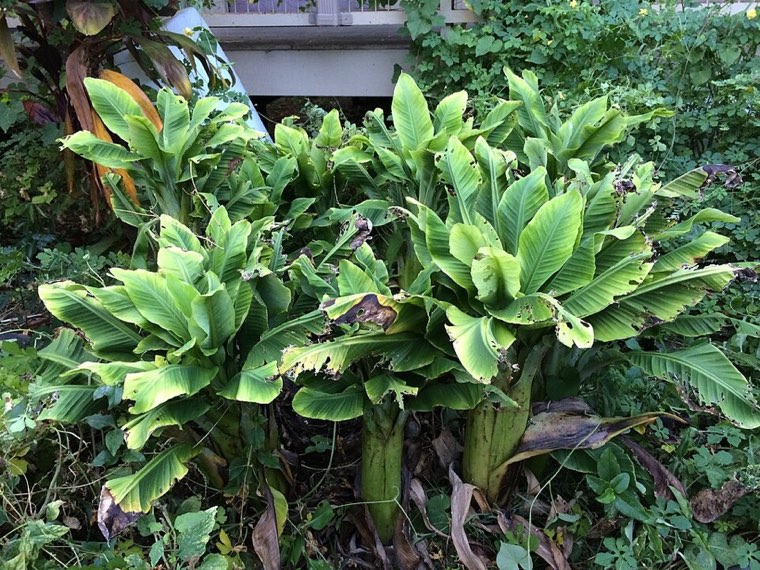
Banana bunchy top disease is caused by Banana bunchy top virus, a virus (nanovirus with a multi-part single-stranded DNA genome), spread by the banana aphid (order Mulpavirales, family Nanoviridae).
Older or alternative scientific names: BBTV.
Present in South and Southeast Asia, East Asia, the Pacific islands, parts of Australia (under containment) and Hawaii, and in sub-Saharan Africa, where it has spread from Central Africa to more than 15 countries since the mid-twentieth century. It has not been found in the Americas, where it is a quarantine pest.
| Region | Status |
|---|---|
| South and Southeast Asia | Widespread |
| East Asia and the Pacific | Widespread; present in Hawaii since 1989 |
| Sub-Saharan Africa | Spreading in Central, West, East and southern Africa |
| Oceania | Present in parts of Australia under strict control |
| Americas | Absent; quarantine pest |
The virus is detected by laboratory tests (PCR or serology). It is transmitted by the banana aphid, Pentalonia nigronervosa (and P. caladii), in a persistent, circulative way: aphids remain infective for weeks. It is not transmitted through soil, tools or true seed.
| Crop stage | What you see |
|---|---|
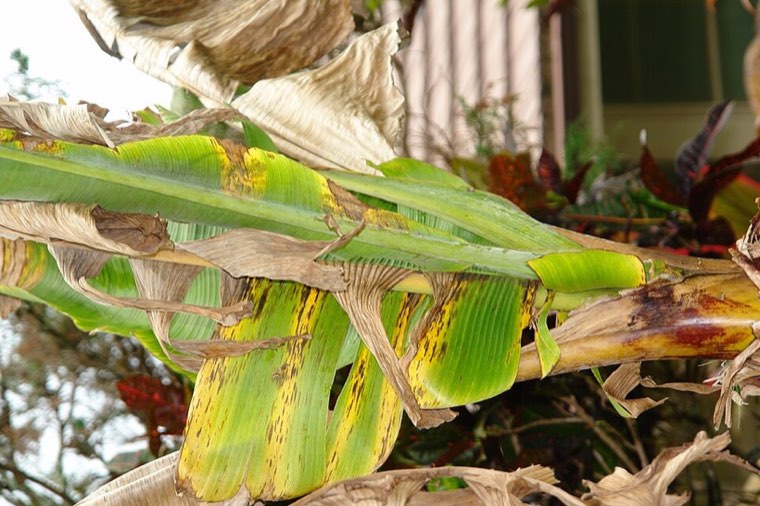
| Early (one or two new leaves) | Dark green dots and dashes ('Morse code') along the secondary veins on the underside of the leaf blade, on the midrib and leaf stalk; 'J-hook' streaks where veins join the midrib. |
| Advanced | Each new leaf is shorter, narrower, brittle and more upright, with yellow, wavy margins; leaves crowd at the top into a 'bunchy' rosette. |
| Fruiting | Plants infected early do not produce a bunch; plants infected late produce small, deformed bunches; suckers from infected mats are infected. |
Banana aphids colonise the base of the pseudostem and young leaves. They acquire the virus after feeding on an infected plant for hours and can transmit it for several weeks. Symptoms appear on new leaves about one to several months after infection. Every sucker from an infected mat is infected, so moving suckers spreads the disease over long distances.
| Stage | Duration | Notes |
|---|---|---|
| Acquisition by aphids | From about 4-18 hours of feeding | Aphids live at the base and in leaf folds. |
| Transmission | Aphids remain infective for about 2-3 weeks or more | Winged aphids move between plants. |
| Symptom development | About 1-3 months | Shown first on the newest leaves. |
| Spread via suckers | At planting | Main long-distance route. |
Aphid populations and spread are greatest in warm conditions; symptom development is slower in cool highlands.
Continuous where bananas grow year-round.
Planting suckers from infected areas, abandoned infected mats, high aphid numbers, lack of coordinated rogueing, and unofficial movement of planting material between regions.
There is no economic threshold: every infected plant is a source of spread and must be destroyed. In free or contained areas any detection triggers official action.
Infected plants produce no marketable fruit, and whole plantations have been lost; in parts of Africa and Asia, farmers have abandoned banana production after bunchy top spread. Losses at farm level commonly reach the whole crop in heavily affected areas.
Control works best as a sequence: prevent, monitor, then act only when a threshold or a risk forecast says so, using the least disruptive option that works.
No chemical controls the virus. Treating infected plants against aphids before they are destroyed prevents aphids carrying virus to neighbouring plants. What is registered differs by country and changes over time; follow the label and your local plant-protection authority.
| Scheme | Group | Mode of action | Notes |
|---|---|---|---|
| IRAC | 4A | Nicotinic acetylcholine receptor competitive modulators (neonicotinoids), against the aphid vector | Used before destroying infected plants in some programmes. |
Bananas and plantains (Musa species) of all types; the related Ensete (enset) and some other Musaceae can also be infected.
How to grow the crop well is the first line of defence. Laisha's free grow guides cover each crop from sowing to harvest:
Written by Laisha from the sources above, in its own words. This page is general reference, not a prescription: confirm identification locally and follow the label and your plant-protection authority.