 Laisha
AI Operating System for Agriculture
Ask Laisha
Laisha
AI Operating System for Agriculture
Ask Laisha
Fusarium oxysporum f. sp. cubense (E.F. Sm.) W.C. Snyder & H.N. Hansen, 1940 · formerly or also: Fusarium odoratissimum (proposed name for Tropical Race 4)
A soil-borne fungus that invades banana roots and blocks the water-conducting tissue, so plants yellow, wilt and die. Race 1 wiped out the 'Gros Michel' export banana in the mid-twentieth century; the Cavendish bananas that replaced it are now being destroyed by Tropical Race 4 (TR4), which has spread from Asia to the Middle East, Africa and Latin America. There is no cure: once in a field the fungus survives in soil for decades, so keeping it out is everything.
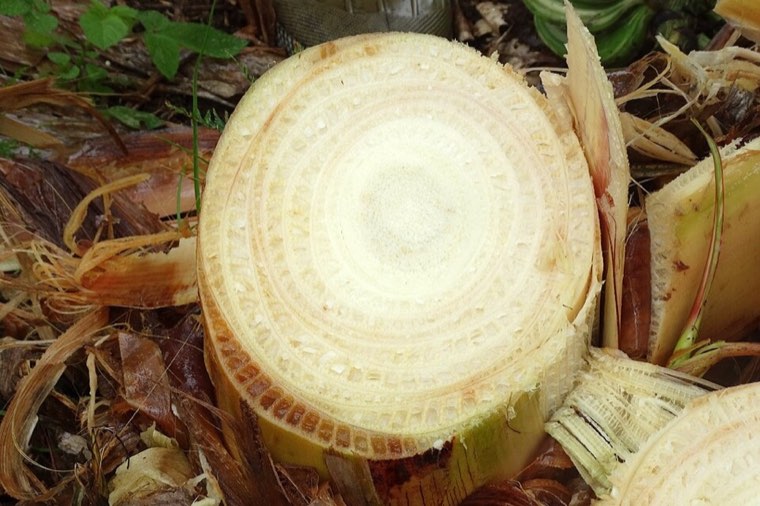
Fusarium wilt of banana is caused by Fusarium oxysporum f. sp. cubense (E.F. Sm.) W.C. Snyder & H.N. Hansen, 1940, a fungus (soil-borne ascomycete causing vascular wilt) (order Hypocreales, family Nectriaceae).
Older or alternative scientific names: Fusarium odoratissimum (proposed name for Tropical Race 4).
Race 1 occurs in almost all banana-growing regions. Tropical Race 4 was first found in Taiwan and spread through Southeast Asia and southern China, then to northern Australia (1997), the Middle East (2013), Mozambique (2013), South Asia, and Latin America (Colombia 2019, Peru 2021, Venezuela 2023). It is a quarantine organism in many countries.
| Region | Status |
|---|---|
| Southeast and East Asia | TR4 widespread in Cavendish plantations |
| South Asia and the Middle East | TR4 present in several countries; Race 1 widespread |
| Africa | Race 1 widespread; TR4 in Mozambique and nearby |
| Latin America and the Caribbean | Race 1 widespread; TR4 present in some countries since 2019 |
| Oceania | TR4 in parts of northern Australia under strict containment |
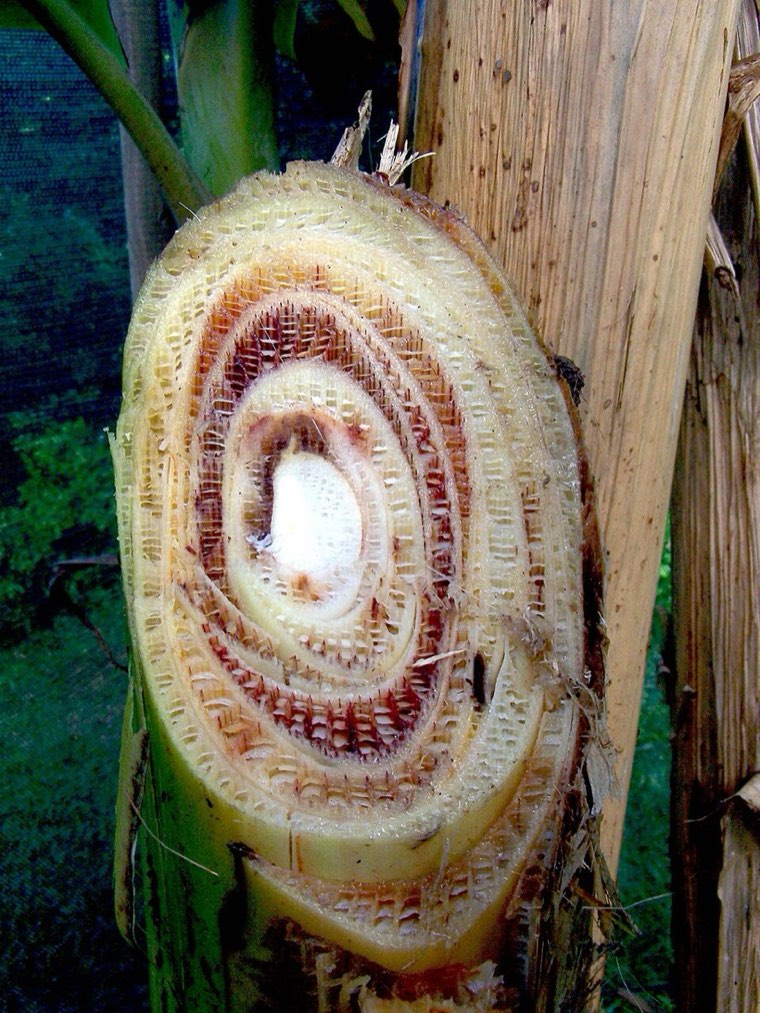
The fungus is identified in a laboratory from discoloured vascular strands, and races (especially TR4) are confirmed with molecular tests. It produces thick-walled resting spores (chlamydospores) that survive in soil for more than 20-30 years.
| Crop stage | What you see |
|---|---|
| Young plants and suckers | Yellowing of the margins of older leaves; stunted growth. |
| Established plants | Older leaves yellow and collapse at the leaf stalk, hanging down around the pseudostem like a skirt; the pseudostem may split near the base; young leaves stay upright longer. |
| Internal symptoms (cut pseudostem or corm) | Reddish-brown to dark brown discoloration of the water-conducting strands, as streaks in the pseudostem and dots in a cross-section of the corm. |
Spores in soil germinate near banana roots, penetrate them and grow into the xylem, where they spread upward and block water flow. When the plant dies, the fungus forms chlamydospores in the decaying tissue, which return to the soil. The fungus spreads in infected planting material, soil on boots, tools, vehicles and animals, and in surface and irrigation water.
| Stage | Duration | Notes |
|---|---|---|
| Chlamydospores in soil | Survive for decades | No host needed. |
| Root infection | Days to weeks after contact | Enhanced by root damage, for example from nematodes. |
| Vascular colonisation | Weeks to months | Symptoms appear as water flow is blocked. |
| Plant death and spore production | Months after infection | New chlamydospores return to the soil. |
Disease develops fastest in warm tropical conditions (about 25-30 °C); TR4 can also cause disease in subtropical climates, where Race 1 symptoms were often milder.
One disease cycle per infected plant; inoculum builds up in soil with each crop cycle.
Moving infected suckers, soil and water between farms; poorly drained soils; root damage by nematodes; continuous banana monoculture of susceptible cultivars; and lack of farm biosecurity.
There is no economic threshold: a single confirmed TR4 plant is a biosecurity emergency in a new area, triggering containment measures under national rules. In areas where the disease is already established, management aims at containment and replanting with resistant material.
Infected plants die or produce no marketable bunch. Race 1 destroyed tens of thousands of hectares of Gros Michel in Central America. TR4 has made large areas of Cavendish plantations in Asia unusable and threatens about 80% of global banana production, including bananas grown for local food in Africa and Asia.
Control works best as a sequence: prevent, monitor, then act only when a threshold or a risk forecast says so, using the least disruptive option that works.
No fungicide or soil treatment cures infected plants or eliminates the fungus from soil; chemicals are used only for disinfecting tools, footwear and vehicles under biosecurity protocols. What is registered for such uses differs by country; follow the label and your national plant-protection authority.
Bananas and plantains (Musa species). Race 1 attacks Gros Michel, Silk and Pome types; Race 2 attacks cooking bananas such as Bluggoe; Tropical Race 4 attacks Cavendish and many other cultivars including some plantains and local varieties. The fungus can survive on roots of some weeds without symptoms.
How to grow the crop well is the first line of defence. Laisha's free grow guides cover each crop from sowing to harvest:
Written by Laisha from the sources above, in its own words. This page is general reference, not a prescription: confirm identification locally and follow the label and your plant-protection authority.