 Laisha
AI Operating System for Agriculture
Ask Laisha
Laisha
AI Operating System for Agriculture
Ask Laisha
Pseudocercospora fijiensis (M. Morelet) Deighton, 1976 · formerly or also: Mycosphaerella fijiensis
The most damaging leaf disease of banana and plantain. Dark streaks spread across leaves until they die, so bunches are small and fruit ripens too early, often during shipment. Export plantations spray fungicides dozens of times a year to control it, while smallholders growing bananas and plantains for food suffer large losses.
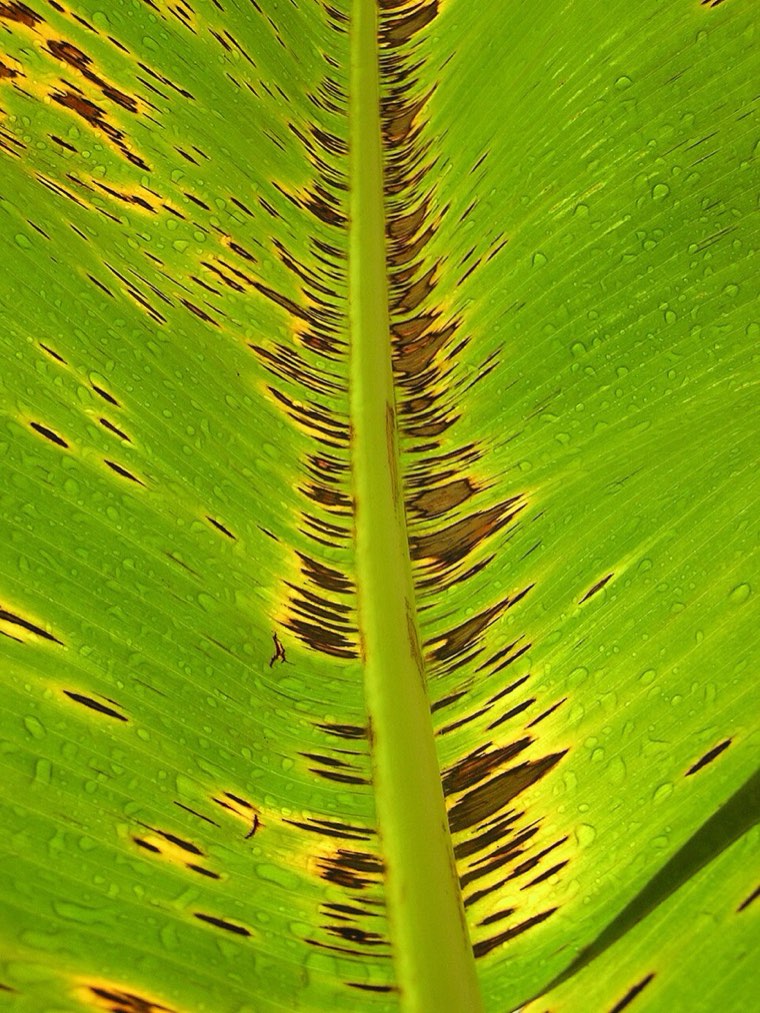
Black Sigatoka is caused by Pseudocercospora fijiensis (M. Morelet) Deighton, 1976, a fungus (ascomycete) (order Mycosphaerellales, family Mycosphaerellaceae).
Older or alternative scientific names: Mycosphaerella fijiensis.
First described in Fiji in 1963, it spread across the humid tropics: Asia and the Pacific, Central America (1972), South America, sub-Saharan Africa and the Caribbean. It has largely replaced the less aggressive yellow Sigatoka in warm lowlands.
| Region | Status |
|---|---|
| Southeast Asia and the Pacific | Widespread |
| Latin America and the Caribbean | Widespread since the 1970s-1990s |
| Sub-Saharan Africa | Widespread in humid banana and plantain zones |
| South Asia | Present in parts of the region |
| Oceania | Present in the Pacific and parts of northern Australia, where it is under control programmes |
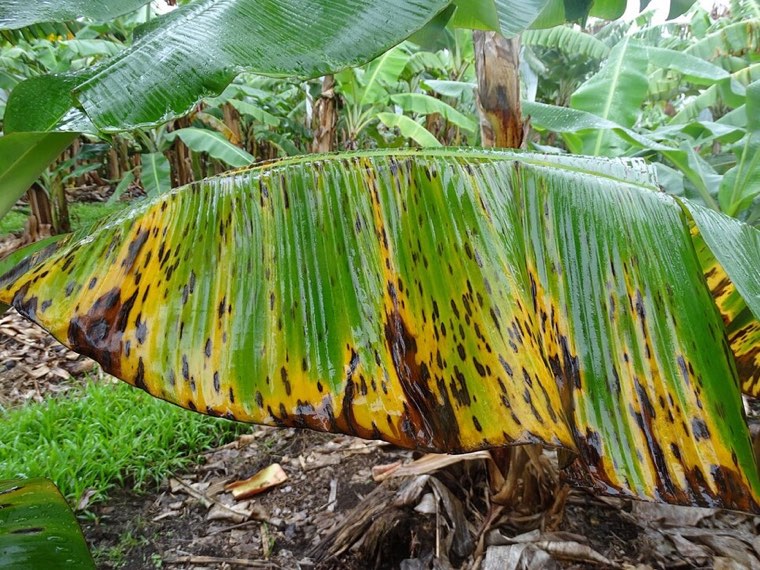
The fungus produces airborne ascospores from sexual fruiting bodies in old lesions and conidia on leaf undersides. Identification is by symptoms and laboratory confirmation; it is distinguished from yellow Sigatoka (Pseudocercospora musae) and Eumusae leaf spot by microscopy or molecular tests.
| Crop stage | What you see |
|---|---|
| Early (young leaves) | Tiny reddish-brown flecks on the underside of the third or fourth youngest leaf, visible against the light. |
| Developing | Flecks lengthen into dark brown to black streaks parallel to the veins, then into elliptical spots with dark borders and yellow halos. |
| Advanced | Spots merge, leaf tissue dies and turns grey with black borders; whole leaves collapse; few functional leaves remain at flowering, so bunches are small and fruit ripens prematurely. |
Ascospores carried by wind from old lesions, and conidia spread by rain and wind, land on young leaves and infect through the pores on the underside when leaves are wet. The fungus grows slowly inside the leaf; symptoms develop through several stages over about three to five weeks before new spores are produced. Leaf wetness and warm temperatures drive the epidemic.
| Stage | Duration | Notes |
|---|---|---|
| Spores land on young leaves | Infection needs leaf wetness | Ascospores airborne; conidia splashed. |
| Incubation and streak stages | About 2-5 weeks | Shorter in warm, wet weather. |
| Mature spots and sporulation | Several weeks | Sexual fruiting bodies in dead tissue. |
| Survival | Continuous | On living and recently killed leaves. |
Most severe at about 25-28 °C with frequent rain or dew; dry seasons and lower temperatures at higher altitudes slow it.
Continuous cycles through the year in the humid tropics.
Warm temperatures, frequent rain and long leaf wetness, dense plantings, poor drainage, weak plants and nearby unmanaged banana plants that provide spores.
There is no fixed numeric economic threshold. Commercial plantations use 'biological warning' or forecasting systems that score the youngest leaves for early streak stages each week, and spray when the disease evolution rises; smallholder recommendations focus on cultural control and keeping enough healthy leaves at flowering.
Thresholds are local. They depend on crop price, control cost, variety and natural-enemy activity, so use the figure your local extension service publishes where one exists.
Yield losses of 35-50% or more are common without control, and plantain crops can lose most of their yield. Premature ripening of fruit from diseased plants causes losses in export shipments. Fungicide costs are a large share of production costs in export plantations.
Control works best as a sequence: prevent, monitor, then act only when a threshold or a risk forecast says so, using the least disruptive option that works.
In export plantations, fungicides are applied frequently, often by air, in alternation between groups and with protectants; smallholders rarely can afford programmes. What is registered differs by country and changes over time; follow the label and your local plant-protection authority.
| Scheme | Group | Mode of action | Notes |
|---|---|---|---|
| FRAC | M03 | Dithiocarbamates and relatives (multi-site) | Protectant backbone. |
| FRAC | M05 | Chloronitriles (multi-site) | Protectant. |
| FRAC | 3 | Demethylation inhibitors (DMI) | Reduced sensitivity widespread. |
| FRAC | 5 | Amines (sterol biosynthesis inhibitors, class II) | Systemic. |
| FRAC | 7 | Succinate dehydrogenase inhibitors (SDHI) | Limited applications per year. |
| FRAC | 11 | Quinone outside inhibitors (QoI) | Resistance documented. |
Bananas and plantains (Musa species), including Cavendish export bananas, plantains and many cooking and dessert types.
How to grow the crop well is the first line of defence. Laisha's free grow guides cover each crop from sowing to harvest:
Written by Laisha from the sources above, in its own words. This page is general reference, not a prescription: confirm identification locally and follow the label and your plant-protection authority.