 Laisha
AI Operating System for Agriculture
Ask Laisha
Laisha
AI Operating System for Agriculture
Ask Laisha
Bactrocera dorsalis (Hendel, 1912) · formerly or also: Bactrocera invadens, Bactrocera papayae, Bactrocera philippinensis
A fruit fly whose females lay eggs under the skin of ripening mango, guava, papaya, citrus and hundreds of other fruits; the maggots turn the flesh to rot. Native to Asia, it invaded Africa in the early 2000s and has become the most damaging pest of mango there. Because it is a serious quarantine pest, its presence can close export markets even where crop losses are small.
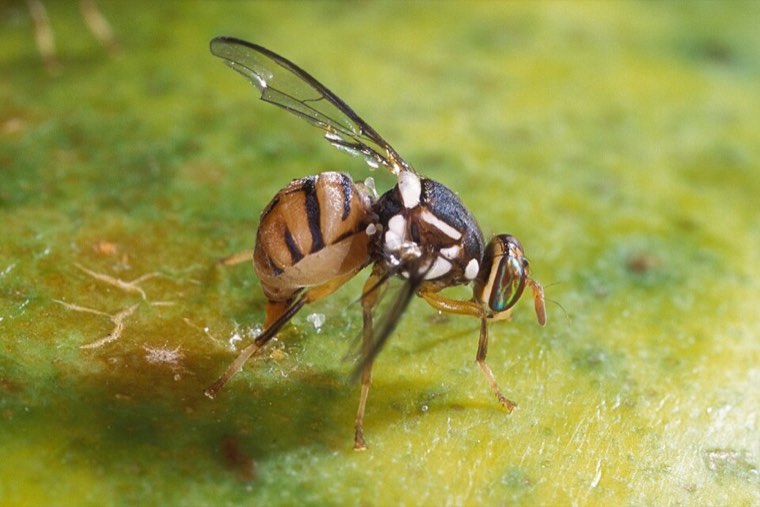
The scientific name of Oriental fruit fly is Bactrocera dorsalis (Hendel, 1912), in the order Diptera, family Tephritidae.
Older or alternative scientific names: Bactrocera invadens, Bactrocera papayae, Bactrocera philippinensis.
Native to tropical and subtropical Asia, from South Asia to southern China and Southeast Asia. Detected in East Africa in 2003 (first described as Bactrocera invadens) and now present across most of sub-Saharan Africa. Established in Hawaii and some Pacific islands. Outbreaks in other regions, including parts of North America and Europe, have been subject to official eradication.
| Region | Status |
|---|---|
| South and Southeast Asia | Native; key pest of mango, guava and citrus |
| East Asia | Native in the south; spreading north |
| Sub-Saharan Africa | Invasive since 2003; widespread, dominant mango pest |
| Pacific | Established in Hawaii and some islands |
| North America and Europe | Quarantine pest; outbreaks eradicated or under official control |
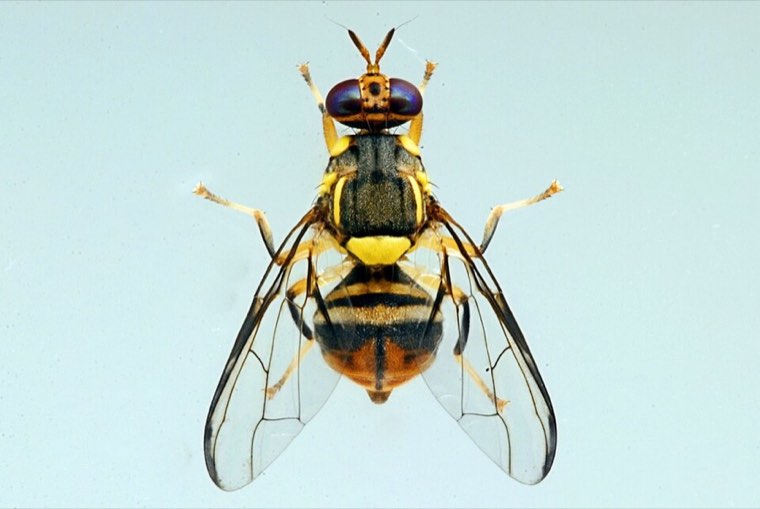
Adults are about 7-8 mm long, with a mostly dark thorax bearing two yellow side stripes, a yellow scutellum and a brown-orange abdomen with a dark T-shaped mark; the clear wings have a narrow dark band along the front edge. Larvae are creamy-white, legless maggots up to about 10 mm, pointed at the head end; mature larvae can flick themselves into the air. Separating this species from close relatives needs a specialist.
| Crop stage | What you see |
|---|---|
| Fruit colour break (mature green to ripening) | Tiny sting marks where eggs were laid, sometimes with oozing sap or a darkened halo. |
| Ripening fruit | Soft, water-soaked patches that collapse; maggots in the flesh when the fruit is cut; premature fruit drop. |
| Harvest and storage | Fruit that looked sound at harvest rots in transit and markets; secondary fungal and bacterial rots. |
Females lay clutches of eggs under the fruit skin, up to more than 1,000 eggs over a life of one to three months. Maggots feed inside the fruit, which usually falls. Mature larvae leave the fruit and pupate in the top few centimetres of soil. Adults need sugars and protein to mature eggs, which is why protein baits attract females.
| Stage | Duration | Notes |
|---|---|---|
| Egg | About 1-3 days at 25-30 °C | Under the fruit skin. |
| Larva (3 instars) | About 7-10 days at 25-30 °C | Feeds inside the fruit. |
| Pupa in soil | About 8-12 days | Barrel-shaped brown puparium. |
| Adult | 1-3 months; about 1-2 weeks before egg laying begins | Strong flier; males strongly attracted to the plant compound methyl eugenol. |
Development is fastest at about 25-30 °C, where a generation takes 3-5 weeks; it slows sharply below about 13-15 °C. Cold winters limit its establishment in temperate regions.
Many overlapping generations (often 8-12) in the tropics where host fruits follow one another through the year.
A sequence of fruiting hosts through the year, abandoned orchards and wild hosts, fallen fruit left on the ground, warm humid weather and the movement of infested fruit by people.
There is no numeric economic threshold for crop protection: one maggot makes a fruit unsaleable, and for export the tolerance is zero. Action is triggered by trap catches (flies per trap per day) rising before fruit colour break, by fruit inspection, and in quarantine areas by any detection, which triggers official measures.
Thresholds are local. They depend on crop price, control cost, variety and natural-enemy activity, so use the figure your local extension service publishes where one exists.
Direct losses in mango in sub-Saharan Africa have commonly been reported at 30-80% of fruit in unmanaged orchards; similar levels occur in guava and other soft fruit in Asia. Quarantine restrictions on exports from infested areas often cost more than the direct crop loss.
Control works best as a sequence: prevent, monitor, then act only when a threshold or a risk forecast says so, using the least disruptive option that works.
Insecticide is used mainly in protein bait sprays (spot-sprays of a protein bait mixed with a small amount of insecticide applied to a few leaves per tree) and in male-annihilation stations, not as full-cover sprays. Post-harvest heat or cold treatments are used for export. What is registered differs by country and changes over time; follow the label and your local plant-protection authority.
| Scheme | Group | Mode of action | Notes |
|---|---|---|---|
| IRAC | 5 | Nicotinic acetylcholine receptor allosteric modulators, site I (spinosyns) | Used in protein bait formulations. |
| IRAC | 3A | Sodium channel modulators (pyrethroids) | Used in some bait stations and attract-and-kill devices. |
| IRAC | 1B | Acetylcholinesterase inhibitors (organophosphates) | Historically used in baits; restricted or withdrawn in many countries. |
Recorded from more than 400 host plants. Major cultivated hosts include mango, guava, papaya, citrus, carambola, rose apple, banana (ripe), avocado, peach, persimmon, loquat, tropical almond, tomato, pepper and cucurbits; wild fruits sustain populations between crop seasons.
How to grow the crop well is the first line of defence. Laisha's free grow guides cover each crop from sowing to harvest:
Written by Laisha from the sources above, in its own words. This page is general reference, not a prescription: confirm identification locally and follow the label and your plant-protection authority.