 Laisha
AI Operating System for Agriculture
Ask Laisha
Laisha
AI Operating System for Agriculture
Ask Laisha
Phenacoccus manihoti Matile-Ferrero, 1977
A small, waxy, pinkish insect that sucks sap from the growing tips of cassava, making them bunch up into dense rosettes and stunting the plant. After it reached Africa from South America in the early 1970s it threatened the staple food of hundreds of millions of people, until a tiny parasitic wasp introduced from its homeland brought it under control - one of the most successful biological control programmes ever. It reappeared in Southeast Asia in 2008 and was controlled there the same way.
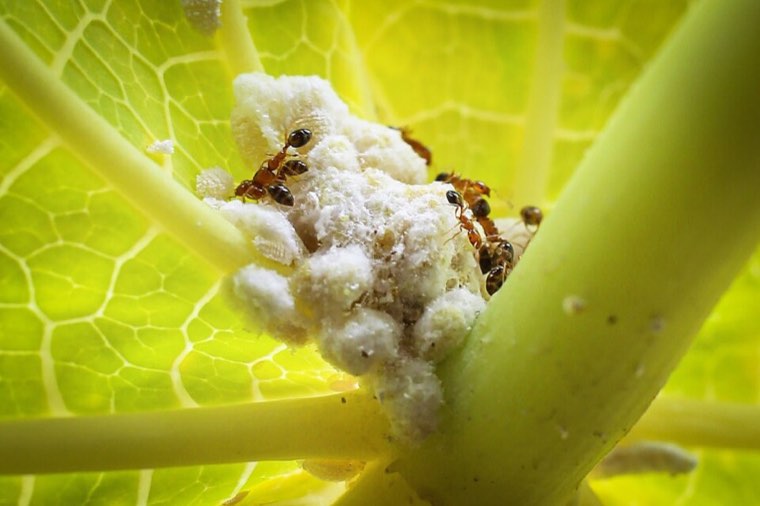
The scientific name of cassava mealybug is Phenacoccus manihoti Matile-Ferrero, 1977, in the order Hemiptera, family Pseudococcidae.
Native to South America (the Paraguay basin). It was accidentally introduced to Central Africa around 1973 and spread across almost the whole African cassava belt within about 15 years. It was found in Thailand in 2008 and has since spread to neighbouring countries of mainland and island Southeast Asia.
| Region | Status |
|---|---|
| South America | Native; minor pest kept in check by natural enemies |
| Sub-Saharan Africa | Invasive since 1973; largely controlled by an introduced parasitoid |
| Southeast Asia | Invasive since 2008; parasitoid released from 2009 |
| Other regions | Absent; quarantine concern for cassava-growing countries |
Adult females are about 2-3 mm, oval, pinkish, and covered with white powdery wax, with short waxy filaments around the edge. Populations consist only of females that reproduce without mating; no males are known. Each female produces a cottony egg sac containing several hundred eggs. Nymphs ('crawlers') are mobile and spread by walking and wind.
| Crop stage | What you see |
|---|---|
| Early growth (first months) | White, waxy colonies on the undersides of leaves near the shoot tip. |
| Dry season | 'Bunchy top': shoot tips crinkle and bunch into a rosette with shortened internodes; leaves yellow and fall. |
| Late growth | Distorted, thin stems unsuitable as planting cuttings; candelabra-shaped branching after tips die; smaller roots at harvest. |
Each generation takes about a month in warm, dry weather. Females pass through three nymphal stages before maturing and laying eggs in a waxy sac. Numbers explode during the dry season and fall sharply when heavy rains wash colonies off the plants. The insect is carried over long distances on infested planting cuttings.
| Stage | Duration | Notes |
|---|---|---|
| Egg (in egg sac) | About 6-8 days at 27 °C | Several hundred eggs per female. |
| Nymph (3 instars) | About 2-3 weeks | First instar crawlers disperse. |
| Adult female | About 2-3 weeks of egg laying | Reproduces without mating. |
Development is fastest at about 25-30 °C; dry, warm periods give the highest populations. Heavy rain is the main natural check.
Many overlapping generations a year in the tropics (up to about 10).
Long dry seasons, drought stress, poor soils, and moving untreated cuttings from infested fields. Insecticide use that kills the introduced parasitoid can allow outbreaks to return.
There is no published numeric economic threshold for smallholder cassava. Where the parasitoid is established, the recommended action is to protect it and use clean cuttings; local action levels based on the percentage of tips with bunchy top are used in some Asian commercial systems.
Thresholds are local. They depend on crop price, control cost, variety and natural-enemy activity, so use the figure your local extension service publishes where one exists.
Before biological control, losses of root yield of up to 80% were reported in affected areas of Africa, plus loss of stems needed as planting material. In Thailand the 2008-2010 outbreak reduced national cassava output substantially before parasitoid releases restored control.
Control works best as a sequence: prevent, monitor, then act only when a threshold or a risk forecast says so, using the least disruptive option that works.
Insecticides are generally discouraged in cassava because they destroy the parasitoid that controls the pest; their use is mainly as a treatment of cuttings before planting where infestation is heavy. What is registered differs by country and changes over time; follow the label and your local plant-protection authority.
| Scheme | Group | Mode of action | Notes |
|---|---|---|---|
| IRAC | 4A | Nicotinic acetylcholine receptor competitive modulators (neonicotinoids) | Used as a cutting dip in some Asian programmes. |
Mainly cassava (Manihot esculenta) and other Manihot species; a few other plants support it occasionally.
How to grow the crop well is the first line of defence. Laisha's free grow guides cover each crop from sowing to harvest:
Written by Laisha from the sources above, in its own words. This page is general reference, not a prescription: confirm identification locally and follow the label and your plant-protection authority.