 Laisha
AI Operating System for Agriculture
Ask Laisha
Laisha
AI Operating System for Agriculture
Ask Laisha
Rhopalosiphum padi (Linnaeus, 1758) · formerly or also: Aphis padi
A dark olive-green aphid of wheat, barley, oats, maize and grasses, recognised by a rusty-red patch around the base of its 'tail pipes'. It rarely causes much damage by feeding, but it is the most important carrier of barley yellow dwarf virus, which stunts and yellows cereals and can cut yields sharply when crops are infected young, especially autumn-sown crops after mild weather.
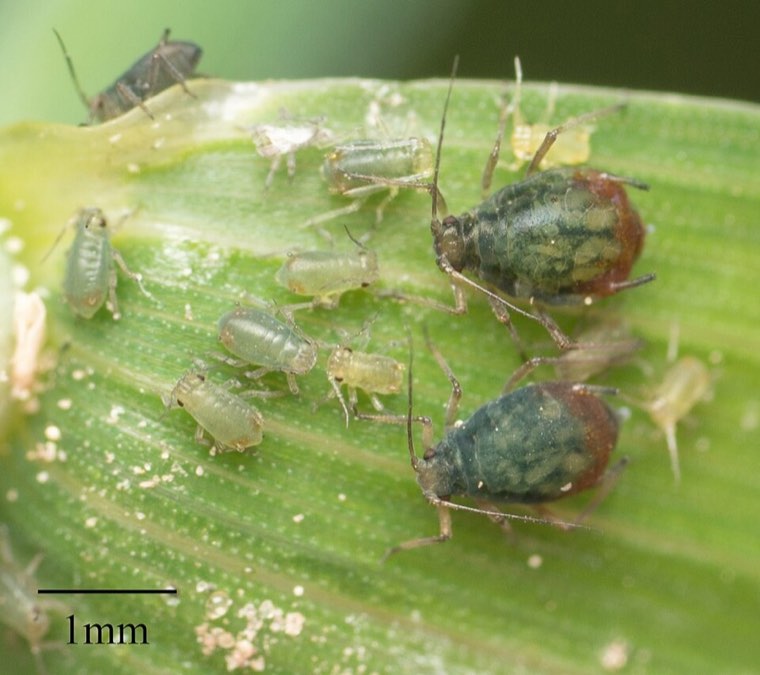
The scientific name of bird cherry-oat aphid is Rhopalosiphum padi (Linnaeus, 1758), in the order Hemiptera, family Aphididae.
Older or alternative scientific names: Aphis padi.
Found in temperate and subtropical cereal-growing regions on every continent. Where winters are mild it survives as active females on grasses and cereals and does not need its woody host.
| Region | Status |
|---|---|
| Europe | Widespread; key barley yellow dwarf vector in autumn-sown cereals |
| North America | Widespread |
| South America | Widespread in temperate cereal zones |
| Asia | Widespread in temperate and highland cereal zones |
| Oceania | Widespread in southern Australia and New Zealand |
| Africa and the Middle East | Present in temperate and highland cereal areas |
Wingless adults are about 1.5-2.5 mm, broadly pear-shaped, olive-green to greenish black, often with a dusting of wax, and have a distinctive rust-red to orange area around the bases of the short cornicles. Winged adults are dark with a greenish abdomen. Colonies sit on leaf sheaths, lower leaves and, in spring, in the ears.
| Crop stage | What you see |
|---|---|
| Emergence to tillering (autumn or early season) | Few aphids on young plants; weeks later, scattered plants or patches turn bright yellow (barley), red-purple (oats) or yellow-red from the leaf tip down (wheat), and are stunted - barley yellow dwarf. |
| Stem elongation to heading | Colonies on lower leaves and sheaths; honeydew; stunted, yellow patches with reduced tillering and short ears if virus infected early. |
| Grain fill | Large colonies may reduce grain weight; poorly filled, blank ears in early-infected plants. |
In cold climates eggs overwinter on bird cherry, a few generations develop there in spring, and winged forms migrate to grasses and cereals for summer; in autumn winged aphids fly back to bird cherry and into newly emerged cereals. In mild climates the aphid reproduces asexually all year on grasses. Autumn flights into newly sown cereals are what spread barley yellow dwarf virus.
| Stage | Duration | Notes |
|---|---|---|
| Egg (cold climates) | Through winter on Prunus padus | Not needed where winters are mild. |
| Nymph (4 instars) | About 7-10 days at 20 °C | Born live. |
| Wingless adult | About 2-3 weeks | Builds colonies on cereals and grasses. |
| Winged adult | About 2-3 weeks | Migrates; transmits virus after feeding on infected grasses. |
Aphids remain active and reproduce at low temperatures (above roughly 3-5 °C), which is why mild autumns and winters lead to secondary spread of virus within crops. Advisory services use accumulated day-degrees above 3 °C (a 'T-sum') from crop emergence to time control of the second generation.
Many overlapping generations where reproduction is asexual; 10-20 or more a year in mild climates.
Early sowing of autumn cereals into warm soils, mild autumns and winters, a 'green bridge' of volunteer cereals and grasses next to new crops, and grass-rich rotations. Hot, dry summers and heavy rain reduce populations.
For barley yellow dwarf, numeric aphid thresholds are not useful because a few infective aphids are enough; control decisions are based on risk factors (sowing date, mild weather, green bridge, aphid flights) and on day-degree timing after crop emergence. For direct feeding damage in spring and summer, count-based thresholds are used and vary by region.
| Crop | Threshold | Unit | Crop stage | Region | Source |
|---|---|---|---|---|---|
| Wheat | Accumulated 170 day-degrees above 3 °C from crop emergence (when aphids are present and untreated seed was used) | day-degrees (T-sum) - a timing threshold for the second aphid generation | Emergence to early tillering, autumn-sown crops | North-western Europe (UK) | AHDB barley yellow dwarf virus management guidance |
| Barley | Accumulated 170 day-degrees above 3 °C from crop emergence | day-degrees (T-sum) | Emergence to early tillering, autumn-sown crops | North-western Europe (UK) | AHDB barley yellow dwarf virus management guidance |
Thresholds are local. They depend on crop price, control cost, variety and natural-enemy activity, so use the figure your local extension service publishes where one exists.
Barley yellow dwarf infection at emergence to tillering can reduce yields of barley, wheat and oats by 20-50% or more in affected areas, with total loss in badly infected patches; later infection causes smaller losses. Direct feeding by large spring colonies reduces grain weight by a few per cent to around 10% in some trials.
Control works best as a sequence: prevent, monitor, then act only when a threshold or a risk forecast says so, using the least disruptive option that works.
Seed treatments and foliar sprays have been used to protect autumn cereals against the virus; their availability has changed greatly in some regions after regulatory reviews. Use sprays only when risk factors justify them and time them by day-degrees or monitoring. What is registered differs by country and changes over time; follow the label and your local plant-protection authority.
| Scheme | Group | Mode of action | Notes |
|---|---|---|---|
| IRAC | 3A | Sodium channel modulators (pyrethroids) | Widely used against virus vectors in cereals; resistance in this aphid is so far limited, unlike in grain aphid (Sitobion avenae). |
| IRAC | 4A | Nicotinic acetylcholine receptor competitive modulators (neonicotinoids) | Seed-treatment use restricted or withdrawn in some regions. |
| IRAC | 9D | Chordotonal organ TRPV channel modulators (pyropenes) | Selective where registered. |
Bird cherry (Prunus padus) and related Prunus species are the winter hosts in cold climates. Summer hosts are cereals (wheat, barley, oats, rye, triticale, maize, sorghum, rice) and many wild and pasture grasses.
How to grow the crop well is the first line of defence. Laisha's free grow guides cover each crop from sowing to harvest:
Written by Laisha from the sources above, in its own words. This page is general reference, not a prescription: confirm identification locally and follow the label and your plant-protection authority.