 Laisha
AI Operating System for Agriculture
Ask Laisha
Laisha
AI Operating System for Agriculture
Ask Laisha
Bemisia tabaci (Gennadius, 1889) · formerly or also: Bemisia argentifolii (for the MEAM1 member)
A tiny white sap-sucking insect that sits on the undersides of leaves of cotton, vegetables, cassava and ornamentals. Its own feeding weakens plants and coats them in sticky honeydew, but its real power is as a carrier of more than 100 plant viruses, including tomato yellow leaf curl, cotton leaf curl and cassava mosaic. What growers call one species is a complex of cryptic species, two of which (MEAM1 and MED) have spread worldwide and resist many insecticides.
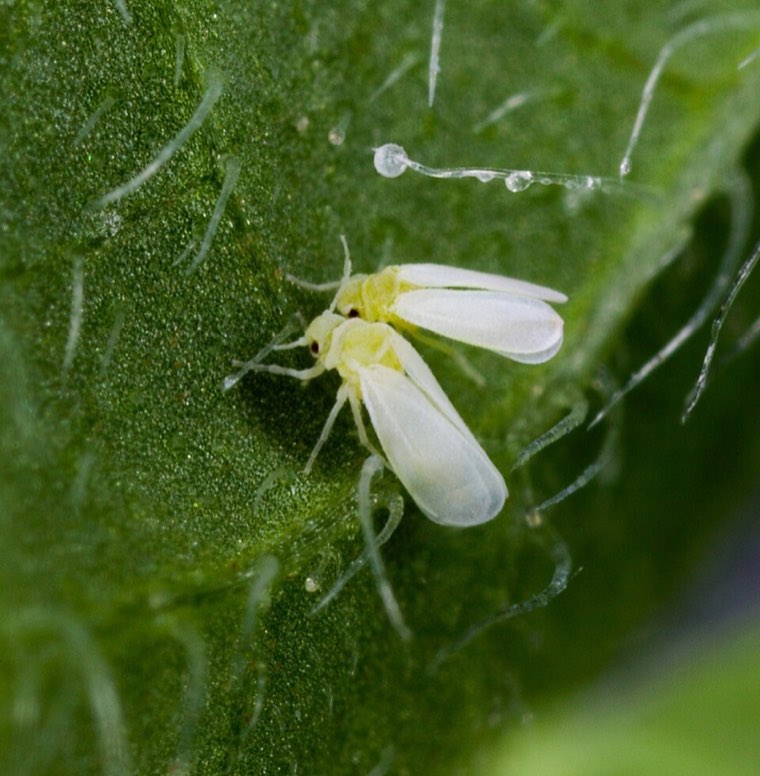
The scientific name of silverleaf whitefly is Bemisia tabaci (Gennadius, 1889), in the order Hemiptera, family Aleyrodidae.
Older or alternative scientific names: Bemisia argentifolii (for the MEAM1 member).
Found on every continent except Antarctica, outdoors in warm regions and in greenhouses everywhere. Native members of the complex occur in Africa, Asia and the Americas; the invasive MEAM1 (formerly 'B biotype') spread from the Middle East-Asia Minor region from the 1980s and MED (formerly 'Q biotype') from the Mediterranean from the 2000s.
| Region | Status |
|---|---|
| Sub-Saharan Africa | Native members; vector of cassava mosaic and brown streak viruses |
| South and Southeast Asia | Native members plus invasive MEAM1/MED; vector of leaf curl viruses |
| East Asia | MED dominant in many areas since the 2000s |
| Americas | MEAM1 invasive since the late 1980s; MED in greenhouses |
| Mediterranean and Europe | MED native in the Mediterranean; greenhouses further north; regulated in parts of Europe |
| Oceania | Native and invasive members present |
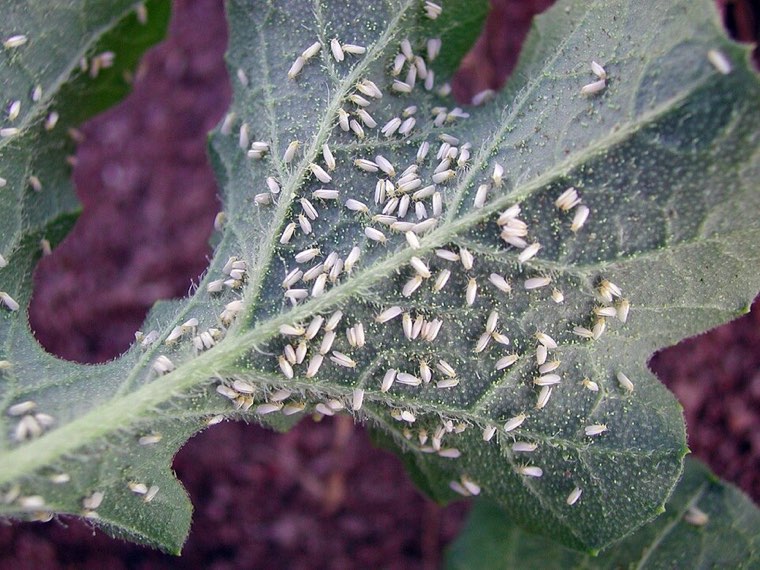
Adults are about 1 mm long with a yellowish body and white, powdery wings held tent-like over the body with a narrow gap between them. Eggs are pear-shaped, stand upright on a short stalk on the leaf underside and turn from white to brown. The first instar ('crawler') moves briefly, then settles; later instars are flat, oval, translucent scales. The last instar, often called the 'pupa', shows red eyespots. Members of the complex can be told apart only by DNA.
| Crop stage | What you see |
|---|---|
| Seedling and young plant | Clouds of tiny white insects fly up when plants are disturbed; early virus infection gives curled, yellowed, stunted plants. |
| Vegetative growth | Yellow speckling, honeydew and black sooty mould on leaves; in squash, MEAM1 feeding causes silvering of leaves; in tomato, irregular ripening of fruit. |
| Flowering and fruiting | Virus symptoms (yellow leaf curl, mosaic, vein thickening) and flower drop; in cotton, sticky lint from honeydew at boll opening. |
Females lay 50-300 eggs on young leaves. After the mobile crawler stage, nymphs stay fixed and feed until adults emerge from the last instar through a T-shaped slit. Adults acquire viruses by feeding on infected plants and, for begomoviruses, transmit them for the rest of their lives.
| Stage | Duration | Notes |
|---|---|---|
| Egg | About 5-7 days at 25-27 °C | On young leaf undersides. |
| Crawler (1st instar) | A few hours to 2 days of movement, then about 2-4 days feeding | The only mobile immature stage. |
| Sessile nymphs (2nd-3rd instars) | About 4-6 days at 25-27 °C | Flat translucent scales. |
| 'Pupa' (4th instar) | About 4-6 days | Red eyespots visible. |
| Adult | About 1-4 weeks | Transmits viruses; flies between crops. |
Development from egg to adult takes about 16-20 days near 27-30 °C and over a month below 20 °C; development stops below about 10-12 °C and above about 35-38 °C. Hot, dry seasons favour the pest.
Overlapping generations year-round in the tropics and greenhouses; 10-15 or more in warm regions.
Hot, dry weather; landscapes with a succession of hosts (cotton, vegetables, weeds); greenhouses without screens; transplants raised alongside infested crops; and broad-spectrum sprays that destroy parasitoids and predators while selecting resistance.
In cotton, thresholds combine adults counted on a specified leaf and large nymphs counted on leaf disks. Where whiteflies transmit viruses (tomato, pepper, beans, cassava), economic thresholds based on insect numbers do not apply: a few infective adults can cause severe loss, so prevention and vector exclusion start before planting.
| Crop | Threshold | Unit | Crop stage | Region | Source |
|---|---|---|---|---|---|
| Cotton | 3-5 adults per leaf and about 40% of leaf disks with large nymphs | adults per 5th main-stem node leaf; % disks infested | Flowering to boll opening | North America (south-western desert cotton) | University of Arizona Cooperative Extension whitefly management guidelines |
Thresholds are local. They depend on crop price, control cost, variety and natural-enemy activity, so use the figure your local extension service publishes where one exists.
Direct feeding reduces plant vigour and yield; honeydew and sooty mould block photosynthesis and make cotton lint sticky, which causes severe problems in spinning mills. Virus transmission is usually the larger loss: tomato yellow leaf curl can cause up to total loss in infected fields, cotton leaf curl disease has caused regional epidemics in South Asia, and cassava mosaic and brown streak destroy millions of tonnes of cassava roots a year in Africa.
Control works best as a sequence: prevent, monitor, then act only when a threshold or a risk forecast says so, using the least disruptive option that works.
Use selective groups that spare natural enemies, target the immature stages on leaf undersides, and treat transplants before planting where virus pressure is high. What is registered differs by country and changes over time; follow the label and your local plant-protection authority.
| Scheme | Group | Mode of action | Notes |
|---|---|---|---|
| IRAC | 7C | Juvenile hormone mimics | Act on eggs and nymphs; resistance documented in MED. |
| IRAC | 16 | Inhibitors of chitin biosynthesis, type 1 | Nymphs only. |
| IRAC | 23 | Inhibitors of acetyl CoA carboxylase (tetronic and tetramic acid derivatives) | Eggs and nymphs. |
| IRAC | 9B | Chordotonal organ TRPV channel modulators | Feeding inhibitor. |
| IRAC | 4D | Nicotinic acetylcholine receptor competitive modulators (butenolides) | Check cross-resistance with 4A locally. |
| IRAC | 28 | Ryanodine receptor modulators (diamides, systemic uses) | Some members active on whitefly. |
Recorded on more than 600 plant species. Major crops include cotton, tomato, pepper, eggplant, cucurbits, beans, soybean, cassava, sweet potato, tobacco and many ornamentals and weeds. Host preferences differ between members of the complex.
How to grow the crop well is the first line of defence. Laisha's free grow guides cover each crop from sowing to harvest:
Written by Laisha from the sources above, in its own words. This page is general reference, not a prescription: confirm identification locally and follow the label and your plant-protection authority.