 Laisha
AI Operating System for Agriculture
Ask Laisha
Laisha
AI Operating System for Agriculture
Ask Laisha
Paracoccus marginatus Williams & Granara de Willink, 1992
A small yellow mealybug covered in white wax that forms dense colonies on papaya, cassava, hibiscus, mulberry and many other plants. Its feeding yellows and crinkles leaves, stunts plants and smothers fruit in wax and sooty mould. Native to Mexico and Central America, it spread through the Caribbean, the Pacific, South and Southeast Asia and West Africa from the 1990s, and in most places it was brought under control by releasing tiny parasitic wasps from its home range.
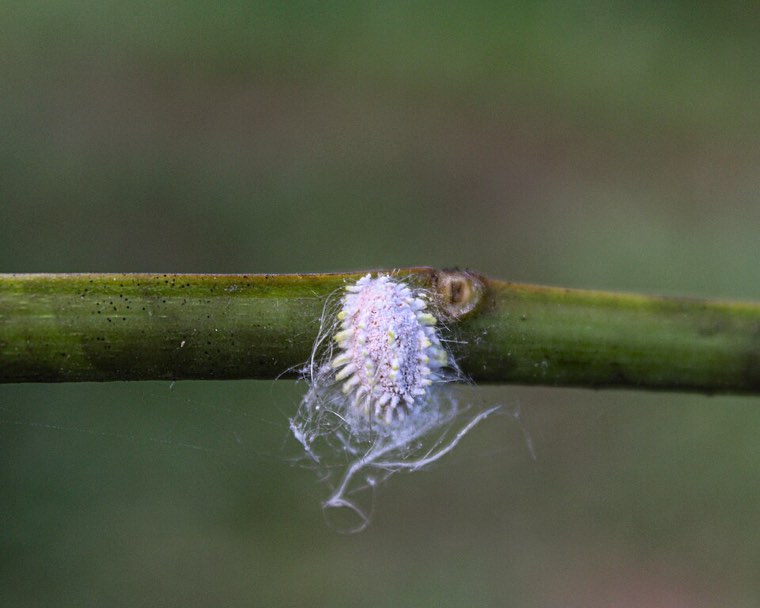
The scientific name of papaya mealybug is Paracoccus marginatus Williams & Granara de Willink, 1992, in the order Hemiptera, family Pseudococcidae.
Native to Mexico and Central America. It invaded the Caribbean in the 1990s, Florida in 1998, Pacific islands (Guam, Hawaii) in the early 2000s, South and Southeast Asia around 2008 (including India, Sri Lanka, Indonesia and Thailand) and parts of West Africa in the 2010s. It is regulated in Europe and other regions where absent.
| Region | Status |
|---|---|
| Central America and Mexico | Native |
| Caribbean and North America | Invasive since the 1990s; under biological control |
| Pacific | Invasive since the early 2000s |
| South and Southeast Asia | Invasive since about 2008; parasitoids released from 2010 |
| West Africa | Invasive in several countries |
Adult females are about 2 mm long, yellow under a covering of white wax, with a ring of short waxy filaments around the edge (shorter than those of many other mealybugs) and no long tail filaments; when crushed or mounted they show yellow body fluid. Eggs are laid in a white cottony egg sac under the female. Males pass through a pupa-like stage in a cocoon and become tiny winged insects.
| Crop stage | What you see |
|---|---|
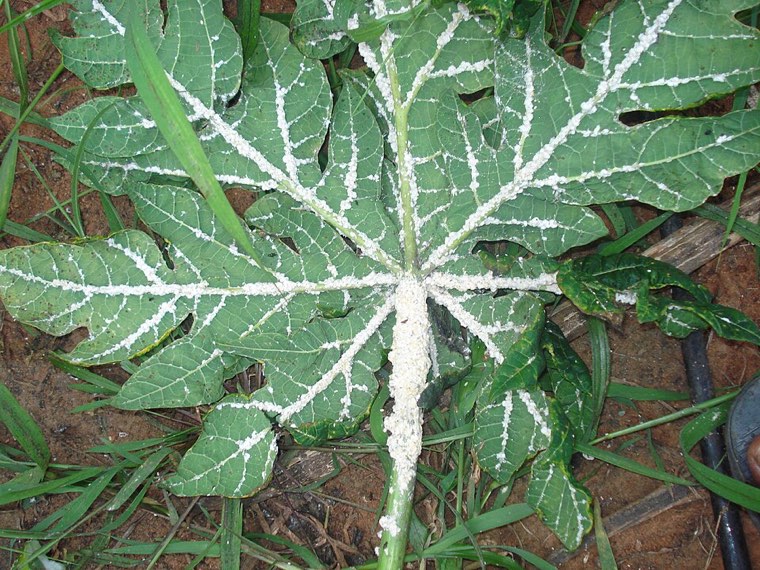
| Young plants and new growth | White, waxy colonies on the undersides of leaves, on shoot tips and on stems; young leaves crinkle and yellow. |
| Established plants | Stunting, bunched shoot tips, leaf drop, heavy honeydew and black sooty mould; in cassava, distorted shoot tips similar to cassava mealybug damage. |
| Fruiting (papaya) | Fruit covered with wax and sooty mould, malformed or dropped young fruit; unsaleable fruit. |
Females lay 100-600 eggs in an egg sac. Crawlers (first-instar nymphs) disperse on the plant, by wind, and on people, animals and planting material, then settle to feed. Females pass through three nymphal instars before maturing; males pass through four stages including a pre-pupa and pupa. Ants that feed on honeydew protect colonies from natural enemies.
| Stage | Duration | Notes |
|---|---|---|
| Egg (in egg sac) | About 6-10 days | Several hundred per female. |
| Nymph (3 female instars) | About 2-3 weeks | Crawlers disperse. |
| Adult female | About 2-3 weeks | Wingless; produces the egg sac. |
| Adult male | A few days | Winged; does not feed. |
A generation takes about one month at 25-30 °C; populations peak in warm, dry periods and are knocked back by heavy rain.
About 10-15 overlapping generations a year in the tropics.
Warm, dry weather; ants tending colonies; movement of infested planting material and fruit; broad-spectrum spraying that kills parasitoids; and abundant alternative hosts around fields.
There is no internationally agreed numeric economic threshold; where parasitoids are established, action is rarely needed. Programmes in newly invaded areas act on detection and on the percentage of plants infested.
Thresholds are local. They depend on crop price, control cost, variety and natural-enemy activity, so use the figure your local extension service publishes where one exists.
Before biological control, losses in papaya and other crops were severe in newly invaded areas; surveys in South Asia in 2010 found more than 60% of papaya plants infested in some districts, with heavy losses also in mulberry (affecting silk production), cassava and vegetables.
Control works best as a sequence: prevent, monitor, then act only when a threshold or a risk forecast says so, using the least disruptive option that works.
Insecticides give poor control because of the waxy covering and egg sacs, and they kill the parasitoids that provide lasting control; use them only to treat new outbreaks before parasitoids are released. What is registered differs by country and changes over time; follow the label and your local plant-protection authority.
| Scheme | Group | Mode of action | Notes |
|---|---|---|---|
| IRAC | 4A | Nicotinic acetylcholine receptor competitive modulators (neonicotinoids) | Systemic; harmful to parasitoids. |
| IRAC | 23 | Inhibitors of acetyl CoA carboxylase | Systemic; slower-acting. |
| IRAC | UNM | Non-specific mechanical and physical disruptors | Oil- or soap-based contact products where registered. |
Recorded on more than 100 plant genera: papaya, cassava, hibiscus, mulberry, guava, avocado, citrus, eggplant, tomato, pepper, cotton, jatropha, teak, plumeria and many ornamentals and weeds.
How to grow the crop well is the first line of defence. Laisha's free grow guides cover each crop from sowing to harvest:
Written by Laisha from the sources above, in its own words. This page is general reference, not a prescription: confirm identification locally and follow the label and your plant-protection authority.