 Laisha
AI Operating System for Agriculture
Ask Laisha
Laisha
AI Operating System for Agriculture
Ask Laisha
Cydia pomonella (Linnaeus, 1758) · formerly or also: Laspeyresia pomonella, Carpocapsa pomonella
The moth behind the proverbial 'worm in the apple'. Its caterpillars tunnel into apples, pears, quinces and walnuts and eat towards the seeds, leaving a frass-filled hole. It is the key pest of apple and pear in almost every temperate fruit region, and modern control is built on degree-day forecasts, pheromone mating disruption and a highly specific virus.
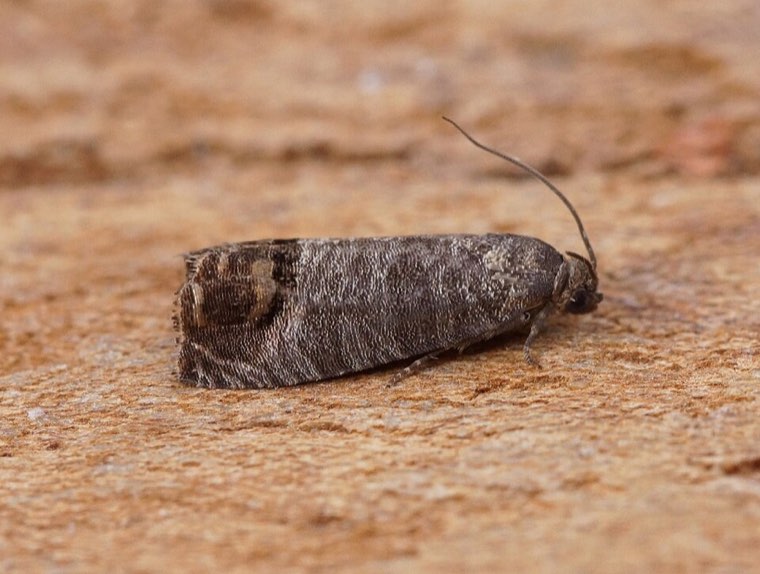
The scientific name of codling moth is Cydia pomonella (Linnaeus, 1758), in the order Lepidoptera, family Tortricidae.
Older or alternative scientific names: Laspeyresia pomonella, Carpocapsa pomonella.
Thought to originate in Central Asia, it now occurs in virtually every temperate pome-fruit region worldwide. It is absent from a few areas, such as Japan and Western Australia, where it is a quarantine pest, and its spread in western China is under official control.
| Region | Status |
|---|---|
| Europe | Widespread; key apple and pear pest |
| Central and West Asia | Native; widespread |
| East Asia | Spreading in parts of China; absent from Japan and Korea |
| Americas | Widespread in temperate fruit regions of North and South America |
| Africa and Oceania | Present in South Africa, eastern Australia and New Zealand; absent from Western Australia |
The moth is about 1 cm long with grey forewings marked by fine wavy lines and a coppery-brown patch at the tip; at rest the wings fold like a tent. Eggs are flat, translucent discs laid singly on leaves and fruit. Larvae are white to pinkish with a dark brown head, up to about 2 cm when mature.
| Crop stage | What you see |
|---|---|
| Petal fall to early fruit growth (first generation) | 'Stings': shallow entries that larvae abandoned; deep entries with a hole on the side or at the calyx end, plugged with reddish-brown frass. |
| Fruit development (second and later generations) | Tunnels to the core and seeds; larger frass-filled exit holes; early ripening and fruit drop. |
| Harvest and storage | Wormy fruit rejected at grading; larvae may leave fruit in storage bins. |
Mature larvae overwinter in silken cocoons under loose bark, in soil litter and in bins, and pupate in spring. Moths fly at dusk when temperatures exceed about 15 °C and females lay eggs near fruit. Newly hatched larvae wander briefly, then bore into a fruit. Development is predicted from heat accumulation (degree-days above about 10 °C) starting from the first sustained trap catch (the 'biofix'), which tells growers when eggs will hatch.
| Stage | Duration | Notes |
|---|---|---|
| Overwintering larva in cocoon | Autumn to spring (diapause) | Under bark and in debris. |
| Pupa | About 2-4 weeks in spring | In the cocoon. |
| Adult moth | About 2-3 weeks | Dusk flight; pheromone-attracted males used for monitoring. |
| Egg | About 6-20 days depending on temperature | First hatch about 140 degree-days (base 10 °C) after biofix in common models. |
| Larva in fruit (5 instars) | About 3-4 weeks | Leaves fruit to pupate or to overwinter. |
Lower developmental threshold about 10 °C; about 600 degree-days (base 10 °C) are needed for one generation. Moth flight and egg laying are suppressed below about 15 °C at dusk.
One generation in cool regions; two to three (with a partial fourth) in warm regions.
Warm, dry summers; abandoned or backyard trees near orchards; poor sanitation of bins and packing sheds; and orchards where mating disruption is not used area-wide.
There is no single numeric economic threshold that applies everywhere. Thresholds combine pheromone-trap catches with degree-day timing: a cumulative catch above a local action level after biofix triggers control timed to egg hatch. Action levels depend on whether mating disruption is in use (stronger lures are needed in disrupted orchards) and on the market's tolerance for damage, which for fresh apples is often below 0.5-1% of fruit. Values are set locally.
Thresholds are local. They depend on crop price, control cost, variety and natural-enemy activity, so use the figure your local extension service publishes where one exists.
Without control, codling moth can damage from a third to almost all of the fruit in an orchard in warm regions. Even low levels matter: fresh-fruit markets and export protocols often accept less than about 1% damaged fruit.
Control works best as a sequence: prevent, monitor, then act only when a threshold or a risk forecast says so, using the least disruptive option that works.
Applications are timed by degree-days to egg hatch, before larvae enter fruit. What is registered differs by country and changes over time; follow the label and your local plant-protection authority.
| Scheme | Group | Mode of action | Notes |
|---|---|---|---|
| IRAC | 28 | Ryanodine receptor modulators (diamides) | Ovi-larvicide. |
| IRAC | 18 | Ecdysone receptor agonists (diacylhydrazines) | Acts on eggs and larvae; resistance documented. |
| IRAC | 5 | Nicotinic acetylcholine receptor allosteric modulators, site I (spinosyns) | Larvicide. |
| IRAC | 15 | Inhibitors of chitin biosynthesis, CHS1 (benzoylureas) | Ovicidal; resistance documented. |
| IRAC | 31 | Baculoviruses (granulovirus) | Biological; very selective. |
Apple and pear are the main hosts; quince, walnut and crab apple are important; apricot, plum, peach and some other stone fruit are attacked occasionally.
How to grow the crop well is the first line of defence. Laisha's free grow guides cover each crop from sowing to harvest:
Written by Laisha from the sources above, in its own words. This page is general reference, not a prescription: confirm identification locally and follow the label and your plant-protection authority.