 Laisha
AI Operating System for Agriculture
Ask Laisha
Laisha
AI Operating System for Agriculture
Ask Laisha
Diaphorina citri Kuwayama, 1908 · formerly or also: Euphalerus citri
A small mottled-brown bug that feeds on the new shoots of citrus. On its own it does modest harm, but it carries the bacterium that causes huanglongbing (citrus greening), the most destructive citrus disease in the world. Wherever greening is present or threatened, managing this insect across whole districts is the main defence.
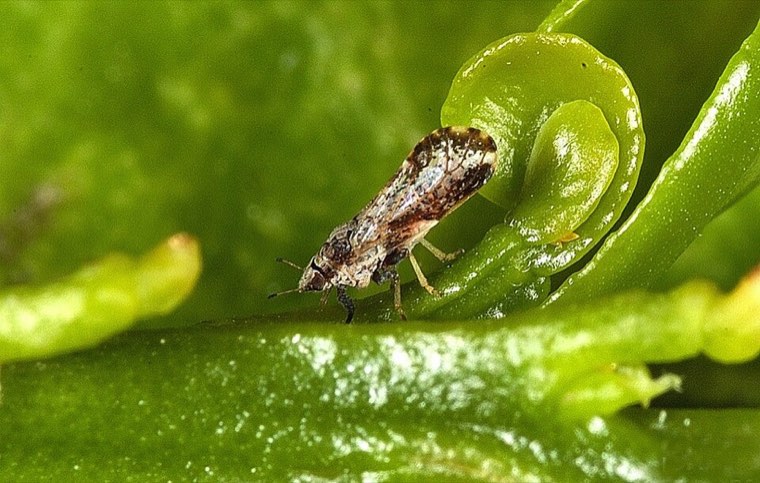
The scientific name of Asian citrus psyllid is Diaphorina citri Kuwayama, 1908, in the order Hemiptera, family Liviidae.
Older or alternative scientific names: Euphalerus citri.
Native to South and Southeast Asia. It reached Brazil by the 1940s and has spread through most of Latin America, the Caribbean and the southern United States (Florida 1998, California 2008), the Middle East and Arabian Peninsula, and parts of East Africa and Indian Ocean islands. It is a quarantine pest in Europe, Australia and elsewhere.
| Region | Status |
|---|---|
| South and Southeast Asia | Native; widespread |
| East Asia | Widespread in southern citrus zones |
| Latin America and the Caribbean | Invasive; widespread; greening present in many countries |
| North America | Invasive in southern citrus areas |
| Middle East and East Africa | Invasive in several countries |
| Europe and Oceania | Absent from most; quarantine pest |
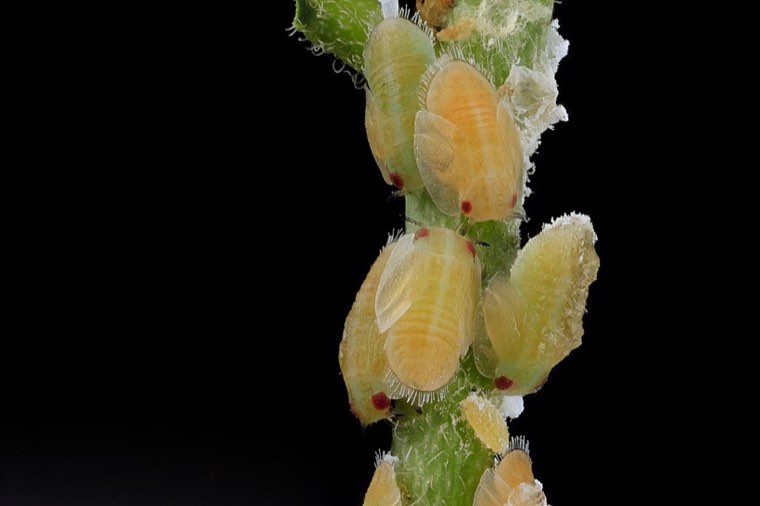
Adults are 3-4 mm long, mottled brown with a light-brown head, and rest with the body tilted at about 45 degrees to the leaf, head down. Eggs are tiny, almond-shaped, yellow to orange, tucked into the folds of very young leaves. Nymphs are flat, yellow-orange, with red eyes, and produce white waxy tubules and honeydew on new shoots.
| Crop stage | What you see |
|---|---|
| New flush (young shoots) | Colonies of nymphs with white waxy threads; curled and twisted young leaves; shoots that fail to expand; honeydew and sooty mould. |
| Mature leaves and trees | Adults resting at a 45-degree angle on leaf undersides; if greening is present, blotchy yellow mottling on leaves that is not symmetrical either side of the midrib. |
| Fruiting | On greening-infected trees, small, lopsided, bitter fruit that stays green at the stem end, and heavy fruit drop. |
Females lay eggs only on new, feathery flush, so populations surge with each flush of growth. Nymphs pass five instars on the flush. Adults live for one to several months and can fly between trees and be carried further by wind. Nymphs and adults that feed on infected trees acquire the greening bacterium and adults transmit it for life.
| Stage | Duration | Notes |
|---|---|---|
| Egg | About 2-4 days at 25-28 °C | On new flush only. |
| Nymph (5 instars) | About 11-15 days at 25-28 °C | Feeds on young shoots; waxy secretions. |
| Adult | About 1-3 months | Each female lays several hundred eggs; transmits the greening bacterium. |
Development is fastest at about 25-28 °C; a generation then takes 2-3 weeks. High summer heat and cold winters reduce numbers; flushing patterns driven by rain and irrigation decide when populations peak.
About 9-10 or more overlapping generations a year where citrus flushes repeatedly.
Repeated flushing (from rain, irrigation or heavy pruning), backyard and abandoned citrus and Murraya hedges, and moving nursery plants without inspection. Unmanaged trees in an area undermine the control in managed orchards.
Where greening is present or a threat, there is no economic threshold based on numbers: the aim is to keep psyllids as low as possible across the whole area, timing control to flush periods. Where greening is absent and the psyllid is managed only for direct damage, local action levels based on infested flush are used.
Thresholds are local. They depend on crop price, control cost, variety and natural-enemy activity, so use the figure your local extension service publishes where one exists.
Direct feeding distorts flush and reduces growth; the decisive loss is huanglongbing, which has cut citrus production in Florida by more than 70% since its arrival and caused large losses in Brazil, Asia and elsewhere. Infected trees decline and cannot be cured.
Control works best as a sequence: prevent, monitor, then act only when a threshold or a risk forecast says so, using the least disruptive option that works.
Insecticide programmes in greening areas are timed to flushing and dormant periods and coordinated across districts, and must respect pollinator and pre-harvest rules. What is registered differs by country and changes over time; follow the label and your local plant-protection authority.
| Scheme | Group | Mode of action | Notes |
|---|---|---|---|
| IRAC | 4A | Nicotinic acetylcholine receptor competitive modulators (neonicotinoids) | Systemic soil or trunk uses on young trees; resistance reported. |
| IRAC | 3A | Sodium channel modulators (pyrethroids) | Used in dormant-season sprays. |
| IRAC | 23 | Inhibitors of acetyl CoA carboxylase | Acts on nymphs. |
| IRAC | 28 | Ryanodine receptor modulators (diamides) | Used in some programmes. |
| IRAC | UNM | Non-specific mechanical and physical disruptors | Oil-based and particle products that smother nymphs or deter settling, where registered. |
Citrus species and close relatives in the family Rutaceae: all commercial citrus, kumquat, and ornamental and culinary relatives such as orange jasmine (Murraya paniculata) and curry leaf (Murraya koenigii), which are important reservoirs in gardens.
How to grow the crop well is the first line of defence. Laisha's free grow guides cover each crop from sowing to harvest:
Written by Laisha from the sources above, in its own words. This page is general reference, not a prescription: confirm identification locally and follow the label and your plant-protection authority.