 Laisha
AI Operating System for Agriculture
Ask Laisha
Laisha
AI Operating System for Agriculture
Ask Laisha
Sclerospora graminicola (Sacc.) J. Schröt., 1879 · formerly or also: Protomyces graminicola
Downy mildew is the most important disease of pearl millet, the staple cereal of the hot, dry Sahel and of the drylands of South Asia. Infected plants are stunted, their leaves turn pale with a white down underneath, and the ears develop into twisted leafy structures that bear no grain - hence 'green ear'. It has caused epidemics that wiped out popular hybrids, so resistant varieties, seed treatment and variety rotation are central to its control.
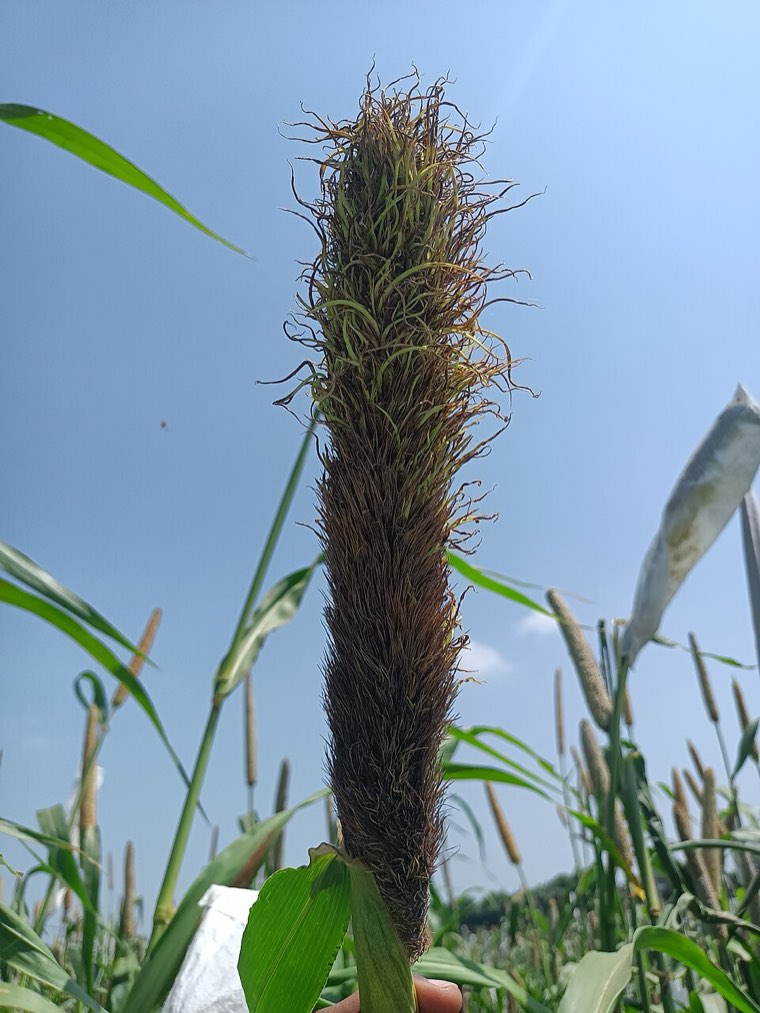
Downy mildew of pearl millet is caused by Sclerospora graminicola (Sacc.) J. Schröt., 1879, an oomycete (downy mildew), not a true fungus (order Peronosporales (Sclerosporales), family Sclerosporaceae).
Older or alternative scientific names: Protomyces graminicola.
Present wherever pearl millet is grown: the Sahel and savannahs of West and Central Africa, East and southern Africa, and South Asia. Epidemics in the 1970s and 1980s destroyed widely grown hybrids in South Asia and prompted resistance breeding.
| Region | Status |
|---|---|
| South Asia | Widespread; historic epidemics on hybrids |
| West and Central Africa (Sahel) | Widespread; major constraint on local varieties and hybrids |
| East and southern Africa | Present |
| Other regions | Recorded on Setaria grasses in temperate areas |
The pathogen grows systemically inside the plant. On humid nights it produces a white downy growth of sporangia on the undersides of leaves; sporangia release swimming zoospores. Thick-walled oospores form in infected leaves and floral tissue, fall into the soil and survive for years. Strains with different virulence (pathotypes) occur.
| Crop stage | What you see |
|---|---|
| Seedling | Pale yellow streaks starting from the base of the leaf and spreading; white down on the leaf underside early in the morning; severely infected seedlings stunted or dead. |
| Tillering to boot | Systemic infection: leaves chlorotic and streaked, then brown and shredded; plants stunted with many small tillers. |
| Earing | Green ear: all or part of the ear turns into twisted, leafy green structures instead of grain-bearing florets. |
Oospores in soil and debris (and occasionally on seed) infect seedling roots. Systemically infected seedlings produce sporangia on their leaves on humid nights; the sporangia are carried by wind to nearby young plants and cause secondary infections. Infected tissue produces new oospores that return to the soil.
| Stage | Duration | Notes |
|---|---|---|
| Oospores in soil | Survive several years | Main primary inoculum. |
| Systemic seedling infection | First weeks after emergence | Seedlings most susceptible. |
| Sporangia and zoospores | Overnight at high humidity, about 15-25 °C | Spread to neighbouring plants. |
| Green ear and new oospores | At earing | Return to the soil. |
Sporulation and infection are favoured by high humidity (above about 90%) on warm nights in the rainy season; seedlings are most susceptible in the first weeks.
One primary infection cycle per crop with several secondary cycles.
Repeated cropping of the same susceptible hybrid over large areas, which selects virulent pathotypes; humid weather at the seedling stage; infested soil; and untreated seed.
There is no numeric economic threshold. Management is preventive: resistant varieties and seed treatment before sowing, and removal of infected seedlings in seed-production plots.
Thresholds are local. They depend on crop price, control cost, variety and natural-enemy activity, so use the figure your local extension service publishes where one exists.
Yield losses of 20-40% are common in susceptible varieties, and epidemics on single widely grown hybrids have caused losses of over 60% in some areas.
Control works best as a sequence: prevent, monitor, then act only when a threshold or a risk forecast says so, using the least disruptive option that works.
Seed treatment with a systemic oomycete fungicide protects seedlings during the most susceptible period where registered. What is registered differs by country and changes over time; follow the label and your local plant-protection authority.
| Scheme | Group | Mode of action | Notes |
|---|---|---|---|
| FRAC | 4 | Phenylamides (seed treatment) | Widely used; insensitive strains reported. |
| FRAC | P07 | Phosphonates | Used in some programmes. |
Pearl millet is the main host. Related strains attack foxtail millet and some wild grasses (Setaria species).
How to grow the crop well is the first line of defence. Laisha's free grow guides cover each crop from sowing to harvest:
Written by Laisha from the sources above, in its own words. This page is general reference, not a prescription: confirm identification locally and follow the label and your plant-protection authority.