 Laisha
AI Operating System for Agriculture
Ask Laisha
Laisha
AI Operating System for Agriculture
Ask Laisha
Chilo partellus (Swinhoe, 1885) · formerly or also: Chilo zonellus
A moth whose caterpillars feed first in the whorl of young maize and sorghum, leaving rows of small holes in the leaves, and then tunnel down inside the stem, killing the growing point or weakening stems so they break. Native to Asia, it invaded eastern and southern Africa in the twentieth century and is now one of the main stem borers of cereals there. The 'push-pull' habitat system was developed largely against it.
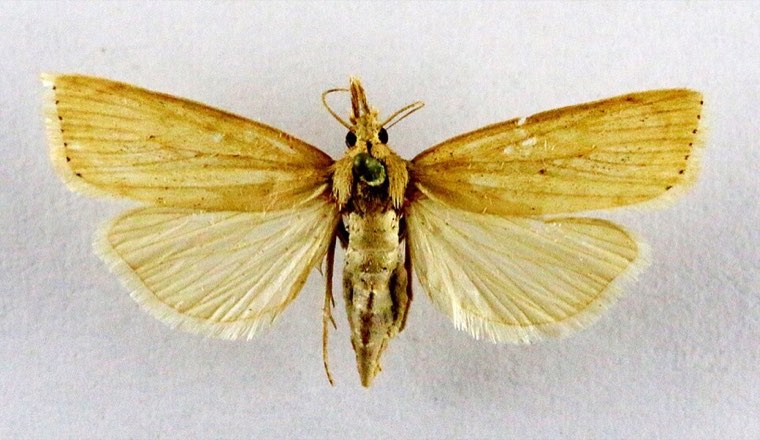
The scientific name of spotted stem borer is Chilo partellus (Swinhoe, 1885), in the order Lepidoptera, family Crambidae.
Older or alternative scientific names: Chilo zonellus.
Native to South Asia and widespread in tropical Asia. It was first recorded in Africa in the 1930s and has spread across eastern and southern Africa and islands of the Indian Ocean, where in many lowland areas it has displaced native stem borers.
| Region | Status |
|---|---|
| South Asia | Native; key pest of maize and sorghum |
| Southeast Asia | Present |
| East Africa | Invasive; dominant stem borer in warm lowlands |
| Southern Africa | Invasive; widespread |
| Middle East | Present in parts of the Arabian Peninsula |
Eggs are flat, oval and laid in overlapping, scale-like masses of 10-80 on the undersides of leaves near the midrib. Larvae are creamy to pinkish-yellow with a brown head and four purplish-brown stripes along the back, plus rows of dark spots; they reach about 2.5 cm. The moth is straw-coloured, about 2.5-3 cm across the wings, with darker scales forming a faint pattern on the forewings and whitish hindwings.
| Crop stage | What you see |
|---|---|
| Early whorl | Rows of small 'shot holes' and windowpanes across leaves, appearing as the leaves unroll; scraped patches on the leaf surface. |
| Late whorl | Dead hearts: the central shoot dries when larvae destroy the growing point; small holes and frass on the stem. |
| Tasselling to harvest | Tunnels inside stems and stalks, broken tassels and stems, lodging; larvae in cobs and peduncles of sorghum heads. |
Young larvae feed in the whorl for about a week, then bore into the stem and feed inside it. They pupate inside the stem. During a dry or cold season, mature larvae enter diapause inside stalks and stubble and resume development when rains return; stalks left in fields or used for fencing and fuel therefore carry the pest into the next season.
| Stage | Duration | Notes |
|---|---|---|
| Egg mass | About 4-8 days at 25-30 °C | On leaf undersides. |
| Larva (5-6 instars) | About 2-4 weeks; months in diapause | Whorl feeding, then inside the stem. |
| Pupa in the stem | About 7-12 days | Behind an exit hole prepared by the larva. |
| Adult moth | About 2-5 days | Nocturnal; females lay several hundred eggs. |
A generation takes about 4-6 weeks in warm weather and longer in cool highlands, where the species is less dominant. Hot dry periods trigger larval diapause.
Commonly 3-5 generations a year in warm areas with two cropping seasons; diapause bridges the dry season.
Warm, dry lowlands; continuous or staggered cereal cropping; stalks and stubble left after harvest; low soil fertility, which makes plants less able to tolerate damage; and grass margins that support the pest without natural enemies.
There is no widely validated numeric economic threshold for smallholder maize and sorghum, where the pest is most important. Decisions are based on the percentage of young plants with fresh whorl feeding and on area-wide prevention. Some national programmes publish local action levels based on leaf-feeding incidence; use those where they exist.
Thresholds are local. They depend on crop price, control cost, variety and natural-enemy activity, so use the figure your local extension service publishes where one exists.
Whorl feeding, dead hearts, stem tunnelling and lodging together cause losses commonly reported at 10-50% of grain yield in eastern and southern Africa and South Asia, depending on the infestation's timing and plant vigour. Tunnels also allow stalk rots to enter.
Control works best as a sequence: prevent, monitor, then act only when a threshold or a risk forecast says so, using the least disruptive option that works.
Applications are effective only on young larvae in the whorl, before they enter the stem. What is registered differs by country and changes over time; follow the label and your local plant-protection authority.
| Scheme | Group | Mode of action | Notes |
|---|---|---|---|
| IRAC | 28 | Ryanodine receptor modulators (diamides) | Whorl application. |
| IRAC | 5 | Nicotinic acetylcholine receptor allosteric modulators, site I (spinosyns) | Whorl application. |
| IRAC | 11A | Bacillus thuringiensis | Biological; granules or sprays into the whorl. |
Maize and sorghum are the main hosts; pearl and finger millet, sugarcane and rice are attacked less often. Wild grasses such as Napier grass, Sudan grass and wild sorghums are alternative hosts.
How to grow the crop well is the first line of defence. Laisha's free grow guides cover each crop from sowing to harvest:
Written by Laisha from the sources above, in its own words. This page is general reference, not a prescription: confirm identification locally and follow the label and your plant-protection authority.