 Laisha
AI Operating System for Agriculture
Ask Laisha
Laisha
AI Operating System for Agriculture
Ask Laisha
Schistocerca gregaria (Forskål, 1775)
A large grasshopper that normally lives alone in the deserts between West Africa and India, but after good rains can multiply, change colour and behaviour, and form swarms of billions that fly hundreds of kilometres and eat almost every green plant. It is the most dangerous migratory pest in the world. Because swarms cross borders, it is managed by national locust units coordinated by FAO, with early warning and preventive control in breeding areas.
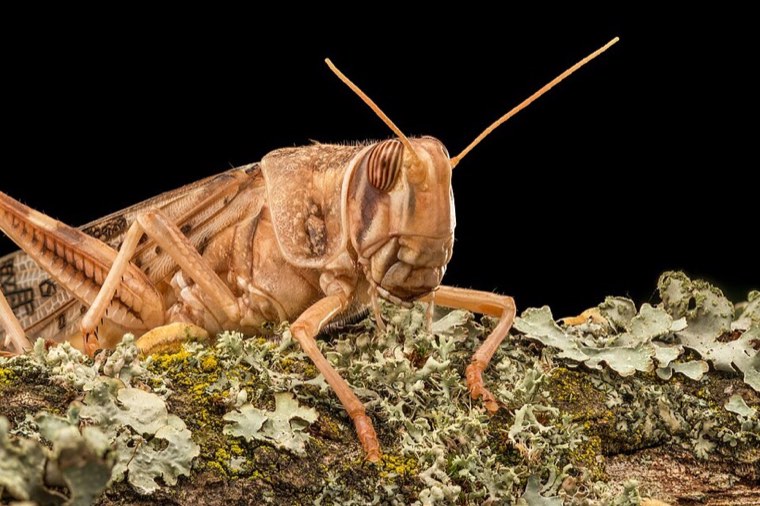
The scientific name of desert locust is Schistocerca gregaria (Forskål, 1775), in the order Orthoptera, family Acrididae.
In quiet 'recession' periods it lives in low numbers across some 16 million km² of arid land in about 30 countries, from Mauritania to India. During plagues, swarms can invade about 29 million km² in some 60 countries, a fifth of the world's land surface. Recent upsurges include 2003-2005 in North and West Africa and 2019-2021 in East Africa, Arabia and South-west Asia.
| Region | Status |
|---|---|
| Sahel and North-West Africa | Recession and breeding area; invaded during plagues |
| Horn of Africa and East Africa | Breeding and invasion area; severe upsurge 2019-2021 |
| Arabian Peninsula and Near East | Recession and breeding area, including Red Sea coasts |
| South-west and South Asia | Spring and summer breeding areas along the Indo-Pakistan border and in Iran |
| Southern Europe and West Africa's coasts | Occasionally reached by swarms during major plagues |
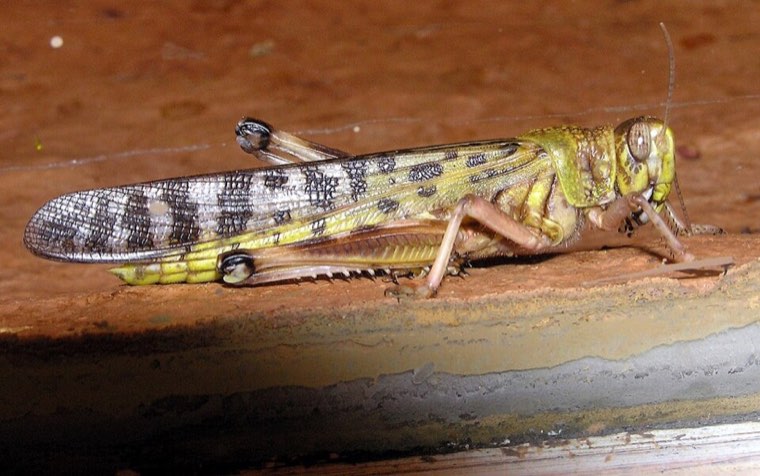
Adults are 6-9 cm long. Solitarious adults are greyish-brown and camouflaged, with a raised ridge on the thorax; gregarious immature adults are pink, turning bright yellow when sexually mature. Hoppers (wingless nymphs) in the solitarious phase are green or sand-coloured; gregarious hoppers are yellow to orange with striking black markings and march in dense bands. Eggs are laid in pods of 60-150 in moist sandy soil.
| Crop stage | What you see |
|---|---|
| Any crop stage - hopper bands | Dense marching bands of black-and-yellow hoppers moving through vegetation, stripping leaves of crops and pasture in their path. |
| Any crop stage - swarms | Clouds of pink or yellow adults; on landing they can strip fields, pasture and trees within hours, often leaving only stems. |
| Ripening grain | Heads of millet and sorghum eaten or broken; total loss of the harvest in affected fields. |
Rain allows plants to grow and females to lay eggs in moist sand. When locusts become crowded on shrinking patches of vegetation, touching each other (especially on the hind legs) triggers rapid changes in behaviour, and over generations in colour and shape: they become gregarious. Successive generations of breeding in good rains turn outbreaks into upsurges and, if not controlled, plagues. Swarms fly with the wind, typically 100-150 km a day.
| Stage | Duration | Notes |
|---|---|---|
| Egg pod in sand | About 10-65 days; about 2 weeks in warm soil | Needs moist sand; eggs laid 10-15 cm deep. |
| Hopper (5-6 instars) | About 24-95 days; usually 30-40 days | Gregarious hoppers form marching bands. |
| Immature adult | About 3 weeks to 9 months | Pink when gregarious; swarms migrate while maturing; slow in cool, dry conditions. |
| Mature adult | Several weeks of egg laying | Yellow when gregarious; total adult life typically 2.5-5 months. |
Egg and hopper development speed up with temperature and stop in cold conditions; adults need warmth to fly (swarms take off as the morning warms above about 20 °C). Maturation waits for rain and fresh vegetation, which can delay it for months.
Usually 2-5 generations a year, following seasonal rains in winter-spring and summer breeding areas.
Unusually heavy or widespread rain in desert breeding areas (for example after cyclones over the Arabian Peninsula) followed by drying vegetation that concentrates locusts; several successive good breeding seasons; and insecurity or funding gaps that prevent survey and early control.
There is no crop-based numeric economic threshold. Control is triggered by surveys that find gregarious hoppers or adults, or densities high enough for gregarisation in breeding areas, under national and FAO preventive-control strategies. Farmers who see swarms or hopper bands should report them to the national locust or plant-protection unit rather than act alone.
A locust eats roughly its own weight (about 2 g) of fresh vegetation each day. A swarm covering 1 km² contains about 40-80 million adults and can eat in a day as much food as about 35,000 people. Plagues have caused total crop loss over wide areas and famine historically; the 2019-2021 upsurge affected millions of hectares of cropland and rangeland across East Africa and South-west Asia.
Control works best as a sequence: prevent, monitor, then act only when a threshold or a risk forecast says so, using the least disruptive option that works.
Chemical control is carried out by trained national teams using ultra-low-volume ground and aerial spraying under FAO guidelines, with protection of people, livestock and water. Farmers should not attempt mass spraying themselves. What is registered differs by country and changes over time; the national locust or plant-protection authority decides.
| Scheme | Group | Mode of action | Notes |
|---|---|---|---|
| IRAC | 1B | Acetylcholinesterase inhibitors (organophosphates) | Fast knock-down of swarms; high toxicity to non-targets. |
| IRAC | 3A | Sodium channel modulators (pyrethroids) | Fast-acting; toxic to aquatic life. |
| IRAC | 15 | Inhibitors of chitin biosynthesis, CHS1 (benzoylureas) | Insect growth regulators for hopper bands; slow, selective. |
Eats almost any green vegetation: cereals (millet, sorghum, wheat, barley, maize, rice), pasture and rangeland grasses, vegetables, cotton, date palm, citrus, fodder shrubs and trees. A few plants with toxic or tough foliage, such as neem, are avoided.
How to grow the crop well is the first line of defence. Laisha's free grow guides cover each crop from sowing to harvest:
Written by Laisha from the sources above, in its own words. This page is general reference, not a prescription: confirm identification locally and follow the label and your plant-protection authority.