 Laisha
AI Operating System for Agriculture
Ask Laisha
Laisha
AI Operating System for Agriculture
Ask Laisha
Striga hermonthica (Delile) Benth., 1836 · formerly or also: Buchnera hermonthica
Striga is a parasitic weed that attaches to the roots of sorghum, maize, millet and upland rice and steals their water and nutrients. Most of the damage is done underground before the bright pink flowers even appear, and one plant can shed tens of thousands of dust-like seeds that last in the soil for years. It is one of the greatest biological constraints on cereal production in sub-Saharan Africa, worst on poor soils.
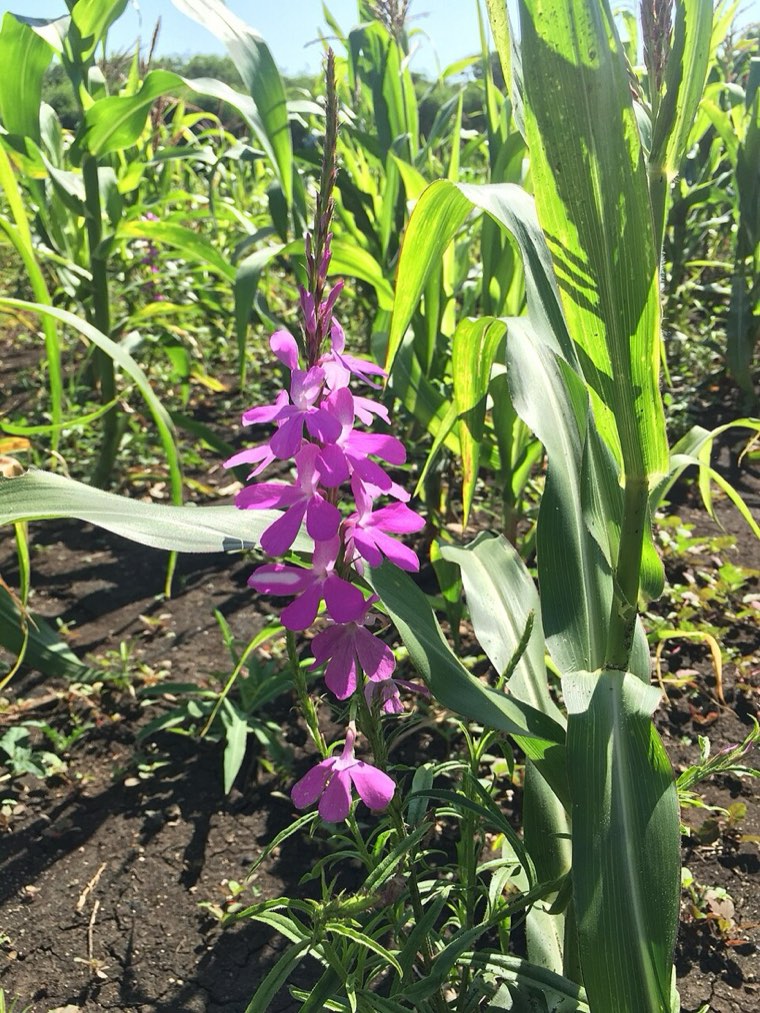
The scientific name of Striga is Striga hermonthica (Delile) Benth., 1836, in the order Lamiales, family Orobanchaceae.
Older or alternative scientific names: Buchnera hermonthica.
Widespread across the savannah zones of sub-Saharan Africa, from Senegal to Ethiopia and south to Tanzania, and in parts of the Arabian Peninsula. It infests many millions of hectares of cereal land. The related S. asiatica occurs in Africa, Asia and was eradicated from the United States; S. gesnerioides attacks cowpea in West Africa.
| Region | Status |
|---|---|
| West Africa and the Sahel | Widespread in sorghum, millet and maize |
| East Africa | Widespread around Lake Victoria, Ethiopia and Sudan |
| Central and southern Africa | Present; S. asiatica more common in the south |
| Arabian Peninsula | Present in Yemen and nearby |
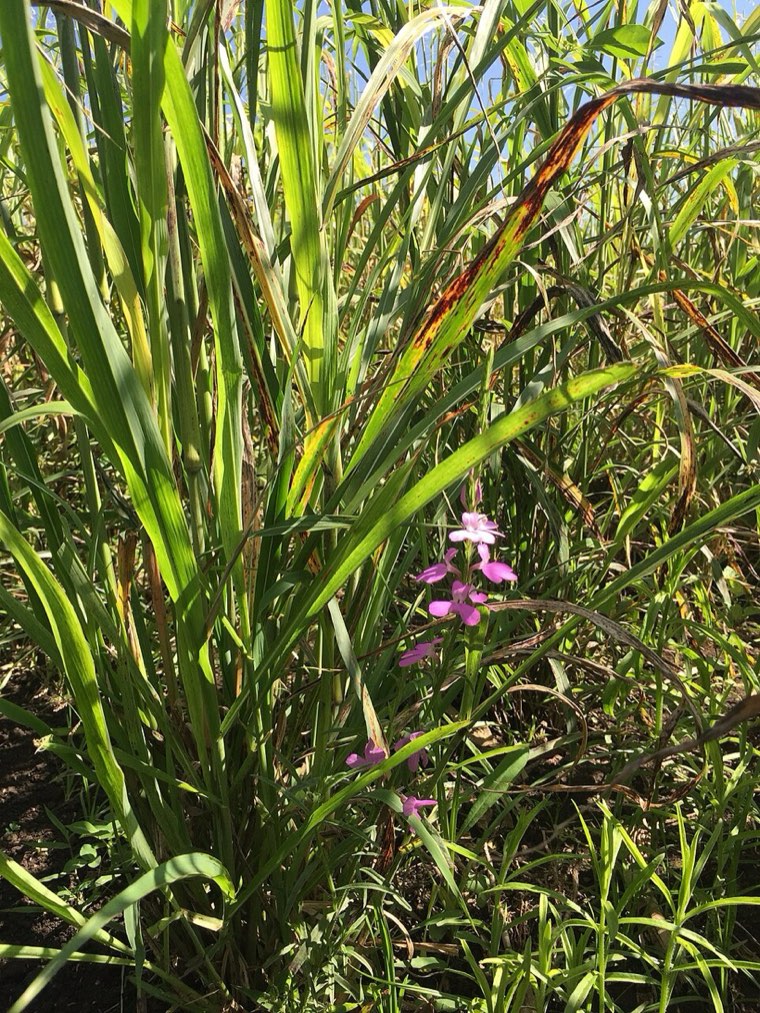
An erect, green, slightly hairy annual herb 30-100 cm tall with narrow opposite leaves and showy pink to purple flowers on spikes. Each plant produces tens of thousands of tiny seeds (about 0.2-0.3 mm), which remain viable in soil for 10 years or more.
| Crop stage | What you see |
|---|---|
| Before Striga emerges (4-8 weeks after crop sowing) | Crop plants are stunted, with yellowing, leaf rolling and wilting even when soil is moist ('drought' symptoms) - the bewitched look that gives the name witchweed. |
| After emergence | Clusters of green Striga shoots with pink-purple flowers around the base of cereal plants. |
| Crop maturity | Poor or no heads, small grain, early death of heavily infested plants. |
Seeds need a period of conditioning in warm, moist soil and then germinate only when they detect chemical signals (strigolactones) released by host roots within a few millimetres. The seedling attaches to the root with a haustorium and lives underground on the host for several weeks, then emerges, flowers and sets seed within about two months. Seeds are spread by wind, water, animals, tools and contaminated crop seed.
| Stage | Duration | Notes |
|---|---|---|
| Seed bank in soil | Viable for 10 years or more | Needs conditioning in warm, moist soil. |
| Germination near host roots | Within days of host signals | Triggered by strigolactones. |
| Attachment and underground parasitism | About 4-7 weeks | Most crop damage occurs here. |
| Emergence, flowering and seed set | About 4-8 weeks | Tens of thousands of seeds per plant. |
Germination and growth are favoured by warm soils (about 30-35 °C) and tropical savannah conditions; it is a problem of warm, semi-arid regions.
One generation per cereal crop; seed bank builds up with each crop.
Continuous cereal cropping, low soil fertility (especially low nitrogen and organic matter), little rotation with legumes, susceptible varieties, and contaminated crop seed.
There is no practical economic threshold, because most damage occurs before the weed is visible and every flowering plant adds thousands of seeds to the soil. Management aims to reduce the soil seed bank over several seasons.
Thresholds are local. They depend on crop price, control cost, variety and natural-enemy activity, so use the figure your local extension service publishes where one exists.
Yield losses of 20-80% are common in infested fields, and total loss occurs in heavy infestations on poor soils; the weed affects the food supply of many millions of smallholder families.
Control works best as a sequence: prevent, monitor, then act only when a threshold or a risk forecast says so, using the least disruptive option that works.
Herbicides have a limited role; the best-documented use is a low dose of an ALS-inhibiting herbicide coated on the seed of herbicide-tolerant maize varieties, which kills Striga as it attaches. What is registered differs by country and changes over time; follow the label and your local plant-protection authority.
| Scheme | Group | Mode of action | Notes |
|---|---|---|---|
| HRAC | 2 | Inhibition of acetolactate synthase (ALS) | Seed coating on herbicide-tolerant maize only. |
| HRAC | 4 | Auxin mimics | Post-emergence on emerged Striga in cereals where registered; does not prevent underground damage. |
Grasses: sorghum, maize, pearl millet, finger millet, upland rice, sugarcane and wild grasses. Related species attack legumes (Striga gesnerioides on cowpea) and other cereals (Striga asiatica on maize and sorghum in Africa and Asia).
How to grow the crop well is the first line of defence. Laisha's free grow guides cover each crop from sowing to harvest:
Written by Laisha from the sources above, in its own words. This page is general reference, not a prescription: confirm identification locally and follow the label and your plant-protection authority.