 Laisha
AI Operating System for Agriculture
Ask Laisha
Laisha
AI Operating System for Agriculture
Ask Laisha
Cercospora zeae-maydis and Cercospora zeina C. zeae-maydis Tehon & E.Y. Daniels, 1925; C. zeina Crous & U. Braun, 2006
Grey leaf spot produces narrow, rectangular, tan-to-grey lesions that run between the leaf veins like matchsticks. In warm, humid weather with long periods of fog or dew, the lesions merge and kill leaves before grain filling, causing serious yield loss and stalk lodging. It became a major disease with continuous maize and reduced tillage in the Americas from the 1980s and spread through sub-Saharan Africa and Asia; two closely related species cause it.
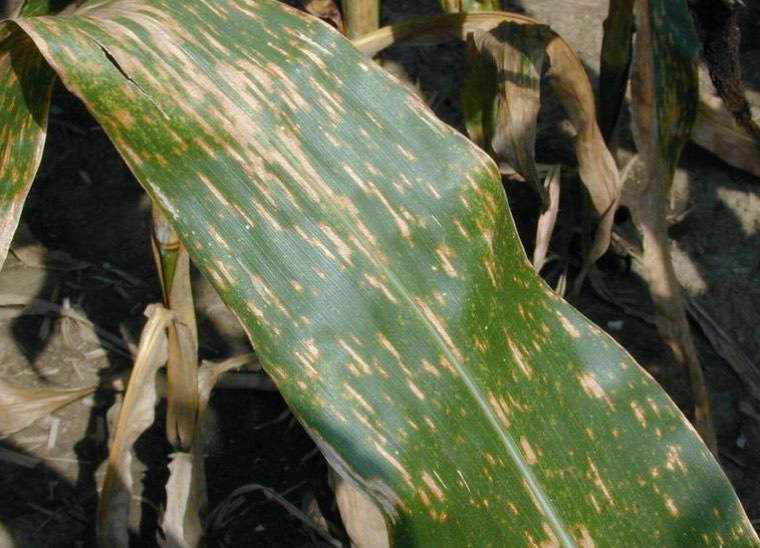
Grey leaf spot of maize is caused by Cercospora zeae-maydis and Cercospora zeina C. zeae-maydis Tehon & E.Y. Daniels, 1925; C. zeina Crous & U. Braun, 2006, a fungus (ascomycete) (order Mycosphaerellales, family Mycosphaerellaceae).
Cercospora zeae-maydis is found mainly in North America; Cercospora zeina causes most grey leaf spot in Africa, Brazil and China. The disease is important in the US Corn Belt, Latin America, East and southern Africa, and East and South Asia.
| Region | Status |
|---|---|
| North America | Widespread; C. zeae-maydis |
| South America | Widespread; mainly C. zeina in Brazil |
| Sub-Saharan Africa | Widespread since the 1990s; C. zeina |
| East and South Asia | Present and spreading; C. zeina in China |
Conidiophores emerge in clusters through leaf pores in lesions, producing long, thin, multi-septate colourless conidia, which give lesions a grey, fuzzy look in humid weather. The fungi survive on maize residue on the soil surface.
| Crop stage | What you see |
|---|---|
| Vegetative (lower leaves) | Small tan spots with yellow halos, becoming rectangular as they expand between veins. |
| Tasselling to silking | Long, narrow, rectangular grey-tan lesions with sharp parallel edges ('matchsticks'), on lower and then upper leaves. |
| Grain filling | Lesions merge so whole leaves die; plants look grey and dead early; stalk rots and lodging follow. |
Spores produced on infected residue start infections on lower leaves after long humid periods. The long latent period (about two to three weeks) means symptoms appear well after infection, and the disease usually becomes obvious around tasselling and then moves up the plant. Because so much inoculum comes from residue on the soil surface, fields in continuous maize under no-till start the season with far more spores than rotated, ploughed fields.
| Stage | Duration | Notes |
|---|---|---|
| Survival on residue | Between seasons | Surface residue is the main source. |
| Infection | Requires many hours of very high humidity or leaf wetness | Often 12 hours or more of humidity above 95%. |
| Latent period | About 14-21 days | Long compared with many leaf diseases. |
| Sporulation and spread | Repeated cycles | Wind and rain splash. |
Favoured by warm temperatures (about 22-30 °C) combined with prolonged high humidity, fog or dew, often in river valleys and humid mid-altitudes.
Two or more cycles per crop because of the long latent period.
Maize after maize, minimum or no tillage that leaves residue on the surface, prolonged humid weather and fog, susceptible hybrids, and dense planting. Valleys, river bottoms and fields surrounded by trees, where fog and dew linger into the morning, are typical hot spots.
There is no single numeric threshold; extension guidance in some regions considers fungicide on susceptible hybrids when lesions are present on the third leaf below the ear or higher on many plants before or around tasselling in humid weather. Criteria differ between regions.
Thresholds are local. They depend on crop price, control cost, variety and natural-enemy activity, so use the figure your local extension service publishes where one exists.
Yield losses of 20-50% or more are reported in susceptible hybrids in favourable seasons, along with weakened stalks and lodging that make harvest difficult. Early leaf death forces the plant to draw sugars from the stalk to fill grain, which weakens stalks and is why lodging often follows severe grey leaf spot.
Control works best as a sequence: prevent, monitor, then act only when a threshold or a risk forecast says so, using the least disruptive option that works.
Fungicides are most economical on susceptible hybrids in high-yield, high-risk fields when applied around tasselling. What is registered differs by country and changes over time; follow the label and your local plant-protection authority.
| Scheme | Group | Mode of action | Notes |
|---|---|---|---|
| FRAC | 11 | Quinone outside inhibitors (QoI) | Often in mixtures. |
| FRAC | 3 | Demethylation inhibitors (DMI) | Systemic. |
| FRAC | 7 | Succinate dehydrogenase inhibitors (SDHI) | In mixtures. |
Maize is the main host; the fungi have been recorded on a few grasses but maize residue is the key source of inoculum.
How to grow the crop well is the first line of defence. Laisha's free grow guides cover each crop from sowing to harvest:
Written by Laisha from the sources above, in its own words. This page is general reference, not a prescription: confirm identification locally and follow the label and your plant-protection authority.