 Laisha
AI Operating System for Agriculture
Ask Laisha
Laisha
AI Operating System for Agriculture
Ask Laisha
Spodoptera exempta (Walker, 1856) · formerly or also: Laphygma exempta
The African armyworm is a moth whose caterpillars appear suddenly in huge numbers after the first rains, especially following a drought, and 'march' across pastures and cereal fields, stripping them to the ground. Outbreaks can cover thousands of square kilometres. Because moths migrate on storm winds from one outbreak area to the next, national and regional forecasting services track them with trap networks and warn farmers.
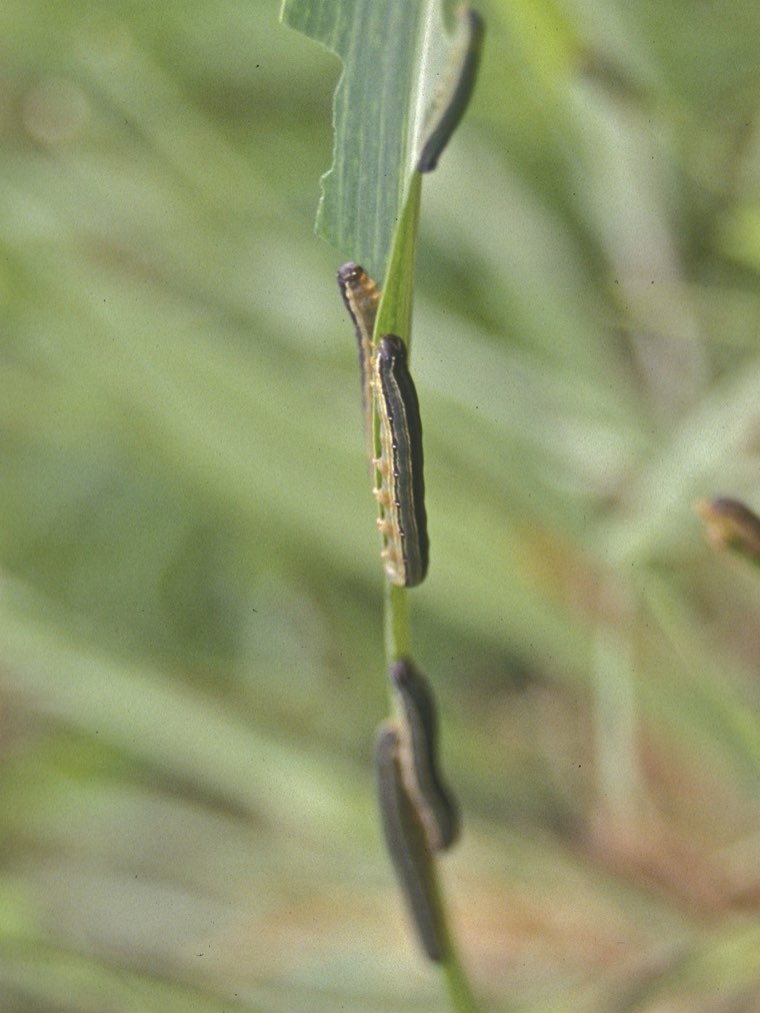
The scientific name of African armyworm is Spodoptera exempta (Walker, 1856), in the order Lepidoptera, family Noctuidae.
Older or alternative scientific names: Laphygma exempta.
Sub-Saharan Africa, especially East and southern Africa, and the Arabian Peninsula; also present in parts of South and Southeast Asia, Australia and Pacific islands, where outbreaks are less frequent.
| Region | Status |
|---|---|
| East Africa | Native; frequent, large outbreaks |
| Southern Africa | Native; regular outbreaks |
| West and Central Africa, Arabia | Present; occasional outbreaks |
| Asia and Oceania | Present; sporadic outbreaks |
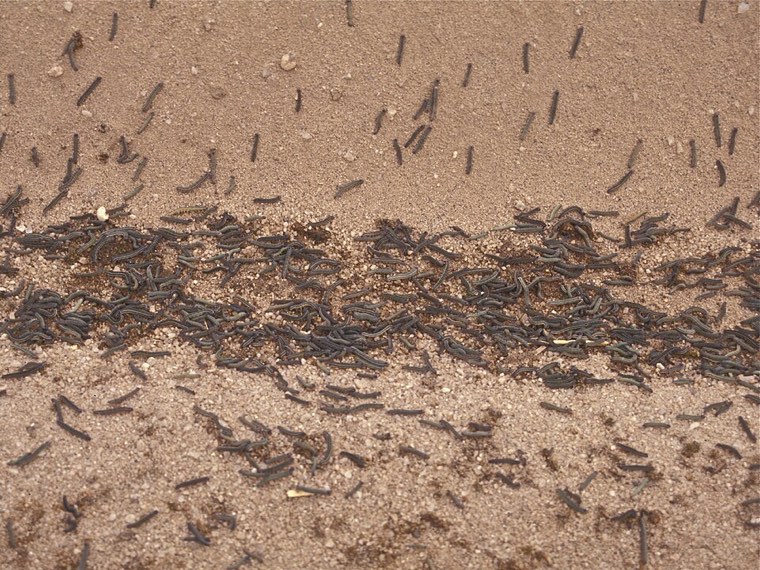
Caterpillars change colour with crowding: at low density (solitary phase) they are green to brown and inconspicuous; in outbreaks (gregarious phase) they are velvety black on the back with thin pale lines along the sides and a pale or green underside, up to about 3 cm long. They lack the inverted Y and four-spot square of the fall armyworm. Moths are dark grey-brown with a wingspan of about 3 cm.
| Crop stage | What you see |
|---|---|
| Seedling cereals and pasture | Sudden appearance of masses of black caterpillars that eat leaves down to the stems, often starting in pastures and grassy field edges. |
| Vegetative cereals | Large areas of crop eaten bare; caterpillars move in bands to neighbouring fields; leaves skeletonised by young larvae. |
| After an outbreak | Bare fields with frass; larvae disappear into the soil to pupate within two to three weeks. |
Moths lay egg batches on grass leaves, often after migrating on winds associated with storm fronts. Larvae feed for two to three weeks and pupate in the soil. Each outbreak generation can produce moths that start a new outbreak downwind, so outbreaks move across a region during the rainy season.
| Stage | Duration | Notes |
|---|---|---|
| Egg batch | About 2-5 days | Up to several hundred eggs per batch, covered with scales. |
| Larva (6 instars) | About 14-22 days | Black and gregarious at high density. |
| Pupa in soil | About 7-12 days | A few centimetres deep. |
| Adult moth | About 1-2 weeks | Strong migrant on wind. |
Development is fastest in warm conditions (about 25-30 °C); outbreaks are linked more to rainfall patterns than to temperature.
Several generations during the rainy season; outbreaks shift geographically from generation to generation.
The first heavy rains after a dry period, when fresh grass growth and moth concentration by storm winds coincide; extensive grasslands near crops.
There is no field-level numeric threshold in general use: outbreaks are sudden and devastating, so action is triggered by outbreak reports and forecasts from national armyworm services and by finding larvae in or next to fields.
Thresholds are local. They depend on crop price, control cost, variety and natural-enemy activity, so use the figure your local extension service publishes where one exists.
Outbreaks can destroy cereal seedlings and pasture over large areas, forcing replanting and causing feed shortages for livestock; losses in affected fields can be total.
Control works best as a sequence: prevent, monitor, then act only when a threshold or a risk forecast says so, using the least disruptive option that works.
Insecticides are used during outbreaks, often through government campaigns, targeting young larvae. What is registered differs by country and changes over time; follow the label and your local plant-protection authority.
| Scheme | Group | Mode of action | Notes |
|---|---|---|---|
| IRAC | 3A | Sodium channel modulators (pyrethroids) | Fast-acting outbreak control. |
| IRAC | 15 | Inhibitors of chitin biosynthesis, CHS1 (benzoylureas) | Selective; young larvae. |
| IRAC | 31 | Baculoviruses | Nucleopolyhedrovirus where registered. |
Grasses and cereals: pasture and rangeland grasses, maize, sorghum, millets, rice, wheat, barley, teff and sugarcane seedlings; sedges such as nutgrass. Broadleaf crops are rarely attacked.
How to grow the crop well is the first line of defence. Laisha's free grow guides cover each crop from sowing to harvest:
Written by Laisha from the sources above, in its own words. This page is general reference, not a prescription: confirm identification locally and follow the label and your plant-protection authority.