 Laisha
AI Operating System for Agriculture
Ask Laisha
Laisha
AI Operating System for Agriculture
Ask Laisha
Exserohilum turcicum (Pass.) K.J. Leonard & Suggs, 1974 (sexual stage Setosphaeria turcica) · formerly or also: Setosphaeria turcica, Helminthosporium turcicum, Drechslera turcica
Northern corn leaf blight makes long, cigar-shaped, grey-green to tan lesions on maize leaves. In cool to moderate, humid weather the lesions multiply and merge until leaves die early, cutting grain filling. It is one of the most widespread leaf diseases of maize, especially in tropical highlands, humid mid-altitude areas and temperate regions with dewy summers. Resistant hybrids and residue management are the main controls.
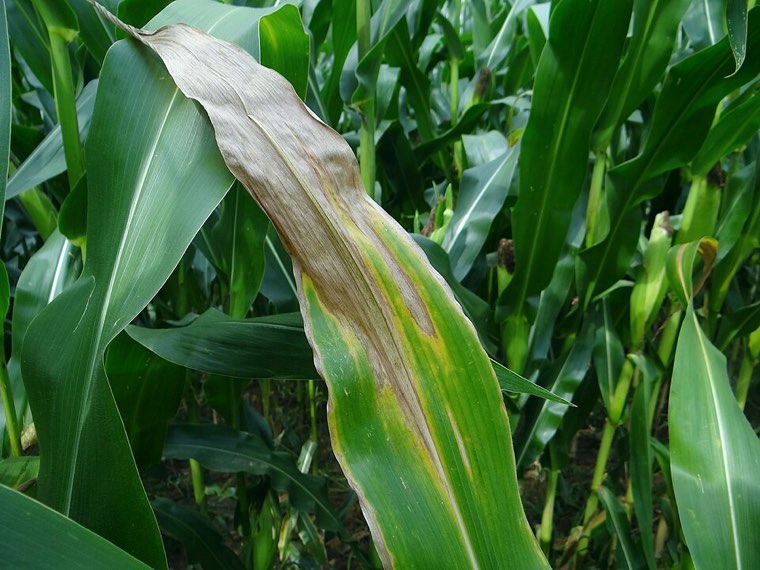
Northern corn leaf blight is caused by Exserohilum turcicum (Pass.) K.J. Leonard & Suggs, 1974 (sexual stage Setosphaeria turcica), a fungus (ascomycete) (order Pleosporales, family Pleosporaceae).
Older or alternative scientific names: Setosphaeria turcica, Helminthosporium turcicum, Drechslera turcica.
Found in maize regions worldwide, and most important where temperatures are moderate and dew or rain is frequent during the growing season: the highlands and mid-altitudes of East and southern Africa, the Andes and Central America, South and East Asia, the US Corn Belt and Europe.
| Region | Status |
|---|---|
| Sub-Saharan Africa | Widespread; major in highland and mid-altitude maize |
| Asia | Widespread; major in hill and temperate areas |
| Americas | Widespread; resurgent in the US Corn Belt |
| Europe | Widespread in humid maize regions |
| Oceania | Present |
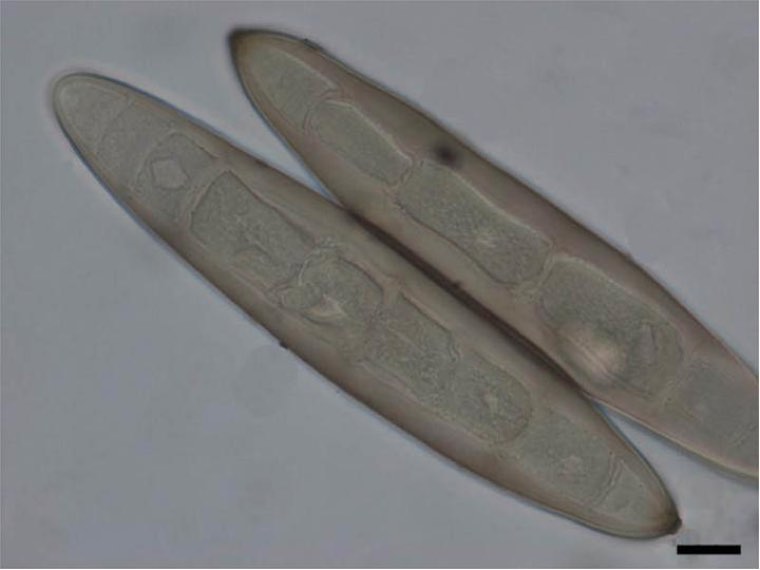
The fungus produces long, slightly curved, dark conidia with several cross-walls and a protruding hilum, on dark conidiophores in the lesions, giving a dark, dusty appearance in humid weather. It survives as mycelium and thick-walled conidia (chlamydospores) in maize residue.
| Crop stage | What you see |
|---|---|
| Seedling to knee-high | Small, oval, water-soaked spots on lower leaves; usually few. |
| Late vegetative to tasselling | Long (about 2.5-15 cm), elliptical or cigar-shaped grey-green lesions that turn tan, starting on lower leaves and moving up; dark sporulation in humid weather. |
| Grain filling | Lesions merge and whole leaves die, so the plant looks frosted or burnt; stalk rots and lodging may follow early leaf death. |
Spores produced on infected residue left on the soil surface are carried by wind and rain to lower leaves, starting infections that produce new spores within about one to two weeks. The disease then climbs the plant through repeated cycles. Infection before or around silking does the most harm.
| Stage | Duration | Notes |
|---|---|---|
| Survival on residue | Between seasons | Mycelium and chlamydospores in maize debris. |
| Infection | About 6-18 hours of leaf wetness | Optimum about 18-27 °C. |
| Lesion development | About 7-12 days to sporulation | Shorter in favourable weather. |
| Secondary spread | Repeated cycles | Wind-blown conidia. |
Favoured by moderate temperatures of about 18-27 °C with heavy dew or frequent rain; hot, dry weather slows it.
Several cycles per maize crop.
Moderate temperatures with long dew periods, maize after maize with residue left on the surface, susceptible hybrids, and late planting that puts the crop's sensitive stages into humid weather.
There is no single numeric threshold; advisory services in some regions suggest fungicide only on susceptible hybrids when lesions are found on or near the ear leaf around tasselling to silking in humid weather. Values and criteria differ by region.
Thresholds are local. They depend on crop price, control cost, variety and natural-enemy activity, so use the figure your local extension service publishes where one exists.
Yield losses of 30-50% occur when the disease reaches the upper leaves before or around silking in susceptible hybrids; later infection causes smaller losses. Early leaf death also predisposes plants to stalk rot and lodging.
Control works best as a sequence: prevent, monitor, then act only when a threshold or a risk forecast says so, using the least disruptive option that works.
Fungicides are economical mainly on susceptible hybrids grown for high yield when disease starts before silking. What is registered differs by country and changes over time; follow the label and your local plant-protection authority.
| Scheme | Group | Mode of action | Notes |
|---|---|---|---|
| FRAC | 3 | Demethylation inhibitors (DMI) | Systemic. |
| FRAC | 11 | Quinone outside inhibitors (QoI) | Often in mixtures. |
| FRAC | 7 | Succinate dehydrogenase inhibitors (SDHI) | In mixtures. |
Maize is the main host; sorghum, Sudan grass, Johnson grass and some other grasses are also infected, and strains differ in host specialisation.
How to grow the crop well is the first line of defence. Laisha's free grow guides cover each crop from sowing to harvest:
Written by Laisha from the sources above, in its own words. This page is general reference, not a prescription: confirm identification locally and follow the label and your plant-protection authority.