 Laisha
AI Operating System for Agriculture
Ask Laisha
Laisha
AI Operating System for Agriculture
Ask Laisha
Scirpophaga incertulas (Walker, 1863) · formerly or also: Tryporyza incertulas, Schoenobius incertulas
The most important stem borer of rice in South and Southeast Asia. Its caterpillars tunnel inside rice stems: in young plants the central shoot dies ('dead heart'); in older plants the panicle emerges empty and white ('white head'). Because rice compensates for early damage, careful scouting avoids unnecessary sprays that destroy the natural enemies of other rice pests.
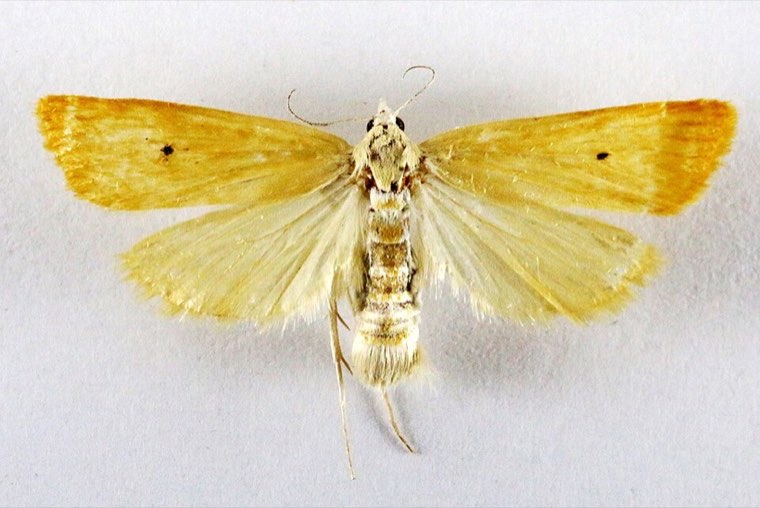
The scientific name of yellow stem borer is Scirpophaga incertulas (Walker, 1863), in the order Lepidoptera, family Crambidae.
Older or alternative scientific names: Tryporyza incertulas, Schoenobius incertulas.
Found in rice-growing tropical and subtropical Asia, from Afghanistan and Pakistan through South Asia, Southeast Asia and southern China to Japan's southern islands, and in parts of Oceania.
| Region | Status |
|---|---|
| South Asia | Native; dominant stem borer of rice |
| Southeast Asia | Native; widespread in irrigated and rainfed lowland rice |
| East Asia | Native in southern China; declined in some areas after changes in cropping |
| Oceania | Present in parts of northern Australia and Papua New Guinea |
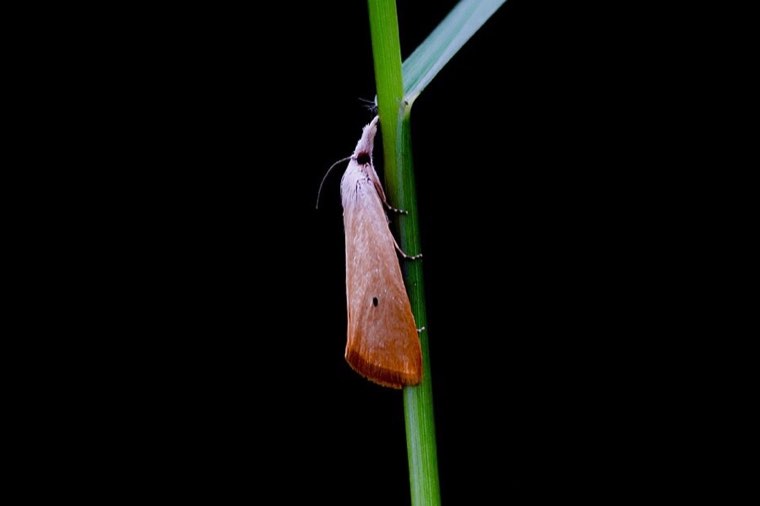
Females have bright yellow-orange forewings, each with a single distinct black spot near the centre, and a tuft of yellowish-brown hairs at the tip of the abdomen; males are smaller and paler. Eggs are laid in flat masses of about 50-150 near the tips of leaves and covered with buff-coloured hairs from the female's tuft. Larvae are pale yellowish-white with an orange-brown head, up to about 2 cm, and live inside the stem.
| Crop stage | What you see |
|---|---|
| Tillering (vegetative) | Dead hearts: the central leaf whorl turns yellow-brown and dries; it pulls out easily and its base is chewed; small holes and frass in the stem. |
| Panicle initiation to booting | Larvae inside lower stems; tillers may die before the panicle emerges. |
| Heading to grain filling | White heads: the panicle emerges empty, white and erect and pulls out easily; partly filled panicles if damage is late. |
Hatching larvae spin down to the plant or crawl to a stem, bore into the leaf sheath and then the stem, and feed inside, moving between tillers. They pupate in the stem near the base. In areas with a dry or cold season, mature larvae rest (diapause) in rice stubble until rains or irrigation return, which is why stubble management matters.
| Stage | Duration | Notes |
|---|---|---|
| Egg mass | About 5-8 days at 25-30 °C | Hair-covered masses near leaf tips. |
| Larva (5-6 instars) | About 3-5 weeks; months in diapause | Inside stems; one larva may damage several tillers. |
| Pupa in the stem | About 7-12 days | Near the base of the tiller, behind a thin exit window. |
| Adult moth | About 3-7 days | Nocturnal; strongly attracted to light. |
A generation takes about 6-8 weeks at 25-30 °C. Larval diapause is triggered by drying stubble and changing day length; it ends when soil is moistened by rain or irrigation.
Typically 3-6 generations a year where rice is grown in two or more seasons; 2-3 where one crop a year is grown.
Continuous or staggered rice cropping, high nitrogen, stubble left standing between seasons, and late planting relative to neighbours.
Thresholds are based on egg masses, moths or the percentage of dead hearts and white heads. Rice compensates for much early dead-heart damage by producing new tillers, so thresholds for the vegetative stage are higher than they look, and many studies show that sprays at low damage levels do not pay. Values differ between regions and seasons.
| Crop | Threshold | Unit | Crop stage | Region | Source |
|---|---|---|---|---|---|
| Rice | 5% dead hearts, or 1 egg mass per m² | % of tillers with dead hearts; egg masses per m² | Tillering (vegetative) | South Asia | ICAR-Indian Institute of Rice Research rice pest management guidance |
| Rice | 2% white heads, or 1 moth per m² | % of panicles; moths per m² | Panicle initiation to heading | South Asia | ICAR-Indian Institute of Rice Research rice pest management guidance |
Thresholds are local. They depend on crop price, control cost, variety and natural-enemy activity, so use the figure your local extension service publishes where one exists.
Dead hearts at tillering usually cause small yield losses because the plant replaces lost tillers; white heads are a direct loss, roughly one empty panicle per damaged tiller. Field losses commonly range from a few per cent to about 20%, and up to 30-60% in outbreak seasons in parts of South and Southeast Asia.
Control works best as a sequence: prevent, monitor, then act only when a threshold or a risk forecast says so, using the least disruptive option that works.
Spray or granule application is justified only above threshold, at egg hatch or early larval entry; once larvae are inside stems, control is poor. What is registered differs by country and changes over time; follow the label and your local plant-protection authority.
| Scheme | Group | Mode of action | Notes |
|---|---|---|---|
| IRAC | 28 | Ryanodine receptor modulators (diamides) | Widely used; reduced susceptibility reported in parts of Asia. |
| IRAC | 14 | Nicotinic acetylcholine receptor channel blockers (nereistoxin analogues) | Used as granules in paddy. |
| IRAC | 11A | Bacillus thuringiensis | Biological; early instars. |
Almost entirely restricted to rice (Oryza sativa) and wild Oryza species; it does not develop well on other grasses.
How to grow the crop well is the first line of defence. Laisha's free grow guides cover each crop from sowing to harvest:
Written by Laisha from the sources above, in its own words. This page is general reference, not a prescription: confirm identification locally and follow the label and your plant-protection authority.