 Laisha
AI Operating System for Agriculture
Ask Laisha
Laisha
AI Operating System for Agriculture
Ask Laisha
Pyricularia oryzae Cavara, 1892 (sexual stage Magnaporthe oryzae B.C. Couch) · formerly or also: Magnaporthe oryzae, Magnaporthe grisea (in older literature)
Rice blast is the most important disease of rice worldwide. The fungus makes diamond-shaped grey lesions on leaves and, most damagingly, attacks the neck of the panicle so that grains do not fill ('neck blast' or 'rotten neck'). It occurs in every rice region, and new races keep overcoming resistant varieties. A related form of the same fungus causes wheat blast.
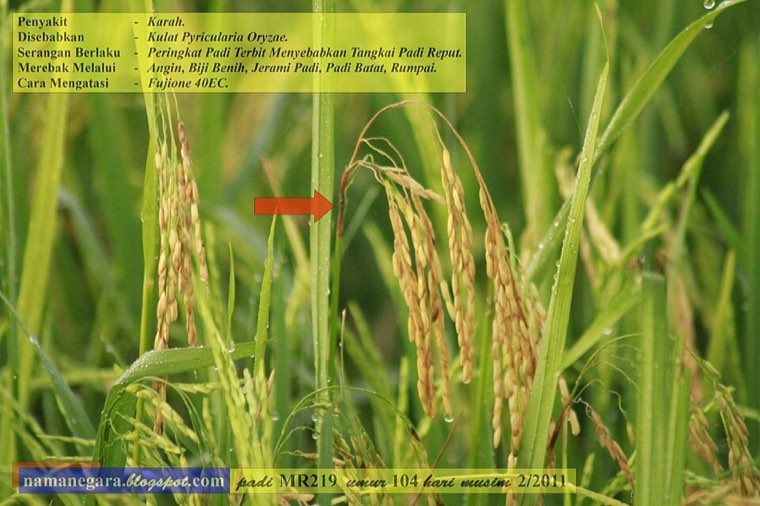
Rice blast is caused by Pyricularia oryzae Cavara, 1892 (sexual stage Magnaporthe oryzae B.C. Couch), a fungus (ascomycete) (order Magnaporthales, family Pyriculariaceae).
Older or alternative scientific names: Magnaporthe oryzae, Magnaporthe grisea (in older literature).
Present in more than 85 countries, wherever rice is grown: irrigated, rainfed lowland and especially upland rice in Asia, Africa, the Americas and Europe. Wheat blast, caused by the wheat-adapted lineage, emerged in Brazil in 1985, spread in South America, and appeared in Bangladesh in 2016 and Zambia in 2018.
| Region | Status |
|---|---|
| South and Southeast Asia | Widespread; severe in upland, rainfed and temperate highland rice |
| East Asia | Widespread; a major disease in temperate rice |
| Sub-Saharan Africa | Widespread, especially in upland rice |
| Latin America | Widespread; wheat blast also present |
| Europe and North America | Present in Mediterranean and US rice areas |
The fungus produces pear-shaped, two-septate, greyish conidia on short stalks in lesions, visible as a grey velvety growth under humid conditions. Conidia are released mainly at night and carried by wind. It survives between crops in infected straw, stubble, seed and on collateral weed hosts.
| Crop stage | What you see |
|---|---|
| Seedling and tillering (leaf blast) | Small water-soaked spots that grow into spindle- or diamond-shaped lesions with grey or whitish centres and brown margins; many lesions merge and seedlings can be killed ('burned' nurseries). |
| Booting (collar blast) | Brown lesions at the junction of the leaf blade and sheath (the collar), killing the flag leaf. |
| Heading to grain filling (node and neck blast) | Nodes turn black and break; the panicle neck turns grey-brown and rots, so the panicle falls over or stays white and empty; partial infection gives unfilled or light grains. |
Conidia land on leaves and germinate in a film of water, forming a dome-shaped, melanised appressorium that builds up enormous pressure to punch through the leaf surface. Lesions form within about 4-5 days and release new conidia for several weeks, especially at night when humidity is high. The disease therefore builds up through repeated cycles during the season, and spreads from leaves to the neck at heading.
| Stage | Duration | Notes |
|---|---|---|
| Conidium lands on a wet leaf | Needs about 6-10 hours of leaf wetness | Spores airborne mainly at night. |
| Appressorium and penetration | About 6-24 hours | Melanin in the appressorium wall is the target of FRAC Group 16 fungicides. |
| Lesion development | About 4-7 days | Shorter at 25-28 °C. |
| Sporulation and spread | Each lesion for up to about 2-3 weeks | Repeated cycles through the season. |
| Survival | Between seasons | In infected straw, seed, stubble and grass hosts. |
Infection is favoured by about 24-28 °C with high humidity (above about 90%) and long dew periods; cool nights with heavy dew followed by warm days are typical blast weather. Very high temperatures and dry air reduce infection.
Multiple infection cycles within each crop season (polycyclic).
Long dew periods and high humidity, cool nights, drought-stressed or aerobic (upland) rice, high or late nitrogen doses, dense planting, susceptible varieties and infected seed. Flooded paddies generally have less leaf blast than upland rice.
There is no numeric economic threshold based on lesion counts that is used widely. Action is triggered by the appearance of leaf blast on susceptible varieties in weather favourable to the disease, and by protection of the crop at late booting and heading where neck blast is a risk. Forecast systems based on leaf wetness and temperature are used in parts of East Asia.
Thresholds are local. They depend on crop price, control cost, variety and natural-enemy activity, so use the figure your local extension service publishes where one exists.
Average annual losses are often estimated at 10-30% of the rice crop in affected regions, with total loss of individual fields in epidemics; neck blast causes the greatest yield loss because whole panicles are empty. Wheat blast has caused losses of up to total crop failure in affected fields in South America and Bangladesh.
Control works best as a sequence: prevent, monitor, then act only when a threshold or a risk forecast says so, using the least disruptive option that works.
Fungicides are most useful on susceptible varieties in high-risk seasons: at first leaf blast, and at late booting and early heading against neck blast. What is registered differs by country and changes over time; follow the label and your local plant-protection authority.
| Scheme | Group | Mode of action | Notes |
|---|---|---|---|
| FRAC | 16.1 | Melanin biosynthesis inhibitors - reductase (MBI-R) | Prevents appressorium penetration; protectant. |
| FRAC | 16.2 | Melanin biosynthesis inhibitors - dehydratase (MBI-D) | Resistance documented in East Asia. |
| FRAC | 11 | Quinone outside inhibitors (QoI, strobilurins) | Resistance documented; use in mixtures. |
| FRAC | 3 | Demethylation inhibitors (DMI) | Systemic. |
| FRAC | 6 | Phospholipid biosynthesis inhibitors (phosphorothiolates and dithiolanes) | Used in Asian rice. |
| FRAC | 24 | Hexopyranosyl antibiotics | Used where registered. |
| FRAC | P02 | Host plant defence induction (benzisothiazoles) | Applied to nursery boxes or paddy in East Asia. |
Rice is the main host of the rice-adapted lineage. Other host-adapted lineages of Pyricularia oryzae attack finger millet, foxtail millet, wheat (wheat blast), perennial ryegrass and other grasses; they generally do not cross-infect rice in the field.
How to grow the crop well is the first line of defence. Laisha's free grow guides cover each crop from sowing to harvest:
Written by Laisha from the sources above, in its own words. This page is general reference, not a prescription: confirm identification locally and follow the label and your plant-protection authority.