 Laisha
AI Operating System for Agriculture
Ask Laisha
Laisha
AI Operating System for Agriculture
Ask Laisha
Xanthomonas oryzae pv. oryzae (Ishiyama, 1922) Swings et al., 1990 · formerly or also: Xanthomonas campestris pv. oryzae
Bacterial leaf blight is one of the most serious diseases of irrigated and rainfed lowland rice in Asia and increasingly in Africa. Leaves dry from the tips and edges in long yellow-to-white streaks, and young plants can wilt and die ('kresek'). It spreads fastest after storms and floods and in heavily fertilised crops. Resistant varieties are the main defence; sprays work poorly.
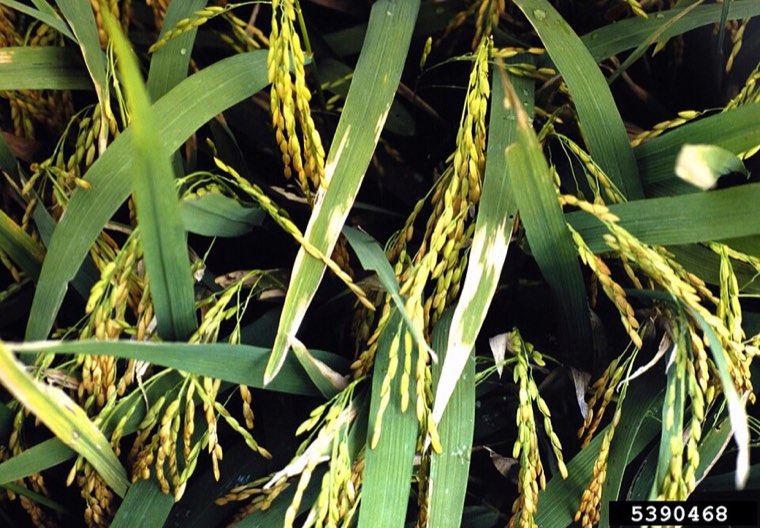
Bacterial leaf blight of rice is caused by Xanthomonas oryzae pv. oryzae (Ishiyama, 1922) Swings et al., 1990, a bacterium (Gram-negative) (order Lysobacterales (formerly Xanthomonadales), family Lysobacteraceae).
Older or alternative scientific names: Xanthomonas campestris pv. oryzae.
Widespread in tropical and temperate Asia, and present in West and East Africa, northern Australia and parts of Latin America. It is a regulated pest in some regions where it is absent.
| Region | Status |
|---|---|
| South Asia | Widespread; major in monsoon season rice |
| Southeast Asia | Widespread; epidemics after typhoons and floods |
| East Asia | Widespread |
| West and East Africa | Present and increasing |
| Americas and Europe | Limited or absent; regulated in some countries |
A rod-shaped bacterium that produces yellow, slimy colonies in culture. In the field, milky or yellowish droplets of bacterial ooze appear on young lesions in the morning and dry into small yellow beads; cutting a fresh lesion and dipping it in water shows a cloudy stream of bacteria under a lens.
| Crop stage | What you see |
|---|---|
| Seedling to early tillering (kresek) | Leaves of young plants roll, turn greyish-green and wilt; whole plants or tillers die, often 1-3 weeks after transplanting. |
| Tillering to booting (leaf blight) | Water-soaked stripes starting at the leaf tip or edge that become yellow to white with a wavy margin; bacterial ooze droplets in the morning. |
| Heading to grain filling | Whole leaves dry and turn greyish-white; partly filled grains and lower grain weight. |
The bacterium survives between crops in infected stubble, volunteer rice, weeds and, to a lesser extent, seed. It enters leaves through water pores at the leaf tips and edges and through wounds, multiplies in the water-conducting tissue and oozes out to spread by water, wind-driven rain and contact.
| Stage | Duration | Notes |
|---|---|---|
| Survival | Between seasons | Stubble, ratoons, weeds, irrigation water. |
| Entry through water pores and wounds | Within hours after rain, flooding or root and leaf damage | Clipping seedlings at transplanting creates entry points. |
| Multiplication in the xylem | Symptoms after about 1-2 weeks | Kresek if roots or leaf wounds infected early. |
| Ooze and spread | Repeated | Spread by water and wind-driven rain. |
Favoured by warm temperatures of about 25-34 °C, high humidity, heavy rain, storms and flooding.
Multiple cycles of spread within each crop.
Typhoons, storms and floods that wound leaves and spread bacteria; high nitrogen; deep water; clipping seedling leaves at transplanting; field-to-field irrigation; and susceptible varieties.
There is no numeric economic threshold, because no curative treatment exists and chemical options are weak. Decisions centre on variety choice before planting and on preventive management in high-risk seasons.
Thresholds are local. They depend on crop price, control cost, variety and natural-enemy activity, so use the figure your local extension service publishes where one exists.
Yield losses of 20-50% are common in severe outbreaks, and kresek can destroy entire young fields. Losses are highest when infection occurs before booting.
Control works best as a sequence: prevent, monitor, then act only when a threshold or a risk forecast says so, using the least disruptive option that works.
No chemical cures infected plants; copper-based products and antibiotics give only limited protection, and antibiotic use on crops is banned or restricted in many countries. What is registered differs by country and changes over time; follow the label and your local plant-protection authority.
| Scheme | Group | Mode of action | Notes |
|---|---|---|---|
| FRAC | M01 | Inorganic (copper) - multi-site | Limited protective effect. |
| FRAC | 25 | Glucopyranosyl antibiotics (protein synthesis) | Restricted or banned in many countries; resistance risk. |
| FRAC | P02 | Host plant defence induction (benzisothiazoles) | Used in East Asia. |
Rice and wild Oryza species; some grasses such as Leersia and Zizania can carry the bacterium.
How to grow the crop well is the first line of defence. Laisha's free grow guides cover each crop from sowing to harvest:
Written by Laisha from the sources above, in its own words. This page is general reference, not a prescription: confirm identification locally and follow the label and your plant-protection authority.